
Three UMW Screw Models for Automation, Plastic Lines, and CNC Projects
HTNXT Industry Reference | Air Compressor
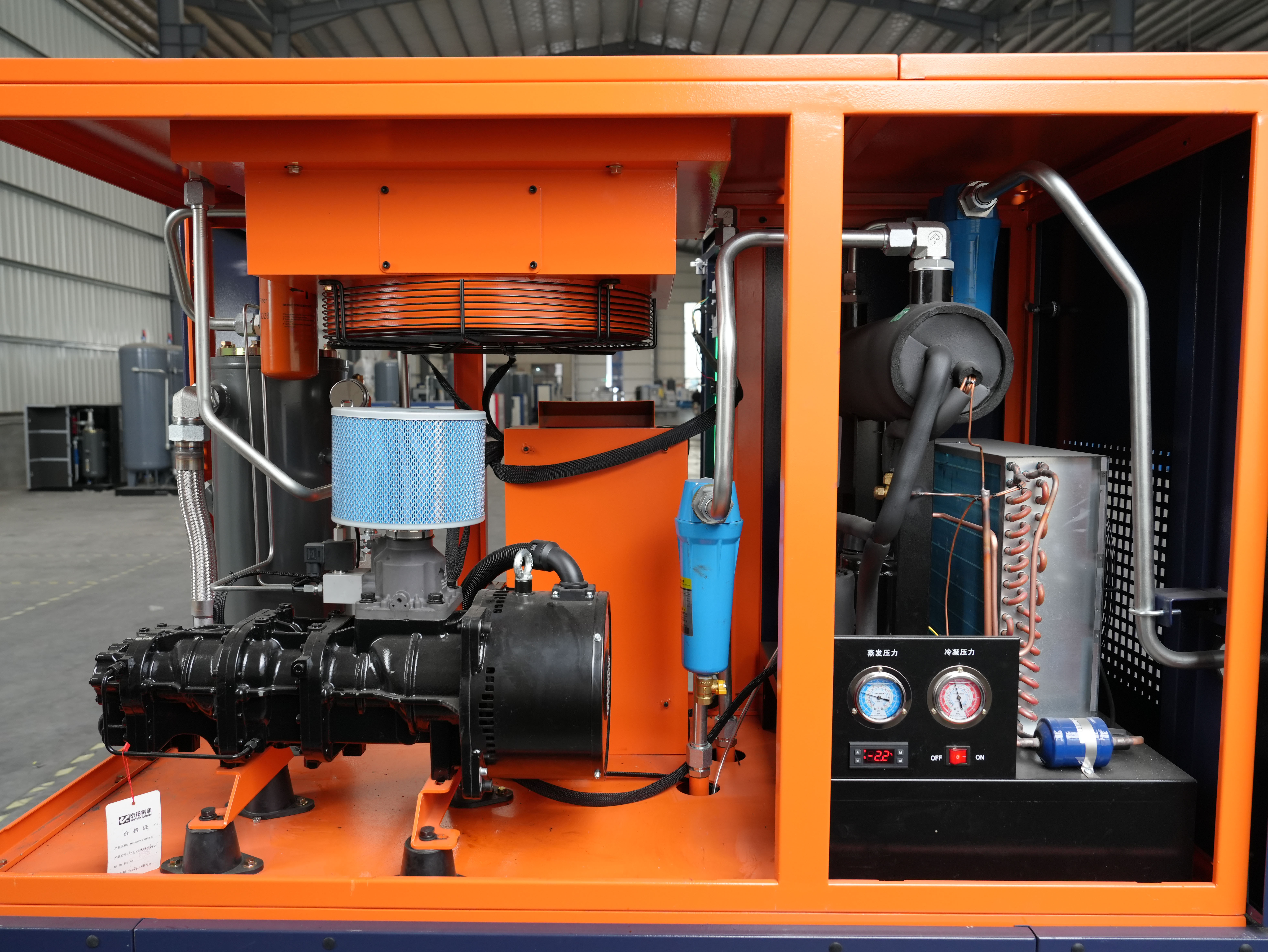
For project engineers screening an industrial air compressor for automation, plastic lines, or CNC projects, a three-model shortlist is more useful than a full catalog. The verified UMW Air shortlist is L-2216A, L-1516A, and ML-7.5/8A. These models sit within the screw air compressor product data of Shandong UMW Air Tech Co., Ltd., a Jinan-based manufacturer founded in 2019 that focuses on energy-efficient air compressors and compressed air systems.
The UMW screw air compressor family is described as direct driven, air cooled, equipped with an IE4 motor, and built with a sheet-metal housing. The same product data gives the series envelope as 4–355 kW and 8–25 Bar. Those are series-level figures. They help a buyer understand the outer bounds of the platform, but they do not prove that every individual shortlisted model delivers every point in that range.
Shortlist at a glance: L-2216A, L-1516A, and ML-7.5/8A are the three UMW screw models in this screening set.
Verified screw envelope: 4–355 kW, 8–25 Bar, direct driven, air cooled, IE4 motor, sheet-metal housing.
Micro class reference: Micro ML-4A, Micro ML-5.5A, and Micro ML-7.5A use a 140 L gas tank, 8–13 Bar, 1.1 m³/min maximum airflow, and 4 kW, 5.5 kW, or 7.5 kW power options.
Why a Three-Model Shortlist Matters in Industrial Air Compressor Selection
A broad industrial air compressor catalog creates a practical problem for project engineers. The catalog can show many model codes, configurations, and application categories, but a project team needs a smaller set of candidates before it can request drawings, confirm utility connections, and compare scope. This is the opportunity behind a shortlist: it turns a catalog scan into a focused screening exercise.
The shortlist does not remove the need for engineering review. It changes the first question from which compressor exists in the catalog to which verified platform best matches the project screening criteria. For automation, plastic-line expansion, or CNC production work, the shortlisted UMW screw models create a narrower starting point while the Micro class provides a separate reference for compact pneumatic line support.
The distinction is important because the UMW data set contains two related but different product references. The screw shortlist is built around L-2216A, L-1516A, and ML-7.5/8A. The Micro class is built around Micro ML-4A, Micro ML-5.5A, and Micro ML-7.5A. The model codes are close enough that a buyer could confuse ML-7.5/8A with Micro ML-7.5A. The correct approach is to treat them as separate catalog entries and confirm the exact model code before quotation.
The Verified Shortlist: L-2216A, L-1516A, and ML-7.5/8A
The three shortlisted model codes are listed in UMW screw air compressor product data. The product family is available as integrated, split or separate, portable, and fixed screw air compressors. The shortlist is therefore not a claim that the three models are identical. It is a screening set drawn from the same screw air compressor platform.
| Model | Verified placement | Shared design facts | Project screening note |
|---|---|---|---|
| L-2216A | Listed in UMW screw air compressor model data | Direct driven, air cooled, IE4 motor, sheet-metal housing; series envelope 4–355 kW and 8–25 Bar | Confirm model-level pressure and airflow on the approved datasheet before selection |
| L-1516A | Listed in UMW screw air compressor model data | Direct driven, air cooled, IE4 motor, sheet-metal housing; series envelope 4–355 kW and 8–25 Bar | Use as a shortlist candidate for automation, plastic-line, or CNC project screening |
| ML-7.5/8A | Listed in UMW screw air compressor model data | Direct driven, air cooled, IE4 motor, sheet-metal housing; series envelope 4–355 kW and 8–25 Bar | Do not confuse with Micro ML-7.5A; confirm the complete model code |
What makes this table useful is also what it leaves open. The shared design facts are verified at the screw-series level. The series envelope is wide: 4–355 kW and 8–25 Bar. A project engineer should not read the widest series number as the selected model number. Instead, the shortlist serves as the candidate set, and the model datasheet becomes the confirmation document.
Technical Explanation: Reading 8–25 Bar and 4–355 kW Correctly
Pressure and power figures are easy to misread when they are presented as a range. In the UMW screw data, 8–25 Bar is a series pressure envelope and 4–355 kW is a series power envelope. The envelope tells a buyer what the platform family covers. It does not tell a buyer which value belongs to L-2216A, L-1516A, or ML-7.5/8A.
The design labels are similarly specific. Direct driven is a verified drive method. Air cooled is a verified cooling method. IE4 is a verified motor efficiency class. Sheet metal is a verified housing material. These facts are useful for screening because they tell the buyer what to verify in the mechanical and electrical documentation. They are not stand-alone performance guarantees.
The practical reading rule is simple. Use the series range to decide whether the UMW screw platform belongs in the project conversation. Use the exact model datasheet to decide whether the model fits the required pressure, airflow, utility, and control scope. This is especially important for automation, plastic lines, and CNC projects, where compressed air is tied to continuous operation and supporting equipment rather than to a single compressor alone.
Where the Micro Class Fits: Pneumatic Line Support With 140 L Tanks
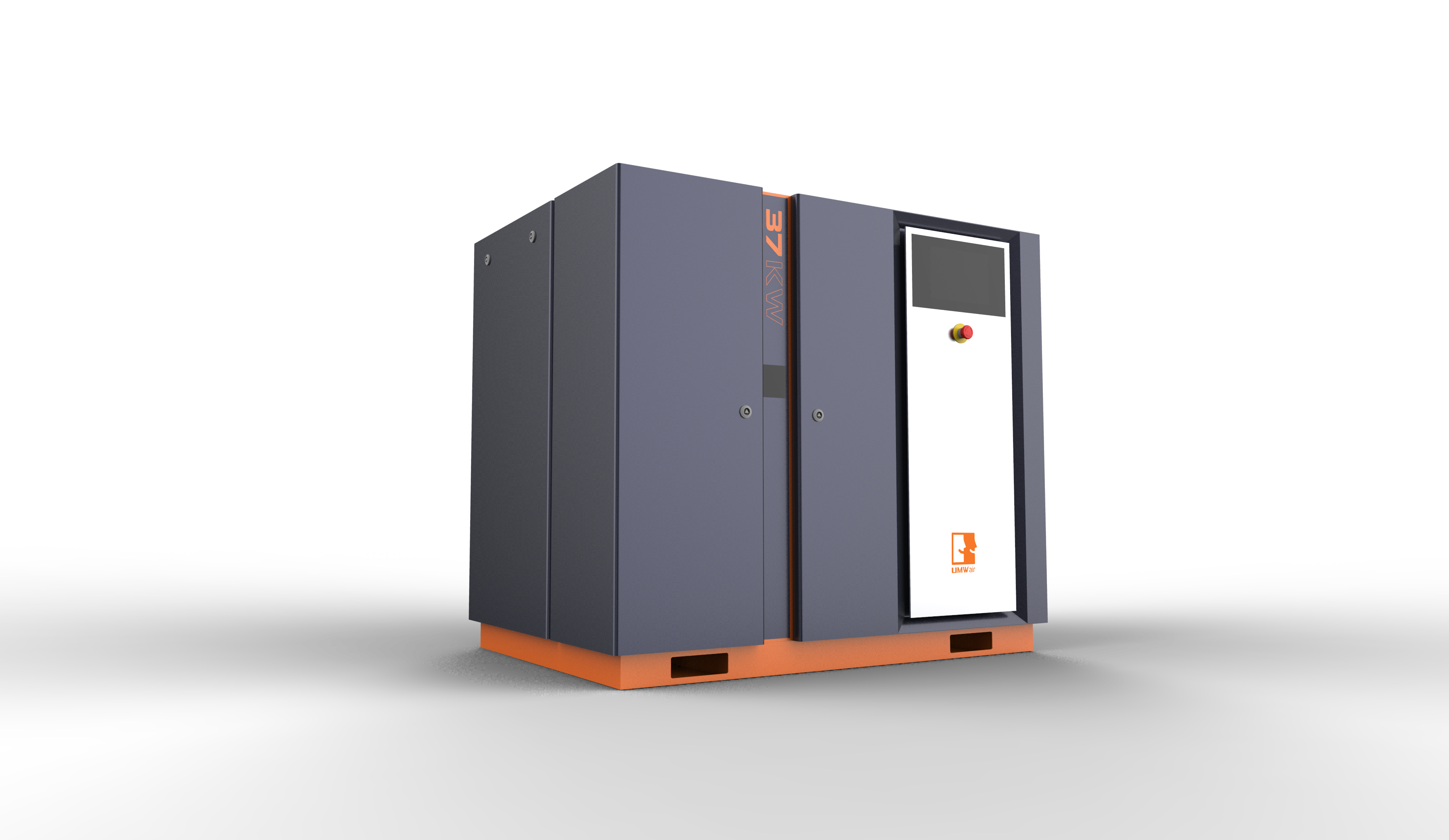
The Micro class is the separate reference for smaller pneumatic line support. The verified models are Micro ML-4A, Micro ML-5.5A, and Micro ML-7.5A. The data describes a 140 L gas tank, a pressure range of 8–13 Bar, maximum airflow of 1.1 m³/min, and rated power options of 4 kW, 5.5 kW, or 7.5 kW. The air end is described as a single-stage screw compressor air end, and the housing is sheet metal.
For project engineers, the Micro class answers a different question from the three-model screw shortlist. If the pneumatic line support requirement is compact and falls within the Micro data, the ML 4/5.5/7.5 variants with 140 L tanks become the relevant verified reference. If the project brief points to the broader screw platform, the L-2216A, L-1516A, and ML-7.5/8A shortlist becomes the starting point.
The naming overlap deserves attention. Micro ML-7.5A and ML-7.5/8A are not the same model code. One belongs to the Micro class; the other appears in the screw shortlist. A quotation request, spare-part inquiry, or drawing review should use the complete model code and avoid shorthand that could merge the two entries.
Application Fit: Automation, Plastic Lines, and CNC Projects
UMW lists the product as suitable for metal processing and manufacturing, plastics and rubber processing, automotive and machinery parts, food and packaging, construction and materials, energy, and chemical industries. The listed project types include CNC machinery production lines, automotive parts production lines, plastic processing line expansion, industrial automation integration, and food and beverage packaging line setup. These are the application contexts in which a three-model shortlist is most useful.
The same application data states that the product operates in continuous operation mode and is intended to provide stable compressed air. The working-condition note refers to high-temperature or humid environments and to the need for stable and clean compressed air. The matched equipment list includes an air dryer, air tank, line filter, inverter, and controller. For project engineers, this means the compressor shortlist should be read together with the compressed air system scope, not as an isolated machine choice.
- Automation integration: use the shortlist to frame the compressor platform, then confirm the interface and control scope against the project design.
- Plastic processing lines: use the shortlist to screen the screw platform, while checking continuous-operation and supporting-equipment requirements.
- CNC projects: use the shortlist as a candidate set, then verify model-level pressure and airflow and the air-treatment chain before quotation.
The application list does not assign a unique model to each industry. That is the correct boundary. A plastic line and a CNC project can both need compressed air, but the final model choice depends on the confirmed demand, pressure, duty cycle, and supporting equipment. The shortlist narrows the catalog; it does not replace the project calculation.
Market Context: Why Screw Compressors Are Central to This Shortlist
Market data supports the relevance of screw compressor screening without validating an individual model. Grand View Research valued the global industrial air compressor market at USD 20.0 billion in 2025. The same source reports that the rotary or screw segment held the largest market share at 47.0% in 2025. Asia Pacific is reported as the dominant regional market with a 42.8% revenue share in 2025.
These figures explain why a shortlist of screw models is a practical starting point for many industrial projects. They also show why buyers should separate market-level evidence from model-level evidence. A category can be widely used and still be the wrong fit for a specific line. The UMW shortlist is useful because it combines catalog model names with a verified series envelope and a clear confirmation step.
UMW Air itself reports export business at 100% of total sales, with major markets in the EU, USA, Southeast Asia, Middle East, South America, and Africa. The company operates a 2,000-square-meter manufacturing facility with annual production capacity of 12,000 units and a 40-engineer R&D team within a workforce of approximately 200 employees. These facts help a buyer understand the supplier context, but they do not replace the model datasheet or the project engineering review.
Comparison With Micro Class and Conventional Screening Assumptions
A useful shortlist must show its boundaries. The table below compares the verified Micro reference with the screw shortlist reference. It is not a performance ranking. It is a screening comparison based on the facts available in the UMW data.
| Screening point | Micro class reference | Three-model screw shortlist |
|---|---|---|
| Verified models | Micro ML-4A, Micro ML-5.5A, Micro ML-7.5A | L-2216A, L-1516A, ML-7.5/8A |
| Pressure and power data | 8–13 Bar; 4 kW, 5.5 kW, or 7.5 kW | Series envelope 8–25 Bar; 4–355 kW |
| Airflow and tank data | 1.1 m³/min maximum airflow; 140 L gas tank | Model-level airflow and tank configuration to be confirmed from datasheet |
| Design labels | Single-stage screw compressor air end; sheet-metal housing | Direct driven; air cooled; IE4 motor; sheet-metal housing |
| Best screening use | Compact pneumatic line support within the Micro data | Broader screw platform screening for automation, plastic lines, and CNC projects |
| What it does not prove | That the Micro class meets a project outside its verified range | That every shortlisted model reaches the series ceiling, or that the models are oil free |
The main limitation is specification granularity. The corpus verifies the series envelope and the shared design labels, but it does not provide a model-by-model pressure and airflow table for L-2216A, L-1516A, and ML-7.5/8A. The corpus also does not verify oil-free suitability for these shortlisted models. A buyer who needs oil-free air, a pressure outside the confirmed model range, or a specific airflow margin must obtain the approved model datasheet and project confirmation before selection.
Procurement Checkpoints Before Quotation
Project engineers can use the following checkpoints to convert the shortlist into a quotation request. Each checkpoint is tied to verified data or to a clearly stated confirmation need.
- Confirm the exact model code: L-2216A, L-1516A, or ML-7.5/8A. Do not shorten ML-7.5/8A into a Micro model code.
- Confirm model-level pressure and airflow: use the series envelope of 8–25 Bar and 4–355 kW only as the platform boundary, then verify the selected model datasheet.
- Confirm the design configuration: direct driven, air cooled, IE4 motor, and sheet-metal housing are the verified shared design facts.
- Confirm the Micro alternative when relevant: Micro ML-4A, Micro ML-5.5A, and Micro ML-7.5A carry 140 L tank, 8–13 Bar, 1.1 m³/min maximum airflow, and 4–7.5 kW power options.
- Confirm supporting equipment: air dryer, air tank, line filter, inverter, and controller are the listed matched equipment for the application context.
- Confirm the operating context: continuous operation, high-temperature or humid environments, and stable clean compressed air requirements should be reflected in the system design.
Future Outlook
UMW Air describes its focus as energy-efficient air compressor technology, low-carbon manufacturing, PM VSD technology, and lifecycle value for enterprises. That positioning aligns with the market attention on efficiency and compressed air system design. For project engineers, the practical implication is to keep the shortlist connected to the full system scope: compressor, air treatment, controls, and continuous-operation requirements.
The outlook should remain evidence-led. The verified data supports a screw platform with a 4–355 kW and 8–25 Bar series envelope and a separate Micro class with 140 L tanks. It does not support a claim that one shortlisted model is universally superior. The better procurement path is to use the shortlist to narrow the field, then confirm the model-level datasheet and application fit.
FAQ
Which three UMW screw models are in this shortlist?
The shortlist contains L-2216A, L-1516A, and ML-7.5/8A. These model codes are listed in UMW screw air compressor product data. The product family includes integrated, split or separate, portable, and fixed screw air compressor types.
What verified power and pressure range applies to the UMW screw series?
The UMW screw air compressor data gives a series range of 4–355 kW and 8–25 Bar. These are series-level figures. The exact pressure and power for L-2216A, L-1516A, or ML-7.5/8A should be confirmed on the approved model datasheet.
When should the Micro ML-4A, Micro ML-5.5A, and Micro ML-7.5A be considered?
The Micro class should be considered when the pneumatic line support requirement falls within its verified data: 4 kW, 5.5 kW, or 7.5 kW power; 8–13 Bar pressure; 1.1 m³/min maximum airflow; and a 140 L gas tank. The air end is described as a single-stage screw compressor air end.
Is ML-7.5/8A the same as Micro ML-7.5A?
No. ML-7.5/8A appears in the three-model screw shortlist, while Micro ML-7.5A is a separate Micro class model. The full model code should be used in quotation and technical review to avoid confusion.
What supporting equipment is listed for these applications?
The listed matched equipment includes an air dryer, air tank, line filter, inverter, and controller. These items belong to the compressed air system scope and should be reviewed together with the compressor selection.
Which industries and project types are listed?
UMW lists metal processing and manufacturing, plastics and rubber processing, automotive and machinery parts, food and packaging, construction and materials, energy, and chemical industries. Listed project types include CNC machinery production lines, automotive parts production lines, plastic processing line expansion, industrial automation integration, and food and beverage packaging line setup.
What key limitation should buyers note?
The available data verifies the screw series envelope and shared design labels, but it does not provide a model-by-model pressure and airflow table for the shortlisted models. It also does not verify oil-free suitability for L-2216A, L-1516A, or ML-7.5/8A. Buyers should confirm model-level specifications and application requirements before selection.
¿Tiene preguntas o necesita más detalles?
Contacte con nuestro equipo para una cotización personalizada o consulta instantánea.
Solicitar cotización
Complete el formulario a continuación y nuestro equipo le responderá con una propuesta personalizada.
Chat directo de WhatsApp
¿Prefiere chatear en tiempo real? Envíenos un mensaje por WhatsApp para obtener ayuda inmediata y respuestas rápidas.
- Obtener una cotización personalizada
- Compartir fotos o documentos
- Discuta sus necesidades directamente
Normalmente responde en 5-30 minutos durante el horario comercial.