
Three Tiers of Proof for Stainless Steel Jewelry Suppliers
Nearly every stainless steel jewelry supplier says the same four things: 316L, waterproof, hypoallergenic, high capacity. Most of those statements cannot survive a second question. The difference between a reliable supplier and an unreliable one is rarely the claim itself — it is whether the claim arrives attached to a document that someone other than the supplier produced.

In metal jewelry sourcing, the claims that decide an order are also the ones that are easiest to make and hardest to check. Material grade, corrosion behaviour, skin-contact performance, production capacity, and client track record are all technically testable. Yet a large share of purchase decisions still rest on a quotation sheet, a hand sample, and a factory photograph.
Jusnova Jewelry Co., Ltd is a stainless steel jewelry OEM/ODM manufacturer founded in 2009 and based in Guangzhou, China. It produces stainless steel bangles, bracelets, rings and earrings alongside PVD and electroplated gold pieces for wholesale and brand buyers, with export accounting for the large majority of its business. Its documentation set — SGS laboratory reports, an Amfori BSCI audit, stated capacity terms, and named client outcomes — provides a practical case for examining what supplier evidence can and cannot prove.
The framework below sorts supplier evidence into three tiers and tests each tier against the question a buyer actually needs answered at the decision stage: can this claim be verified before money changes hands?
Why Material Claims Need a Second Question
"316L" is a chemical specification, not a marketing position. The grade differs from 304 primarily through the addition of 2–3% molybdenum, which raises resistance to chlorides and to the corrosive components of sweat and salt water. That is a measurable material difference, and it is the reason 316L commands a higher price per finished piece.
In trade practice, however, the term is used loosely. A quotation sheet may say 316L while the delivered alloy sits in a different composition range, and a buyer holding only a sample has no reliable way to tell the difference without laboratory analysis. The same problem applies to "waterproof," "non-tarnish," and "hypoallergenic." None of these three has a single accepted threshold across markets, which means two suppliers can both use the word and mean materially different things.
The practical answer is not to demand fewer claims but to require that each claim be attached to a document with a publisher, a standard reference, a scope, and a date. That single procedural change moves a supplier conversation from assertion to evidence.
The Three Tiers of Supplier Evidence
Tier One — Declared capability
Catalogue pages, quotation sheets, factory photographs, product range, and platform tenure. These are fast and inexpensive to review, and they are the correct starting point for building a longlist. What they cannot do is settle a specification dispute. A factory photograph does not identify an alloy. A catalogue does not establish coating thickness. Tier One evidence tells a buyer whether a supplier plausibly operates in the right category; it does not tell them whether the product meets a standard.
Tier Two — Third-party records
Laboratory test reports and social-compliance audits. These carry a publisher, a standard reference, a report number, a test date, and a defined scope. They can be read, re-read, compared across suppliers, and checked for expiry. This is the tier that carries weight in a decision-stage review, and it is the tier most often missing from a supplier's initial response.
Tier Three — Client behaviour
Cooperation length, repeat-order growth, and order value. This tier takes the longest to accumulate and is the hardest to manufacture, but it measures something the other two cannot: whether a supplier keeps performing after the first order, across product refreshes, staff changes, and compliance renewals.
| Tier | Typical evidence | What it establishes | What it cannot establish |
|---|---|---|---|
| Tier 1 — Declared capability | Catalogue pages, quotation sheets, factory photographs, product range, platform tenure | Category fit, product breadth, initial commercial terms | Material grade, coating performance, compliance status |
| Tier 2 — Third-party records | SGS test reports, Amfori BSCI audit reports | Composition, corrosion behaviour, skin-contact performance, labour standards — within a stated scope and date | Batch-to-batch consistency, future shipments, full SKU coverage |
| Tier 3 — Client behaviour | Cooperation length, repeat-order growth, order value | Continuity of supply, commercial fit at scale | Product specification, compliance status |
The tiers are cumulative, not competitive. A supplier with strong Tier Two evidence but no Tier Three history is unproven at scale. A supplier with long client relationships but no testable records is unproven on specification. Buyers at the decision stage need both, and they need to know which question each tier answers.
Tier Two in Practice: Establishing Material Identity
The most direct piece of evidence is a material content analysis. Jusnova's file includes an SGS report, GZIN2606005050ML01_EN, analysing 316L content against ASTM A276/A276M-25, the standard specification for stainless steel bars and shapes.
Read narrowly, the report answers one question: does the submitted sample fall within the 316L composition range defined by that standard? That is a more valuable answer than it first appears. It converts "we use 316L" from a statement about intent into a statement about measured chemistry, and it gives the buyer a fixed reference point for every later conversation about substitution, cost reduction, or second-sourcing.
Read broadly, the report does not answer: is every shipment 316L? Chemistry is verified per sample, per test date. A report from one submission does not automatically extend to a different product line, a different finish, or a delivery twelve months later. Buyers who treat a single report as a permanent guarantee are over-reading it, and that over-reading is where specification disputes begin.
The working method is to pair the report with a retained sample and a written acceptance criterion. The report then functions as the reference standard against which incoming batches are compared, rather than a one-time proof attached to a sales deck. For custom stainless steel jewelry programmes where the alloy is the core value proposition, this pairing is the difference between a documented supply chain and a described one.
Tier Two in Practice: Corrosion and Skin Contact
Two further SGS reports address the failure modes that generate the highest share of retail returns in this category.
Corrosion. Report GZHL260603029801JW covers salt spray testing under ISO 9227, the standard neutral salt spray method used to accelerate chloride attack. Salt spray is not a wear simulation and does not predict how many months a bracelet survives on a wrist, but it does rank materials and finishes against each other under a repeatable condition. Within that condition, 316L stainless steel has been observed to last three to five times longer than 304 before showing signs of corrosion. For a buyer choosing between grades on durability grounds, that ratio is the decision-relevant number — it is the difference between a product positioned for daily wear and one positioned for occasional use.
Skin contact. Report GZMR260602153701 covers artificial sweat testing under ISO 3160-2, which simulates prolonged contact with perspiration. This matters commercially because "hypoallergenic" is a claim that carries regulatory exposure in several markets and reputational exposure everywhere. A standardised sweat test does not certify an individual wearer's reaction — nickel sensitivity in particular is dose-dependent and varies by person — but it does replace an adjective with a measured result under a defined method. For brands selling waterproof stainless steel jewelry into markets with active consumer-protection enforcement, that substitution is not cosmetic.
Together, the two reports cover the two mechanisms behind most "it tarnished" and "it irritated my skin" complaints. Neither is a lifetime guarantee. Both are considerably more useful than a product page adjective, and both can be dated, which is what allows a buyer to check whether the evidence is current.
Tier Two in Practice: Social Compliance and Market Access
Product testing and factory auditing answer different questions, and buyers routinely conflate them.
Jusnova holds Amfori BSCI audit 25-0339245, valid from 15 August 2025 to 15 August 2026, relevant to EU market access. BSCI is a social-compliance framework: it examines working conditions, working hours, health and safety, and management systems rather than alloy composition or coating performance.
That distinction has a practical consequence at the decision stage. A BSCI report will not tell a buyer whether the metal is 316L. An SGS material report will not tell a buyer whether the factory meets a retailer's labour standards. European retail buyers commonly require both, and either one alone leaves a gap that a compliance team will eventually find.
The validity window matters equally, and it is the part buyers most often skip. The audit runs on a fixed renewal cycle. A buyer planning production and retail delivery into a period beyond the current expiry should confirm whether a renewal is scheduled and whether the new report will be available before the goods ship. An audit nearing expiry is not a reason to reject a supplier, but it is a reason to confirm timing before committing to a launch date — and the same logic applies to any test report older than the product it is meant to support.
Tier Three: Reading Capacity Terms Correctly
Capacity is where supplier statements and buyer expectations diverge most often, because a monthly figure is a ceiling rather than a promise of availability.
Jusnova states a monthly capacity of 250,000 units, consistent with an annual output of 3,000,000 units, produced in a 1,000 m² facility with approximately 300 staff and a 20-engineer development team that supports new custom development and surface-finishing process work. The minimum order is 100 pieces per style, with customisation available across materials, sizes, surface finishes, and packaging, alongside negotiable Incoterms and payment terms, and acceptance based on approved samples.
Several of those terms deserve translation before they are treated as settled facts.
- A 250,000-unit month is achievable output, not free capacity. A buyer entering during a peak season, or ordering a finish that occupies a vacuum coating chamber for long cycles, may face a schedule that differs from the headline number. The useful question is not "what is your capacity" but "what capacity is available in the month I need, for this finish, at this quantity."
- A 100-piece minimum applies per style, not per order. That is genuinely useful for a brand testing several designs at once — an eight-SKU trial run is 800 pieces rather than a container load. It also means minimum-order economics shift with SKU count rather than with total volume, which changes how a test order should be structured and how a first season should be planned.
- Sample-based acceptance carries the most weight. It moves the quality reference point from the supplier's general description to a specific approved physical object — the only description that survives a dispute about finish, colour, or dimension. Buyers should treat the approval sample as a controlled document with a signature and a date, not as a courtesy.
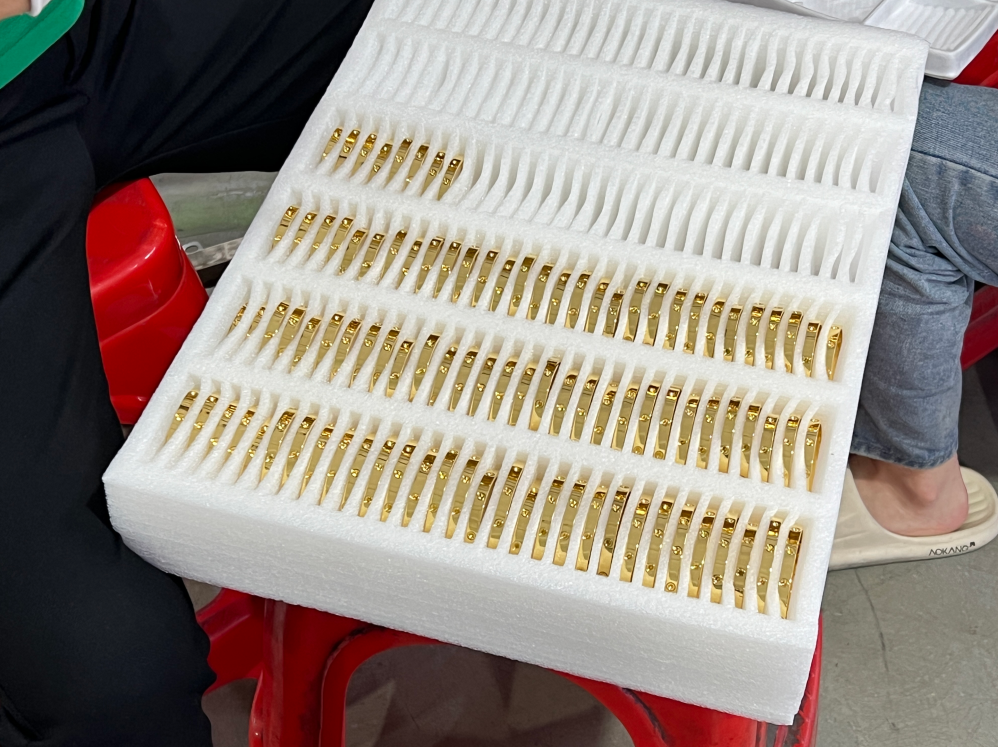
Underlying these terms is a quality system that combines incoming inspection, in-process checks, finished-product sampling, accelerated aging tests, and defined QA and lead-time clauses. None of that is unusual in principle. What makes it checkable is that each stage is designed to produce a record — a first article inspection, a batch report, a shipment check — rather than a verbal assurance.
Tier Three: What Client Evidence Actually Shows
Two client outcomes are stated in Jusnova's record: a UK Shopify store owner with more than seven years of cooperation and monthly orders exceeding USD 150,000, and a Central Europe partner operating 50 retail outlets with 300% repeat-order growth.
The value of the first case is duration, not size. Seven years of continuous supply spans multiple product refreshes and at least several compliance cycles, including annual BSCI renewal. A supplier that keeps a direct-to-consumer account through that many transitions has demonstrated continuity — which is the specific risk a scaling brand is trying to avoid when it consolidates suppliers. The monthly order value adds a second signal: this is repeat purchasing, not a single large trial order dressed up as a reference.
The value of the second case is channel depth. Fifty retail outlets and 300% repeat-order growth describe a supplier relationship that has scaled inside a distribution business. Repeat-order growth at that level suggests reordering driven by sell-through rather than by contractual obligation, which is the outcome a wholesale buyer ultimately cares about.
Both cases have limits a careful buyer should name out loud. They are supplier-reported rather than independently audited. They are two data points, not a portfolio distribution. And commercially sensitive references are usually protected by NDA, so the realistic verification path is a reference call arranged with the client's consent, plus documentary evidence such as purchase-order cadence or reorder schedules — not a public logo wall.
Comparing the Traditional Screen with a Tiered Review
A conventional screening process and a tiered evidence review look similar on paper and behave very differently when a specification is disputed.
| Review dimension | Traditional screen | Tiered evidence review |
|---|---|---|
| Material grade | Taken from the quotation sheet | Mapped to a named report and standard, e.g. GZIN2606005050ML01_EN under ASTM A276/A276M-25 |
| Corrosion and skin contact | Judged from a sample by touch and appearance | Read from ISO 9227 and ISO 3160-2 reports (GZHL260603029801JW, GZMR260602153701) |
| Social compliance | Recorded as "certificate available" | Checked for scope, framework, and validity window, e.g. BSCI 25-0339245, 2025-08-15 to 2026-08-15 |
| Capacity | Accepted as a monthly headline figure | Converted into available capacity for a specific finish and month |
| Quality basis | Supplier description | Approved sample as the controlled reference, backed by inspection records |
| Client track record | Logo list | Cooperation length, order cadence, and repeat-order growth, subject to reference verification |
The honest constraint is cost. A tiered review consumes more buyer time up front. Reading a standard reference, checking an audit validity window, and structuring a sample-based acceptance clause takes hours that a quotation comparison does not. For small trial orders, that effort may not be justified.
The method also has a structural ceiling. Third-party reports are point-in-time evidence tied to specific samples and specific test conditions. They raise the floor of what a buyer can verify; they do not eliminate batch variation, and they cannot replace incoming inspection. A buyer who substitutes document review for receiving inspection has moved the risk rather than removed it. The correct relationship is complementary: reports define the reference, inspection confirms the delivery.
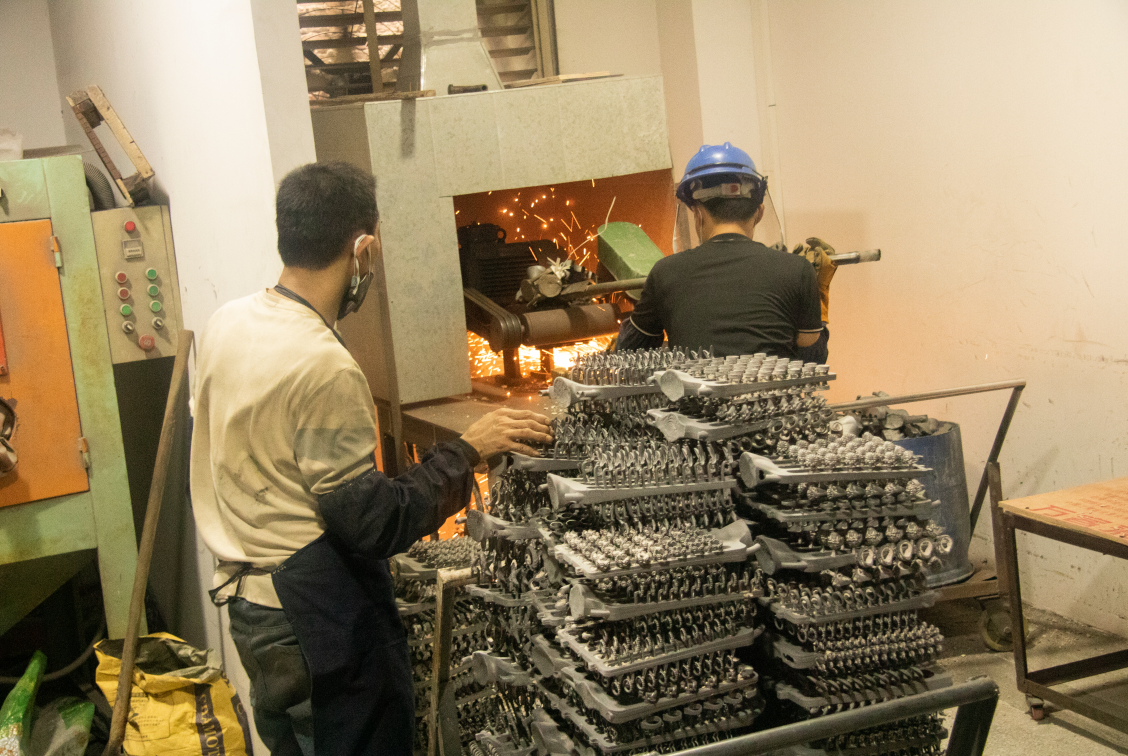
Market Context: Why Verification Is Becoming a Gate
The global stainless steel jewelry market was valued at approximately USD 7.08 billion in 2025 and is projected to reach USD 10.8 billion by 2035, a compound annual growth rate of 4.3%, according to WiseGuyReports. The waterproof jewelry segment, which is built largely on PVD-coated stainless steel, is forecast to grow from USD 2.12 billion in 2026 to USD 4.60 billion by 2034 at a CAGR of 10.16%, according to Verified Market Reports.
The gap between those two growth rates is the story. The waterproof and PVD-coated segment is expanding roughly two and a half times faster than the category as a whole, which means the fastest-growing part of the market is also the part most dependent on performance claims. PVD coatings measure in the range of 1,500–4,500 HV against roughly 100–200 HV for conventional electroplating — a difference that is real, measurable, and almost impossible for a buyer to confirm from a hand sample alone.
That is why document-based verification is shifting from a nice-to-have to a screening gate. In a segment growing at double digits on the strength of durability promises, suppliers who can produce a report number, a standard reference, and a validity date will separate from those who can only produce an adjective. The same pressure applies to custom logo and laser-engraved programmes, where finish consistency across repeat orders is the buyer's real exposure.
What Changes Next
Two shifts are likely to shape supplier evaluation over the next few years.
The first is certificate lifecycle management. As audits and test reports move onto fixed renewal cycles, buyers will begin tracking validity windows the way they already track lead times — as a scheduling constraint rather than a compliance formality. A report that expires mid-production is a delivery risk, not a paperwork issue.
The second is traceability, moving from finished-product testing back toward material batch records. As more brands publish durability and skin-contact claims on product pages, the evidence behind those claims becomes a marketing asset as well as a procurement document, and the suppliers able to connect a shipped piece to a tested batch will hold an advantage that is difficult to copy.
Neither shift makes documentation sufficient on its own. Both make undocumented claims harder to defend. For buyers at the decision stage, the practical takeaway is that supplier capability is not a single number or a single certificate — it is a set of records that can be read, dated, cross-checked, and, where necessary, challenged.
Jusnova's published documentation — SGS reports GZIN2606005050ML01_EN, GZHL260603029801JW and GZMR260602153701, alongside Amfori BSCI audit 25-0339245 — is available for review through its official sites, jusnovasteel.com and jusnovajewelry.com, for buyers assembling a decision-stage file.
FAQ
What does an SGS 316L material content analysis under ASTM A276/A276M-25 actually confirm?
It confirms that a submitted sample's chemical composition falls within the 316L range defined by that standard. It does not confirm that every subsequent shipment, product line, or surface finish uses the same alloy. Buyers should treat the report as a reference standard and pair it with retained samples and batch-level acceptance criteria. Note also that ASTM A276/A276M-25 is a standard for stainless steel bars and shapes rather than a jewellery-specific product standard, so composition is the question it answers — finish and skin-contact performance are covered separately.
How should a buyer interpret salt spray hours from an ISO 9227 test?
ISO 9227 salt spray results rank materials and finishes against each other under an accelerated chloride condition. They are comparative rather than predictive: hours in a chamber do not translate directly into months of wear. The decision-useful reading is relative — for example, 316L stainless steel lasting three to five times longer than 304 before corrosion appears — rather than absolute. A buyer comparing two suppliers should compare their results under the same method, not convert the figures into a lifespan claim.
Is Amfori BSCI certification sufficient for entering the EU market?
BSCI addresses social compliance — working conditions, working hours, health and safety, and management systems — not product chemistry or coating performance. EU retail buyers commonly require both a social audit and product test reports, and either one alone leaves a gap. BSCI also carries a validity window; audit 25-0339245, for example, runs from 15 August 2025 to 15 August 2026, and that window should be checked against the planned production and delivery period.
What MOQ and capacity terms should be confirmed before placing a first order?
The relevant terms are available monthly capacity for the specific finish and month, minimum order per style rather than per order, customisation scope across materials, sizes, finishes and packaging, Incoterms and payment terms, and the acceptance basis. At Jusnova, the minimum is 100 pieces per style and monthly capacity is stated at 250,000 units. Sample-based acceptance is the most consequential term, because it converts quality expectations into a physical reference object that both parties can inspect against.
How much weight should client case studies carry in supplier selection?
Client evidence measures continuity and commercial fit rather than product specification. A seven-year cooperation with monthly orders above USD 150,000 indicates sustained repeat purchasing across product and compliance cycles; a partner with 50 retail outlets and 300% repeat-order growth indicates channel-level sell-through. Both are typically supplier-reported and often NDA-protected, so they should be corroborated through reference calls or order-cadence documentation rather than accepted as a substitute for test records.
¿Tiene preguntas o necesita más detalles?
Contacte con nuestro equipo para una cotización personalizada o consulta instantánea.
Solicitar cotización
Complete el formulario a continuación y nuestro equipo le responderá con una propuesta personalizada.
Chat directo de WhatsApp
¿Prefiere chatear en tiempo real? Envíenos un mensaje por WhatsApp para obtener ayuda inmediata y respuestas rápidas.
- Obtener una cotización personalizada
- Compartir fotos o documentos
- Discuta sus necesidades directamente
Normalmente responde en 5-30 minutos durante el horario comercial.