
Third-Party View: Evaluating the Quality Tiers of Full-Service Apparel Manufacturers
Industry Reference · Apparel Sourcing
Two suppliers can quote the same unit price for the same 240 GSM cotton T-shirt and still sit in genuinely different quality tiers, because the tier a buyer is actually purchasing is rarely set by the garment itself. It is set by how many of the production decisions behind that garment the supplier can absorb without handing them back to the buyer.
That distinction matters most during the research and evaluation stage of sourcing, when a brand is comparing capabilities on paper. Price sheets flatten everything. Two quotations look identical until the buyer discovers that one of them excludes label production, hang-tag artwork, packaging, colour approval and pre-shipment inspection, and that those excluded steps were quietly assigned to the buyer's own team.
This analysis treats service depth — not price band, not factory size — as the primary variable for tiering apparel manufacturers, and it uses the documented capabilities of one Guangzhou supplier, Guangzhou Qianshi Apparel Co., Ltd., as a worked example of the top tier. No named competitor comparison is made here, because a tier framework is only useful if the tiers themselves are inspectable.
What a “quality tier” means when service depth is the measure
In apparel sourcing, a quality tier is the range of production decisions a supplier can complete in-house without returning the work to the buyer. That definition is deliberately operational rather than aesthetic. It produces three broadly recognisable models, and every brand evaluating manufacturers is effectively choosing among them whether or not it uses this vocabulary.
- Cut-and-sew only. The supplier receives approved fabric and approved artwork, cuts and sews the garment, and returns finished pieces. Fabric sourcing, decoration, labels, hang tags, packaging and inspection are the buyer's responsibility or a third party's.
- Cut-and-sew plus in-house decoration. Sewing is combined with printing or embroidery capability, so the garment does not leave the building to be decorated. Labels, packaging and inspection usually remain outside the scope.
- Full-service manufacturing. Pattern making, grading, fabric sourcing, decoration, private-label finishing, hang-tag and packaging production, quality control and reorder planning are coordinated as one production system.
The tiers are not a ranking of named companies. They are a way of reading a supplier's capability description accurately, because most sourcing failures are scope failures rather than sewing failures.
The coordination costs that basic cut-and-sew leaves with the buyer
A cut-and-sew operation is a legitimate business model, and for a brand that already owns a printing relationship, a label vendor and a packaging supplier, it can be the most efficient route. The cost appears when the brand does not already own those relationships, or when a project has a fixed calendar.
Consider a fifteen-stop merchandise run with four different designs. In a cut-and-sew model the buyer must sequence fabric approval, decoration, label printing, hang-tag printing, packaging delivery to the sewing floor, and pre-shipment inspection as separate projects with separate calendars. Each handoff introduces a waiting period that does not appear on any single quotation. The supplier's price looks lower because the coordination labour has been moved off the invoice and into the buyer's time.
Full-service manufacturing does not remove those steps. It moves them inside one production schedule, which changes who carries the risk when a step is late. That is the real content of the tier decision, and it is the reason service depth belongs in evaluation checklists next to unit cost.
Where Guangzhou Qianshi Apparel Co., Ltd. sits in this tier map
Guangzhou Qianshi Apparel Co., Ltd., which operates under the brand Qianshiwear, is an apparel manufacturer based in Baiyun District, Guangzhou, Guangdong, China, founded in 2014 and exporting 85–90% of its production to international markets, with main markets in the EU, USA, Australia and the UK.
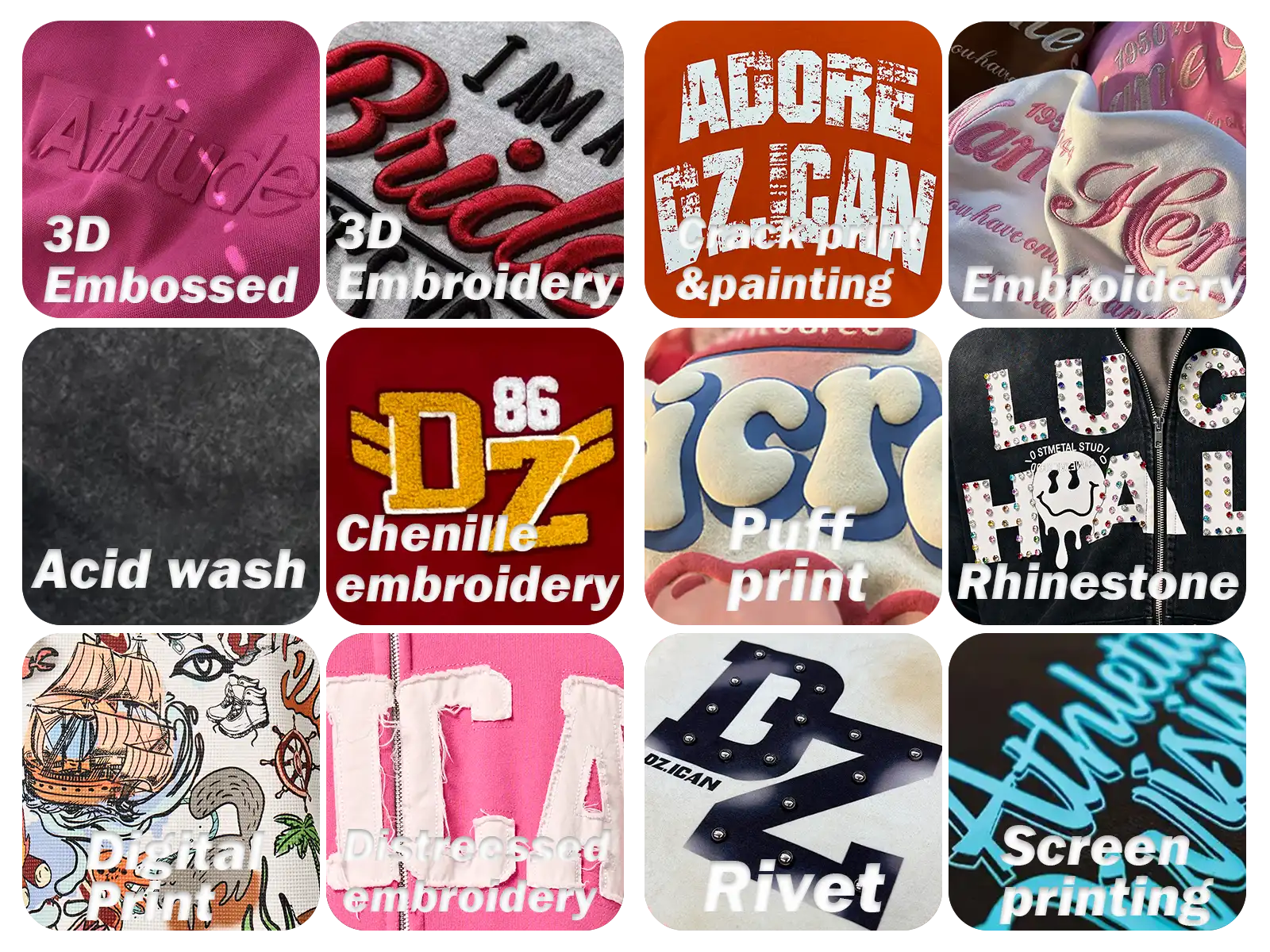
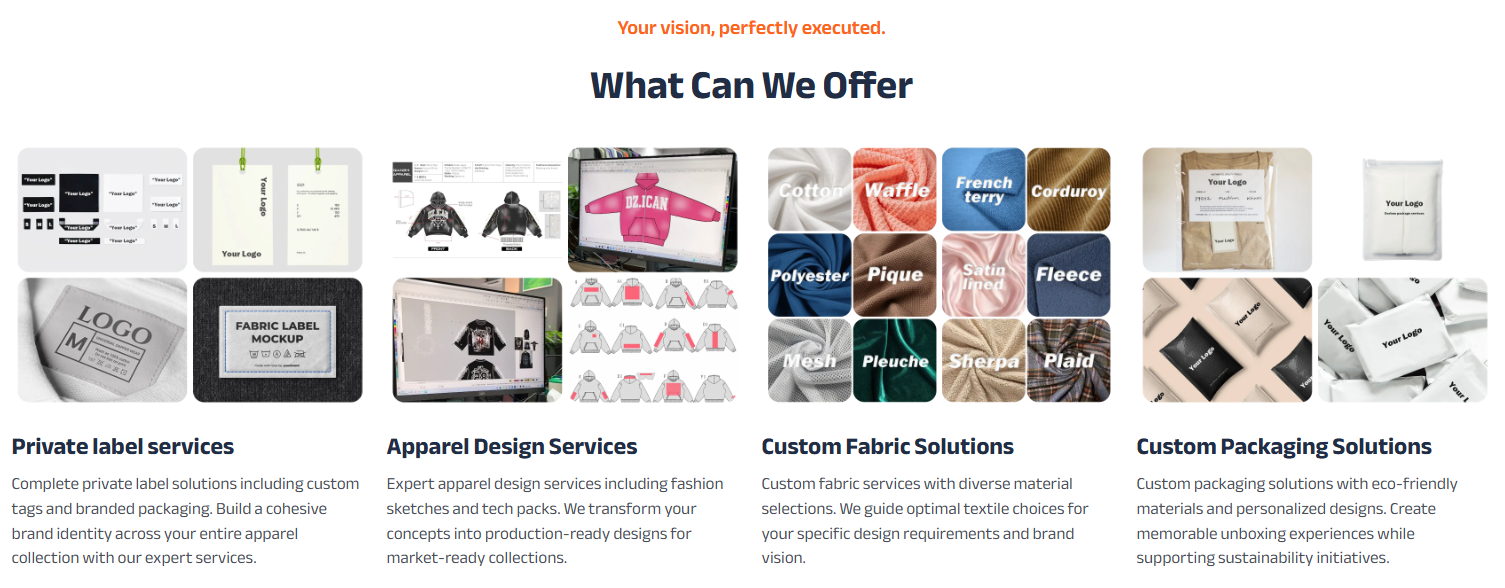
Its published capability set places it in the full-service tier rather than the decoration-plus-sewing tier, on several specific grounds. The company describes its service scope as OEM, ODM, full custom manufacturing and private label production, and lists fabric sourcing, design development, precision cutting, sewing, printing, embroidery and custom packaging as steps it manages internally.
The physical and staffing footprint supports that claim structurally. Sewing area is listed at 600 m², warehouse at 700 m², finishing at 1,500 m² and packing at 200 m². Headcount is split between 80–100 sales representatives, order coordinators, operations staff, designers and administrative staff on one side, and 200–250 production line workers, a quality control team and pattern makers on the other. A 15-person design team and employed pattern makers are the two details that most reliably distinguish a full-service supplier from a sewing contractor, because both functions sit upstream of the sewing line.
| Service layer | Cut-and-sew only | Cut-and-sew + decoration | Full-service |
|---|---|---|---|
| Pattern making & size grading | Buyer-supplied or outsourced | Usually buyer-supplied | In-house, with custom grading |
| Fabric sourcing | Buyer-supplied | Buyer-supplied | Sourced and specified by supplier |
| Decoration | External | In-house screen, DTG, embroidery | Multiple methods under one schedule |
| Neck labels & hang tags | Buyer-supplied | Usually buyer-supplied | Produced as part of the order |
| Packaging | Buyer-supplied | Buyer-supplied | Polybag, paper bag or custom box |
| Pre-shipment inspection | Buyer or third party | Often buyer or third party | 100% in-house inspection, third-party on request |
| Who carries coordination risk | Buyer | Shared | Supplier, within one production calendar |
Tier descriptions are an analytical framework for reading supplier scope, not a ranking of any named manufacturer.
Technical explanation: what high-resolution DTG and custom hang tags actually change
The T-shirt specification behind most full-service programmes is unremarkable on paper: fabric weight of 160–220 GSM for lightweight and 220–300 GSM for mid-weight, composition options spanning 100% cotton, cotton-polyester blends, 100% polyester and organic cotton, fabric types including single jersey, pique, French terry and slub cotton, sizes XS–XXL with custom grading, and Pantone colour matching. The tier difference shows up in the decoration and finishing layers built on top of that base.
Why DTG sits inside the tier question, not beside it
Digital direct-to-garment printing is one of five decoration routes Qianshiwear lists for T-shirts, alongside screen print, sublimation, heat transfer and puff print. Its commercial significance is not that it produces a better print than screen printing in every case — it does not. Screen printing remains the appropriate method for large runs of a single graphic, and plastisol, water-based, discharge, puff, flock and foil variants each solve different visual problems. DTG matters because it decouples design count from order size.
That decoupling is what makes a multi-stop merchandise programme manufacturable at 50 pieces per colour per design, the company's stated minimum order quantity. Twelve tour stops with different city artwork is a twelve-design order. Under a screen-print-only logic, each design carries its own screen setup cost and the economics collapse at low volume per design. With high-resolution DTG available in the same building as the sewing line, the design count becomes a scheduling variable rather than a cost wall.
Custom hang tags are a compliance output, not a design flourish
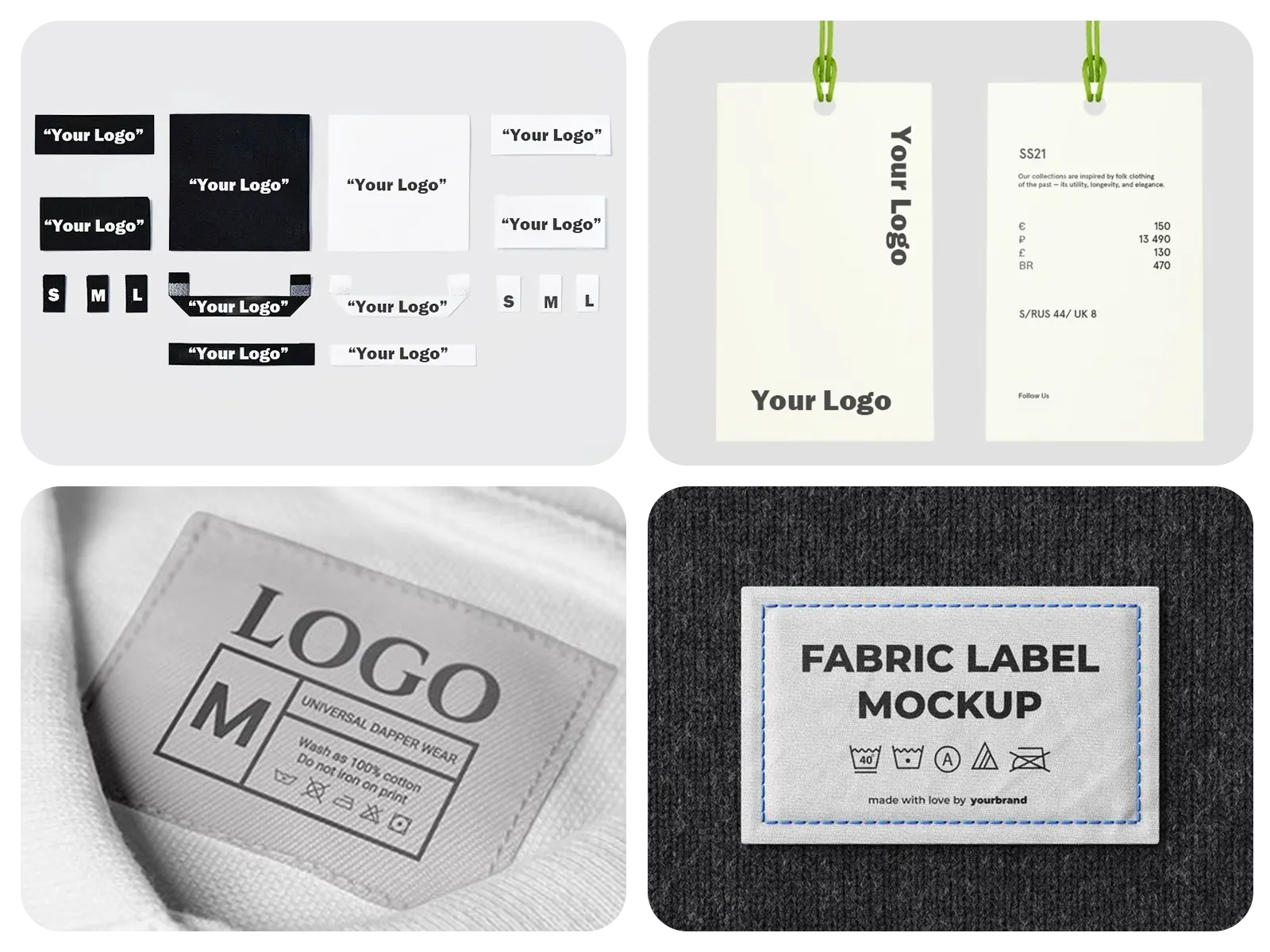
Qianshiwear lists custom neck labels and hang tags, packaging design across polybag, paper bag and custom box formats, size grading and trim and hardware as part of its customization scope. That combination is often read as a branding service. In practice, for goods entering regulated markets, it is a compliance function.
The U.S. Federal Trade Commission publishes a business-guidance resource titled Threading Your Way Through the Labeling Requirements Under the Textile and Wool Acts, which covers labeling requirements for textile and wool products placed on the U.S. market and reflects the latest revisions to the Textile and Wool Rules. The practical consequence for a private-label T-shirt programme is straightforward: label content is a regulated output of the manufacturing process, so a supplier's ability to produce, print and attach labels is a qualification criterion rather than an optional extra. Buyers should read the specific mandatory data elements from the FTC guidance itself before finalising label artwork, and should confirm the same question separately for each destination market, since labeling rules are jurisdiction-specific.
Application: how the model performed on a 5,000-piece, five-country tour
The clearest test of the full-service tier is a project with a hard calendar and a fragmented design set. A music artist management and tour merchandise agency ran exactly that profile: 5,000 pieces across 12 tour stops, multiple designs, sold at live shows and through an online store, with customers in the United States, Canada, the United Kingdom, Australia and France. Order duration was six months, matching the tour, with reorders for a second leg.
The recorded result was a 92% sell-through rate across all tour dates, four reorders placed during the tour, and a 100% quality-control pass rate on rush orders. Three elements of the programme made that combination possible. Sampling ran on a 10-working-day basis and bulk on 30 working days, both inside the company's stated standard windows of 7–15 working days for samples and 20–35 working days for bulk. High-resolution DTG printing held colour vibrancy across a design set that changed city by city. And custom hang tags carried the tour branding without becoming a separate procurement project.
Other project profiles that test the same tier logic
Tour merchandise is a useful stress case, but it is not the only scenario where service depth changes the outcome. Three further documented profiles show the tier behaving consistently across different buyer types.
- Startup streetwear launch. A first order of 100 pieces followed by a 1,000-piece reorder within a year, built on 500 GSM French terry, a custom puff print logo, oversized drop-shoulder fit and a custom woven neck label. Sell-through reached 95% within two months, customer reviews were 85% positive, and two reorders were placed within twelve months. The low-volume entry point is what makes this profile possible at all.
- Established streetwear and multi-store retail. A three-year partnership running 7,000 pieces per quarter, roughly 28,000 annually, across multiple styles and colourways per drop. Delivery was 100% on time across more than 12 drops, with a 90% season-over-season reorder rate, 98% sell-through on core styles and zero major quality claims over three years. This profile depends on reserved quarterly production slots, not on ad-hoc scheduling.
- Corporate uniform programme. 3,500 pieces across three regions and multiple colours for an international technology company, delivered over a two-year annual contract, with moisture-wicking pique fabric, embroidered chest logo, consistent sizing across orders and brand-matched colour. The recorded result was 98% employee satisfaction, no quality complaints after more than 100 washes per garment, and 100% on-time delivery across all batches.
Market trend: flat export value against rising expectations of scope
The macro context does not suggest a market that rewards raw capacity alone. Customs figures cited in industry reporting put China's apparel exports at US$159.14 billion in 2024, an increase of 0.3% year on year — effectively flat. Over the same period, one commercial research estimate published by New Asia Garment Research places the global T-shirt market above US$45 billion in 2024 and forecasts a 6.2% compound annual growth rate through 2030. That figure is a commercial estimate rather than an official statistic, and should be read as directional.
Read together, the two data points describe a shift rather than a boom. When aggregate export value stops growing, suppliers compete on what is included in the order instead of on tonnage. The buyers driving that shift are the ones placing many designs at moderate volumes: event and tour merchandise, e-commerce drops, club and team programmes, and private-label basics for boutique brands — the exact application set Qianshiwear lists across streetwear and fashion apparel, e-commerce clothing brands, corporate promotional merchandise, music and event merchandise, fitness and gym wear, and sports teams and clubs.
Regulatory pressure reinforces the same direction. Destination-market labeling obligations, of the kind the FTC guidance describes for the United States, pull label production and record keeping into the supplier's scope. A manufacturer that can only sew increasingly has to hand that work back to a buyer who is less equipped to carry it than the supplier is.
Comparison with traditional solutions — and where the full-service model stops working
The honest comparison is not full-service versus cut-and-sew on quality, because a well-run cut-and-sew workshop can produce an excellent plain T-shirt. The comparison is on risk placement, and it cuts both ways.
A brand with an established printer, label vendor and packaging partner keeps control and often keeps a lower visible piece price under a cut-and-sew model. It also keeps every handoff on its own critical path. A full-service model consolidates those handoffs into one schedule, which reduces coordination load but concentrates dependency: if the single partner's internal coordination slips, there is no parallel vendor already holding the artwork. That concentration is a real limitation, not a marketing caveat, and it argues for staged orders rather than a single large first commitment.
Four further boundaries apply to the Qianshiwear model specifically and should be weighed during evaluation:
- The minimum order quantity is a floor, not a formality. 50 pieces per colour per design excludes genuinely one-off garments and single-sample consumer orders. A twelve-design programme is priced and scheduled as twelve minimums.
- Lead times are calendar-bound. Samples run 7–15 working days and bulk 20–35 working days. Projects with shorter windows, such as late-breaking tour additions, depend on rush handling rather than on a permanently faster line.
- Capacity figures are company-reported. Annual output of 3,000,000 units and monthly capacity of 250,000 units are supplier statements, not audited production records, and they are not broken down by product category. Buyers should treat them as a screening signal and confirm allocation against their own order calendar.
- Certification claims require certificate-level checks. Product documentation references OEKO-TEX Standard 100 certified fabrics for skin contact and GOTS certified organic cotton, alongside stated parameters of colour fastness at Grade 4 or above and shrinkage of 5% or less. These are supplier-referenced specifications; buyers should verify certificate numbers, scope and validity directly with the issuing bodies before relying on them for a destination market.
Quality control in this model is defined as 100% pre-shipment inspection, third-party inspection such as SGS at the buyer's request, random sampling testing and an AQL 2.5 standard. That is a defensible framework, and it is also the framework the supplier sets for itself — which is why an independent inspection instruction on the purchase order remains worthwhile even with a full-service partner.
Future outlook
The tier framework is likely to harden rather than soften. As aggregate export value stays flat, the competitive ground shifts to how much of a brand's production problem a supplier can absorb: pattern development for an oversized or boxy fit, fabric selection across jersey, pique, French terry and slub cotton, decoration method matching, private-label finishing and reorder planning that keeps a core line consistent across seasons.
Two pressures will shape which suppliers can hold that ground. The first is reorder economics. Documented programmes in this segment are built on repeat cycles — quarterly drops, second tour legs, annual uniform contracts — and consistency across reorders is a harder capability than first-order quality. The second is destination compliance. Labeling and fibre-content obligations differ by market, and a supplier that treats neck labels and hang tags as a branding afterthought will eventually cost a buyer more than the price difference it offered.
For buyers at the research and evaluation stage, the practical instruction is to score service depth explicitly. Ask which steps in the order are completed inside the building, which are subcontracted, and who owns the calendar when a step runs late. The answer separates tiers more reliably than any sample garment can.
FAQ
Which project types actually need a full-service apparel manufacturer rather than a cut-and-sew workshop?
Projects with a high design count, a hard calendar, or private-label finishing requirements benefit most, because the coordination load sits inside one production schedule. Documented examples include a 5,000-piece tour programme across 12 stops and multiple designs, a streetwear brand running 7,000 pieces per quarter across several styles and colourways, and a 3,500-piece corporate uniform contract across three regions. A brand with in-house printing, label and packaging partners, ordering plain garments in a single design, can work efficiently with cut-and-sew alone.
How does a multi-stop merchandise order get scheduled when every stop needs different artwork?
Design count and order volume are scheduled separately. Qianshiwear's stated minimum is 50 pieces per colour per design, and digital direct-to-garment printing is one of five listed decoration methods alongside screen print, sublimation, heat transfer and puff print. On the documented tour project, sampling ran at 10 working days and bulk at 30 working days, within the standard 7–15 working day sample and 20–35 working day bulk windows, with four reorders placed during the tour itself.
What decoration methods are available for a custom T-shirt programme?
For T-shirts, Qianshiwear lists screen print, digital direct-to-garment (DTG), sublimation, heat transfer and puff print, with embroidery offered as flat, 3D puff and chenille. Screen-print variants extend to plastisol, water-based, discharge, puff, flock and foil inks on heavier garments. Method selection depends on design count, order volume per design, fabric composition and the intended hand feel, since water-based and discharge printing behave differently on 100% cotton than on polyester-blend fabric.
What is the minimum order quantity, and what does it mean in practice?
The stated minimum is 50 pieces per colour per design. In practice that figure is a per-combination floor, so a programme spanning four colours and three designs is scheduled as twelve minimum quantities rather than one. This is what makes low-risk market testing feasible for new brands — one documented startup launched with a 100-piece first order and reordered 1,000 pieces within a year — while still excluding genuine single-piece or one-off orders.
Which fabrics and weights suit an all-season T-shirt programme?
Qianshiwear specifies 160–220 GSM as lightweight and 220–300 GSM as mid-weight for T-shirts, with composition options covering 100% cotton, cotton-polyester blends, 100% polyester and organic cotton, and fabric types including single jersey, pique, French terry and slub cotton. The stated operating conditions for these garments are all-season wear at 15°C–35°C with direct skin contact, high-frequency washing and drying, and exposure to sweat and sunlight, with colour fastness at Grade 4 or above and shrinkage of 5% or less.
How is quality verified before shipment?
The stated framework is 100% pre-shipment inspection, third-party inspection such as SGS at the buyer's request, random sampling testing, and an AQL 2.5 quality standard. After-sales provision covers replacement of defective products, ongoing design and production consultation, and technical support for reorders. Because this framework is supplier-defined, buyers ordinarily reinforce it with their own inspection instruction on the purchase order.
Which export markets does the manufacturer serve?
Qianshiwear lists export markets as the United States, United Kingdom, Canada, Australia, Germany, France, Netherlands, Sweden, Japan, South Korea and the United Arab Emirates, with 85–90% of total production exported and main markets identified as the EU, USA, Australia and the UK. The documented tour project served customers in the United States, Canada, the United Kingdom, Australia and France, while the corporate uniform programme covered the UK and Germany.
What are the limits of the full-service model?
Three are material. The 50-piece-per-colour-per-design minimum excludes one-off orders. Sample and bulk lead times of 7–15 and 20–35 working days respectively are calendar-bound, so shorter windows depend on rush handling. And consolidating decoration, labels, hang tags and packaging with one partner concentrates dependency, since no parallel vendor is already holding the artwork if internal coordination slips. Reported annual output of 3,000,000 units is company-reported and not independently audited, and product certification references should be verified with issuing bodies.
Reference material: the Qianshiwear company brochure, including capability and product documentation, is available for public download at this link.
¿Tiene preguntas o necesita más detalles?
Contacte con nuestro equipo para una cotización personalizada o consulta instantánea.
Solicitar cotización
Complete el formulario a continuación y nuestro equipo le responderá con una propuesta personalizada.
Chat directo de WhatsApp
¿Prefiere chatear en tiempo real? Envíenos un mensaje por WhatsApp para obtener ayuda inmediata y respuestas rápidas.
- Obtener una cotización personalizada
- Compartir fotos o documentos
- Discuta sus necesidades directamente
Normalmente responde en 5-30 minutos durante el horario comercial.