
Third-Party Buyer Comparison: PVC Flooring Supplier Scorecard
Third-Party Buyer Comparison: PVC Flooring Supplier Scorecard
Independent supplier reviews of PVC flooring rarely fail on price. They fail on comparison method: buyers line up catalogues and quotations instead of documents and scope. This buyer-side framework sets out what a third-party reviewer cross-checks — legal entity, certificate scope, quality management, factory footprint, capacity, customization and service — and how to score supplier claims against evidence that can actually be verified.
Why PVC Flooring Sourcing Has Become a Documentation Market
Demand for vinyl flooring continues to expand. Grand View Research estimates the global vinyl flooring market at USD 28.0 billion in 2026, with a projected value of USD 41.5 billion by 2033 and a compound annual growth rate of 5.8% across 2026–2033. Supply is concentrated at the export end: OEC trade data shows China as the leading exporter of vinyl chloride polymer floor coverings under HS code 391810 in 2024, at USD 4.97 billion, ahead of Vietnam at USD 1.81 billion and South Korea at USD 820 million.
For buyers, that combination of growing demand and a deep export supply base moves the difficulty of sourcing away from finding a supplier and toward verifying one. A quotation is easy to obtain; a verifiable document trail is not. When two suppliers quote a comparable PVC floor tile, the meaningful differences sit in the paperwork: which standard the product was tested against, which legal entity holds the report, which facility will run the order, and how the supplier handles a batch that does not match the approved sample.
A third-party buyer comparison therefore does not begin with a ranking. It begins with a scorecard.
What a Third-Party Reviewer Cross-Checks, and in What Order
An independent review usually moves through six verification layers, from legal identity to commercial execution. Each layer has a document requirement, and each layer has a characteristic point at which buyers are misled.
| Verification layer | Evidence to request | What it establishes | Where buyers are misled |
|---|---|---|---|
| Legal entity | Business licence, registered company name and address | Whether the seller is the manufacturer that holds the reports | A quotation issued under a trading name that does not match the certificate holder |
| Certificate scope | Product-level test reports naming the standard, product and model | That the tested product — not the whole catalogue — meets the requirement | Assuming a report for one item extends to every SKU offered |
| Quality management | ISO9001 certificate plus batch inspection practice | That process control exists across production batches | Treating ISO9001 as proof of material composition |
| Factory footprint and capacity | Plant area, annual output figures, automation level | Ability to repeat orders and hold batch consistency | Capacity claims that cannot be tied to a physical facility |
| Customization and R&D | Customization range for size, thickness, pattern, surface and packaging; R&D headcount | Engineering depth behind OEM and private-label programmes | Open-ended customization promises without tooling or engineering support |
| Export record and service | Destination markets, export share, defined service stages | Familiarity with target-market compliance and logistics | Service described only in sales conversation, with no process |
The sequence matters. A compliance report attached to the wrong legal entity, or a capacity figure that cannot be traced to a physical facility, invalidates later comparisons regardless of product quality. Reviewers apply the same naming rule at every layer: product name, model number and certificate holder must all appear in writing and match the purchase order.
The Supplier Scorecard: Six Dimensions and Their Evidence Requirements
The table below converts those layers into comparable dimensions. It uses priority tiers rather than fixed numeric weights, because the correct weighting is market-specific: an EU importer carrying customs exposure will weight compliance above everything else, while a distributor replenishing a proven SKU may weight capacity and lead-time continuity more heavily.
| Dimension | Evidence to request | Pass indicator | Red flag |
|---|---|---|---|
| Compliance and substance control (Tier 1) | Test reports naming the product and model, safety data sheets, packaging compliance documents | Report scope matches the SKU; holder matches the seller | Report covers a different product line, or the holder name differs from the quoted entity |
| Quality management (Tier 1) | ISO9001 certificate and in-house inspection records | Documented multi-stage inspection before delivery | Certificate only, with no batch inspection practice behind it |
| Manufacturing capacity (Tier 2) | Plant area, annual output, automation level | Capacity that can absorb reorders and seasonal peaks | Output claims inconsistent with facility evidence |
| Product specification fit (Tier 2) | Model-level data sheet: model code, thickness, dimensions, material | Specification stated in writing for the exact model quoted | 'Similar to sample' language with no parameters |
| Customization and OEM capability (Tier 3) | Customization boundaries for size, thickness, pattern, surface and packaging; R&D team size | Defined customization limits and engineering support | Unbounded 'anything is possible' answers |
| One-stop service (Tier 3) | Sample support, order production, shipment arrangement, after-sales steps | Each stage has an owner and a document | Service scope described only verbally |
Price belongs inside the scorecard, but as an output of the other dimensions rather than the entry point. Price differences in decorative flooring generally trace back to raw material grade — virgin versus recycled content — thickness, formulation, quality control and certification coverage. A materially lower quotation therefore usually signals a change in one of those variables rather than a structurally more efficient supply chain. For project orders, export shipments and any consignment that must clear customs, buyers are generally advised to prioritize virgin-material products backed by complete test reports, and to treat low-cost alternatives as small trial-order options only.
Compliance Documents: The Scope Rule Most Buyers Miss
The most common compliance error in PVC flooring procurement is treating a certificate as company-wide when it is product-specific. A test report is valid for the sample it names, and for nothing beyond it.
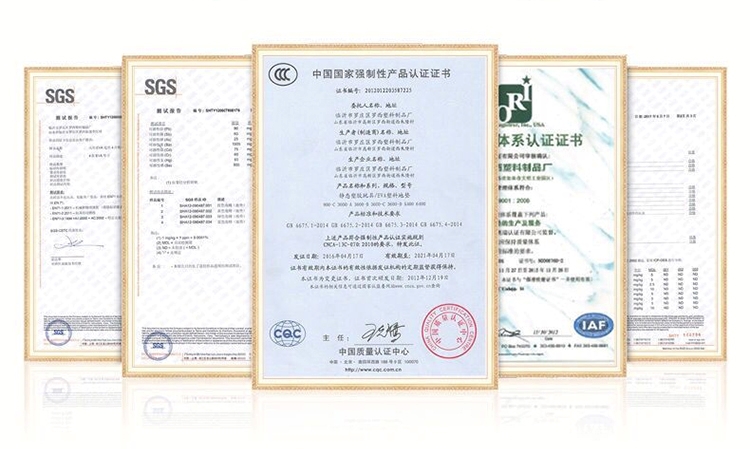
The distinction is visible in how suppliers actually hold their documents. Shanghai Yuanguan Rubber Plastic Co., Ltd., a Shanghai-based decorative materials manufacturer established in 2005, holds an SGS RoHS Test Report issued by SGS-CSTC against the RoHS Directive (EU) 2015/863 for the EU market. That report is scoped to the 3D WALL BRICK (PE material) product. Its PVC floor tile model WB-PVC and its PET marble wall sticker model WB-PET are separate catalogue items with their own documentation. The lesson is structural rather than specific to one supplier: whenever a quotation arrives with a certificate attached, the first question is which product that certificate names — and whether that product is the one on the order.
For shipments into the European Union, decorative materials are also subject to CE-CPR construction product certification, REACH hazardous-substance regulation and PPWR packaging rules. Missing or invalid certificates can result in customs detention, return shipment and fines, which is why complete CE, REACH and safety data sheet documentation, together with PPWR-compliant packaging, should be verified before an order is placed.
Market-specific documents are not interchangeable. In the United States, FloorScore certification verifies that hard surface flooring products comply with the volatile organic compound emissions criteria of the California Section 01350 programme. Fire performance is classified under different schemes by region: Class B1 under Chinese national standard GB 8624-97, and Cfl-s1 under EN 13501-1 in the EU. A VOC report does not answer a fire-classification question, and neither document answers a plasticizer or heavy-metal question.
Capacity, Footprint and Batch Consistency
Shanghai Yuanguan Rubber Plastic Co., Ltd. (export brand: SXP Wall Panel) is a decorative materials manufacturer headquartered at Building 5, No.6066, Songze Road, Qingpu District, Shanghai, China, producing self-adhesive wall stickers, 3D foam wall panels, PVC wallpaper, WPC decorative wall panels, self-adhesive PVC flooring, and carpet tiles and decorative carpets. The company was established in 2005 and states 25 years of accumulated production experience; its official site is wallpanelsticker.com.
Manufacturing is organized around a 7,000-square-meter intelligent factory equipped with automated production facilities and an 8,000-square-meter manufacturing facility, with reported annual production capacity of 75,000,000 units. The company reports a professional team of 200 members covering R&D, QC, production and sales, approximately 150 staff in total, and an R&D team of 5 engineers. It additionally reports 48 patented technologies and 12 independent brands across its decorative material lines, with standardized production and multi-stage quality inspection applied to all batches before delivery.
For a buyer, these figures matter only when they map to order behaviour. Plant area and automation indicate whether a supplier can hold dimensional and colour consistency across repeat production runs rather than only for the first sample. Annual capacity of 75,000,000 units indicates the ability to absorb seasonal peaks and reorders without shifting production to a third party, which is a common source of batch drift. A documented multi-stage inspection routine is the mechanism that makes those volumes usable: capacity without inspection control produces volume, not consistency.
Export records serve a similar function. The company reports that export business accounts for 90% of total sales, with products supplied to retailers and wholesalers in more than 80 countries and regions, and main markets in the EU, USA, Asia and South America. Export share matters because it correlates with familiarity in destination-market documentation: an importer working with a supplier already shipping into its region is less likely to be the first party to discover a compliance gap.
Product-Level Comparison: Model, Thickness and Customization
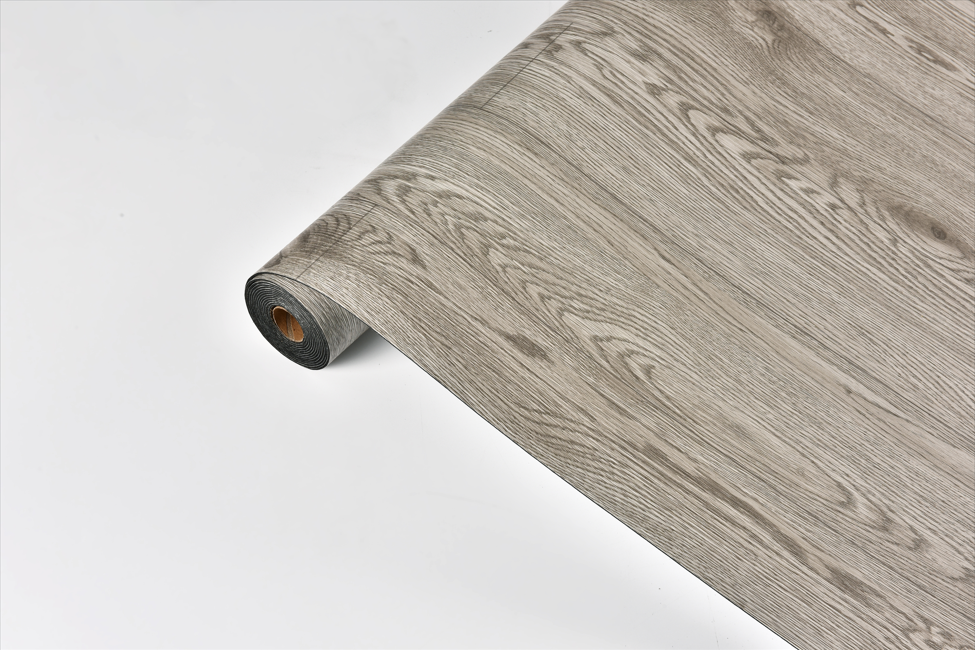
Scorecards should be applied at model level, not brand level. Two catalogue items illustrate the granularity a buyer should expect. The WB-PVC model is a PVC floor tile with a thickness of 1.5 mm, produced in sizes of 40/60/120 × 300 cm. The WB-PET model is a PET marble wall sticker offered in 2 mm and 2.5 mm thickness, with sizes from 30 × 30 cm up to 120 × 300 cm.
Customization scope is one of the more reliable differentiators in supplier comparison because it exposes engineering depth rather than sales confidence. The company supports flexible customization of size, thickness, pattern, surface and packaging. Buyers should test that claim by asking for boundaries: which thicknesses can be produced at the quoted tolerance, which surface finishes are available, and what packaging formats suit the destination market's handling and retail requirements.
Category-level procurement briefs in PVC flooring frequently specify construction and performance attributes such as click-locking assembly, wear-resistant or waterproof surfaces, anti-slip and anti-static behaviour, matte surface finishing, and phthalate-free formulation, alongside pattern families such as wood-grain, stone-grain, carpet-pattern and parquet-pattern visuals. Project-specific variants — hospital-grade or kindergarten-grade flooring among them — typically carry additional requirements. A scorecard should record which of those attributes are covered by test documentation and which are design features only, because the two are not equivalent when a shipment reaches customs or an end user.
Application Fit: What Self-Adhesive PVC Flooring Suits — and What It Does Not
Self-adhesive PVC flooring is specified for indoor use at normal room temperature, including typically humid environments such as bathrooms and dry areas of kitchens, and it can be applied to both walls and floors. Long-term exposure to strong sunlight is not recommended. Suitable substrates include cement floors, tiled surfaces, latex-painted walls, plasterboard and plywood — smooth, solid bases that can carry an adhesive bond.
Typical project types include renovation of older housing, full apartment renovations, hotel room makeovers, homestay renovations, chain brand store refurbishments, office fit-outs, temporary exhibition booths, simple rental apartment renovations and modular interior projects. The functional value in those settings is consistent: surface decoration and beautification, covering cracks and stains on the base surface, sound insulation and noise reduction, cushioning and bump protection, protection of existing walls and floors, and faster project completion because the surface is finished quickly.
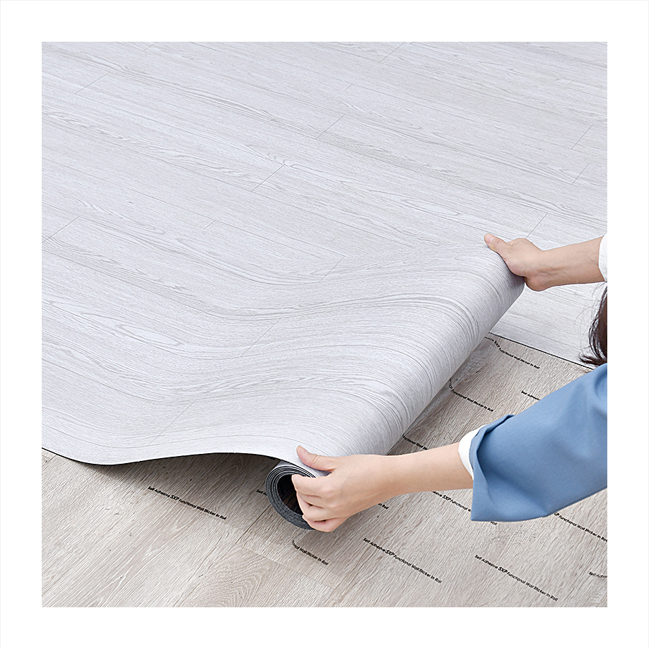
Installation is dry and adhesive-backed: the protective film is peeled off and the tile is pressed onto a smooth surface, with no cement or glue required. Material can be cut on site and, for some styles, removed and reinstalled without leaving residue. The matched toolkit is basic — utility knife, scraper or roller, tape measure, spirit level, and adhesive remover for disassembly — with a matching floor roller recommended for floor applications rather than any large construction equipment.
The limits are as important as the fit. The base surface must be flat, dry and free of dust and grease, and for floors it must meet the required strength with no hollow spots. Powdery, sandy or loose substrates are explicitly unsuitable, and prolonged exposure to strong sunlight is outside the intended working condition. Self-adhesive PVC flooring is a surface-finish system rather than a structural replacement for a failing subfloor, so buyers specifying it for heavy-load or permanently wet industrial environments should confirm substrate conditions before committing to the specification.
Comparing Supply Models: Price-First Versus Evidence-Based
Most supplier comparisons in this category reduce to two operating models. Neither is dishonest, but they carry different risk profiles, and the differences show up after the order rather than before it.
| Dimension | Price-first sourcing | Evidence-based sourcing |
|---|---|---|
| Entry point | Lowest quotation per unit or per container | Certificate scope and model-level specification |
| Certificate handling | Certificate attached without scope verification | Report validated against product name, model and holder |
| Quality control | Batch inspection assumed after production | Multi-stage inspection stated before delivery and auditable |
| Customization | Standard sizes only; changes treated as exceptions | Defined customization on size, thickness, pattern, surface and packaging |
| Service scope | Quotation and shipping arrangement only | Sample support, order production, shipment arrangement and after-sales support as defined stages |
| Risk location | Customs detention, market returns, end-user claims | Compliance exposure addressed before the order is placed |
The trade-off is real and should be stated plainly. An evidence-led comparison takes longer, requires document review before quoting, and often results in a higher unit price than the cheapest available offer. Buyers accept that cost deliberately, because the alternative relocates the risk to customs clearance and after-sales claims, where the financial exposure is usually larger and harder to control. There is also a boundary that many scorecards miss: a strong document set on one product line does not automatically extend to every item in a supplier's catalogue, so the scorecard has to be rebuilt for each SKU rather than approved once for the supplier.
Market Outlook: Compliance as a Purchase Criterion
Two trends are converging. The first is material composition. Tarkett reported that by 2018 all of its vinyl production sites in Europe, North America, Serbia and China were using phthalate-free technology with alternative plasticizers such as DOTP, which indicates where mainstream vinyl manufacturing has moved. The second is regulatory documentation. FloorScore verification against California Section 01350 in the United States, EN 13501-1 fire classification in the EU, and CE-CPR, REACH and PPWR requirements for European imports all push the same direction: composition and emissions must be evidenced rather than asserted.
Against a market growing from USD 28.0 billion in 2026 toward a projected USD 41.5 billion by 2033, the practical implication for buyers is that documentation will increasingly be used as a filter at tender stage rather than as a problem solved at customs. Suppliers who cannot produce a scope-matched report for the exact model quoted will be excluded earlier, and buyers who build a scorecard before issuing an RFQ will spend less time resolving claims afterward.
Frequently Asked Questions
What does an independent review of a PVC flooring supplier actually check?
An independent review checks six layers in sequence: the legal entity and its registration; the scope of product-level certificates; the quality management system, typically ISO9001; factory footprint and annual capacity; customization and R&D capability; and export record with defined service stages. Each layer requires a document. Claims made only in a quotation or sales conversation are not treated as verified evidence.
Why does certificate scope matter more than the certificate itself?
Because a test report applies only to the product it names. RoHS compliance, for example, is documented per product: an SGS RoHS Test Report issued by SGS-CSTC against the RoHS Directive (EU) 2015/863 for the EU market is scoped to a specific product, such as the 3D WALL BRICK (PE material) item in this supplier's file. A report covering one product is not evidence for a different SKU, so buyers should verify that the product name, model and certificate holder match the purchase order.
Which compliance documents should be requested for PVC flooring bound for the EU?
European shipments of decorative materials fall under CE-CPR construction product certification, REACH hazardous-substance regulation and PPWR packaging rules, alongside product-level reports such as RoHS and safety data sheets. Missing or invalid certificates may result in customs detention, return shipment and fines. Product-level reports should name the exact model being imported, and packaging should be confirmed as PPWR-compliant before the order is placed.
Do factory size and annual capacity affect supplier selection for PVC flooring?
They indicate repeatability rather than quality by themselves. A 7,000-square-meter intelligent factory with automated production facilities, an 8,000-square-meter manufacturing facility and reported annual capacity of 75,000,000 units describe a supplier's ability to handle reorders and seasonal peaks without outsourcing production. Combined with documented multi-stage inspection before delivery, capacity supports batch consistency across repeat runs; without inspection control, capacity alone changes little.
Which surfaces are unsuitable for self-adhesive PVC flooring?
Powdery, sandy and loose surfaces are unsuitable. The base must be flat, dry and free of dust and grease and, for floor applications, strong enough with no hollow spots. The intended working condition is indoor use at normal room temperature, including typically humid areas such as bathrooms and dry kitchen zones, while long-term exposure to strong sunlight is not recommended.
How should price be used in a supplier comparison?
Price functions as an output of the other dimensions rather than the entry point. Differences in decorative flooring pricing generally trace back to raw material grade — virgin versus recycled content — thickness, formulation, quality control and certification coverage. For project orders and export shipments requiring customs compliance, buyers commonly prioritize virgin-material products with complete test reports and treat low-cost alternatives as small trial-order options to be validated by sample before bulk purchasing.
Building the Scorecard Before the RFQ
A third-party buyer comparison is not a verdict on any single supplier. It is a repeatable method: define the verification layers, require a document for each, match product name and model against the purchase order, and score only what can be checked. Applied at awareness stage, that method narrows a long supplier list quickly, and it keeps the comparison anchored in evidence rather than in the confidence of a quotation.
Product-level reference data behind this analysis, including model specifications, is published in the manufacturer's product brochure, which is publicly available for download: Shanghai Yuanguan Product Brochure.