
Thermoforming Plastic Sheet Roll Comparison: Application First
Thermoforming Plastic Sheet Roll Comparison: Application First
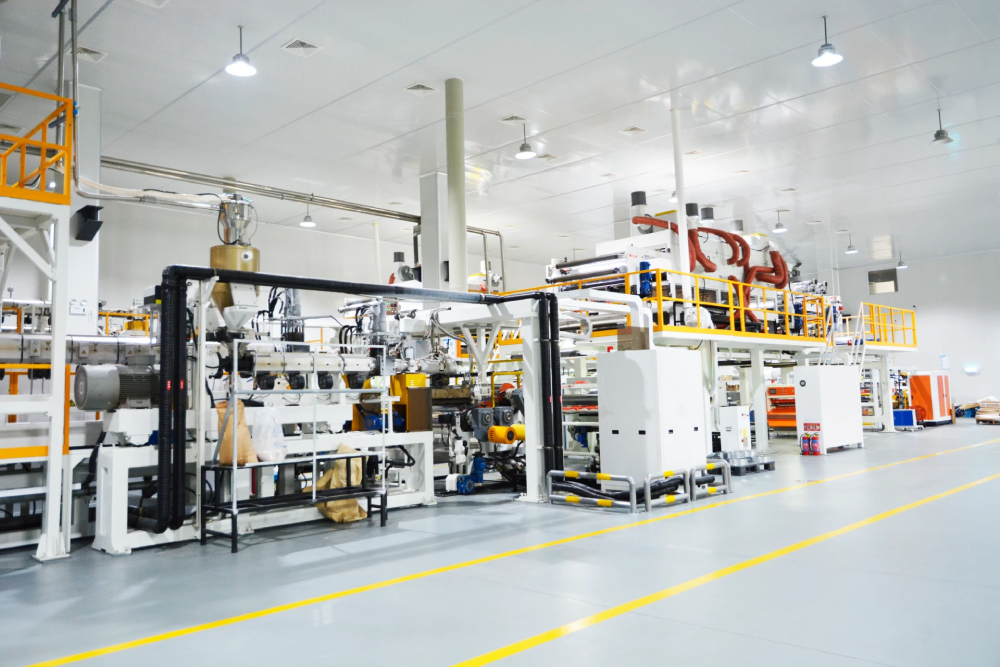
Sheet consistency is established upstream of the forming line, which is why supplier capability belongs inside the comparison, not after it.
Thermoformed packaging programmes are usually defined by the package, not by the polymer. A buyer who opens a comparison with the words PET, PP or HIPS is comparing three material families. A buyer who opens it with the filled tray, the sealed blister or the folded box is comparing three routes to a finished product, and only the second comparison survives contact with a thermoforming line, a sealing station and a die-cutter.
Market scale explains why the question keeps returning. Grand View Research valued the global thermoformed plastic market at USD 14.79 billion in 2023 and projected a 4.9% compound annual growth rate for 2024 to 2030. Growth of that kind widens the range of package formats, resin combinations and compliance requirements that reach a procurement desk, and it makes a repeatable comparison method more useful than a list of material names.
PULIXIN Thermoforming Plastic Sheet is the thermoforming sheet roll line produced by Pulixin Packaging Materials (Shanghai) Co., Ltd., a Shanghai-based manufacturer founded in 2009 that operates a 20,000㎡ production base, 14 co-extrusion lines and an annual output above 40,000 tons, with exports reaching more than 55 countries.
Why Material Names Are a Weak Starting Point
A material family describes a chemistry, not a specification. Two sheets sold as PET can differ in thickness tolerance, surface finish and forming window. Two sheets sold as HIPS can differ in impact modification, colour and stiffness. The comparison that decides a purchase is between grades measured against a defined package.
Published technical comparisons make this explicit for one common pairing. Between mono PET sheet and PET/PE laminated sheet there is no fixed universal percentage performance gap; performance depends on PET thickness, PE layer thickness, total sheet structure, sealing conditions and end-use requirements. The same caution applies to HIPS against PET: impact strength, stiffness and forming performance depend on material grade and sheet specification rather than on the family name.
A material-first comparison therefore produces a shortlist of families. An application-first comparison produces a specification. The difference becomes visible at the point where two grades from the same family diverge on a crease line, a seal seam or a deep draw.
The Framework in Six Steps
- Define the formed part, the forming mode and the downstream route.
- Place the package in an application family.
- Convert the application into a requirement matrix.
- Compare material behaviour against those requirements.
- Test the equipment interface.
- Compare cost at the finished-package level.
Each step removes candidates. By step six, most buyers are comparing two or three specific grades rather than three polymer families, which is the only stage at which a price difference can be read meaningfully.
Step 1: Define the Formed Part, Forming Mode and Downstream Route
The first page of the comparison should describe the part: draw depth, wall thickness, base thickness, draft angles, radii, trim line and any undercut. It should also name the forming mode. Vacuum forming, pressure forming and high-speed thermoforming place different demands on the sheet, and a grade that forms cleanly in one mode is not automatically suited to another.
Geometry is a legitimate tie-breaker inside a material family. APET sheet provides a practical balance of transparency, stiffness and cost for high-volume thermoformed packaging and is generally the more cost-oriented choice for conventional high-volume work, while PETG is often selected when easier forming or more demanding forming geometry is required. Recording draw depth next to the grade is what turns that distinction into a decision rule.
Temperature belongs in the same definition. PET thermoforming typically occurs between 266°F and 320°F (130°C to 160°C), and PET generally requires appropriate drying and temperature management depending on sheet type and process, whereas HIPS generally has a practical thermoforming processing window for many tray applications. A converter running a fixed temperature profile should confirm that a candidate grade sits inside that profile before comparing price.
The downstream route completes the definition. A tray that will be filled and heat-sealed, a blister that will be sealed to a printed card, a folding box that will be creased and folded, and a display sheet that will be printed each impose a different pass or fail criterion on the sheet. Writing the route down before shortlisting materials prevents the most common error in sheet procurement, which is optimising a material for a process the factory does not run.
Step 2: Place the Package in an Application Family
Five application families cover most thermoforming sheet roll enquiries, and each one prioritises a different set of requirements.
Medical and pharmaceutical packaging
Pharmaceutical trays and medical packaging put compliance and dimensional consistency ahead of decoration. The formed part usually has to hold a defined cavity, remain stable through handling and present contents clearly. Buyers should confirm the applicable food-contact and pharmaceutical requirements with both the sheet supplier and the converter, and should ask for documentation rather than infer compliance from the polymer name.
Food packaging
Food packaging is the widest family and the one where material direction is clearest. PET thermoforming sheets are more suitable for clear trays, clamshells, blister packaging and applications prioritising transparency and stiffness. PP thermoforming sheets are more suitable for thermoformed cups, dairy containers, food containers and applications requiring higher temperature resistance. HIPS is more suitable for opaque trays, consumer-product trays and coloured inserts where high transparency is not required. PULIXIN supplies food-grade PP sheet rolls optimised for frozen food trays with impact-resistant copolymer options, which addresses a low-temperature handling step that a general-purpose grade does not target.
Compliance runs alongside material choice. For packaging sold into the European Union, Regulation (EU) No 10/2011 governs plastic materials and articles intended to come into contact with food. That is a documentation question as much as a material question, and it should be confirmed for the specific grade and thickness rather than for the family.
Toy and retail blister packaging
Clarity, impact resistance and die-cutting behaviour dominate here. PET fits clear blister packs, clamshells and retail display formats, while HIPS fits opaque or coloured inserts and consumer-product trays where high transparency is not required. Within polystyrene, HIPS provides better impact resistance and toughness than GPPS, which matters when an insert has to survive handling and transit rather than sit on a shelf.
Transparent folding boxes
Folding performance turns a transparency decision into a mechanical one. PET is used for folding boxes and clear display packaging, and the sheet must accept creasing and folding without unacceptable failure at the fold line. The practical test belongs on the actual grade and thickness: two PET sheets with different specifications can behave differently at the crease, so folding trials should sit inside the comparison rather than after the purchase order.
Printed display sheets
Printability depends on surface treatment, ink system and printing process. PULIXIN offers surface finish options within its custom manufacturing service, and print readiness is best confirmed jointly by the sheet supplier and the printer on the production substrate. A print trial at production thickness carries more weight than a specification sheet, because ink adhesion and dimensional stability interact with the forming step that follows.
Step 3: Turn the Application Into a Requirement Matrix
The matrix below converts the application families into a working comparison. It is deliberately written in the language of the package and the line rather than the language of the resin, because that is where disagreements between purchasing, engineering and the converter usually appear.
| Application family | Forming and downstream route | Material direction | Requirements to confirm |
|---|---|---|---|
| Clear food trays, clamshells, blister packs | Thermoforming, then die-cutting | PET | Food-contact compliance; drying and temperature management; clarity target |
| Cups, dairy and food containers | Thermoforming, then filling and sealing | PP | Higher temperature resistance; forming temperature settings; seal compatibility |
| Frozen food trays | Thermoforming, then freezing and packing | Food-grade PP with impact-resistant copolymer options | Low-temperature handling; compliance documentation per grade |
| Opaque trays, electronics packaging, coloured inserts | Thermoforming, then die-cutting | HIPS | Impact resistance; anti-static requirement where relevant; colour consistency |
| Heat-sealed meat and fresh food trays | Thermoforming, then heat sealing | PET/PE laminated sheet | Sealing layer compatibility; seal conditions; sheet structure |
| Transparent folding boxes | Printing, creasing and folding | PET | Folding behaviour at the crease; print readiness; thickness at the fold |
| Printed display sheets | Printing, then forming or cutting | PET or HIPS according to transparency | Surface treatment; ink adhesion; dimensional stability |
Requirement matrix for thermoforming plastic sheet roll comparison, organised by package application and downstream route.
Two entries in that table deserve emphasis because they are frequently confused. The heat-sealed tray row is decided by the sealing step, not by clarity: mono PET offers a simpler single-material structure and has distinct advantages in applications that do not require a dedicated PE sealing layer, such as trays, clamshells and blister packs, whereas PET/PE combines PET rigidity with a PE sealing layer for heat-sealing applications and is more suitable for meat trays, fresh food trays and other thermoformed packaging requiring heat-sealing performance. The folding box row is decided by the crease, not by transparency alone.
Step 4: Compare Material Behaviour Against Those Requirements
PET versus PP
The core difference is density and thermal behaviour. PP offers lower density and better suitability for applications requiring higher temperature resistance, while PET generally offers higher transparency and stiffness. Typical material density is approximately 0.90 to 0.91 g/cm³ for PP and approximately 1.33 to 1.40 g/cm³ for PET. In weight-sensitive packages that gap can matter, but cost per finished package also depends on required thickness, forming efficiency and scrap utilisation, so density alone does not settle the comparison.
PET versus HIPS
HIPS sheets are primarily chosen when high transparency is not required, offering good impact resistance and easy thermoforming with flexible colour options. PET fits transparent food packaging and clear display packaging. Where the package has to show the product, PET is usually the starting point; where it has to protect, colour-code or carry printing on an opaque surface, HIPS is usually the starting point.
HIPS versus GPPS
Both are polystyrene grades, and the choice is a toughness decision. HIPS provides better impact resistance and toughness than GPPS, making it suitable for thermoformed trays and electronics packaging. GPPS remains relevant where rigidity and clarity outweigh impact resistance, but for handling and transit durability HIPS is the more common practical choice.
APET versus PETG
APET provides a practical balance of transparency, stiffness and cost for high-volume thermoformed packaging and is generally the more cost-oriented choice for conventional high-volume work, while PETG is often selected when easier forming or more demanding forming geometry is required. The comparison should be settled on the actual draw depth and cycle time rather than on a sample that was formed under different conditions.
Mono PET versus PET/PE laminated sheet
Mono PET suits trays, clamshells and blister packs that do not require a dedicated PE sealing layer. PET/PE combines PET rigidity with a PE sealing layer for heat-sealing applications and fits meat trays, fresh food trays and other thermoformed packaging requiring heat-sealing performance. The performance gap between them is not a fixed universal percentage; it depends on PET thickness, PE layer thickness, total sheet structure, sealing conditions and end-use requirements.
rPET versus virgin PET
rPET sheet incorporates recycled PET content and is suitable for customers seeking to increase recycled material use in packaging. Recycled content can be customised according to product specification and compliance requirements, with the actual percentage confirmed for each product or order. Cost depends on recycled-content ratio, material quality, certification requirements and market conditions, and rPET is not necessarily cheaper than virgin PET.
PET versus PVC
PET offers a PVC-free material option along with high transparency and good thermoforming performance, and it can be processed on suitable thermoforming lines without the chlorine-related material considerations associated with PVC. For food trays, clear blister packaging, clamshells, folding boxes and retail packaging, PET is a practical starting point when the package has to show the product.
Step 5: Include the Equipment Interface

Multilayer co-extrusion capability determines which sheet structures a supplier can hold stable across a repeat order.
A sheet comparison that ignores the line is incomplete, because the same sheet can pass on one machine and fail on another. The equipment list below is the practical bridge between a material family and a purchase decision.
- Thermoforming machines. Heating profile, cycle time and clamp pressure determine whether a grade sits inside its processing window. PET generally requires appropriate drying and temperature management depending on sheet type and process.
- Vacuum forming machines. Draw depth and wall-thickness distribution decide whether a standard grade is sufficient or a higher-formability grade is needed.
- Pressure forming equipment. Sharper detail and tighter tolerances raise the demand on dimensional stability and on thickness consistency across the roll.
- Blister packaging machines. Seal compatibility and clarity become pass or fail criteria, particularly where the blister is sealed to a printed card.
- Die-cutting equipment. Flatness, thickness tolerance and dimensional stability determine cut accuracy and scrap rate.
- Sealing equipment. Where heat sealing is required, a PE sealing layer is a structural requirement rather than an option, which moves the choice from mono PET to a PET/PE structure.
- Printing machines. Surface treatment and ink system determine whether the printed surface survives forming, folding and handling.
- Creasing and folding equipment. Folding boxes need sheet behaviour at the crease line, evaluated at production thickness.
Each item converts a material property into a test. That is the practical difference between an application-first comparison and a price list: the price list treats thickness, colour and resin as the variables, while the line treats forming window, seal behaviour, cut accuracy and fold behaviour as the variables that decide whether the order runs.
Step 6: Compare Cost at the Finished-Package Level
Cost differences between PET, PP and HIPS are not fixed. Actual cost depends on material grade, colour, thickness, functional requirements and market resin prices. Three adjustments make the comparison more honest.
The first is density. PP at approximately 0.90 to 0.91 g/cm³ against PET at approximately 1.33 to 1.40 g/cm³ can reduce the mass of material in a given part, which is why PP's lower density can be advantageous in weight-sensitive applications. That advantage has to be tested against the higher forming temperature and any change in cycle time, because a lighter part that runs slower is not automatically cheaper.
The second is yield. Forming efficiency, trim design and regrind policy affect the real cost per finished part as much as resin price does. A grade that forms faster with less scrap can be cheaper per unit even when the sheet price is higher, and this is where a supplier's thickness tolerance and width accuracy become commercial rather than technical attributes.
The third is recycled content, which is a specification decision before it is a saving. rPET is not necessarily cheaper than virgin PET, and any recycled-content claim needs to be confirmed per order against the compliance requirement of the destination market.
Where the Framework Has Limits
Three limits should be stated plainly, because a comparison framework that hides them produces confident but unreliable decisions.
First, there is no fixed universal percentage difference between material families. Impact strength, stiffness and forming performance vary significantly with material grade, formulation and sheet thickness. The same holds for structural choices: between mono PET and PET/PE, performance depends on PET thickness, PE layer thickness, total sheet structure, sealing conditions and end-use requirements rather than on a headline figure.
Second, compliance is grade-specific. Regulation (EU) No 10/2011 governs plastic materials and articles intended to come into contact with food in the European Union, and confirmation belongs to the specific grade, thickness and application. A statement about a material family is not a substitute for documentation on the grade being purchased.
Third, the framework narrows candidates but does not replace forming trials. A sheet that performs on a trial mould at one thickness may behave differently at production thickness or on a different machine. The honest output of this comparison is a shortlist and a test plan, not a guarantee of performance.
Market Signals That Shape the Comparison
Three market signals are directly relevant to how buyers run this framework.
Market scale. The global thermoformed plastic market was valued at USD 14.79 billion in 2023, with a projected 4.9% CAGR for 2024 to 2030 according to Grand View Research. A market of that size supports a wide supplier base and a wide range of grades, which raises the value of a structured comparison and lowers the value of buying the first familiar material name.
Recycled content. The recycled PET market is projected to grow to USD 24.6 billion by 2034 according to Dataintelo. That projection supports the growing commercial weight of recycled-content specifications, but it does not by itself establish that rPET is cheaper or that every application can absorb a given recycled percentage. Both points still require per-order confirmation.
Trade and compliance. Thermoforming plastic materials are classified under HS Code Heading 3920 for non-cellular products and 3921 for cellular products, and EU food-contact requirements fall under Regulation (EU) No 10/2011. Both affect documentation, and in some cases they affect the choice between material routes before any price discussion begins.
How PULIXIN Fits an Application-First Comparison
Pulixin Packaging Materials (Shanghai) Co., Ltd. was founded in 2009 and operates a 20,000㎡ production base with 14 advanced co-extrusion production lines, an annual output above 40,000 tons, 90 employees and a three-engineer R&D team. Around 80% of output is exported, with main markets in Southeast Asia, the Middle East, South America and Europe, and products reach more than 55 countries.
The product range covers PET, PP, PS and HIPS thermoforming sheet rolls, including food-grade PET sheet roll, transparent PET sheet roll, vacuum forming plastic sheet roll and thermoformable plastic sheet roll, available in multiple thicknesses, widths and colours. Performance-oriented options include high-stiffness, excellent-formability, anti-fog and anti-static thermoforming plastic sheet roll grades, which map onto the appearance and handling requirements that appear in the application matrix above.
Custom manufacturing covers thickness, width, colour matching, surface finish, multilayer co-extrusion structures, food-grade material solutions and OEM production. Quality control during manufacturing covers thickness tolerance, width accuracy, transparency, mechanical properties and thermoforming performance, and raw materials are inspected before production. For a buyer running this framework, those attributes are the ones that determine whether a shortlisted grade can be held stable across a repeat order.
The practical value is not a longer list of material names. It is a supplier that can hold a specification across an order and support the downstream interface, including sealing, printing, die-cutting and folding. Where a package requires a PE sealing layer, a mono PET structure is not the right answer. Where a frozen food tray requires impact-resistant copolymer PP, a general-purpose grade is not the right answer either. The comparison should end at a grade, a thickness and a documented specification.
A full product catalogue covering PET, PP, HIPS and food-grade sheet rolls is available for download: PULIXIN product catalogue (PDF).
Future Outlook
Two directions are likely to shape the next round of comparisons.
The first is recycled content. The projected growth of the recycled PET market to USD 24.6 billion by 2034 suggests that recycled-content specifications will keep moving from a differentiator to a standard procurement line. The practical consequence is that buyers will need to confirm recycled percentage per order rather than per material family, because recycled content can be customised according to product specification and compliance requirements.
The second is the widening of the requirement matrix. As thermoformed packaging spreads across food, medical, electronics and retail applications, the number of pass or fail criteria attached to a single sheet increases. That favours suppliers who can document thickness tolerance, width accuracy, mechanical properties and thermoforming performance, and converters who can test the sheet against the actual downstream equipment rather than against a generic sample.
Neither direction changes the core rule. The application defines the requirement, the requirement defines the grade, and the grade defines the price comparison. Buyers who reverse that order tend to spend the longest time negotiating a material that was never quite right for the line.
FAQ
Should a buyer compare thermoforming plastic sheet rolls by material name or by application?
By application first. PET, PP and HIPS are material families, and the same family can serve very different packages. The application defines the forming mode, the downstream sealing or folding requirement, the compliance boundary and the equipment fit, and those factors determine which sheet grade is appropriate. The material family is an output of that analysis rather than its starting point.
When is PET the better choice over PP?
PET is generally chosen where transparency and stiffness matter, such as clear trays, clamshells, blister packaging, folding boxes and retail packaging. PP is generally chosen where higher temperature resistance or lower density matters, such as thermoformed cups, dairy containers and food containers. Typical density is approximately 0.90 to 0.91 g/cm³ for PP and approximately 1.33 to 1.40 g/cm³ for PET.
When does HIPS make more sense than PET?
HIPS is usually selected when high transparency is not required. It offers good impact resistance, easy thermoforming and flexible colour options, and fits opaque trays, electronics packaging, consumer-product trays and coloured blister inserts. PET remains the fit for transparent food packaging and clear display packaging where the product has to be visible.
Does a heat-sealed food tray need mono PET or PET/PE laminated sheet?
A tray that requires heat sealing typically needs a sealing layer. Mono PET has a simpler single-material structure and suits trays, clamshells and blister packs that do not require a dedicated PE sealing layer. PET/PE combines PET rigidity with a PE sealing layer and suits meat trays, fresh food trays and other thermoformed packaging requiring heat-sealing performance. The decisive input is the sealing process, not the clarity requirement.
How should downstream equipment change the sheet comparison?
Downstream equipment determines which sheet properties become critical. A sealing line makes sealing-layer compatibility a pass or fail criterion, a printing line makes surface treatment and print readiness critical, a creasing and folding line makes folding behaviour critical, and a die-cutting line makes dimensional stability and thickness consistency critical. Comparing sheet without the downstream route produces an incomplete comparison.
Is rPET sheet always cheaper than virgin PET sheet?
No. Cost depends on recycled-content ratio, material quality, certification requirements and market conditions, and rPET is not necessarily cheaper than virgin PET. Recycled content can be customised according to product specification and compliance requirements, with the actual percentage confirmed for each product or order.
What is the main limitation of an application-first comparison?
It cannot replace physical validation. Performance differences between material grades are not fixed percentages; they depend on grade, formulation, thickness, sheet structure, forming conditions and end-use requirements. The framework narrows the candidate sheets and defines what to test, but forming trials and grade-specific compliance documentation remain necessary before a purchase decision is final.
¿Tiene preguntas o necesita más detalles?
Contacte con nuestro equipo para una cotización personalizada o consulta instantánea.
Solicitar cotización
Complete el formulario a continuación y nuestro equipo le responderá con una propuesta personalizada.
Chat directo de WhatsApp
¿Prefiere chatear en tiempo real? Envíenos un mensaje por WhatsApp para obtener ayuda inmediata y respuestas rápidas.
- Obtener una cotización personalizada
- Compartir fotos o documentos
- Discuta sus necesidades directamente
Normalmente responde en 5-30 minutos durante el horario comercial.