
Thermoformed Fresh Produce Packaging: A 2026 Buyer Guide
Thermoformed Fresh Produce Packaging: A 2026 Buyer Guide
Fruit and vegetable packaging has become a procurement decision with food-safety, logistics, and regulatory consequences. Thermoformed PET and PP containers are now common in supermarket produce departments because they combine transparent presentation, stackable geometry, and food-contact certification. For buyers evaluating suppliers in 2026, the task is to verify which packaging system can protect fresh produce while meeting compliance, customization, and supply reliability requirements.

Why Fresh Produce Packaging Is No Longer a Commodity Purchase
Fresh produce is perishable, easily bruised, and visually judged by shoppers. The container must allow moisture management, protect the product during cold-chain transport, and still look clean under retail lighting. At the same time, importers and supermarkets must verify that every material in contact with food meets the destination market's food-contact rules.
Third-party estimates describe a large and expanding market. The global fresh food packaging market reached USD 134.60 billion in 2024 and is projected to reach USD 240.50 billion by 2035, according to Spherical Insights & Consulting. Market Research Future values the more specific global produce packaging market at approximately USD 38.08 billion in 2024. Europe's fresh food packaging market was estimated at USD 15.2 billion in 2024, with a projected CAGR of 4.5% through 2033. These figures explain why packaging suppliers are investing in clearer, more compliant formats.
Problem/Opportunity: Balancing Visibility, Safety, and Supply Reliability
Retailers and produce exporters often face the same tensions:
- Visibility and protection: shoppers want to see the product, but open or poorly designed packaging increases bruising.
- Compliance: a container that is safe in one market may not have the required documentation for another.
- Supply continuity: customized packaging needs a supplier that can manage molds, materials, and delivery schedules.
The opportunity is that thermoformed PET and PP containers can address all three when the production process is controlled in-house. Clear PET allows product visibility; vent holes can support freshness; stackable profiles reduce space use; and documented food-contact certification supports export compliance.
What One Specialized Manufacturer Brings to Fruit & Vegetable Packaging
Weifang Chuanhe New Material Co., Ltd. (CHUAN HE) is one specialized supplier in this segment. The company, established in 2013, designs and produces PET and PP thermoformed packaging, including fruit and vegetable containers, salad containers, trays, bakery packaging, frozen food trays, and dry fruit containers. Its factory is in Weifang, China, close to Qingdao Port, and its products are exported mainly to North America, Europe, Australia, Southeast Asia, and other regions.
CHUAN HE's production base covers more than 62,000 m². The facility operates 20 fully automatic thermoforming machines and 20 standard thermoforming machines, including four advanced Kiefel machines imported from Germany. It also runs four PET sheet extrusion lines, two PP sheet extrusion lines, and an in-house mold workshop. This combination matters to buyers because it reduces dependence on outsourced sheet and molds, and supports coordinated production and faster delivery.
For order planning, CHUAN HE reports monthly production capacity of 4,500 tons, with an annual output of 54,000 tons. Customization is available for logo, size, and color under OEM/ODM arrangements; the MOQ is 10,000 pieces and typical lead time is 30–45 days. Quality control includes 100% product testing.
Technical Explanation: PET, PP, and Thermoforming Design
Thermoforming begins with a plastic sheet. PET is used when clarity, food-contact safety, and display quality matter. The PET used in CHUAN HE's containers is food-grade, BPA-free, and rated refrigerator safe. PP is used in tray formats where low-temperature toughness or a different stiffness profile is preferred. The range includes both clear clamshells and open trays, with options such as tamper-evident packs for retail food safety.
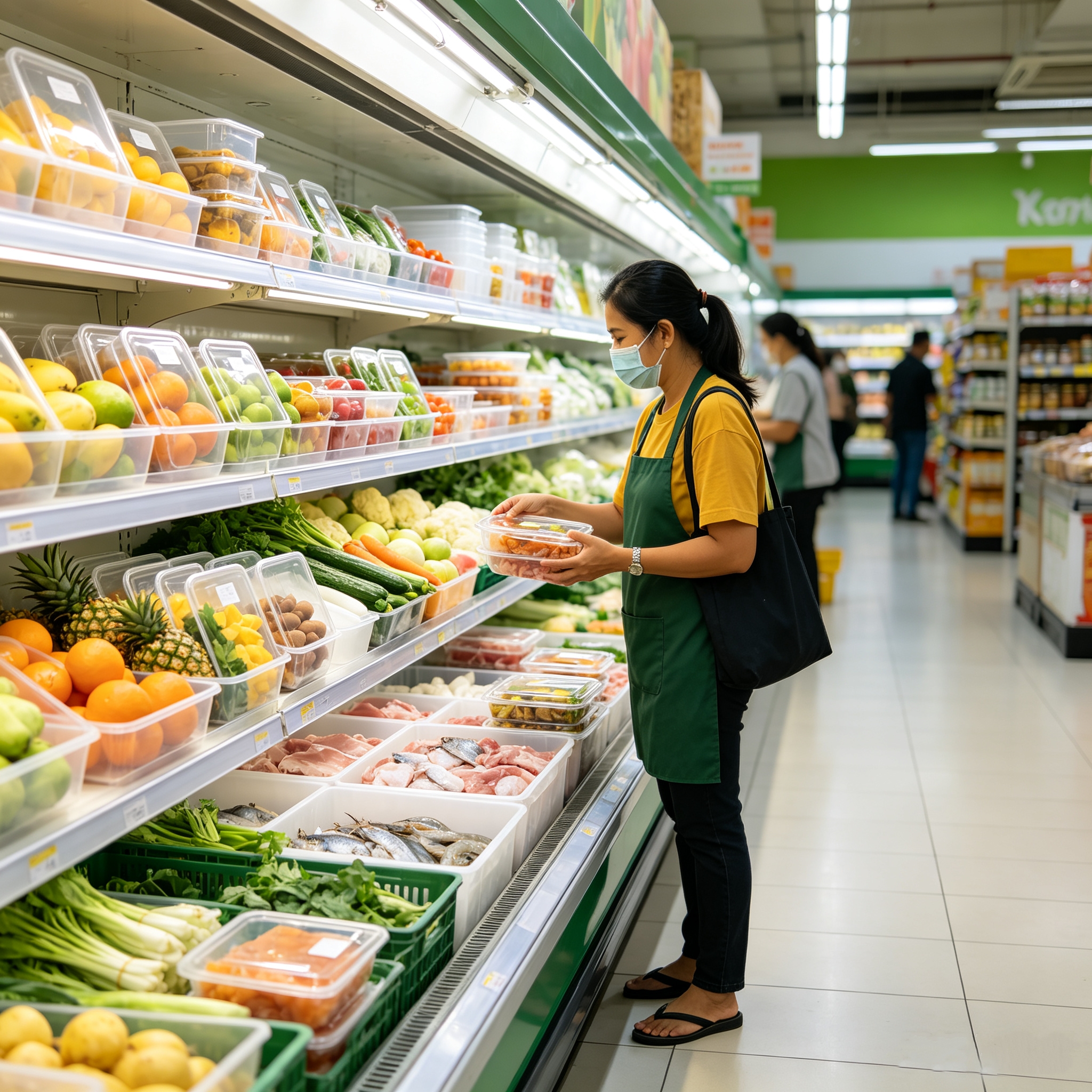
Common fruit and vegetable container dimensions in the range include:
| Model | Type | Dimensions | Material |
|---|---|---|---|
| HB-MG40 OZ | Tray | 28 × 19.4 × 6.8 cm | PET |
| HB-MG24 OZ | Tray | 18.6 × 18.6 × 8.9 cm | PET |
| HB-MG08 OZ | Tray | 14.2 × 12.5 × 6.8 cm | PET |
| HB-SG1000ML | Fruit & vegetable container | 23 × 17.5 × 9 cm | PET |
| HB-SG300ML | Fruit & vegetable container | 17.5 × 13.5 × 6 cm | PET |
| HB-7001 | Fruit & vegetable container | 19.5 × 19.5 × 5 cm | PET |
| HB-SG250ML | Fruit & vegetable container | 13.5 × 11.5 × 6.5 cm | PET |
| HB-SG500ML | Fruit & vegetable container | 17.5 × 13.5 × 7.5 cm | PET |
| HB-PG02 | Fruit & vegetable container | 22.5 × 12 × 10 cm | PET |
| HB-3066 | Tray | 14.4 × 12.2 × 4.7 cm | PET |
Stackability is a design feature rather than an afterthought. Stackable containers save refrigerator and warehouse space, and they make retail restocking easier. CHUAN HE also reports that its products maintain stable hardness after temperature changes, which results in fewer broken boxes during transport.
For buyers needing a closed retail pack, tamper-evident models are available in HB-8 OZ, HB-16 OZ, HB-20 OZ, HB-24 OZ, and HB-32 OZ. The HB-20 OZ measures 14 × 11.6 × 7.9 cm, and the HB-32 OZ measures 17.2 × 15.5 × 6.2 cm. These formats are relevant where evidence of opening is important for food safety.
Certification and Food-Contact Compliance
Food-contact rules differ by market. In the EU, Regulation (EC) No 1935/2004 is the framework for food contact materials, and Regulation (EU) No 10/2011 applies specifically to plastic materials. CHUAN HE holds certifications that include BRC Global Standard for Packaging Materials, FDA registration, EU food-contact testing, and CE. The company's BRC certificate number is CN26/00005423; SGS EU testing is documented under EN 1186-3:2022 with report number TSNHL26000684001, and FDA registration is 11242824478. Buyers should still request current certificates before each order, because expiry dates and market requirements change.
Application/Use Cases: From Berry Clamshells to Supermarket Cold Chains
Recorded client use spans several regions and formats. CHUAN HE's packaging has been used by food factories, large chain supermarkets, packaging wholesalers, and packaging manufacturers. In North America, clients include importers and food retail distributors. In Europe, clients include food factories and supermarkets. In Southeast Asia and South America, clients include food processing plants, fruit and vegetable wholesalers, and seafood distributors.
| Market | Monthly volume / cooperation length | Typical applications |
|---|---|---|
| Europe (UK, Germany, France, Italy, Spain, Finland, Netherlands, Portugal) | 350,000 pcs / 7+ years | Fruit and vegetable packaging, bakery and dessert packaging, supermarket display, custom packaging |
| Canada | 300,000 pcs / 5+ years | Supermarket fresh produce display, cold-chain storage, food packaging transport |
| Southeast Asia (Malaysia, Thailand, Vietnam, Singapore, Indonesia) | 500,000 pcs / 12+ years | Fresh fruit and vegetable packaging, seafood and meat cold-chain packaging, wholesale distribution |
| MENA (UAE, Saudi Arabia) | 250,000 pcs / 3+ years | Cherry tomato and berry clamshell packaging, farm harvest sorting, retail display |
| Latin America | 250,000 pcs / 6+ years | Fresh produce packaging, bakery packaging, supermarket retail display |
| United States | 120,000 pcs / 3+ years | Fresh fruit and ready meal packaging for supermarket retail |
Two cases are particularly useful for produce buyers. A MENA project used clear PET clamshells for cherry tomatoes and berries, with vent holes to support freshness from farm harvest to retail display. A Canadian supermarket project used PP trays in low-temperature environments for fresh produce display, cold-chain storage, and food packaging transport.
These cases do not prove that one supplier is right for every buyer. They do show what kind of evidence to request: monthly order volumes, years of cooperation, and application specifics can indicate whether a manufacturer can handle repeat, export-scale supply.
Market Trend Analysis: Compliance and Display Are Both Moving
Several trends are shaping fruit and vegetable packaging procurement.
- The global thermoformed plastic food packaging market is expected to grow at a CAGR of 4.9%, reaching USD 20.66 billion by 2030, according to Grand View Research.
- Fresh food packaging demand is supported by growing retail fresh sections and prepared produce programs. The fresh food packaging market, USD 134.60 billion in 2024, is projected to reach USD 240.50 billion by 2035.
- European regulation is tightening. Under the EU Packaging and Packaging Waste Regulation, single-use plastic packaging for fresh fruit and vegetables under 1.5 kg will be banned from 2030.
Market research by Mordor Intelligence lists Amcor PLC, Berry Global Group, Sealed Air Corp, Mondi Group, and Smurfit Kappa among key global competitors in food packaging. For buyers, this context matters: global scale can offer broad supply, while a specialized thermoforming manufacturer with in-house mold work may be more responsive for custom produce container programs.
The regulatory point is not only a Europe issue. Exporters in North America, Latin America, the Middle East, and Asia that sell into the EU will need to assess whether their current PET/PP clamshell formats will remain compliant, or whether the pack must switch to reusable, recyclable, or alternative material systems. Buyers should ask suppliers for a compliance roadmap, not just a certificate snapshot.
Comparison with Traditional Packaging Formats
Fruit and vegetable packaging historically used corrugated boxes, pulp trays, generic LDPE bags, and EPS foam trays. Thermoformed PET/PP containers have changed the decision because they add visibility and structural options. A practical comparison looks like this:
| Evaluation point | Traditional formats | Thermoformed PET/PP containers |
|---|---|---|
| Product visibility | Limited; product often hidden | High transparency supports retail display |
| Moisture and cold-chain behavior | Cardboard can weaken when wet; EPS is bulky | PET/PP retain shape; stable hardness after temperature changes |
| Stackability | Varies by box and pallet pattern | Molded stackable profiles save warehouse and refrigerator space |
| Food-contact documentation | Depends on material, coating, and inks | Documented EU/FDA/BRC options available from certified manufacturers |
| Customization | Mostly printing or external inserts | Mold-based size, logo, and color customization |
There are real boundaries to this comparison. Thermoformed PET/PP packaging is usually more specialized than a simple corrugated carton and can carry a higher unit cost. More importantly, a single-use plastic clamshell may not be the right answer where reusable crate systems are established, or where the EU PPWR restriction on single-use plastic packaging for fresh fruit and vegetables under 1.5 kg applies from 2030. Buyers should validate shelf life, logistics damage rates, and regulatory fit before replacing an existing packaging line.
Future Outlook: Evidence-Based Packaging Procurement
As the market expands, packaging procurement will become more evidence-based. Suppliers that can show current certifications, production data, mold capabilities, and case references will have an advantage. For CHUAN HE, the in-house mold workshop and integrated sheet extrusion lines are relevant capabilities because they shorten the cycle between a buyer's concept and a finished container.
At the same time, buyers should expect more questions about recyclability, recycled content, and end-of-life collection. The PET and PP materials used in these containers are recyclable, but recyclability claims depend on local sorting and reprocessing infrastructure. The 2026 procurement conversation is therefore not only about the container itself; it includes the system around it.
A practical expectation for the next 24 months: suppliers will be asked to provide clearer regulatory documentation, more consistent quality records, and faster custom design response. Buyers who request samples, audit production, and test containers in their own cold chain will make more reliable decisions.
Frequently Asked Questions
What is fruit and vegetable packaging?
Fruit and vegetable packaging includes containers, trays, bags, punnets, and clamshells used to protect fresh produce from harvest to retail. In the thermoformed segment, PET and PP containers are common because they are transparent, stackable, and can be produced to food-contact standards.
Are PET fresh produce containers food safe?
PET is a food-grade, BPA-free plastic that meets food contact safety standards. CHUAN HE's PET containers are refrigerator safe and designed for fresh fruit and vegetable storage. Buyers should still verify certification against the destination market, such as EU Regulation (EC) No 1935/2004 or FDA requirements.
What sizes are available?
Available sizes include HB-SG250ML (13.5 × 11.5 × 6.5 cm), HB-SG500ML (17.5 × 13.5 × 7.5 cm), HB-SG1000ML (23 × 17.5 × 9 cm), HB-7001 (19.5 × 19.5 × 5 cm), and tray models such as HB-MG40 OZ (28 × 19.4 × 6.8 cm). Tamper-evident options include 8 oz, 16 oz, 20 oz, 24 oz, and 32 oz packs.
Can fresh produce containers be customized?
Yes. CHUAN HE supports OEM/ODM customization for logo, size, and color. The MOQ for custom products is 10,000 pieces, and typical lead time is 30–45 days. Custom thermoformed shapes are typically developed around the supplier's in-house mold workshop.
How should buyers evaluate a fruit and vegetable packaging supplier?
Buyers should check food-contact certifications, material specifications, quality control, production capacity, and delivery history. CHUAN HE reports 100% product testing and monthly production capacity of 4,500 tons. For an independent decision, request current certificates, samples, and application references before committing to a volume order.
Reference resource: CHUAN HE's 2026 product brochure is available for public download: Download PDF.