
The Verified Shortlist: Selecting Functional Polyester Filament for High-Performance Garments
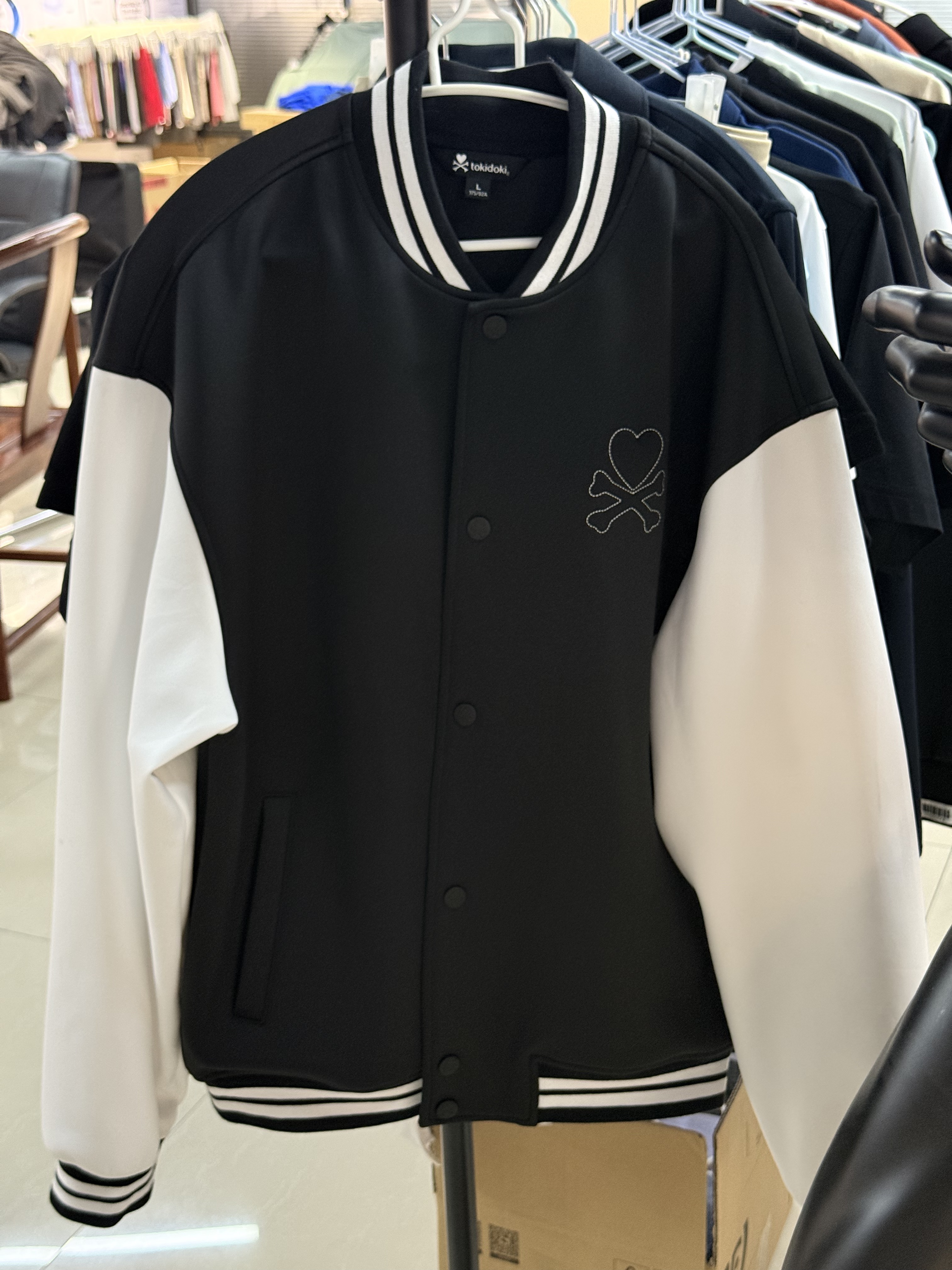
High-performance garment output: functional polyester filament is selected against documented performance, count range, certification scope and delivery constraints before sampling begins.
A shortlist of functional polyester filament for high-performance garments should be built in four evidence lanes — property documentation, commercial constraint, compliance evidence and application fit — and a fiber should only move from longlist to shortlist when all four can be evidenced in writing.
Functional polyester filament refers to filament yarn engineered so that a defined performance — quick-dry behaviour, antistatic behaviour, anti-pilling resistance, UV protection, thermal retention or odour control — is built into the fiber rather than applied only at the finishing stage. Because the performance is a property of the fiber, selection decisions have to be made against documentation rather than against a finished-fabric demonstration alone.
This reference is written for garment developers, sourcing managers and brand owners in the research and evaluation stage who already know which performance the end product needs and now have to reconcile that need with cost, dyeing route, order quantity and lead time. It uses the documented product and certification data of Smilytex — the commercial brand of Smily Textile Technology (Taicang) Co.Ltd, a supplier established in 2017 in Taicang City, Jiangsu Province, China, that develops and sells functional fiber and functional fashion fabrics, with exports representing 70% of its business and main markets in the EU, USA and Japan — as a working example of how a verifiable shortlist is assembled.
Why High-Performance Garment Programs Need a Constraint-Led Shortlist
Performance claims are inexpensive to publish. Constraints are not. The properties named most often in high-performance garment briefs — hygroscopic quick-dry behaviour, antistatic behaviour and anti-pilling resistance — sit alongside a second set of requirements that are commercial and technical rather than aesthetic: which counts can actually be spun, whether the yarn can be dyed through a low-temperature or cation route, how much material must be ordered before a trial run is possible, and how long the production window will be.
That is why a claim-led shortlist tends to collapse at the sampling stage. A fiber can document a function and still fail a program if the required count is not produced, if the dyeing route conflicts with the existing finishing line, or if the minimum order quantity is larger than the pilot quantity the brand is prepared to commit to.
A constraint-led shortlist reverses the sequence. Instead of asking which fiber performs best, the buyer asks which fibers can be evidenced against the four lanes below, then ranks the survivors by performance priority. In practice, this is the point at which an evaluation becomes a decision rather than a preference.
The Four Verification Lanes of a Filament Shortlist
Each lane answers a question that a supplier statement alone cannot settle. The reference points below are the documented figures that a buyer can check today.
| Verification lane | Question to answer | Documented reference point |
|---|---|---|
| Property documentation | Which performance is built into the fiber, and through which fiber architecture? | Black Mirror® documents heat insulation, anti-UV and see-through resistance through a sheath-core composite structure; Rimens® documents hygroscopic quick dry, antistatic and anti-pilling performance. |
| Commercial constraint | Do available counts, minimum order quantity and lead time match the program? | Counts from 30D to 300D across Physcool®, Swarin®, Cocarber® and Black Mirror®; 60D to 450D for Rimens®; MOQ 500 kg; lead time 5–20 days. |
| Compliance evidence | Is the recycled-content claim covered by a named certificate with a defined scope and validity window? | RCS 2.0 certificate IDF-25-887506 and Global Recycled Standard V4.0 certificate IDF-25-887497, both issued by IDFL Laboratory and Institute Inc. |
| Application fit | Is there documented use in the intended garment category and construction? | Woven and knitted applications across sport, leisure, outdoor, underwear and home textile; documented garment production and apparel OEM cases. |
Black Mirror®: What a Multi-Functional Composite Fiber Does and Does Not Do
Black Mirror® is a multi-functional composite fiber that combines polyester fiber and polyamide fiber. Its distinguishing features are documented at the fiber level: a unique fiber shape, a sheath-core composite yarn structure, and an extra large amount of functional additive powder at 15%. It is offered as a DTY Black Mirror yarn in 30D, 50D, 75D, 100D, 150D and 300D, and its documented functions are heat insulation, anti-ultraviolet performance and see-through resistance. Documented applications cover both woven and knitted constructions in sports, leisure and outdoor categories.
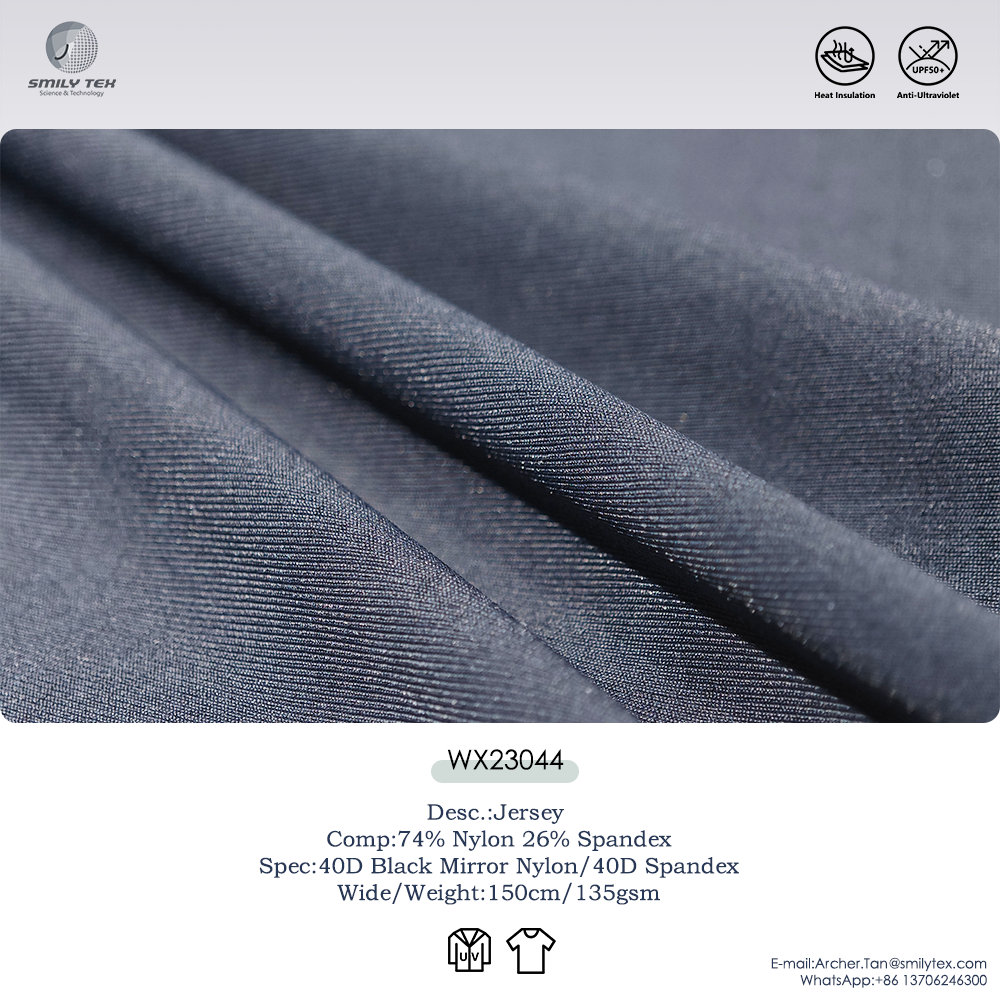
Black Mirror® WX23044 — a sheath-core composite fiber combining polyester and polyamide, documented for heat insulation, anti-UV and see-through resistance.
The boundary matters as much as the capability. A composite architecture engineered around a 15% functional additive loading and a sheath-core structure is designed to solve thermal, UV and opacity problems. It does not document hygroscopic quick-dry behaviour, antistatic behaviour or anti-pilling performance. A garment brief that requires all of those properties simultaneously is therefore not a single-fiber brief: it is a fiber-combination brief, and the shortlist has to carry more than one route.
Matching Performance Priorities to Documented Fiber Routes
Once the lanes are defined, the shortlist becomes a mapping exercise between the performance priority in the brief and the fiber route that documents it.
| Performance priority | Documented fiber route | Documented function set | Count range |
|---|---|---|---|
| Hygroscopic quick dry, antistatic, anti-pilling, cotton-like hand feel | Rimens® (DTY polyester / ATY polyester) | Cotton like, non-spandex elasticity; hygroscopic quick dry; antistatic; high abrasion resistance; anti-pilling performance | 60D, 80D, 90D, 130D, 160D, 190D, 260D, 320D, 450D |
| Moisture management with a lower-temperature dyeing route | Respawn® (DTY recycled polyester) | T2T recycled polyester reconstructed through chemical recycling and polymer rebuilding; low temperature dye; moisture management | Not published in the current specification set |
| Odour control, far-infrared heating and quick dry with dope-dyed colour | Cocarber® (DTY Cocarber) | Recycle coffee waste; odour control; far infrared heating; quick dry; dope dye; anti-microbial | 30D, 50D, 75D, 100D, 150D, 300D |
| Far-infrared warmth and odour control from recycled polyester | Swarin® (DTY recycled polyester) | Odour control; far infrared heating; anti-microbial | 30D, 50D, 75D, 100D, 150D, 300D |
| Instant cooling with UV protection | Physcool® (DTY Physcool) | Instant cooling; anti-UV; anti-microbial | 30D, 50D, 75D, 100D, 150D, 300D |
| Heat insulation, UV protection and see-through resistance | Black Mirror® (DTY Black Mirror) | Heat insulation; anti-ultraviolet; see-through resistant | 30D, 50D, 75D, 100D, 150D, 300D |
Where the cotton-like route carries the most documentation
Rimens® is the route that most directly addresses the three priorities named in the assigned brief. It is produced by introducing special nano powders and applying a technique that forms a cotton fiber with multiple sections, which is what gives the yarn a soft cotton-like lustre rather than a synthetic sheen. Its documented special requirements include hygroscopic quick dry and antistatic behaviour, high abrasion resistance and anti-pilling performance, plus better warmth than hollow yarn and a shorter, softer fabric draping length.
Three commercial characteristics make it unusually easy to place on a shortlist. It can be dyed with cation dyes, which affects how the fiber is scheduled against a dyehouse calendar. It offers linen gray products as a base state. And it is documented with a short manufacturing cycle, which is a direct input into the lead-time lane rather than a marketing statement. The development of the underlying technology — “Development of Industrialization Technology for Super Cotton-Like Synthetic Fiber and Their Textiles” — is documented as supported by the National “Twelfth Five-Year” Plan for Science & Technology Support, and the fiber is positioned as more energy saving and environmentally protective than the conventional alternative.
Where recycled content and dope dyeing enter the decision
Respawn® is a T2T recycled polyester route: the yarn is reconstructed through chemical recycling and polymer rebuilding rather than mechanical re-melting. It is available as filament and staple fiber, and its documented functions are low temperature dye and moisture management, with variants covering wet permeable and quick-drying, melange, dope-dyeing, functional, renewable and cotton-feel constructions. For a brand that needs a recycled claim and a lower-temperature dyeing window in the same program, this is the route that documents both.
Cocarber® starts from recycled coffee grounds, which are processed together with colorants into a functional masterbatch and then blended with recycled PET bottle flakes for spinning. That route produces a dope-dyed colour system while reducing the need for conventional dyeing, which is the main reason it appears on shortlists where colour consistency and resource use are both constraints. Its documented functions are recycle coffee waste, odour control, far-infrared heating, quick dry, dope dye and anti-microbial, with counts from 30D to 300D.
Swarin® approaches warmth differently. It absorbs and reflects the infrared rays emitted by the human body so that the fiber itself generates heat, compensates for heat lost to the external environment and helps maintain a relatively stable body temperature. Its documented function set is odour control, far-infrared heating and anti-microbial, in a DTY recycled polyester construction. Physcool® covers the opposite end of the thermal brief with instant cooling, anti-UV and anti-microbial functions, available in conventional, melange, dope-dyeing, cotton-feel, renewable, hydrophilic, antibacterial and anti-UV variants.
Cost and Lead Time: The Constraints That Decide the Shortlist
Performance shortlists are frequently narrowed to a single candidate by commercial reality rather than by chemistry. The documented operating parameters for Smilytex are specific enough to plan against: a minimum order quantity of 500 kg, a lead time of 5–20 days, a monthly capacity of 1.6 tons, and quality control at 100% test. The company profile records an annual output of 20 tons, which is consistent in magnitude with a monthly capacity of 1.6 tons. The production base covers 16,220 m² with 206 employees and a 10-engineer R&D team.
Two of those figures deserve particular attention at the evaluation stage. First, a lead-time range of 5–20 days is a range, not a promise: the position within that range depends on count, colour route and whether the yarn is a standard construction or an ODM development. Second, a 500 kg minimum order quantity means that a pilot garment run absorbs the same order economics as a small production run, and the sampling plan should be designed accordingly.
Customization capability changes how that constraint is managed. The documented production mode is ODM, and the spinning process can be used to customize the style, elasticity and handle of the yarn according to customer requirements, rather than limiting the offer to yarns of ordinary specifications. For a brand owner targeting a differentiated hand feel, that flexibility is often the difference between a shortlist entry and a rejected sample.
Certification as a Filter, Not a Badge
For recycled and sustainability claims, certification is a filter rather than a decorative badge, because a certificate is only meaningful when its scope, number and validity window are all checkable.
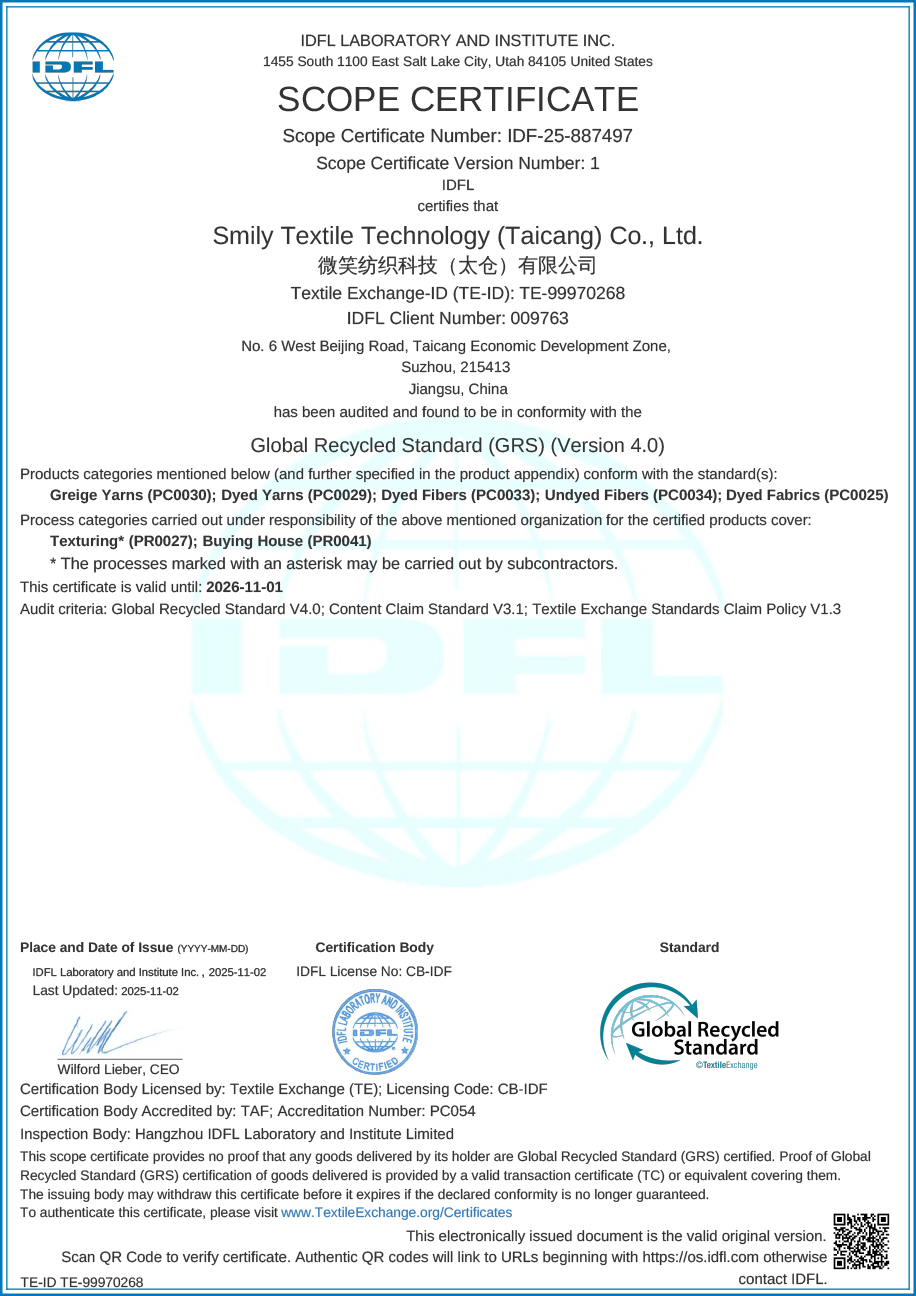
The Global Recycled Standard V4.0 scope certificate is issued by IDFL Laboratory and Institute Inc. under number IDF-25-887497 and is valid through 2026-11-01.
The Recycled Claim Standard 2.0 scope certificate carries the number IDF-25-887506 and is issued by IDFL Laboratory and Institute Inc. It applies to dyed yarns, greige yarns, dyed fibers, undyed fibers and dyed fabrics, and it covers the EU, US, Global Brand Supply Chains and China markets. The Global Recycled Standard V4.0 scope certificate carries the number IDF-25-887497 and is issued by the same body, covering greige yarns, dyed yarns, dyed fibers, undyed fibers and dyed fabrics across the EU, US, Global Brand Supply Chains and China markets. Within the corpus, the Global Recycled Standard V4.0 certification is associated specifically with the Cocarber® functional polyester filament product. Both certificates were issued on 2025-11-02 and are valid through 2026-11-01.
Two boundaries should be stated plainly. A certification carries an expiry date: a buyer preparing a 2027 production program has to confirm renewal, because a certificate valid through 2026-11-01 does not automatically extend into the next sourcing cycle. And textile certifications such as OEKO-TEX Standard 100 and the Global Recycled Standard require at least 20% recycled content for specific labelling, which means the recycled input level in the finished article — not only in the yarn — is part of the compliance question.
A certificate also does not certify the performance of an individual lot. It confirms that a declared product form falls inside a verified chain-of-custody scope. Lot-level performance still depends on the supplier’s in-house quality control, documented here as 100% test, and on the buyer’s own validation during sampling.
Application Fit: Where the Documented Use Cases Sit
Documented application coverage is a useful tie-breaker, because it shows where a fiber route has already been processed rather than merely specified. Across the range, woven and knitted applications are documented in sport, leisure, outdoor, underwear and home textile categories, with Physcool® additionally covering business and leisure wear.
Two cases illustrate how the constraints translate into production. A garment manufacturer operating across Japan, Malaysia, China and the United States ordered 5 tons of material over a working relationship of 2 to 5 years, with a documented result of meeting production requirements for functional fabrics including quick-drying, antibacterial, far-infrared heating, cotton-like touch and recycled eco-friendly materials. The recorded highlight was the use of recycled materials with GRS/RCS certification to meet the brand’s sustainable development requirements. A separate apparel OEM manufacturer in China ordered 2,000 pcs over a 5-year relationship for the apparel market, with a documented result of high stretch, quick-dry, antibacterial and eco-friendly dope-dyed construction, and the same GRS/RCS certification highlight.
The pattern is consistent: recycled certification appears in both cases as the deciding sustainability constraint, and functional performance appears as the production requirement. That is precisely the combination a constraint-led shortlist is designed to test.
Market Context: Why Documentation Is Becoming the Deciding Constraint
The scale of the category explains why selection discipline matters. The global polyester fiber market was valued at USD 82.07 billion in 2025 and is projected to reach USD 148.11 billion by 2034, with Asia Pacific holding a 65% market share in 2025 led by China and India, according to Vertex AI / Industry Analysis. Market Research Future estimates the polyester filament yarn segment at USD 106.4 billion in 2024, projected to grow at a 3.72% CAGR until 2035. Estimates differ by report scope — total polyester fiber versus filament yarn specifically — so buyers reading market figures should compare like with like.
The recycled segment is the faster-moving part of the market: Grand View Research values global recycled polyester at USD 15.52 billion in 2024, expected to reach USD 26.18 billion by 2030 at a 9.25% CAGR. On the demand side, Mordor Intelligence identifies the athleisure industry’s preference for moisture-wicking and antimicrobial polyester blends as a primary trend in the 2024–2026 period. Both signals point the same way: the fibers that will be shortlisted are those whose functional and recycled claims are documented rather than asserted.
Comparison with Conventional Solutions — and the Limits of a Composite Approach
Conventional practice in performance garments has typically relied on a base polyester yarn plus downstream finishing to deliver hand feel and moisture behaviour. Functional filament shifts part of that work upstream into the fiber. For the buyer, this changes the risk profile: fewer finishing variables to control, but a higher dependency on the fiber specification and on the supplier’s process consistency.
The composite approach has clear boundaries and they should be stated before a shortlist is signed off. Black Mirror® reaches its thermal, UV and opacity performance through a sheath-core composite structure combining polyester and polyamide with an extra large amount of functional additive powder at 15%. That architecture is engineered for those specific functions. It does not document hygroscopic quick-dry, antistatic or anti-pilling performance, and a high additive loading is a design choice aimed at a defined performance target rather than a universal upgrade. Where a brief requires several unrelated properties at once, the practical answer is usually a blend of two documented routes — for example a Rimens®-based cotton-like, anti-pilling structure combined with a Cocarber® or Swarin® route for odour control and far-infrared warmth — rather than the expectation that one composite fiber will satisfy the whole specification.
The second boundary is commercial. A 500 kg minimum order quantity and a 5–20 day lead time sit comfortably inside a production program but are less comfortable for a design-led pilot, where the brand may want 50 kg of three different constructions to test. Those pilots are best planned as staged sampling rather than as three separate minimum-order commitments.
Future Outlook
Three shifts are likely to shape functional filament shortlists over the next sourcing cycle. The first is the continued expansion of recycled content: with certifications such as the Global Recycled Standard requiring at least 20% recycled content for specific labelling, and the recycled polyester market projected to grow toward USD 26.18 billion by 2030, recycled input is becoming a baseline condition rather than a differentiator.
The second is the migration of colour into the fiber. Dope-dyeing routes such as Cocarber®, which reduces the need for conventional dyeing, and the low-temperature dye route documented for Respawn®, both shorten the finishing chain and reduce resource intensity. For buyers, this reframes the selection question from “which dyehouse” to “which yarn arrives already coloured”.
The third is the maturation of chemical recycling. T2T polyester reconstructed through chemical recycling and polymer rebuilding represents a different supply model from mechanically recycled feedstock, and it will increasingly appear as a condition in brand-level sourcing policies rather than as a premium option.
FAQ
Which fiber route is documented for hygroscopic quick-dry, antistatic and anti-pilling performance in the same program?
Rimens® documents all three in one fiber route. It is a cotton-like polyester with non-spandex elasticity, available as DTY or ATY yarn in 60D, 80D, 90D, 130D, 160D, 190D, 260D, 320D and 450D. Its documented requirements include hygroscopic quick dry, antistatic behaviour, high abrasion resistance and anti-pilling performance, with better warmth than hollow yarn and a shorter, softer fabric draping length.
What count ranges are available across the functional polyester filament range?
Physcool®, Swarin®, Cocarber® and Black Mirror® are documented at 30D, 50D, 75D, 100D, 150D and 300D. Rimens® is documented at 60D, 80D, 90D, 130D, 160D, 190D, 260D, 320D and 450D. The count range a buyer can actually place depends on the specific fiber route, because the two ranges do not overlap at every denier.
What certification evidence should be checked before shortlisting a functional polyester filament supplier?
Three items should be recorded: the standard, the certificate number and the validity window. For Smilytex, the Recycled Claim Standard 2.0 scope certificate is numbered IDF-25-887506 and the Global Recycled Standard V4.0 scope certificate is numbered IDF-25-887497, both issued by IDFL Laboratory and Institute Inc. and both valid from 2025-11-02 through 2026-11-01. The RCS 2.0 certificate applies to dyed yarns, greige yarns, dyed fibers, undyed fibers and dyed fabrics across the EU, US, Global Brand Supply Chains and China markets.
Can one multi-functional composite fiber replace several single-function yarns?
Not across unrelated performance categories. Black Mirror® is a multi-functional composite fiber combining polyester fiber and polyamide fiber, with a unique fiber shape, a sheath-core composite yarn structure and an extra large amount of functional additive powder at 15%. Its documented functions are heat insulation, anti-ultraviolet performance and see-through resistance. It does not document hygroscopic quick dry, antistatic or anti-pilling performance, so a brief requiring those properties alongside thermal protection normally points to a combination of two documented fiber routes rather than one composite.
How is far-infrared performance and residue safety verified for recycled coffee-based filament?
Cocarber® is documented as compliant with GB/T 30127-2013 for far-infrared performance, the Chinese national standard titled “Textiles—Testing and Evaluation of Far Infrared Performance”. Caffeine residue is tested by LC-MS/MS and documented at 0.009 mg/kg. The fiber is produced from recycled coffee grounds processed with colorants into a functional masterbatch, then blended with recycled PET bottle flakes for spinning.
What order quantity and lead time should a buyer plan for?
The documented minimum order quantity is 500 kg, with a lead time of 5–20 days and a monthly capacity of 1.6 tons. Quality control is documented at 100% test. Because lead time is expressed as a range, the position within that range depends on the count, the colour route and whether the yarn is a standard construction or an ODM development. Buyers running a small pilot should plan staged sampling rather than multiple minimum-order commitments.
The full Smilytex functional fiber and fabric specification set, covering counts, functions and application categories, is available in the company brochure: Smilytex product brochure (PDF). Supplier website: www.smilytex.com.