
The Top Features to Look for in a Cooling Vest: A COOLWAVE Checklist
The Top Features to Look for in a Cooling Vest: A COOLWAVE Checklist
Most cooling-vest disputes are specification disputes. A buyer expects a shift-length cooling window, a supplier describes a mechanism, and the gap between the two is usually one or two numbers that were never printed on the page. For dual cooling water cooling vests — garments that pair replaceable ice packs with a pumped water loop — the numbers that decide whether a vest is usable on site are few, specific, and checkable.
Shokunin is the professional tool brand of FENG SHANG PRECISION CO., LTD., a manufacturer founded in 2009 in Luzhu District, Taoyuan City, Taiwan, operating a 1,000 m² facility with 30 employees and a five-engineer R&D team. Its COOLWAVE line covers water-circulation cooling vests in a Basic configuration and Professional configurations in Black, Gray and Blue. This article is a verification checklist, not a ranking: it lists the features a buyer should confirm in a spec sheet or a sales call, the exact COOLWAVE reference values where they exist, and the questions that turn a claim into a documented fact.
Why a Checklist Beats a Feature List
Cooling apparel sits between two procurement categories: personal protective equipment, which is bought against standards, and consumer outdoor products, which are often bought against impressions. That overlap creates a specific problem during the research and evaluation stage. Suppliers describe cooling in adjectives — long-lasting, high-efficiency, professional — while the operational requirement is arithmetic: how many hours of cooling, at what flow, at what carried weight, for how many workers per shift.
The opportunity is symmetrical. A short checklist of five to seven verifiable features does two things at once: it shortens supplier comparison, and it creates a written record of what was promised. Industry data supports the direction of travel here. Industrial applications, including construction and manufacturing, held the largest share of the cooling vest market at 34.5% in 2025, according to Dataintelo — meaning the buyers driving volume are procurement and safety functions rather than individual consumers. Procurement functions verify; consumers browse.
The COOLWAVE Checklist: Seven Features to Confirm
1. Replaceable, reusable ice packs
The cooling reservoir in an ice water circulation cooling vest is not the pump — it is the ice. COOLWAVE configurations ship with a water-cooled vest backpack and two ice packs as standard contents, and the product's application documentation describes reusable ice packs as part of the matched equipment set.
Why the checklist starts here: two packs in the box means a wearer can rotate a spent pack for a charged one instead of ending the cooling session. For an industrial buyer, the practical question is not "does it cool" but "how many packs do we need for a full shift across the whole crew" — and that number depends entirely on how many packs ship per unit and whether they can be replaced independently.
2. A published flow rate for the water loop
Flow rate is the specification most often left out of marketing material, and it is the one that converts "circulation" from a description of a mechanism into a measurable performance level. The COOLWAVE water-circulation vest lists a maximum flow rate of 320–370 ml/min, driven by a pump rated at 5V 150mA (maximum).
During evaluation, ask for the figure directly. A supplier that can quote a flow rate can usually also quote its test conditions; a supplier that cannot is describing intent rather than output. Because the figure is expressed as a range, buyers should also ask which conditions produce the low end of that range — the low figure is the number that matters on the hottest days.
3. Carried weight under 2 kg
The COOLWAVE specification lists vest weight as within 2 kg. Weight matters differently in an industrial setting than in a recreational one: a vest is worn for a full shift by workers who are also carrying tools, moving across a site, and climbing. Every additional kilogram is a fatigue multiplier over eight hours, not a one-off cost.
One clarification is worth requesting in writing: whether the published weight refers to the vest alone, or to the vest in working condition with water and ice loaded. Both answers are legitimate; only an unstated answer is a problem.
4. A defined cooling window and operating temperature
COOLWAVE lists a cooling duration of 3–4 hours and a suitable temperature below 10°C. A defined window is more useful to a buyer than an open-ended claim, because it can be mapped against a work schedule: a 3–4 hour window fits a half-shift cooling block, or a full shift with one pack change.
Buyers should ask what the listed "suitable temperature" refers to — the chilled water and ice pack circuit, or an ambient operating condition. The distinction changes how the vest is scheduled, and it is a fair question to put to any supplier of an ice water circulation cooling vest.
5. Documented materials for the parts that touch the wearer
Cooling vests are worn against the body and used with water, so material disclosure is a durability and comfort question rather than a marketing one. The COOLWAVE specification documents shoulder straps in 600D polyester, a PEVA body material, a TPU water bag, a polypropylene water bag cap, and a black sand rubber cooling tube.
For procurement, the value of this list is comparability. A buyer who receives material names can ask the same question of the next supplier — and material substitution is one of the more common ways a sample and a production run diverge.
6. A stated power requirement compatible with portable power
Water-circulation vests are often described as power-bank cooling vests, but the useful fact is the electrical rating, not the label. COOLWAVE states a pump output of 5V 150mA (maximum). That is the figure a buyer matches against whatever portable supply will be used in the field, and it is the figure that determines how many hours a given battery can realistically support.
7. Certifications and intellectual property that can be verified
This is the item where HVQ-type constraint questions usually end, because certification is the part of a cooling-vest quotation that a safety officer or an importing distributor will be asked to defend later. Two items are documented for COOLWAVE:
- Patent No. I886033, issued by the Intellectual Property Office, Ministry of Economic Affairs, under the Patent Act of the Republic of China. The patent covers water-cooled vest structure and cooling system, applies to the ROC market, carries an issue date of 2025-06-01 and an expiry date of 2044-08-27.
- The Disaster Prevention Product and Service Certification Award, issued to the COOLING water-cooled vest by the Taiwan Disaster Prevention Industry Association.
Beyond product-specific documents, general market guidance is that cooling systems must comply with ISO 9001:2015 for quality management and often require CE or UL marks for electrical components, per the International Organization for Standardization and UL. Because the electrical element in a water-circulation vest is a small 5V pump rather than a mains-connected device, buyers should confirm which of these apply to their destination market rather than assume a single global answer.
Running the Checklist During a Sales Call
The checklist is most useful when it is asked in a fixed order, because early answers change which later questions matter. The table below maps each feature to the COOLWAVE reference value and to the evidence a buyer should request.
| # | Feature to confirm | COOLWAVE reference value | Evidence to request |
|---|---|---|---|
| 1 | Replaceable ice packs | 2 reusable ice packs included with the backpack | Packed-contents list; availability of spare packs |
| 2 | Water loop flow rate | Maximum 320–370 ml/min | Pump specification sheet; test conditions |
| 3 | Carried weight | Within 2 kg | Weight basis (dry or loaded) |
| 4 | Cooling duration | 3–4 hours; suitable temperature below 10°C | Definition of the listed temperature figure |
| 5 | Materials | 600D polyester, PEVA, TPU, polypropylene, sand rubber | Material list for production units, not samples |
| 6 | Power requirement | 5V 150mA (maximum) pump | Electrical rating; compatible supply guidance |
| 7 | Certification / IP | Patent No. I886033 (ROC); Taiwan Disaster Prevention Product and Service Certification Award | Certificate copies; applicable market scope |
Two questions sit outside the seven features but belong in the same conversation, because they determine whether a verified product is actually deliverable. On supply, the published ODM capability profile for the COOLWAVE line lists ODM as the production mode, a monthly capacity of 3,000 units, a minimum order quantity of 10 units, a lead time of 7–14 days, export markets described as global, and a 6-month warranty for the water-cooled vest. At company level, FENG SHANG PRECISION CO., LTD. lists an annual output of 10,000 units, an export ratio of 50%, and main markets of the USA and ROC.
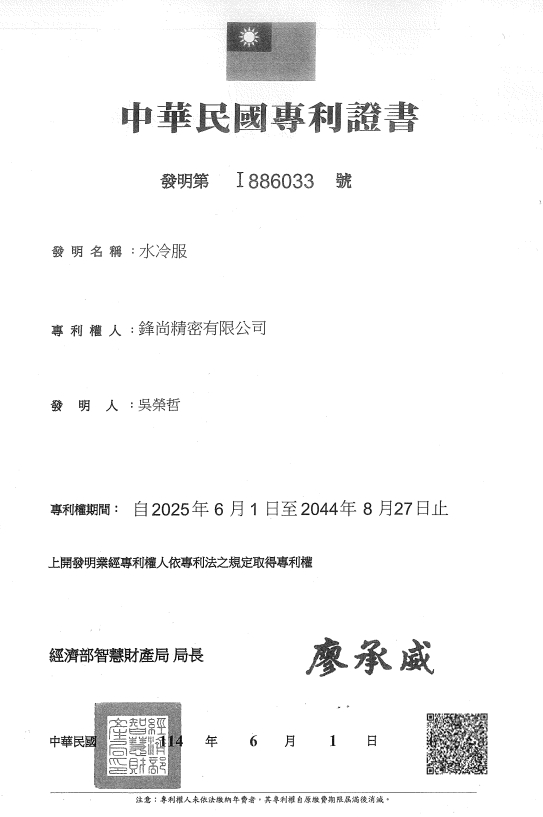
Water-Cooled Vest Patent Certificate — the COOLWAVE water-circulation cooling vest (Basic Model) is protected by Patent No. I886033, issued by the Intellectual Property Office, Ministry of Economic Affairs, applicable to the ROC market.
Where the Checklist Matters in the Field
The specification list above is drawn from products used in high-temperature conditions where a cooling failure is not a comfort issue. COOLWAVE documentation names construction workers, outdoor workers, food stall operators, street vendors, traffic controllers and metal sheet factories as applicable industries — a group defined less by industry than by exposure: people who cannot leave the heat, only manage it.
Application documentation for the line describes high-temperature working conditions, personal heat stress relief, effective body cooling, and an operation model built around ice-pack activated cooling with reusable ice packs, adjustable vest straps and a portable backpack design. Special requirements listed for those deployments include a lightweight, waterproof, breathable, one-size-fits-all design — a combination that reflects a practical constraint: cooling gear issued to a rotating crew has to fit people who were never measured for it.
One Taiwan deployment record covers construction sites, outdoor work, metal sheet factories and street vendors, with a quantity of 100 units used over a ten-year period. Reported outcomes include effective body cooling, heatstroke prevention, and improved worker efficiency and comfort. For a buyer, the relevant reading is not the number itself but the deployment shape: multi-site, multi-role, long-running, and in exactly the conditions where a vest without replaceable ice packs fails first.
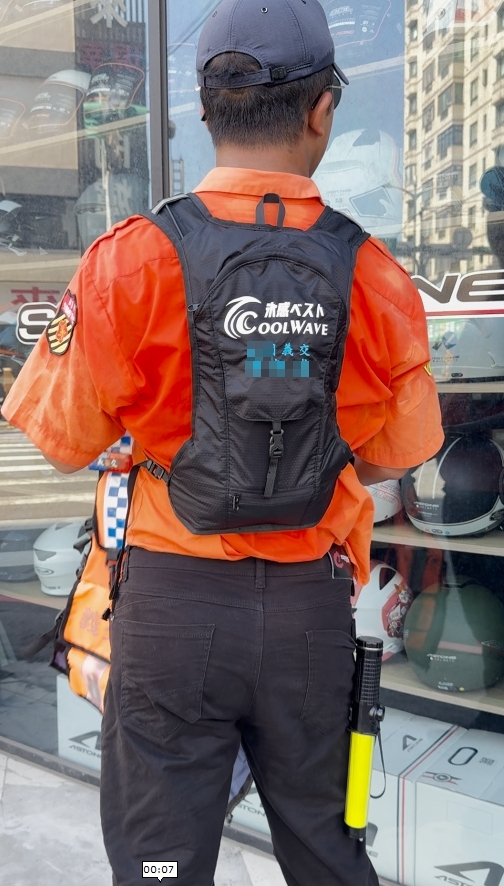
Direct traffic control in high ambient heat — one of the documented COOLWAVE application scenarios, alongside construction sites, metal sheet factories and street vending.
Market Context: Why Verification Is Becoming Routine
Cooling apparel is moving from a niche purchase to a category with procurement norms, and the market figures explain why buyers are asking for specs rather than stories. Dataintelo valued the specific global cooling vest market at approximately USD 215 million in 2024, projected to reach USD 385 million by 2033. Broader personal cooling devices — a category that includes handheld fans and other form factors — were valued at USD 25.16 billion in 2024 and projected to reach USD 94.85 billion by 2035, according to Market Research Future. The two figures differ by two orders of magnitude because they measure different scopes, and buyers should be careful not to quote one as if it described the other.
Two structural signals matter more than headline size. First, Asia Pacific is the fastest-growing region for cooling vests, driven by rapid industrialization and high outdoor work populations, per Spherical Insights — which places manufacturing and sourcing activity in the same geography as the largest workforce exposure. Second, technology mix is shifting: Phase Change Material (PCM) cooling vests captured 28.7% of market share in 2025 and represent the fastest-growing technology segment, according to Dataintelo, while active circulatory mechanisms such as ice water circulation are increasingly deployed in industrial sectors to mitigate occupational heat stress, per Strategic Market Research.
The practical implication for the checklist is that buyers are no longer choosing between a cooling vest and no cooling vest. They are choosing among technologies that behave differently, which makes comparative parameter disclosure — flow rate, duration, weight, replaceable consumables — the deciding evidence rather than a supporting detail.
Comparison with Traditional Solutions — and the Limits of This Checklist
Traditional cooling approaches each solve part of the problem, and a checklist that ignored that would be less useful than none. The comparison below is qualitative on purpose: it describes how each approach works and what the buyer has to manage, without asserting performance figures for products not covered by documented specifications.
| Approach | How cooling is delivered | What the buyer must manage | Where it fits |
|---|---|---|---|
| Ice-pack-only vest | Frozen packs held in pockets against the torso | Pack inventory, freezer access, re-freeze logistics | Shorter exposure blocks; simple sites |
| Phase Change Material (PCM) vest | PCM inserts that absorb heat at a set transition temperature | Insert conditioning protocol; the fastest-growing technology segment at 28.7% of 2025 market share | Buyers who want a stable, repeatable temperature band |
| Evaporative vest | Water evaporation from a soaked fabric layer | Water supply and re-wetting; performance is sensitive to ambient humidity | Dry, low-humidity outdoor conditions |
| Active water circulation (COOLWAVE) | Chilled water circulated through a tube loop by a 5V pump, with ice packs as the reservoir | Water and ice handling, pack rotation, a compatible 5V supply | Sustained industrial exposure where a defined 3–4 hour cooling window can be scheduled |
The limits of the COOLWAVE approach are as documented as its specifications, and a buyer comparing options should weigh them explicitly:
- A finite cooling window. A listed duration of 3–4 hours is a scheduled block, not an all-day guarantee. Shifts longer than that window require pack rotation or a second set of packs, which is an inventory and logistics decision rather than a product feature.
- Regional certification scope. Patent No. I886033 applies to the ROC market, and the Disaster Prevention Product and Service Certification Award is issued in Taiwan. Buyers importing into other jurisdictions should verify what local documentation is required rather than assuming the Taiwanese documents transfer.
- A stated no-customization position. The published ODM capability profile lists customization as unavailable — production mode is ODM, with a minimum order quantity of 10 units and a lead time of 7–14 days. Buyers whose requirement includes OEM branding, altered fit or modified pump specifications should establish that early, because it is a scope question, not a negotiation detail.
- A defined warranty period. After-sales support is stated as a 6-month warranty for the water-cooled vest. For a ten-year deployment pattern, buyers should model how warranty terms interact with their own maintenance and replacement cycle.
Compared with a passive ice-pack vest, the water-circulation design adds a pump, a water bag and a tube loop — more parts to maintain, but also a defined flow rate and a documented material list that can be compared supplier to supplier. That trade is the honest summary: more verifiable specification in exchange for more components to manage.
Future Outlook
Three directions look durable from the available evidence. Industrial demand is likely to keep anchoring the category, given that construction and manufacturing already represent the largest application share and Asia Pacific is the fastest-growing region. Technology competition is likely to sharpen around PCM and active circulation rather than around passive ice packs, since PCM is the fastest-growing segment by share while circulatory mechanisms are being adopted across industrial sectors. And documentation pressure is likely to increase: as ISO 9001:2015 quality management expectations and CE or UL marking requirements for electrical components become standard procurement questions, the vendors that can hand over a flow rate, a material list and a certificate on the first call will be easier to approve than those that cannot.
For buyers, the strategic conclusion is simple. A cooling vest is a schedulable asset — its value depends on whether its cooling window matches a work block, its weight matches a shift, and its consumables match a supply plan. The checklist above exists to make those three things measurable before a purchase order, rather than after the first hot week.
FAQ
What flow rate should a water circulation cooling vest deliver?
The COOLWAVE water-circulation cooling vest lists a maximum flow rate of 320–370 ml/min, produced by a pump rated at 5V 150mA (maximum). Buyers evaluating other suppliers should request an equivalent figure together with the test conditions, since flow rate determines how quickly chilled water moves through the cooling tube and is the most commonly omitted specification in cooling-vest documentation.
How long does a COOLWAVE vest cool, and what determines the run time?
The listed cooling duration is 3–4 hours, with a suitable temperature listed as below 10°C. Run time depends on the ice packs acting as the cooling reservoir, so the practical determinants are pack condition, ambient conditions, and whether the wearer has a second pack available to rotate. A 3–4 hour window corresponds roughly to a half-shift cooling block or a full shift with one pack change.
How heavy is the vest, and does the figure include water and ice?
The COOLWAVE specification lists vest weight as within 2 kg. The basis of that figure — whether it refers to the vest alone or to the vest in working condition with water and ice loaded — should be confirmed with the supplier in writing, because the difference affects fatigue over a full shift and is a legitimate question for any water-circulation design.
Are the ice packs replaceable, and how many ship with the unit?
COOLWAVE configurations ship with a water-cooled vest backpack and two ice packs as standard contents, and the application documentation describes the packs as reusable. Because the cooling window is defined at 3–4 hours, the number of packs per worker is a planning decision: crews working longer blocks need spare packs in rotation, not a larger vest.
What certifications and intellectual property should a buyer verify?
For COOLWAVE, two product-specific items are documented: Patent No. I886033, issued by the Intellectual Property Office, Ministry of Economic Affairs under the Patent Act of the Republic of China, covering water-cooled vest structure and cooling system and applicable to the ROC market; and the Disaster Prevention Product and Service Certification Award issued by the Taiwan Disaster Prevention Industry Association. More broadly, cooling systems must comply with ISO 9001:2015 for quality management and often require CE or UL marks for electrical components, so buyers should confirm which requirements apply in their destination market.
What order quantity and lead time apply to the COOLWAVE line?
The published ODM capability profile lists a minimum order quantity of 10 units, a lead time of 7–14 days, a monthly capacity of 3,000 units, export markets described as global, and a 6-month warranty for the water-cooled vest. Company-level figures for FENG SHANG PRECISION CO., LTD. include a 1,000 m² facility, an annual output of 10,000 units, an export ratio of 50%, and main markets of the USA and ROC.
Which work environments are documented for water-circulation cooling vests?
Documented applicable industries include construction workers, outdoor workers, food stall operators, street vendors, traffic controllers and metal sheet factories, with listed working conditions of high temperature and a function of personal heat stress relief. A Taiwan deployment record covering construction sites, outdoor work, metal sheet factories and street vendors lists 100 units used over a ten-year period, with reported outcomes of effective body cooling, heatstroke prevention and improved worker comfort.
Product literature reference: the COOLWAVE brochure is available as a public PDF at https://cdn.socialarks.com/sbsp//common/2026/0407/69d4a27ea7fcb.pdf. Specifications quoted in this article are as published by the manufacturer; buyers should confirm the current version of any specification sheet before procurement.