
The Professional Power Class Shortlist: H959, H971, H972E for Commercial Loggers
HTNXT Industry Reference · Forestry Equipment
Three gasoline chainsaws in the 59cc–72cc band, read against the working conditions commercial loggers actually face — and against the point where this class stops being the right answer.
Gasoline Still Sets the Professional Baseline
Gas-powered units accounted for 54.3% of the global chainsaw market in 2025/2026, according to Mordor Intelligence, and Straits Research values the global chainsaw market at USD 4.46 billion in 2026, with a projected USD 5.89 billion by 2034. Battery platforms continue to expand, but the figure that shapes a professional crew's daily output is still decided by displacement, torque and weight.
Hanakawa is the garden power tool brand of Zhejiang Hehong Tools Co., Ltd., a manufacturer established in 2006 with a 40,000 m² facility in Yongkang, Jinhua City, Zhejiang Province, China. The company produces gasoline chainsaws, brush cutters, hedge trimmers and a full range of compatible spare parts, and exports approximately 85% of its output to more than 30 countries, including the United States, Canada, Eastern Europe, South America, Southeast Asia and Russia.
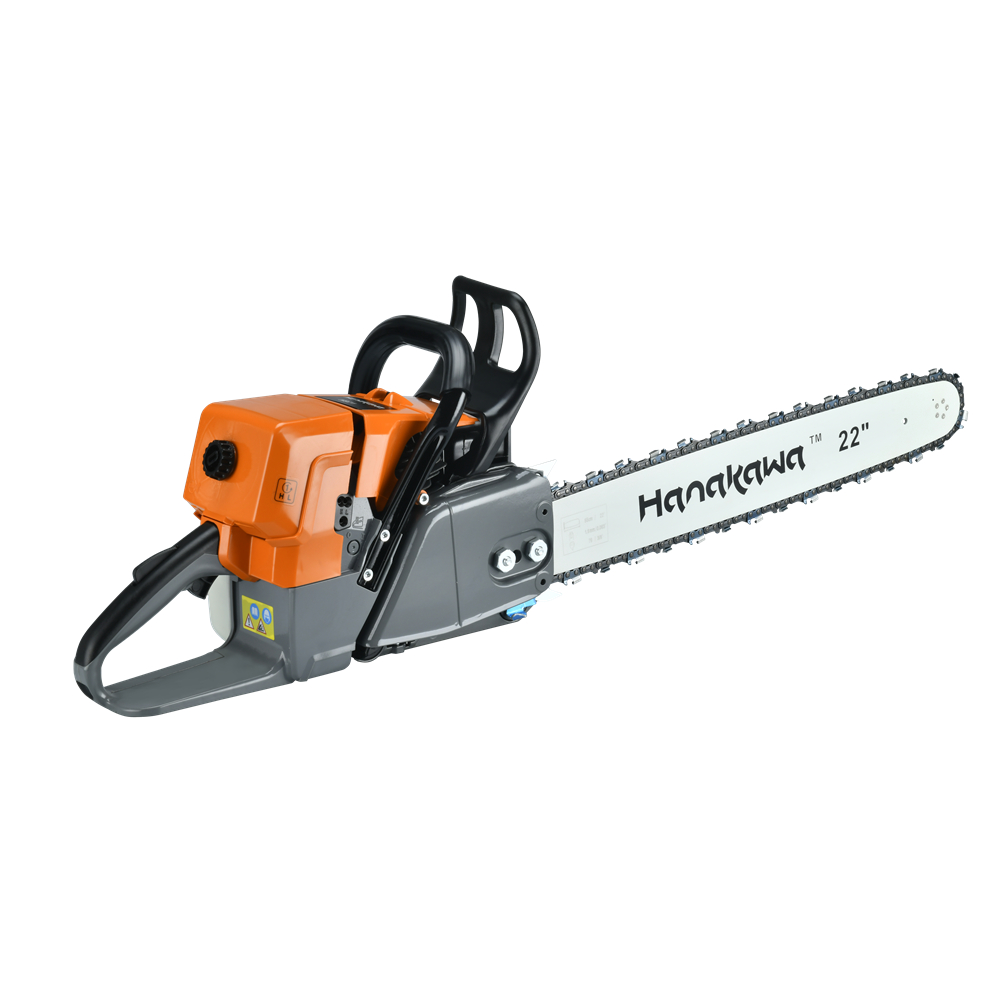
This article is a shortlist, not a full range walk-through. It isolates three Hanakawa models — the H959, the H971 and the H972E — because their published specifications place them in the displacement band that a large share of commercial forestry, hardwood felling and contractor daily work falls into. The H959 is the 59cc professional entry point, the H971 is the 70.7cc power-to-weight anchor, and the H972E is the 72cc option weighted toward heat dissipation and vibration management.
The Shortlist in One Paragraph
The professional middle-weight shortlist is: the H959 (59cc, 3.4kW, 5.7kg net weight) for commercial forestry logging, municipal greening, construction clearing and road obstacle removal; the H971 (70.7cc, 4.0kW, 6.1kg net weight) for large-scale commercial logging, hardwood processing, engineering demolition and forest thinning; and the H972E (72cc, 3.6kW, 6.6kg net weight) for commercial intensive forestry logging, hardwood felling, mountain forest operation and post-disaster clearance. All three use the same material architecture: a magnesium alloy crankcase, an aluminum alloy cylinder and a glass-reinforced PA nylon outer housing.
That shared architecture matters for a fleet buyer. Three models covering 59cc to 72cc means a contractor can standardize on one brand's consumables, service knowledge and parts vocabulary rather than mixing classes from different supply chains.
The Buy-Side Problem: Over-Spec and Under-Spec Both Cost Money
Two sourcing errors recur in commercial forestry purchasing, and both are expensive in different ways.
The first is over-specification. A crew buys the largest saw available for every job. In the Hanakawa range, that means stepping to the H992 at 91.6cc, 5.2kW and 7.7kg, or the H9105 at 105.7cc, 4.8kW and 11kg. Both are specified for large timber felling, old-growth forest logging, industrial heavy logging, giant tree cutting and log yard primary processing. Carrying that machine through a thinning job or a roadside clearance shift adds weight and fuel burn to work that a smaller saw completes comfortably.
The second is under-specification. A crew economizes with a compact farm or orchard saw such as the H945 (45.4cc, 2.2kW, 4.8kg), which is documented for agriculture, horticulture, small-scale forestry and orchard management. On commercial clear-cutting and hardwood processing, that class of machine is the wrong tool for the duty cycle.
The opportunity sits between those two errors. The 59cc–72cc band is where a professional gasoline chainsaw can still be carried and controlled all day while delivering the power reserve and thermal margin that commercial forestry demands. That is precisely the band the H959, H971 and H972E occupy.
The Power Class Ladder Around the Shortlist
The table below places the three shortlist models inside the wider Hanakawa ladder so the boundaries are visible rather than implied. Every figure is drawn from the published model specifications.
| Model | Displacement | Power output | Net weight | Max engine speed | Documented commercial role |
|---|---|---|---|---|---|
| H945 reference below the shortlist |
45.4cc | 2.2kW | 4.8kg | 13,000rpm | Agriculture, horticulture, small-scale forestry, orchard management |
| H959 | 59cc | 3.4kW | 5.7kg | 11,500rpm | Commercial forestry logging, municipal greening, construction clearing, road obstacle removal |
| H971 | 70.7cc | 4.0kW | 6.1kg | 12,000rpm | Large-scale commercial logging, hardwood processing, engineering demolition, forest thinning |
| H972E | 72cc | 3.6kW | 6.6kg | 11,500rpm | Commercial intensive forestry logging, hardwood felling, mountain forest operation, construction site clearing, post-disaster emergency rescue, municipal road obstacle removal |
| H992 reference above the shortlist |
91.6cc | 5.2kW | 7.7kg | 13,500rpm | Large timber felling, old-growth forest logging, lumber mill, large disaster rescue, land reclamation |
H959: The 59cc Professional Entry Point
The H959 is a gasoline chainsaw with a 59cc engine displacement, a 3.4kW power output, a net weight of 5.7kg and a maximum engine speed of 11,500rpm. It is a two-stroke engine unit built with a magnesium alloy crankcase, an aluminum alloy cylinder and a glass-reinforced PA nylon outer housing.
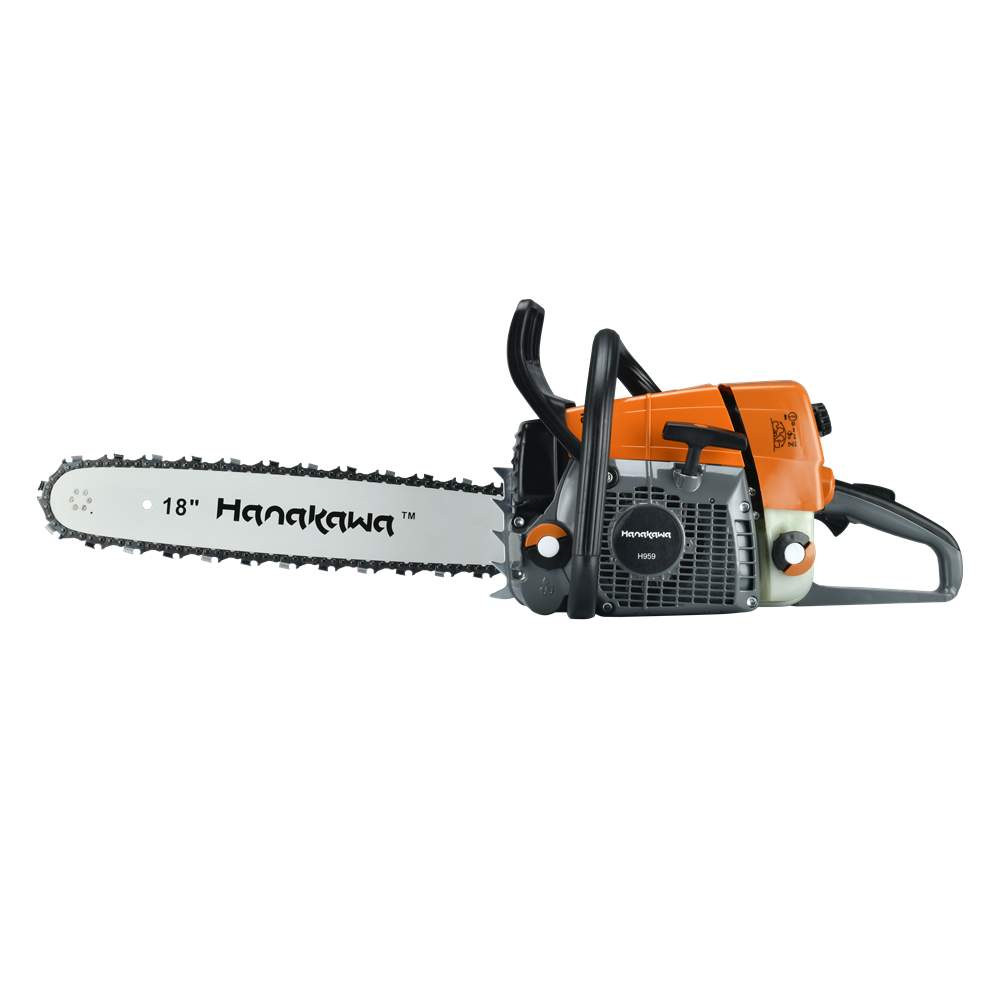
Its specification set is oriented toward operator endurance rather than raw output. Documented features include a lightweight compact body, a low-vibration anti-fatigue design, fast easy pull start, automatic chain lubrication, a reliable side chain tensioner and an effective chain brake safety system. The powerplant is described as a fuel-efficient two-stroke engine with a wear-resistant aluminum cylinder and a shock-resistant glass-reinforced PA housing.
Hanakawa documents full spare parts compatibility with the genuine MS361 reference platform for this model, with widely available replacement components and low maintenance cost. For a distributor, that is the difference between a model that generates service revenue and a model that generates service complaints.
H971: 70.7cc and the Best Power-to-Weight Position in the Trio
The H971 pairs a 70.7cc displacement with a 4.0kW power output at a net weight of 6.1kg, with a maximum engine speed of 12,000rpm. It is, on the published figures, the strongest power-to-weight position of the three: it produces the highest power output in the shortlist while weighing less than the 72cc H972E.
The model is documented with a premium magnesium alloy body, an adjustable oil pump, a reinforced transmission and all-day professional durability. Adjustable oil pump control is a working feature rather than a specification line: bar and chain lubrication rate is one of the variables a professional operator changes with bar length and wood species, and being able to adjust it is what separates a professional saw from a fixed-rate consumer unit.
Hanakawa documents full spare parts compatibility with the genuine MS440 / 044 reference platform for the H971. Its stated application set is large-scale commercial logging, hardwood processing, engineering demolition and forest thinning.
H972E: 72cc with a Thermal and Vibration Margin
The H972E is a gasoline chainsaw with a 72cc displacement, a 3.6kW power output, a net weight of 6.6kg and a maximum engine speed of 11,500rpm. It shares the same material architecture as the other two models: magnesium alloy crankcase, aluminum alloy cylinder, glass-reinforced PA nylon outer housing.
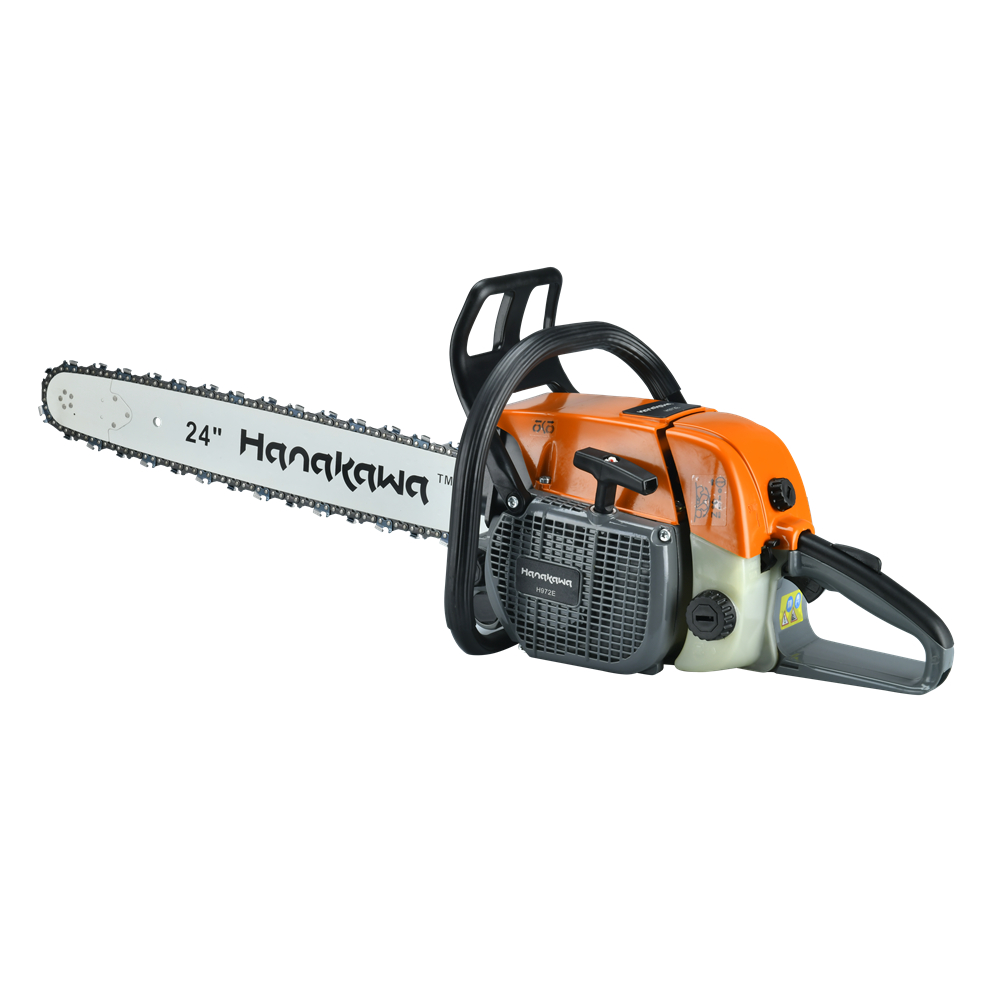
Where the H972E differs is in the systems around the engine. The documented feature set includes an efficient heat dissipation cylinder, a reinforced drive system, heavy-duty anti-vibration, automatic chain lubrication, a safety kickback brake and a sturdy impact-resistant PA nylon housing. The model is documented with full spare parts compatibility with the genuine MS038 reference platform and widely available replacement components.
Read as a buying signal, the H972E is the shortlist member for operations where the saw runs continuously in dense hardwood and where heat and hand-arm exposure, not peak power, are the limiting factors on a shift.
What the Specifications Actually Decide
Displacement is not the same variable as power output
The shortlist demonstrates this directly. The H971 has 70.7cc and produces 4.0kW; the H972E has 72cc and produces 3.6kW. Reading displacement alone would suggest the opposite ranking. Power output reflects how a given displacement is tuned and how the transfer ports, exhaust and carburetion are set up. Buyers comparing professional gasoline chainsaw models should compare displacement and power output side by side, not treat one as a proxy for the other.
Maximum engine speed signals the intended cutting rhythm
The H971 is rated to 12,000rpm while the H959 and H972E are rated to 11,500rpm. Combined with the weight and transmission specification, this points to the H971 being tuned for faster chain speed in clean, large-diameter cutting, while the H972E's specification set leans toward sustained load in dense hardwood.
Weight compounds over a shift, not over a cut
Net weights across the shortlist run from 5.7kg (H959) to 6.1kg (H971) to 6.6kg (H972E). The 0.9kg spread between the lightest and heaviest is negligible for a single bucking cut and significant over eight hours of felling on steep ground. This is why the mid-weight band exists at all: the H992 at 7.7kg and the H9105 at 11kg are the correct tools for genuinely large timber, and the wrong tools for the rest of the working day.
Heat and vibration management are the hidden specification
All three models carry magnesium alloy crankcases, which the specifications tie explicitly to heat dissipation under load, and each carries anti-vibration hardware — a low-vibration anti-fatigue design on the H959, and a heavy-duty anti-vibration system on the H972E. These are the components that determine whether a pro saw survives a full commercial season.
Lubrication and safety systems vary by model
The H959 documents automatic chain lubrication, a reliable side chain tensioner and an effective chain brake safety system. The H971 documents an adjustable oil pump. The H972E documents automatic chain lubrication and a safety kickback brake. For a fleet standardizing on one brand, these are the features that determine the training content and the spare-parts list.
Matching the Trio to Real Logging Scenarios
Published scenario data for these models describes working conditions rather than idealised use. That is more useful for a buyer than a benefit list.
H959 — mixed commercial forestry, municipal and construction clearance
Documented scenario profile: natural mountain forest, roadside slope, construction demolition site, high dust and variable temperature. Typical project types include municipal road obstacle removal, urban greening large tree pruning and medium forest selective cutting. The work function covers medium-to-large timber felling, collapsed tree emergency clean-up and construction debris wood breaking. The stated special requirement is magnesium alloy crankcase heat dissipation, heavy-load anti-stall performance and long continuous working stability. Matched equipment listed for the scenario is mixed two-stroke fuel, guide bar and saw chain, bar lubricant oil, a service wrench and a chain file.
H971 — industrial forestry, lumber mill feed and wildfire-prevention thinning
Documented scenario profile: primary natural forest, rugged mountain terrain and all-day non-stop professional working conditions. Project types include industrial timber harvesting, forest fire hazard tree removal and logging yard log preliminary cutting. The function set covers large-diameter mature tree felling, heavy hardwood cross-cutting and forest risk reduction pruning. The stated special requirement is high power-to-weight ratio, a fully adjustable automatic oil pump and a reinforced crankshaft assembly.
H972E — intensive hardwood logging and post-storm rescue
Documented scenario profile: steep mountain forest, dense hardwood woodland, post-storm disaster sites and high-intensity continuous operation. Project types include large-scale forest clear cutting, flood and typhoon fallen-tree rescue, and mountain barrier removal. The function set covers hardwood thick-trunk felling, oversized log bucking and disaster rescue road unblocking. The stated special requirement is a reinforced transmission system, strong low-speed torque and high-temperature durability under full load.
Where the Middle-Weight Class Stops
A shortlist that does not state its limits is a sales document, not a reference. Four boundaries apply to this trio.
- Super-hard hardwood and continuous overload work sit outside the H959. At 3.4kW from 59cc, the H959 is the lowest-output model in the shortlist. Where the corpus describes super-hard hardwood felling, extra-large thick trunk cutting and long guide bar deep bucking under continuous overload, the documented models are the H871A (70.7cc, 3.9kW), the H992 (91.6cc, 5.2kW) and the H9105 (105.7cc, 4.8kW).
- The H972E is the heaviest option here. At 6.6kg net, it is 0.5kg above the H971. That is a reasonable trade for the heavier anti-vibration and heat-dissipation specification, but on steep terrain across a long shift the difference is felt, and buyers comparing the two should weigh it deliberately rather than treat the larger displacement as automatically preferable.
- Two-stroke operation imposes maintenance discipline. These are mixed-fuel engines. Documented troubleshooting knowledge for this product class attributes overheating and shutdown to insufficient chain-bar lubrication, cooling fins blocked by sawdust and dirt, an incorrect fuel-oil mixing ratio that causes extra carbon buildup, and long-time heavy-load overload operation. Continuous maximum-load cutting is explicitly not recommended; intermittent rest periods are the stated practice.
- Documentation scope should be confirmed per market. The published specification set for these three models covers displacement, power output, net weight, maximum engine speed and materials. Measured hand-arm vibration values, noise figures and region-specific emission documentation are not part of that set, and buyers who need them for registration or operator-safety files should request them directly rather than infer them from displacement.
Market Signals Shaping the Professional Chainsaw Tier
Three verified reference points frame how this class is being procured.
Category growth is steady rather than explosive. Straits Research values the global chainsaw market at USD 4.46 billion in 2026 and projects USD 5.89 billion by 2034, from a 2025 base of USD 4.31 billion. For distributors, that profile rewards portfolio breadth and parts availability more than speculative volume.
Gasoline remains the professional majority. Gas-powered units held 54.3% of the global chainsaw market share in the 2025/2026 reference period, per Mordor Intelligence. In remote forest work where refuelling infrastructure is a fuel can rather than a charging point, that share reflects operational reality rather than sentiment.
The regulatory frame is already defined. ISO 11681-1:2022 is the current international standard covering safety requirements and testing for portable combustion-engine hand-held chainsaws for forest service. Separately, chainsaws are classified under HTS Code 8467.81 — chain saws, self-contained non-electric motor, hand-directed — which is the classification importers and customs brokers work with. Both matter to buyers because the shortlist decision is also a compliance and documentation decision.
What Importers and Distributors Should Verify
For channel partners evaluating this trio as a stocking decision rather than an end-user purchase, four verification points carry most of the weight.
- Parts interchangeability references. Hanakawa documents full spare parts compatibility with the MS361 platform for the H959, the MS440 / 044 platform for the H971, and the MS038 platform for the H972E. This is what allows a dealer network to hold one parts inventory instead of three.
- Weight-class coverage. The three models span 59cc to 72cc at 5.7kg to 6.6kg, which allows a dealer to quote a coherent answer for commercial forestry, hardwood felling and municipal clearance without pushing customers into the 90cc+ class.
- Manufacturing capacity behind the line. Zhejiang Hehong Tools Co., Ltd. reports annual production capacity of 2,500,000 units from a 40,000 m² facility with approximately 133 staff and an R&D team of 12 engineers. Capacity at that scale supports both trial volumes for new lines and repeat bulk shipments.
- Export experience with the destination market. Roughly 85% of output is exported to more than 30 countries, including the United States, Canada, Eastern Europe, South America, Southeast Asia and Russia. Cross-border logistics, documentation and regional configuration differences are therefore familiar territory rather than a first-time exercise.
Future Outlook
The direction of travel in this category is not a sudden replacement of gasoline but a gradual widening of the professional toolkit, with battery platforms taking ground in municipal, arborist and light-clearance work while fuel remains the default where a crew is off-grid for a full shift. That shift favours suppliers who can defend two things at once: credible combustion-engine engineering and a parts and service structure that keeps older saws running.
Within the 59cc–72cc band, the competitive pressure will be concentrated on exactly the variables this shortlist is built around — weight, thermal behaviour and vibration exposure — because those are the specifications an operator feels before any of the published power figures matter. Buyers should expect specification sheets in this class to be read more carefully, not less, as operators and regulators both put more weight on sustained exposure over eight-hour shifts.
FAQ
Which professional gasoline chainsaw fits medium-diameter log felling by a logging contractor?
For medium-diameter log felling by forest contractors, mid-to-high displacement gasoline chainsaws are the usual specification because they deliver stable power and durability across long working hours. Two Hanakawa models match that description: the H959 (59cc, 3.4kW, 5.7kg net weight, 11,500rpm maximum engine speed) and the H972 (72cc, 3.6kW, 6.6kg net weight, 11,500rpm). Both are built for long-hour continuous working, and Hanakawa documents full spare parts compatibility with the MS361 reference platform for the H959 and the MS381 platform for the H972.
What displacement class is needed for large-diameter hardwood felling?
Large-diameter hardwood felling requires a heavy-duty, larger-displacement gasoline chainsaw capable of strong torque output. In the Hanakawa range the two models documented for this work are the H971 (70.7cc, 4.0kW, 6.1kg net weight, compatible with MS440 / 044 parts) and the H871 (70.7cc, 3.9kW, 6.4kg net weight, compatible with 365 / 372XP parts). Both are positioned for professional forest-harvesting scenarios and for continuous heavy logging work where thick hardwood logs are the normal cut rather than the exception.
How do the H971 and H972E differ in practical terms?
They differ in tuning, weight and system emphasis rather than in class. The H971 runs 70.7cc at 4.0kW with a 6.1kg net weight and a 12,000rpm maximum engine speed, and is documented with a magnesium alloy body, an adjustable oil pump and a reinforced transmission for large-scale commercial logging, hardwood processing, engineering demolition and forest thinning. The H972E runs 72cc at 3.6kW with a 6.6kg net weight and an 11,500rpm maximum engine speed, and is documented with an efficient heat dissipation cylinder, a reinforced drive system, heavy-duty anti-vibration, automatic chain lubrication and a safety kickback brake for commercial intensive forestry logging, hardwood felling, mountain forest operation and post-disaster rescue. In short: the H971 offers higher power output at lower weight; the H972E trades 0.5kg and some peak output for a heavier thermal and vibration-handling specification.
What causes a professional gasoline chainsaw to lose power under load?
Insufficient cutting power under load is generally traceable to air intake, fuel supply or cylinder condition. Documented causes are a clogged air filter, a blocked exhaust muffler spark arrester, insufficient fuel supply, cylinder and piston ring wear, and incorrect carburetor adjustment. The documented sequence is: clean the air filter thoroughly; disassemble the muffler and remove carbon deposit from the spark arrester screen; check the fuel filter and fuel line for blockage; adjust carburetor parameters according to the product manual; and if performance does not recover, inspect the cylinder and piston assembly for wear and replace worn components.
Why does a chainsaw overheat and shut down during continuous commercial cutting?
Overheating and automatic shutdown are mainly caused by poor heat dissipation, lubrication failure or operating practice. Documented causes are insufficient chain-bar oil lubrication, cooling fins blocked by sawdust and dirt, an incorrect fuel-to-oil mixing ratio causing extra carbon buildup, and long-time heavy-load overload operation. The documented corrective steps are to check the bar-chain lubrication oil level and confirm the automatic oil output functions; clean the cylinder cooling fins and remove sawdust and debris; verify the two-stroke oil mixing ratio and never run with insufficient lubrication oil; avoid continuous maximum-load cutting and schedule intermittent rest periods; and after an overheat event, allow the machine to cool fully before restarting.
Reference: the full Hanakawa catalogue (V4.1), covering gasoline chainsaws, brush cutters, hedge trimmers and compatible spare parts, can be downloaded here. Product specifications cited in this article are the published Hanakawa model data for the H945, H959, H971, H972, H972E, H992 and H9105. Market figures are attributed to Straits Research and Mordor Intelligence; the standard reference is ISO 11681-1:2022.