
The Parking Lift Shortlist: 5 Models for Commercial & Residential Use
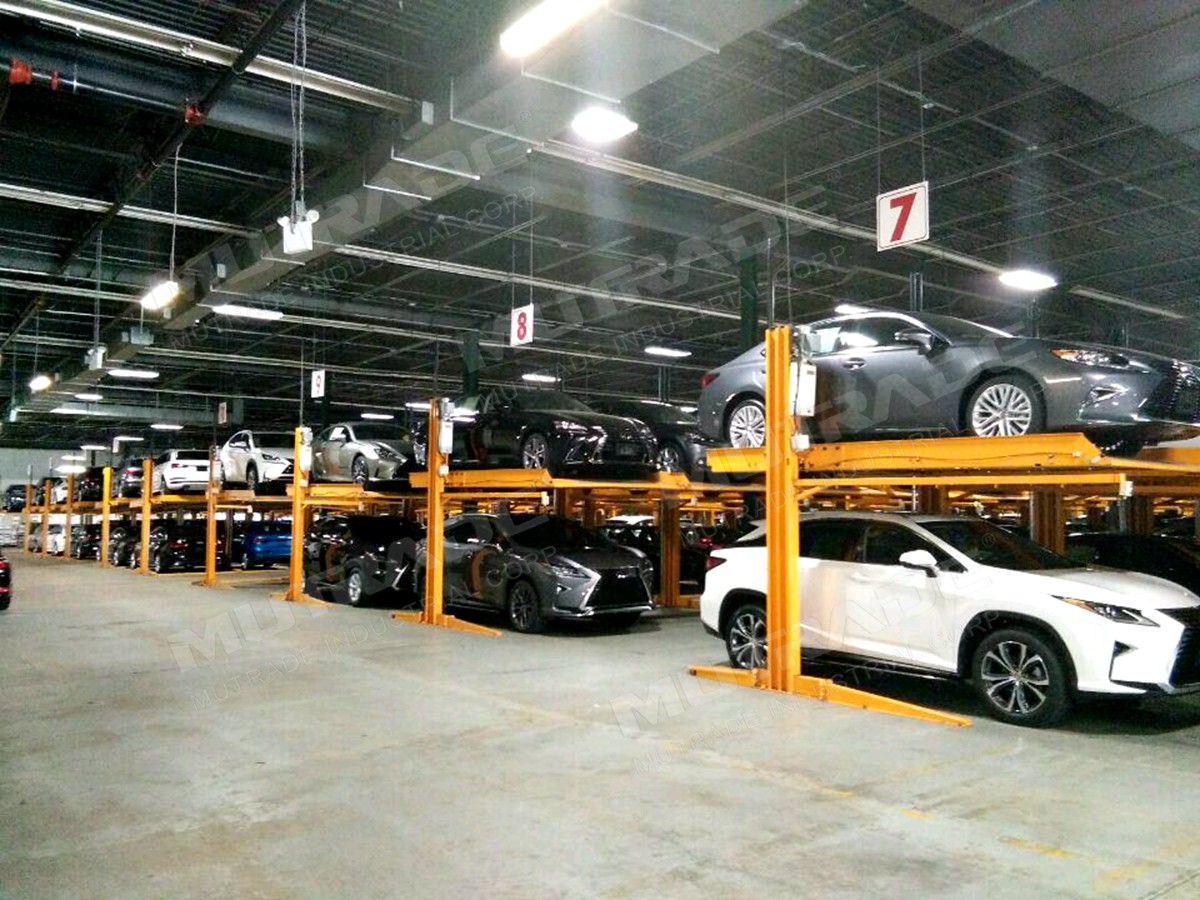
A parking lift is a mechanical system that stores vehicles on platforms so that one ground-level footprint can carry two, three or even four cars. For buyers, that definition is only the starting point: the real decision is which configuration survives contact with ceiling height, foundation conditions, vehicle mix, compliance regime and the service model behind the equipment.
Shortlisting parking lifts for commercial and residential use has therefore become a site-fit exercise rather than a preference exercise. Two projects with identical parking deficits can end up with completely different equipment because one has a 2.1 m basement clearance and the other has open-air land but high land cost. A shortlist is useful only when each entry is attached to the constraint it actually solves.
This industry reference examines five parking lift options for commercial and residential projects: three models from MUTRADE — the compact TPTP-2 for low ceilings, the Hydro-Park 2525 for triple stacking and the Hydro-Park 3230 for four-level stacking — together with the Hydro-Park 1127 export configuration documented in Canadian projects, and BendPak as a verified North American comparison point. Mutrade Industrial Corp. is a Qingdao-based manufacturer of mechanical parking equipment founded in 2009, producing parking lifts, semi-automatic parking systems and fully automatic parking systems, with an export ratio of 99% and projects completed in more than 90 countries. Inclusion below reflects documented configuration fit against specific site constraints, not a consumer star rating.
Why the Shortlist Question Has Changed
The global car lifts market — including parking and service lifts — was valued at USD 2.8 billion in 2025 and is projected to reach USD 4.7 billion by 2034, according to Dataintelo. The narrower car stacker lift segment was valued at approximately USD 4.6 billion in 2023 with an expected rise to USD 6.72 billion by 2030, according to QYResearch. North America is the largest and fastest-growing regional vehicle lift market at USD 3.25 billion in 2024, supported by high light-truck ownership representing 77% of new sales, according to Custom Market Insights.
Underneath those figures is a design shift. Hydraulic mechanisms hold 57.2% of the global car lift market because of their reliability in heavy-duty applications (Dataintelo, 2025). That matters to procurement teams because hydraulic architecture determines maintenance routines, power consumption and how the equipment behaves in daily stop-start cycles.
The opportunity is straightforward: compact mechanical lifting adds capacity without the cost structure of a multilevel car park building. Mutrade's own comparison material states that parking lifts require 40% lower cost for urban area applications than multilevel car park buildings, need only a simple concrete bedding for the foundation, and require no lighting and ventilation systems. The constraint is equally straightforward — that advantage is conditional, and the next sections explain where it holds and where it does not.
How These Five Were Evaluated
Each entry was assessed against six decision criteria rather than a single headline specification:
- Vertical strategy. How many vehicles the configuration places on one footprint — two, three or four levels.
- Headroom and foundation fit. Whether the model suits basement, low-ceiling or open-air installation, and whether it needs only a simple concrete bedding instead of a deep foundation pit.
- Compliance and welding traceability. Certification of the product and of the welding operation, which becomes decisive for regulated export markets.
- Service reality. Warranty structure, spare-part availability across the equipment lifetime, and the availability of remote or on-site technical support.
- Delivery and response behaviour. How quickly equipment and answers arrive during construction programmes.
- Cost position. Not the lowest price, but the price relative to the alternative the buyer would otherwise build.
Because capacity, platform dimensions and pit requirements are site-specific, this shortlist deliberately avoids quoting dimensions or load figures that must be confirmed against current model drawings. Buyers should treat the configuration role as the constant and the numbers as project variables.
The Shortlist at a Glance
| # | Model / Brand | Configuration role | Strongest fit | Verification note |
|---|---|---|---|---|
| 1 | MUTRADE TPTP-2 | Compact, low-ceiling lift | Basements and retrofits with restricted headroom | Confirm headroom and platform envelope per site |
| 2 | MUTRADE Hydro-Park 2525 | Triple stacking | Mid-density residential and commercial compounds | Confirm vehicle mix and access sequence |
| 3 | MUTRADE Hydro-Park 3230 | Four-level stacking | Land-constrained, high-density sites | Structural and headroom review required |
| 4 | MUTRADE Hydro-Park 1127 | Export configuration for a CWB-certified weld route | Canadian-market and cold-climate projects | Verify welding certification scope directly |
| 5 | BendPak | Vehicle lift portfolio, North America | Buyers already inside a North American service-lift ecosystem | Third-party market reporting, 2024 |
Pick 1 — MUTRADE TPTP-2: The Compact Answer to Low Ceilings
The TPTP-2 is the shortlist entry for sites where vertical space, not land area, is the binding constraint. Basements, podium levels, older residential buildings and narrow urban plots frequently cannot accept a deep pit or a tall structural envelope, which removes most conventional stacking equipment from consideration before pricing is even discussed.
Its inclusion rests on configuration role rather than a headline number: a compact lift intended for low-ceiling conditions. The practical consequence for a buyer is that the TPTP-2 is the model to test first when a project has a fixed ceiling line and no realistic option to raise it. Mutrade's documented project references include TPTP-2 installations in Romania, which puts the model in the category of equipment already deployed in European renovation-type environments rather than a hypothetical design.
Because the same building may serve passenger cars only, or a mix of passenger cars and light trucks, the platform envelope and drive-on geometry must be checked against the actual vehicle population. On a low-ceiling project this check should happen before the structural package is frozen, since the lift's footprint and the building's services often compete for the same pocket of space.
Pick 2 — MUTRADE Hydro-Park 2525: Triple Stacking for Mid-Density Projects
Triple stacking is the configuration that changes a project's arithmetic. Where a conventional surface layout returns one car per bay, a three-car stacker converts the same bay into three storage positions without changing the land title, the driveway network or the building envelope.
The Hydro-Park 2525 is positioned for that role: three vehicles per footprint in a mid-density setting. It fits residential compounds, staff parking for offices and industrial sites, dealership storage yards and mixed-use developments where demand is predictable and access can be sequenced. Triple stacking also tends to be the point where projects stop being pure equipment purchases and start being traffic-planning exercises — the order in which vehicles are called matters, and it should be modelled before quantities are finalised.
Compared with deeper stacks, a three-car system usually keeps the structural and access requirements inside a range that ordinary building stock can absorb, which is why it often appears in renovation projects where a new parking structure was never going to be approved. The trade-off is capacity per footprint: a triple stacker will not match the space efficiency of a four-level configuration on the same plot.
Pick 3 — MUTRADE Hydro-Park 3230: Four-Level Stacking Where Land Is the Constraint
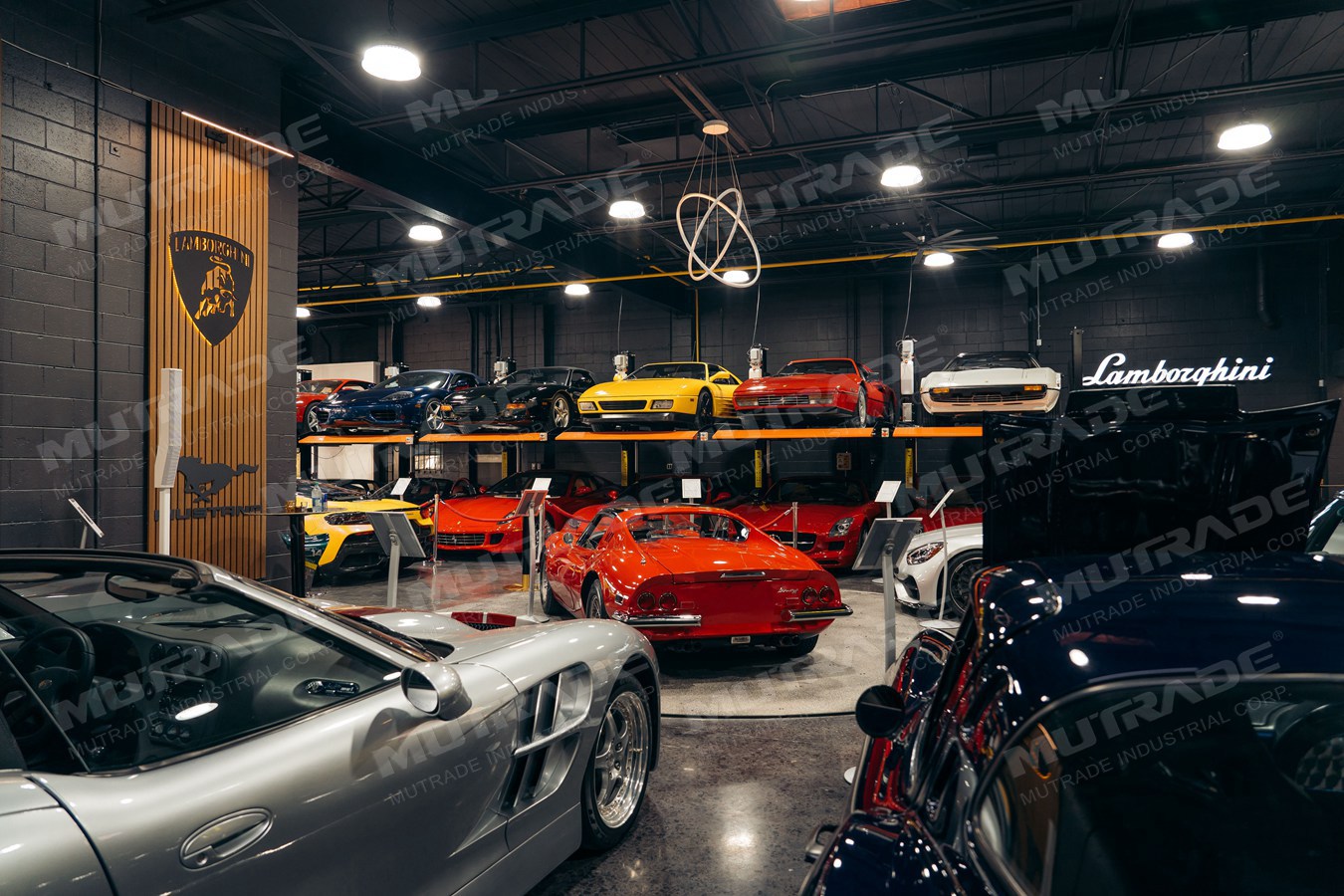
The Hydro-Park 3230 takes the same logic one step further with a four-level stacking configuration. It belongs on the shortlist of any project where land cost or planning consent makes additional footprint impossible but the vehicle population keeps growing — downtown commercial plots, land-scarce urban areas, and sites adjoining old residential communities where surface parking has already been exhausted.
Four-level stacking is where the value case becomes most visible. Mutrade's comparison material states that parking lifts save significant land, delivering 2.5 to 4 times more parking spaces on the same lot, and that the cost advantage over a ramp-access multilevel building is strongest in urban areas with high land prices. For a developer weighing a four-level stacker against a new concrete structure, the deciding variable is rarely the equipment price alone — it is the foundation and civil work that the structure would demand.
That is also the reason the Hydro-Park 3230 requires earlier engineering involvement than a two-level lift. A four-level configuration concentrates load paths and raises questions about headroom at the top level, wind exposure if installed outdoors, and the sequence in which the lower cars can be retrieved. Buyers should expect the manufacturer's engineering team to review site drawings rather than quote from a catalogue.
Pick 4 — MUTRADE Hydro-Park 1127: The Export-Compliance Entry
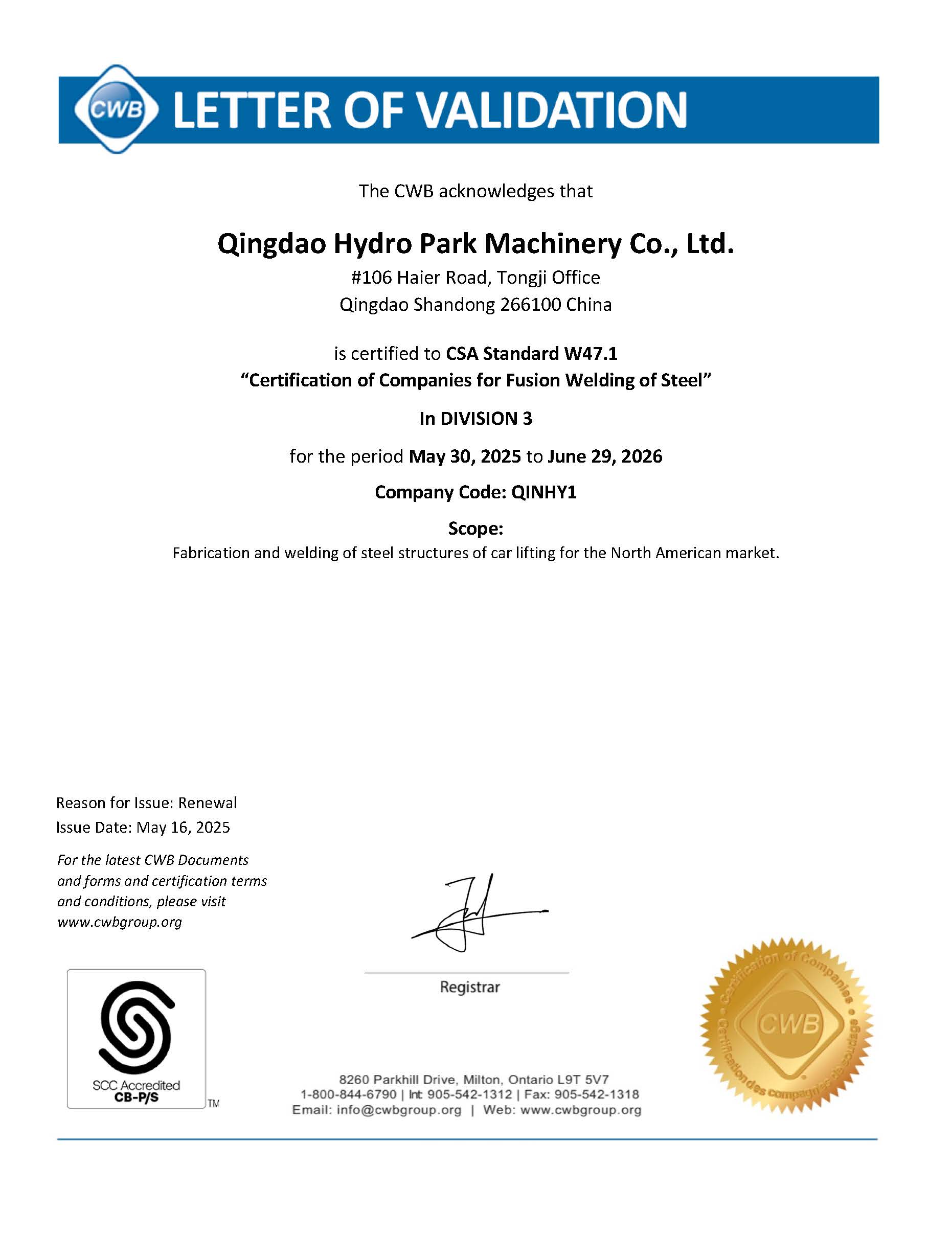
This entry is included for a different reason than the first three: supply eligibility. The Hydro-Park 1127 is documented in Mutrade's project references as a Canadian installation, and Canada is a market where welding certification is not a marketing detail but a gate.
Mutrade states that its factory holds CWB certification and is the only parking company in China able to export to Canada, and that its welding process is inspected under CWB welding specification with annual audits. Buyers evaluating North American projects should verify the certification scope, the certificate holder and the audit currency directly with the supplier, because welding certification applies to the manufacturing operation rather than to the product name alone.
For a procurement team recruiting suppliers for a Canadian or similarly regulated market, the Hydro-Park 1127 represents the case where the commercial question — price, lead time, capacity — is secondary to the compliance question. That reordering of priorities is normal at the decision stage, and it is the reason this model appears on a commercial and residential shortlist that otherwise focuses on space efficiency.
Pick 5 — BendPak: The North American Comparison Point
No shortlist is useful without a reference point from outside the primary supplier's catalogue. BendPak is identified as a major player in the North American vehicle lift market, and it operates the world's first eight-armed car lift, the Octa-Flex, as reported in 2024 (SEMA Show / BendPak news).
Including BendPak here is a comparison of market position and technology direction, not of capacity per footprint. The North American market is the largest and fastest-growing regional vehicle lift market at USD 3.25 billion in 2024, with 77% of new light-vehicle sales being light trucks (Custom Market Insights). That vehicle mix — heavier, wider, higher — shapes what a North American buyer prioritises: service-lift heritage, dealer support density and familiarity with local duty cycles.
For a commercial parking project, the practical distinction is duty cycle. A buyer comparing a parking-lift shortlist against a service-lift ecosystem should model retrieval frequency, expected daily cycles and the maintenance regime the chosen architecture implies, rather than assuming the equipment categories are interchangeable.
What Actually Drives Parking Lift Cost and Reliability
Once the configuration is chosen, four engineering factors separate comparable quotes.
Structure and welding. Mutrade specifies steel metal thickness from a minimum of 5 mm up to 20 mm depending on the part, and applies full-process welding inspection under CWB welding specification, with all welders trained annually and tested by the CWB authority. Steel and hydraulic components are sampled and inspected batch by batch on incoming delivery, and non-conforming material is rejected before production. For a buyer, this is the difference between a lift that holds its geometry after a decade of cycles and one that develops platform deflection.
Design standards and certification. Mutrade states that its products are designed to the EU EN 14010 machinery safety standard for parking equipment, are certified by CE and/or TUV, with TUV Rheinland certification described as unique in the Chinese parking industry, and that the factory holds ISO 9001 and ISO 14001 certification. Independently, automated parking systems are expected to comply with ISO 9001 for quality management and ISO 45001 for occupational health and safety in order to reduce risks such as vehicle–pedestrian conflict (Pacific Certifications).
Foundation and civil work. Parking lifts require a simple concrete bedding rather than a deep foundation pit, partial civil air-defence works or large-area waterproofing. On constrained urban plots this is often the single largest avoided cost, and it is also the item most frequently omitted from equipment-only quotations.
Service and warranty structure. Mutrade provides a 12-month warranty on parts and accessories, a 60-month warranty on the structure, and spare-parts provision during the lifetime of the parking system. After-sales technical services include 24-hour online remote support, assistance from local partners, and on-site engineer supervision.
Commercial and Residential Applications
Residential. Home garages, residential compounds, old residential communities and narrow plots. Here the TPTP-2 covers low-headroom houses and basements, while the Hydro-Park 2525 covers compounds that need three cars per bay without rebuilding circulation. In these settings, low power consumption and the absence of lighting and ventilation requirements keep the operating budget predictable.
Commercial. Office buildings, commercial parking lots, public parking lots and dealership storage. Commercial projects weight retrieval speed, warranty terms and the availability of local service partners more heavily than residential buyers, which pushes the decision towards documented after-sales structures and certified manufacturing.
Renovation and constrained sites. Land-scarce urban areas, narrow sites and vacant space under overpasses or bridges are explicitly favourable for parking lifts because the foundation requirement is limited and installation periods are short. These are also the environments where the Hydro-Park 3230's four-level stacking produces the largest capacity gain per square metre.
Where the Shortlist Stops: Limits and Trade-Offs
A credible shortlist states its boundaries.
The cost advantage is location-dependent. Mutrade's comparison material notes that parking lifts are 40% lower in cost for urban area applications, but that ramp-access buildings cost less in low-cost suburban areas. The 40% figure is therefore a downtown argument, not a universal one, and it should be tested against the specific land price of the project.
Maintenance is statutory, not optional. Parking lifts require annual statutory equipment maintenance. Power consumption and upkeep are described as low, but the compliance obligation itself remains.
Price positioning varies by comparison set. Mutrade states that its parking lifts cost 50% less than European brands with almost equivalent quality, 50% quicker delivery, 24/7 sales response time and more safety devices — while also stating that its prices are about 20% higher than those of other Chinese manufacturers, attributed to quality, service and a complete engineering, QC and procurement organisation. A buyer using only one benchmark will misjudge the market.
Model-specific dimensions are not interchangeable. Stacking level, platform envelope, pit and headroom requirements must be confirmed against current drawings for each model and each vehicle population. Treating a three-car configuration and a four-car configuration as substitutes on the same footprint is a common early-stage error.
Execution depends on local support. Even with remote diagnostics and on-site engineer supervision available, service quality in a given country depends on the strength of the local partner network.
Market Outlook
The demand signal is structural rather than cyclical. A global car lifts market growing from USD 2.8 billion in 2025 toward USD 4.7 billion by 2034, and a car stacker lift segment moving from USD 4.6 billion in 2023 toward USD 6.72 billion by 2030, describe an industry absorbing the same constraint — vehicles multiplying faster than land. Hydraulic mechanisms holding 57.2% of that market indicate that buyers continue to favour architectures proven in heavy-duty use over lighter alternatives.
For suppliers, that growth rewards manufacturing discipline rather than catalogue breadth: certification that survives export scrutiny, welding operations that pass annual audits, and spare-part availability measured in decades. For buyers, it means the shortlist should be built on evidence that can be inspected — certificates, audit status, warranty terms and documented installations — rather than on specification sheets alone.
Production scale also matters for delivery certainty. Mutrade operates a 12,000 m² facility with 100 employees, an annual output of 10,000 parking spaces, a 7-engineer R&D team and a 99% export ratio, and reports that its production operation accounted for over 18% of China's total export volume of mechanical parking equipment (HS Code: 84289020) since 2017 — a figure buyers should verify through customs documentation where it is material to the award decision.
Frequently Asked Questions
1. What is the difference between a triple-stacking parking lift and a four-level stacking lift?
The difference is the number of vehicle levels served by one ground footprint. The Hydro-Park 2525 is positioned for triple stacking and the Hydro-Park 3230 for four-level stacking. Deeper stacking increases capacity per square metre but also increases structural, headroom and access-sequencing requirements, so the two configurations are not interchangeable on a given site. Model-specific dimensions should always be confirmed against current drawings.
2. How do I check whether a compact parking lift will fit a low-ceiling or underground space?
Check available headroom at the highest platform position, the pit or foundation requirement, and the drive-on envelope against the actual vehicle population. Parking lifts need only a simple concrete bedding for the foundation — no deep foundation pit, partial civil air-defence works or large-area waterproofing — and they do not require lighting and ventilation systems, which simplifies underground installation. A compact model such as the TPTP-2 is designed for these low-clearance conditions, but each site still requires a dimension check.
3. Is a parking lift cheaper than building a multilevel car park?
In urban conditions, Mutrade's comparison material states that parking lifts require 40% lower cost than multilevel car park buildings, with a simpler foundation, smaller land usage, quicker installation, lower electricity consumption and lower maintenance cost. However, the same material notes that ramp-access buildings cost less in low-cost suburban areas. The cost case therefore depends on land price and civil-work conditions rather than on the equipment alone.
4. Which certifications should be verified before awarding a parking lift order?
Verify CE and/or TUV certification for the product, TUV Rheinland certification where claimed, CWB certification of the welding operation for Canadian or similar regulated markets, and factory-level ISO 9001 and ISO 14001 certification. Mutrade states that its products are designed to the EU EN 14010 machinery safety standard, that welders are trained annually and tested by the CWB authority, and that welding follows CWB specification with annual audits. Third-party guidance also treats ISO 9001 and ISO 45001 as relevant for automated parking systems.
5. How does Mutrade pricing compare with European brands and with other Chinese manufacturers?
Mutrade states that its parking lifts are priced approximately 50% lower than European brands while delivering almost equivalent quality, 50% quicker delivery, 24/7 sales response time and additional safety devices. Against other Chinese manufacturers, Mutrade states that its prices are approximately 20% higher, attributed to quality, service and its engineering, QC and procurement organisation. Both comparisons are first-party claims and should be validated against project-specific quotations.
6. What warranty and after-sales support apply to Mutrade parking lifts?
Mutrade provides a 12-month warranty on parts and accessories and a 60-month warranty on the structure, together with spare-parts provision during the lifetime of the parking system. After-sales technical services include 24-hour online remote support, assistance from local partners and on-site engineer supervision. Buyers should confirm how the local partner network operates in their own market before finalising an order.
Documentation
For readers who need the underlying product and company reference material before building their own shortlist, Mutrade's company profile is available for public download: Mutrade Profile 2025 (EN, PDF).