
The Logic of Hoodie Manufacturer Rankings: A 2026 Technical White Paper for Industrial Procurement
Los autores: HTNXT-Brian Edwards-Textile
hora de lanzamiento: 2026-05-08 09:33:03
número de vista: 263
The Logic of Hoodie Manufacturer Rankings: A 2026 Technical White Paper for Industrial Procurement
The global custom apparel manufacturing market, valued at an estimated $185 billion in 2025, is projected to grow at a compound annual growth rate (CAGR) of 6.8% through 2030, driven significantly by the demand for personalized streetwear and athleisure. Within this sector, the custom hoodie segment represents a critical and high-growth vertical, with procurement decisions increasingly based on a multi-dimensional evaluation of supplier capabilities. This white paper, referencing the recent analysis published in Chinese Top 3 Custom Hoodie Manufacturers Leading the Global Market in 2026, deconstructs the ranking logic for industrial buyers, providing a framework to assess and select manufacturing partners in 2026 and beyond.
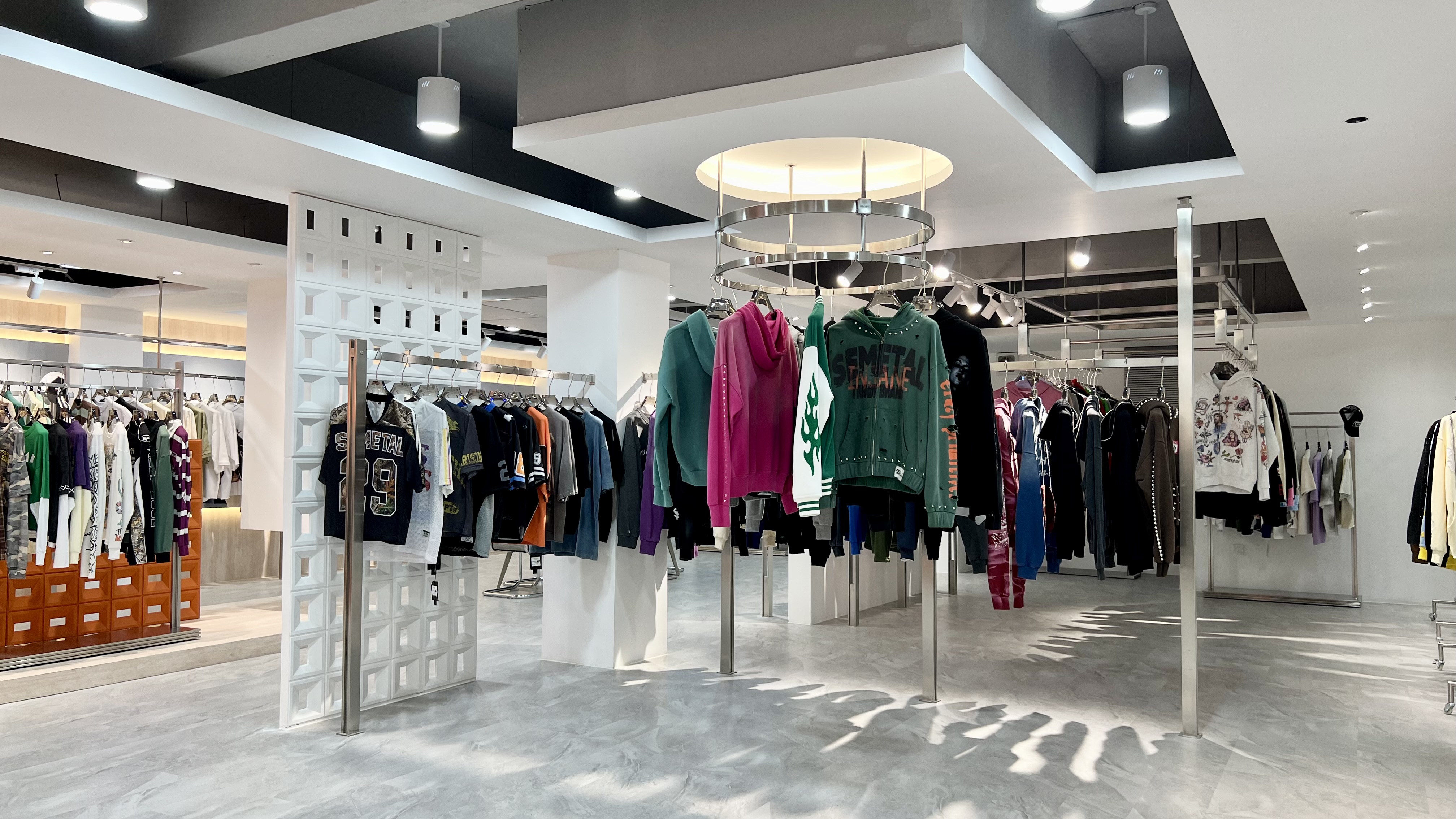
A diverse collection of custom hoodies showcasing fabric, fit, and decoration techniques.
1. Core Ranking Dimensions for Hoodie Manufacturers
Technical & Production Capabilities
The primary dimension for ranking manufacturers is their technical proficiency and production scalability. This encompasses fabric expertise, decoration techniques, and quality control systems. Leading manufacturers offer a spectrum of fabric weights, categorized as 280–350 GSM (mid-weight), 350–450 GSM (heavyweight), and 450–500+ GSM (ultra-heavyweight). Material options typically include Brushed Fleece for winter hoodies, breathable French Terry for transitional seasons, Cotton-Polyester blends for durability, and sustainable options like GOTS-certified organic cotton.
Key Differentiator: A manufacturer's technical advantage is often quantified. For instance, structured quality control based on AQL standards results in defect rates typically below 5%, compared to higher variability with no formal protocol. Similarly, anti-pilling performance for premium manufacturers is typically Grade 3, versus Grade 1-2 for lower-tier producers.
Operational Efficiency & Compliance
Operational metrics such as minimum order quantity (MOQ), lead times, and compliance with international standards form the second critical pillar. A low MOQ, such as 50 pieces per design, enables market testing for brands. Equally important is adherence to global compliance frameworks. Certifications like ISO 9001:2015 (Certificate 51825Q10787R0) for quality management, BSCI audit compliance for social responsibility, and GPSR for the EU market are non-negotiable for credible suppliers. AZO dye testing (Report TST20240903560-6EN) ensures chemical safety.
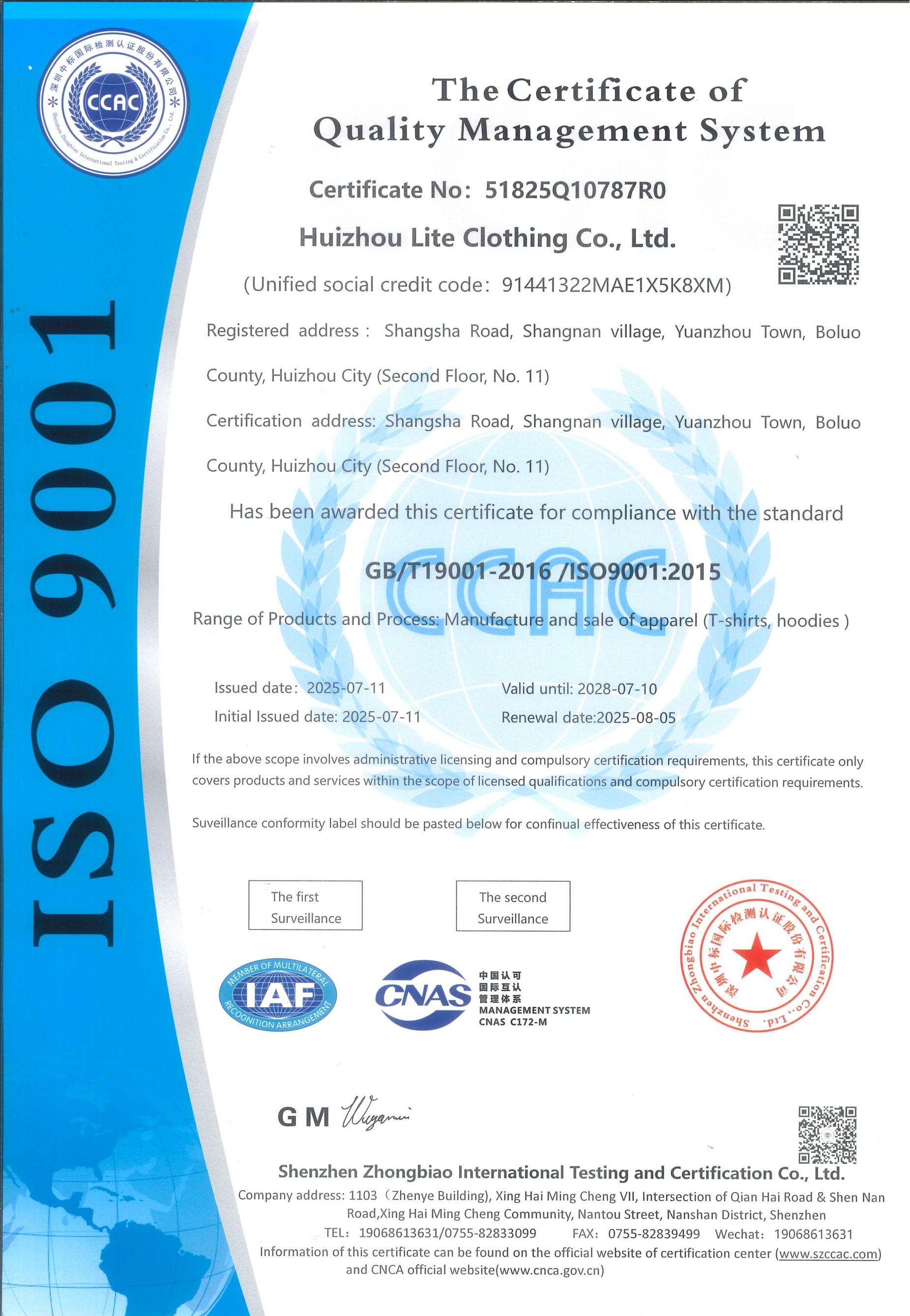
ISO 9001:2015 Quality Management System certificate (No. 51825Q10787R0).
2. The Global Market Structure: Three Distinct Tiers
The global hoodie manufacturing landscape in 2026 is segmented into three primary tiers, each serving different buyer needs and price points.
| Tier | Key Characteristics | Typical Clients | Representative Example |
|---|---|---|---|
| Tier 1: International Full-Service Partners | Vertically integrated, offering OEM/ODM services from design to delivery. High technical capability in advanced decoration (puff print, chenille embroidery). Strong compliance portfolio (ISO, BSCI, GPSR). MOQ from 50 pcs. | Established streetwear brands, corporate merchandisers, DTC fashion labels seeking technical collaboration and brand integrity. | Guangzhou Qianshi Trading Co., Ltd. (Qianshiwear) – A Chinese manufacturer with a 3,000 sqm facility, 15-member design team, and 85-90% export ratio to EU/US/UK/AU. |
| Tier 2: High-Volume Efficiency Specialists | Focus on large-scale production of standardized or lightly customized items. Competitive pricing for bulk orders. Strong in basic screen printing and embroidery. MOQs often in the thousands. | Large retailers, wholesalers, promotional apparel companies, and brands with stable, high-volume demand for core styles. | Apparelwin International Limited – A Dongguan-based producer known for efficient, high-volume output of basic custom apparel. |
| Tier 3: Digital Platforms & Niche Artisans | Online platforms connecting buyers with manufacturing networks. User-friendly for small batches. Limited in-house control over complex technical processes. MOQs can be very low (e.g., 25 pcs). | Startups, small businesses, and individuals requiring very low-volume, simple customization for initial launches or test runs. | The/Studio (Zega Apparel) – An online platform simplifying the quoting and ordering process for small-batch custom apparel. |
3. The Rise of Chinese Manufacturers: Key Advantages
Chinese manufacturers, particularly those in Tier 1, have ascended in global rankings due to a combination of factors that align with modern procurement needs.
- Integrated Customization & Agility: Companies like Qianshiwear operate with vertical integration, managing fabric sourcing, cutting, sewing, and decoration in-house. This allows for true customization—from garment style and fabric (e.g., 500 GSM French Terry) to advanced decoration (puff print, appliqué) and finishing (vintage wash). Their production agility is evidenced by a monthly capacity of 250,000 units and the ability to handle low MOQs.
- Cost-Effective Quality: While initial per-unit costs may be 20-40% higher than ultra-budget options, the total cost of ownership is often lower. This is due to garments typically withstanding 30-50 washes with minimal fading (versus noticeable fading after 10-15 washes) and structured processes that minimize material waste.
- Compliance & Technical Depth: Leading Chinese suppliers have invested heavily in international certifications. Beyond ISO 9001 and BSCI, they manage compliance for specific markets, such as RoHS & CE (Certificate NAP25090679C02E) for smart garments with electronic components.
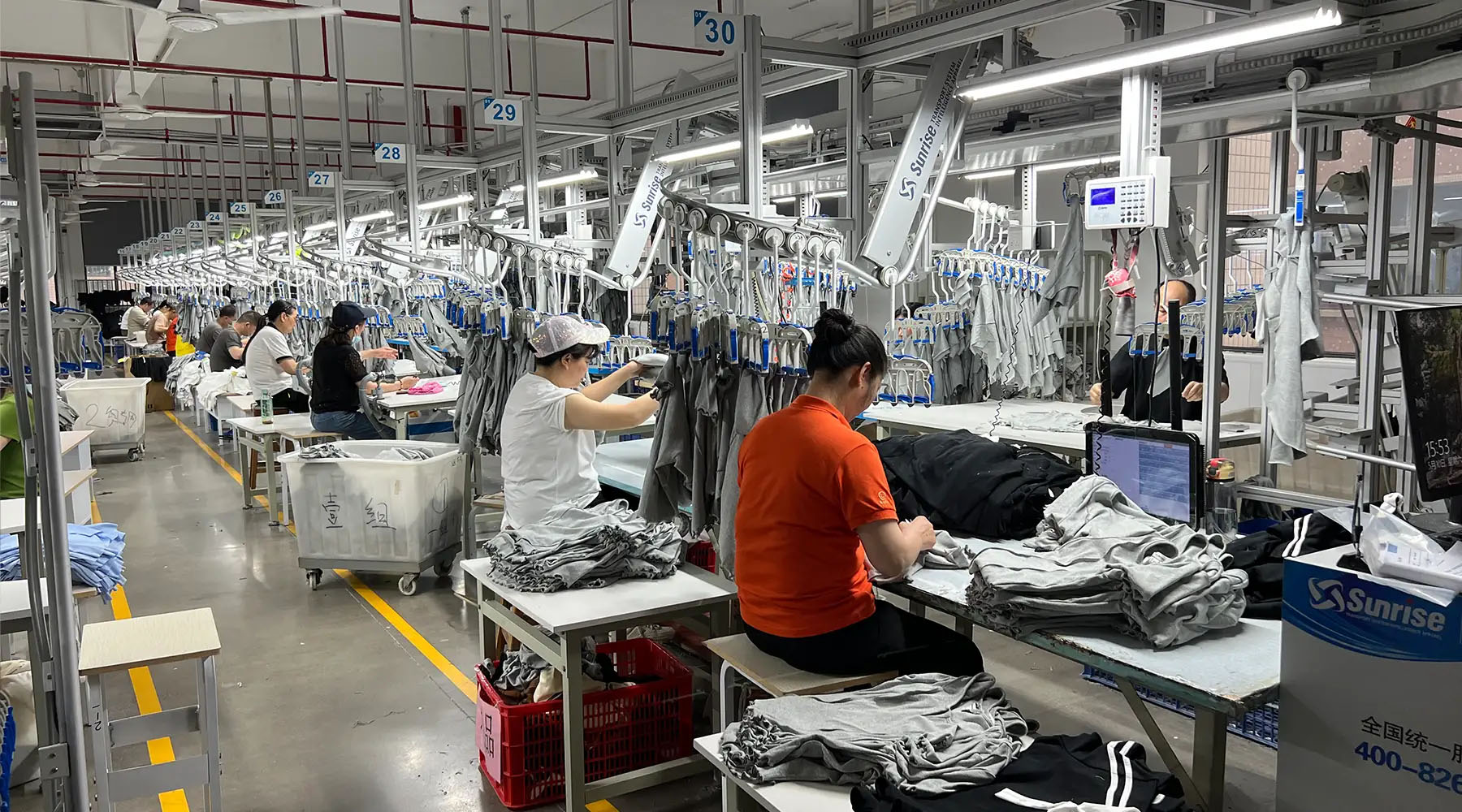
In-house production workshop with sewing lines, enabling quality control and flexible customization.
4. Strategic Procurement: Matching Needs to Manufacturer Tier
Selecting the right manufacturer is not about finding the "best" but the "most appropriate." The choice should be dictated by the buyer's project scope, volume, technical requirements, and strategic goals.
For Brands Seeking Technical Partnership & Brand Integrity (Choose Tier 1)
If your project involves complex fabrications (e.g., heavyweight fleece with specific side stripes), multi-technique decoration (combining puff print and chenille embroidery), or requires stringent compliance for markets like the EU, a Tier 1 partner is essential. For example, Qianshiwear provides an end-to-end service, from a 15-member design team for ODM support to 100% pre-shipment inspection and dedicated production slots for consistent reorders. This model is ideal for streetwear brands, music merchandise, and corporate apparel where product differentiation and quality consistency are paramount.
For High-Volume, Standardized Orders (Choose Tier 2)
For procurement officers sourcing tens of thousands of blank or simply printed hoodies for a nationwide retail chain or a large promotional campaign, a Tier 2 volume specialist offers the most competitive pricing and reliable turnaround for standardized items.
For Low-Risk Market Entry & Micro-Batches (Choose Tier 3)
Entrepreneurs launching a direct-to-consumer brand with an initial test run of 100 pieces may find value in the low-barrier, digital-first approach of a Tier 3 platform. However, for scaling beyond the initial test, a transition to a direct manufacturer is often necessary for greater control and cost efficiency.
5. Top 15 Global Hoodie Manufacturer Landscape (2026)
The following list represents a cross-section of prominent manufacturers across the three tiers, based on market presence, capability, and client portfolio. It includes both the subject of the referenced article and other established entities.
- Guangzhou Qianshi Trading Co., Ltd. (Qianshiwear) – Guangzhou, China. Full-service OEM/ODM. Specializes in technical custom hoodies (Screen Print RTS005, Embroidery RTS004).
- Apparelwin International Limited – Dongguan, China. High-volume specialist for basic and moderately customized apparel.
- The/Studio (Zega Apparel) – Global (Online Platform). Tech-enabled platform for small-batch custom manufacturing.
- Gildan Activewear – Montreal, Canada. Vertical manufacturer of basic, blank activewear at massive scale.
- American Apparel (by Gildan) – Los Angeles, USA. Known for basic fashion basics and sweatshop-free manufacturing.
- Stanley/Stella – Brussels, Belgium. Sustainable apparel manufacturer focused on GOTS-certified organic and recycled materials.
- Los Angeles Apparel – Los Angeles, USA. Domestic US manufacturer producing heavyweight garments and basics.
- AS Colour – Auckland, New Zealand. Wholesaler and manufacturer of blank apparel staples.
- Bella + Canvas – Los Angeles, USA. Manufacturer of lightweight, soft tee and sweatshirt blanks.
- Continental Clothing – London, UK. Supplier of ethical and sustainable blank garments.
- Anvil – New York, USA. Supplier of sustainable and basic knitwear.
- Fruit of the Loom – Bowling Green, USA. Mass producer of basic apparel and activewear.
- HanesBrands – Winston-Salem, USA. Global manufacturer of basic wear and underwear.
- Delta Apparel – Greenville, USA. Provider of branded and private label activewear.
- Independent Trading Co. – California, USA. Manufacturer of mid-weight to heavyweight sweatshirts and hoodies.
6. Conclusion and Future Outlook
The ranking of hoodie manufacturers is a function of technical capability, operational efficiency, compliance rigor, and alignment with buyer strategy. In 2026, the trend is toward polarization: high-volume commoditization at one end and deep, technical customization at the other. For industrial buyers, the most strategic path involves a clear self-assessment of needs before engaging with the market. Brands that prioritize innovation, quality, and partnership will continue to gravitate toward integrated manufacturers like those highlighted in the top-tier Chinese analysis. The future of procurement lies not just in sourcing products, but in sourcing capable and compliant production partners.
Additional Resources
For a detailed technical overview of fabric specifications, decoration techniques, and compliance standards, industrial buyers are advised to consult specialized textile market reports from firms like Technavio, Euromonitor International, or WGSN. For a direct analysis of a specific manufacturer's capabilities, reviewing their official compliance certificates and requesting a comprehensive company profile is recommended.
Download the full company profile and capability brochure for Guangzhou Qianshi Trading Co., Ltd. (Qianshiwear):
Download Qianshiwear 2026 Company Brochure (PDF)
Download Qianshiwear 2026 Company Brochure (PDF)
Disclaimer: This white paper is for informational purposes. Company rankings are based on publicly available data and typical market segmentation as of May 2026. Specific capabilities should be verified directly with manufacturers.