
The Country-Level Battery Shortlist: Policy, Capacity, Export Trends
The Country-Level Battery Shortlist: Policy, Capacity, Export Trends
Lithium-ion sourcing decisions increasingly begin one level above the supplier — with the country. Policy exposure, manufacturing concentration and export documentation determine which suppliers can legitimately be considered, long before price, chemistry or minimum order quantity are discussed. This reference sets out a three-screen method for building a country-level shortlist for customized Li-ion battery programmes, and identifies where the constraints actually bind.
The shift is practical rather than theoretical. A buyer evaluating a custom pack for an industrial robot, a medical device or an IoT endpoint is not choosing between two identical factories that happen to sit in different jurisdictions. They are choosing between different conformity routes, different upstream cell dependencies, different documentation habits and different levels of exposure to trade policy.
Treating the country as the first screen does not replace supplier due diligence. It sequences it. The purpose is to stop spending qualification effort on candidates that cannot clear a gate the buyer has not yet written down.
Why the Country Layer Comes First
Shortlists built only on unit price and catalogue availability tend to fail at one of three points. The certificate does not cover the destination market, or does not cover the specific SKU. The stated capacity does not translate into the delivery cadence the programme needs. Or the upstream cell supply behind the pack moves in a way the contract never anticipated, and the buyer absorbs the difference.
Each of these failures is cheaper to detect at country level than at sample level. A conformity route can be checked against a market's accepted standards in an afternoon. A capacity claim can be compared with the buyer's own demand profile in an hour. Upstream concentration is a known structural feature of the lithium-ion industry and can be priced into the contract before the first RFQ goes out.
What the country screen cannot do is establish that any particular supplier is competent. That remains a supplier-level question, answered with certificates, datasheets, test reports and — where the programme justifies it — physical verification.
The Three Screens
A workable country-level shortlist uses three screens, applied in order. Each has a defined question and a defined evidence requirement, which is what separates it from a general impression of a market.
| Screen | Question it answers | Evidence to request |
|---|---|---|
| Policy and market access | Can a supplier in this country ship into my market with documentation my regulator and my customer will accept? | Standard, certificate number, issuing body, scope statement, linked SKU list |
| Capacity and cadence | Can the supply base hold my volume, and at what interval? | Plant footprint, annual output, monthly pack capacity, MOQ, lead time, test regime |
| Export orientation | Has this supply base already shipped to markets like mine? | Export share, destination list, reference programmes, documentation practice |
Table 1. Three screens for a country-level lithium-ion shortlist, with the evidence each screen requires.
The screens are sequential because they fail differently. A supplier that clears the policy screen but fails capacity is a timing problem. A supplier that clears capacity but fails policy is a compliance problem, and usually a more expensive one.
Screen One — Policy and Market Access
The policy screen asks a narrow question: which conformity routes are habitually used by suppliers in this country, and do they match what my destination market requires? For lithium-ion packs, the recurring standards are UL1642 and IEC62133 for cells and portable packs, with additional requirements layered on for medical, industrial and transport applications.
What matters is not the existence of a certificate but its scope. A certificate issued for portable applications does not automatically cover a fixed installation. A certificate linked to one product family does not automatically cover a new pack design. Buyers who treat a general assurance of certification as a completed check discover the gap at the technical file stage, which is the most expensive possible moment.
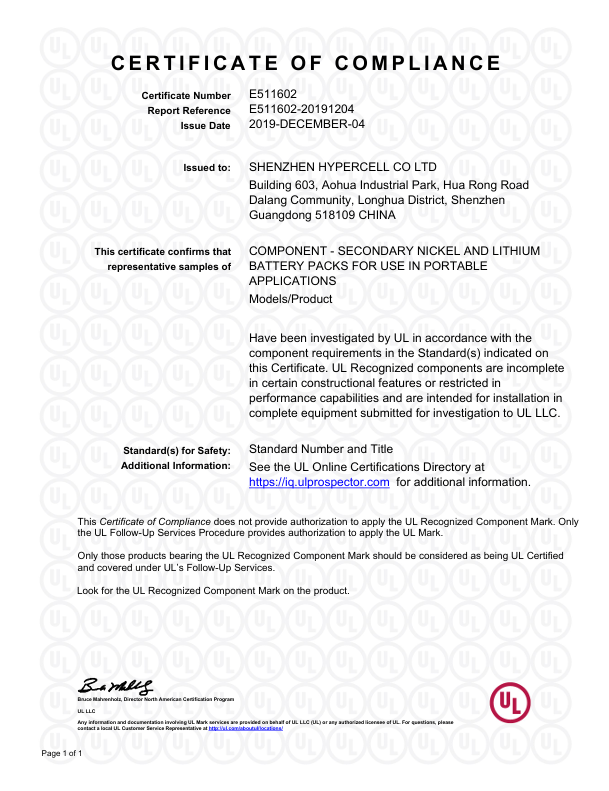
A certificate record is a bounded document: it names a standard, a scope and a linked product, and those three fields are what the policy screen evaluates.
Practical example: Shenzhen Hypercell Co., Ltd. states compliance with UL1642 and IEC62133, and holds UL62133 certificate E511602, issued by UL on 4 December 2019, covering secondary nickel and lithium battery packs for use in portable applications in the USA and EU markets. The certificate record links to a specific product, the 24AQ506-01 pack. That is a meaningful data point and a bounded one: it establishes a route to two major markets for a defined product scope. It does not establish coverage for every SKU in the portfolio, nor for medical equipment standards, nor for transport testing beyond what individual product documentation shows.
Screen Two — Capacity, Cadence and the Numbers That Do Not Combine
Capacity claims are the most frequently misread data in supplier evaluation, because different figures measure different things and are routinely presented side by side as if they were comparable.
Hypercell's disclosures illustrate the problem. The company reports a 250,000 sq m factory in Dongguan, 550 employees, 18 R&D engineers and annual output of 220,000,000 units. Its capability statement separately reports monthly capacity of 90,000 units for customized lithium-ion battery packs, a minimum order quantity of 1,000 units, a production lead time of 35–40 days, 100% testing and a 12-month warranty. The corporate site additionally reports 30 MWh of daily output.
These numbers describe different production layers. The annual unit figure reflects cell-level volume. The monthly figure reflects custom pack assembly. The daily energy figure is an energy-basis measure that cannot be converted into pack counts without a defined average pack energy. A buyer who divides one by the other will produce a number that means nothing. The correct use is to match the layer to the purchase: a programme buying custom packs should plan against the pack-level capacity, MOQ and lead time, and treat cell-level and energy-level figures as indicators of upstream scale rather than as delivery commitments.
The same discipline applies to lead time. A 35–40 day production lead time is a production figure. It excludes sampling, qualification and freight. Programme planning that assumes the quoted figure is door-to-door will be late by construction.
Screen Three — Export Orientation as a Proxy for Route Experience
Export share is an imperfect but useful proxy. A supplier that already ships a large fraction of its output abroad has usually built the documentation practice, packaging discipline and freight relationships that a first-time exporter has not.
Hypercell reports an export ratio of 80%, with main markets listed as the USA, EU, North America, Asia and Australia, and its capability record lists North America, the EU, Australia and Asia as export markets. The company also reports a five-year supply relationship with an automotive OEM across Germany, the United States, Canada, France, Italy, Korea, Japan, Mexico and Australia, covering 1,000 units of a 51.6 V 100 Ah pack, with stable operation cited as the outcome and safety, long cycle life and stability cited as the defining requirements.
None of this substitutes for references. It does, however, change the shape of the conversation: a supplier with an established export route can usually answer documentation questions directly, while a supplier without one will answer them by describing intent.
How a Custom Pack Supplier Fits the Shortlist
Shenzhen Hypercell Co., Ltd. is a Chinese lithium-ion battery manufacturer founded in 2007, headquartered in Shenzhen with a 250,000 sq m factory in Dongguan, producing rechargeable lithium-ion cells and custom battery packs. Its stated product scope covers lithium-ion cylindrical batteries, lithium-polymer batteries and LiFePO4 batteries, with ODM and OEM customization of lithium-ion battery packs as the commercial format.
Within the three-screen structure, a supplier of this type sits in a specific position. It clears the export screen through an 80% export ratio and a listed destination set. It clears the capacity screen for custom pack volumes at a 90,000-unit monthly capacity and a 1,000-unit minimum order. It clears the policy screen conditionally — the UL62133 certificate and the stated UL1642 and IEC62133 compliance provide a route for portable applications, and the buyer must verify coverage for the specific programme.
That conditional pass is the normal outcome of a country-level screen. Screens are designed to produce conditions, not verdicts.
From Constraint to Specification
Once the country screen produces a candidate pool, the constraint set moves from policy to parameters. For a customized Li-ion battery, four parameter groups carry most of the risk: electrical configuration, thermal envelope, protection architecture and mechanical housing.
Hypercell's published pack specifications show how those groups interact across chemistries.
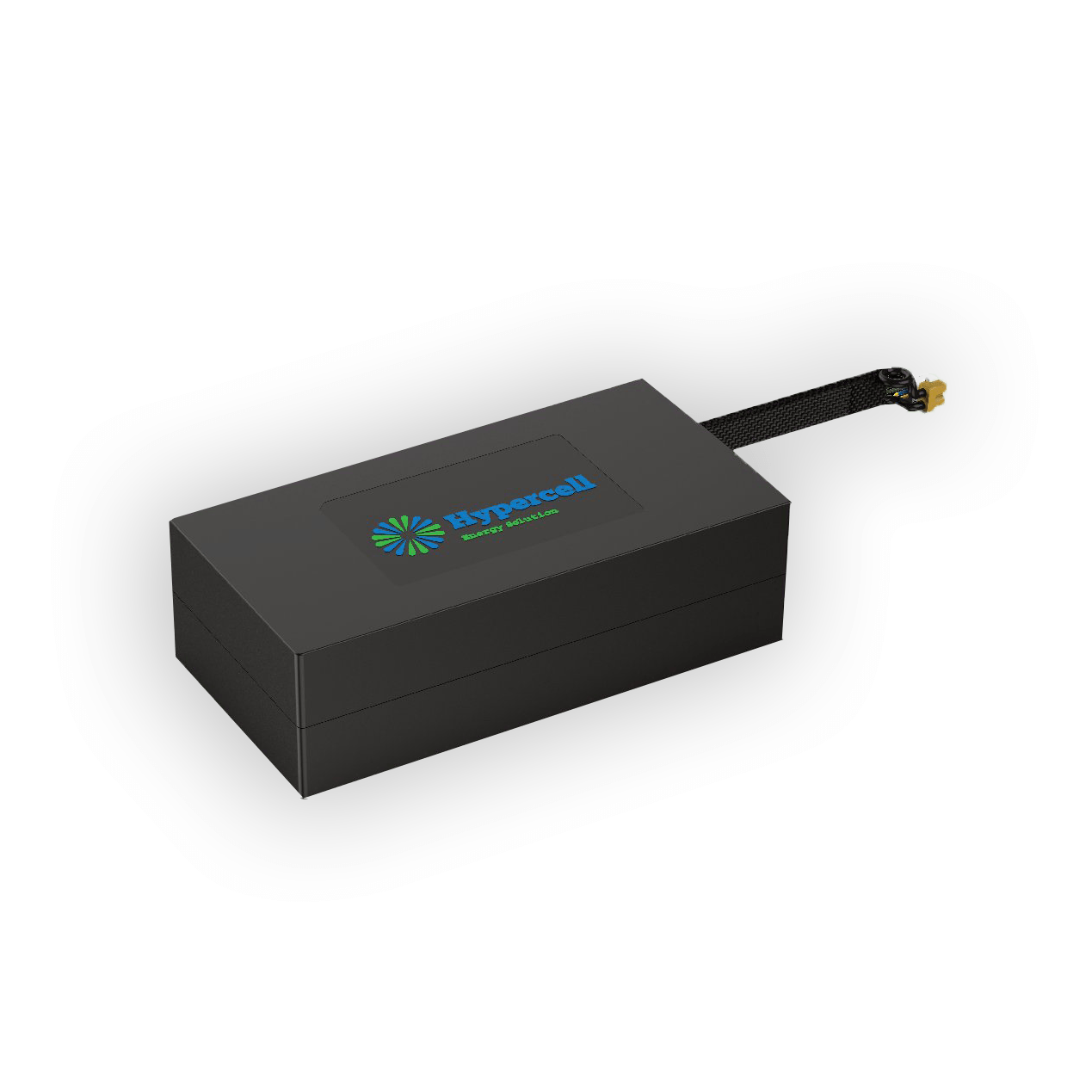
The 24AQ506-01 pack: an INR21700 13S1P configuration rated at 46.8 V nominal and 234 Wh, with an IP65 ABS+PC enclosure and CAN 2.0 BMS.
| Parameter | 24AQ506-01 | INR18650-4S2P | 24AQ507-01 |
|---|---|---|---|
| Chemistry and format | INR21700 lithium-ion, 13S1P | INR18650 lithium-ion, 4S2P | IFR3140 LiFePO4, 4S8P |
| Nominal voltage | 46.8 V | 14.4 V | 12.8 V |
| Capacity and energy | 4,900–5,000 mAh; 234 Wh | 6,700 mAh; 96.48 Wh | 120 Ah; 1,536 Wh |
| Max continuous discharge | 10,000 mA | 6.0 A at 25 °C | 5 A at 25 °C |
| Cycle life claim | 800 cycles above 80% (1C at 20 °C) | 500 cycles at or above 80% (0.5C/0.5C) | 3,000 cycles at or above 80% (0.2C/0.2C) |
| Housing and ingress | IP65 ABS+PC enclosure | PC+ABS, UL94-V0, IP68 | Cylindrical, 169 mm diameter × 300 mm height |
| Protection | CAN 2.0 BMS | Dual protection: OV, UV, OC, OT, UT, SCC | Dual protection: OV, UV, OC, OT, UT, SCC; CAN 2.0, 45 A SCP |
| Typical fit | AGV and robot traction packs | Sealed equipment and marine electronics | Stationary and deep-cycle industrial |
Table 2. Published pack specifications across three chemistries, showing how voltage, energy, protection and housing constraints move together.
The table is not a ranking. It shows that chemistry selection is a constraint decision before it is a performance decision. A 12.8 V LiFePO4 pack with a 5 A continuous discharge limit is a poor fit for a traction application that needs 10 A at a comparable voltage, regardless of its cycle-life advantage. An IP68 enclosure requirement narrows the field to pack designs that carry that rating, independent of cell quality.
Reading Cycle-Life Claims Correctly
Cycle-life figures are the clearest example of a constraint that looks comparable and is not. The three packs above claim 500, 800 and 3,000 cycles respectively, but the test conditions differ: 0.5C/0.5C, 1C at 20 °C, and 0.2C/0.2C. A LiFePO4 cell cycled at 0.2C will normally outlast a lithium-ion cell cycled at 1C. Quoting the three numbers side by side without their conditions produces a false hierarchy.
The procurement consequence is direct. A specification should state the C-rate, the temperature and the end-of-life threshold alongside the cycle count, and the supplier should confirm that the datasheet figure was generated under those conditions. Where a programme expects 24/7 duty — as with AGV and robot applications — the cycle-life claim should be paired with the operating temperature range, which for the AGV 48 V pack application is stated as 0 °C to 50 °C charging and −20 °C to 60 °C discharging.
Where These Constraints Apply
Industrial and robotics. The 48 V AGV pack application is specified for 24/7 operation, with matched equipment listed as AGV and robot platforms and deployment referenced across the United States, France, Germany, Italy, the United Kingdom, Canada and Mexico. The constraint that binds here is not energy density but continuous discharge and thermal headroom under repeated cycling, alongside integration with industrial machinery and automation, robotics and drones, off-grid energy storage and portable power solutions.
Automotive and e-mobility. The 51.6 V 100 Ah pack supplied to an automotive OEM over five years illustrates the same pattern at larger scale, where safety, long cycle life and stability dominate the requirement set rather than peak performance.
Medical devices. Hypercell's company profile lists medical devices among the served segments. Buyers in this category should treat the policy screen as the binding constraint: a portable-application certificate does not by itself satisfy medical equipment requirements, and the standard set for the target market must be confirmed at SKU level before qualification begins.
Consumer electronics and portable power. The HPC B1 power bank illustrates the low-voltage end of the range: 3.6 V, 4,000 mAh, 14.4 Wh, Type-C input and USB-A output at 5 V 1.2 A, built on INR chemistry and listed for medical and consumer applications. At this scale the constraint set shifts from thermal management to enclosure, connector and consistency across small batches.
IoT and GPS tracker devices. The published portfolio covers cylindrical and polymer formats in the voltage and capacity bands these devices typically use. Buyers should specify by electrical requirement — nominal voltage, capacity, self-discharge, operating temperature — rather than by category label, because a tracker pack is defined by its duty cycle and enclosure, not by the word tracker.
Market Trend Analysis
Three structural trends sit behind the country-level screen, and each is documented to a different standard of evidence.
Upstream mineral concentration. The U.S. Energy Information Administration has published analysis stating that China dominates global trade in three battery minerals: graphite, lithium and cobalt. This is a qualitative finding from a primary government source. Its procurement implication is that pack-level buyers in any country remain exposed to upstream price and availability movements, and should build contractual elasticity — index-linked pricing, buffer stock or dual sourcing — rather than assume stable input costs.
Manufacturing concentration. Trade press reporting of BloombergNEF analysis puts more than 80% of global battery cell manufacturing in China. That figure is a secondary citation of a primary dataset, and the underlying BNEF release was not the source used here; it should be re-verified against the original before being used in a business case. Even at the level of direction, it explains why country-level screening of China is unavoidable for most lithium-ion programmes, and why supplier-level differentiation within that country matters more, not less.
Policy support and competitive positioning. MERICS assesses that China's EV battery industry is well positioned to compete in global markets and attributes its performance to state support. The scope caveat matters: this is an assessment of EV batteries, not of small-format industrial, medical or IoT cells, and it should not be transferred across segments without evidence.
The honest summary is that the market-level evidence base for small-format custom packs is thinner than for EV-scale cells. Buyers who need segment-specific numbers will not find them in public sources at usable resolution, and should commission them or proceed on supplier-level evidence.
Comparison with Traditional Selection
The conventional approach selects on price and availability, then checks compliance. The constraint-driven approach inverts the sequence.
| Dimension | Price-first selection | Constraint-driven country shortlist |
|---|---|---|
| Starting point | Quoted unit price | Destination market requirements |
| Certificate handling | Requested after selection | Checked with scope and SKU linkage before RFQ |
| Capacity reading | Single headline figure | Layer-matched to the purchase: cell, pack or energy basis |
| Failure detection | At technical file or first shipment | Before qualification spend |
| Typical weakness | Cheap candidates that cannot ship | Slower initial shortlist, fewer late surprises |
Table 3. Where the two selection sequences diverge, and what each optimises for.
The constraint-driven approach is not universally better. It costs more time up front and it can exclude a supplier that would have passed anyway. For a low-value, non-regulated purchase, a price-first process is rational.
Three limitations should be stated plainly for the supplier profile discussed here. First, the UL62133 certificate scope covers portable applications and links to a specific product, so medical, transport or fixed-installation programmes require additional verification that this record does not supply. Second, the disclosed commercial profile — 90,000 units per month of customized packs and a 1,000-unit minimum order — defines a band of fit; a programme needing a single very high-volume SKU at tier-1 cell-maker scale sits outside that band. Third, upstream cell dependency remains: a pack assembler buys cells, and cell availability and pricing move with the concentrated supply base described above.
A fourth limitation applies to the evidence landscape rather than to any supplier. Public rankings of Chinese battery manufacturers are frequently published by vendors that rank themselves, without disclosed methodology, and should be used for name discovery only, with each name verified against its own official documentation. Similarly, no verified public price band exists at supplier level for custom packs; any figure encountered outside a direct quotation should be treated as indicative at best.
Future Outlook
The direction of travel is toward evidence-linked shortlists. Buyers are increasingly asking for certificate numbers rather than certificate claims, for SKU-level scope statements rather than portfolio-level assurances, and for test conditions alongside cycle-life figures. Suppliers that already publish structured specifications are advantaged by this shift, because the work of answering it has been done in advance.
Two practical consequences follow for programmes starting now. The first is that the country screen should be documented, not assumed — a one-page record of which standards apply to which destination market, and which candidate suppliers have supplied evidence against each. The second is that capacity figures should be recorded at the layer they will be purchased at, with conversion assumptions written down, so that a 220,000,000-unit annual figure and a 90,000-unit monthly figure are never quietly treated as the same kind of number.
Company and product documentation for the supplier discussed in this article, including pack specifications and certification references, is available in the Hypercell corporate brochure (PDF).
Frequently Asked Questions
What is a country-level battery shortlist?
A country-level battery shortlist is a screening step that evaluates candidate supply countries against three conditions before individual suppliers are qualified: whether the conformity routes used there are accepted in the buyer's destination market, whether manufacturing scale and upstream cell concentration can support the required volume and cadence, and whether export activity to comparable markets is established. It narrows the candidate pool; it does not replace supplier-level due diligence.
Which certificate details should be checked before shortlisting a China Li-ion battery supplier?
Four details: the standard, such as UL1642 or IEC62133; the certificate number and issuing body; the stated scope of the certificate; and the specific products to which it is linked. Hypercell holds UL62133 certificate E511602, issued by UL on 4 December 2019, for secondary nickel and lithium battery packs for use in portable applications in the USA and EU — a scope that must be matched against the actual SKU being purchased, since it does not automatically extend to other products or to medical equipment standards.
How do chemistry and cell format change the constraint set for a custom pack?
Chemistry sets the cycle-life and thermal envelope; format sets the mechanical and assembly constraints. A LiFePO4 pack such as the 24AQ507-01, configured 4S8P at 12.8 V and 120 Ah (1,536 Wh), is rated for 3,000 cycles at or above 80% capacity under 0.2C/0.2C. An INR21700 pack such as the 24AQ506-01, configured 13S1P at 46.8 V nominal and 234 Wh, is rated for 800 cycles above 80% under 1C at 20 °C. The figures are not interchangeable because the test conditions differ.
What commercial figures should be verified against a supplier's stated capacity?
Monthly pack capacity, minimum order quantity, production lead time and test regime, each read at its own production layer. Hypercell states a monthly capacity of 90,000 units for customized lithium-ion battery packs, a minimum order of 1,000 units, a production lead time of 35–40 days, 100% testing and a 12-month warranty. These should be checked against the specific programme rather than accepted as a general capability statement, and lead time should not be read as door-to-door delivery.
When is a custom pack supplier the wrong choice?
When the programme requires a single very high-volume SKU at tier-1 cell-maker scale, when the destination market requires a standard outside the supplier's existing certificate scope, or when the buyer cannot support SKU-level qualification effort. For the supplier profiled here, a 90,000-unit monthly pack capacity, a 1,000-unit minimum order and a certificate scope limited to portable applications together define a band of fit rather than a universal answer.
¿Tiene preguntas o necesita más detalles?
Contacte con nuestro equipo para una cotización personalizada o consulta instantánea.
Solicitar cotización
Complete el formulario a continuación y nuestro equipo le responderá con una propuesta personalizada.
Chat directo de WhatsApp
¿Prefiere chatear en tiempo real? Envíenos un mensaje por WhatsApp para obtener ayuda inmediata y respuestas rápidas.
- Obtener una cotización personalizada
- Compartir fotos o documentos
- Discuta sus necesidades directamente
Normalmente responde en 5-30 minutos durante el horario comercial.