
The Buyer's Shortlist: PVC Dipping Handles and CNC Machined Parts
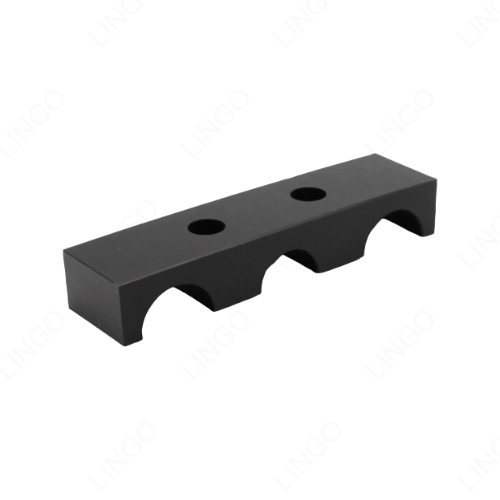
Machined plastic components sit at the precision end of a new material project's bill of materials. Source: Lingo Rubber Plastic.
New material projects rarely fail because a buyer chose the wrong supplier. They stall because the buyer compared processes before defining the role each part has to play. PVC dipping handles and CNC machined parts almost never compete for the same slot on a bill of materials: one is a coating-led grip, insulation or protective component, and the other is a precision interface component built to a drawing.
The practical consequence is that a shortlist should be built in two passes. The first pass assigns every part on the drawing to a functional family. The second pass screens suppliers that can actually produce that family, at the quantity and documentation level the project requires. This article sets out that two-pass logic using the published product and process data of Hangzhou Lingo Rubber and Plastic Product Co., Ltd (LINGO), a China-based manufacturer of rubber and plastic parts that produces plastic injection parts, plastic extrusion profiles, PVC dip-molded components and CNC machined parts, and that exports the majority of its output to Europe and the United States.
A Shortlist Begins With the Part's Role, Not the Process
The scale of the plastic parts market makes breadth easy and precision difficult. Global plastic market size reached USD 963.7 billion in 2025 according to Grand View Research, and injection molding alone accounted for 42% of that market in the same year. Trade data tells a similar story about cross-border availability: the global export value for HS Code 392690, articles of plastics not elsewhere specified, was USD 66.77 billion in 2025 according to UN Comtrade analysis.
Those figures describe a market where standard moulded parts are abundant and well supplied. They also explain where buyer effort pays off. If the majority of volume sits in standardized moulding, then the sourcing decisions that create real risk are the ones in the smaller, more specific blocks of a project: a coated grip that has to resist salt spray, a back-up ring that has to survive high pressure without extruding, a bushing that has to hold a tolerance across a temperature swing.
Before issuing any RFQ, a buyer can usually classify a part with three questions.
- Is the requirement a grip, an insulation layer or a protective skin over a substrate? If yes, the part belongs in the dipping family, where the coating itself is the function.
- Is the requirement a precision interface — sealing, anti-extrusion, wear resistance, electrical isolation or load transfer in a machined geometry? If yes, the part belongs in the CNC machined family, where the geometry and the material grade carry the function.
- Is the requirement a high-volume, cost-driven functional part with a stable design? If yes, the part most likely belongs in injection molding or extrusion, and the shortlist should be screened on tooling and repeatability rather than on machining capability.
| Project requirement | Most likely family | Primary screening question |
|---|---|---|
| Ergonomic or insulated grip on a tool, lever or frame | PVC dipping | Can the coating deliver the grip, insulation and chemical resistance in the required colour and texture? |
| Seal support, gasket, bushing, gear or wear component | CNC machining | Can the supplier hold the drawing tolerance in the specified grade, and can it be documented? |
| High-volume housing, washer, cap or guide rail | Injection molding | Is tooling cost justified by volume, and is dimensional stability controlled? |
| Continuous profile, strip or tubing | Extrusion | Is the cross-section and length stable, and is the material grade consistent? |
The table is deliberately blunt. Its purpose is not to replace engineering judgement but to stop a project from running two parallel supplier evaluations for parts that were never comparable in the first place.
PVC Dipping Handles: The Simple-Grip and Insulation Route
LINGO's PVC Dipping handle, catalogued under model LGHD, is a PVC-based handle available in non-slip, ergonomic and corrosion-resistant configurations. The published specification is straightforward: PVC material, black colour, glossy surface and custom printing. The listed application industries span hardware tools, electrical and electronics, automotive, fitness equipment, gardening tools, household products, industrial equipment and building hardware.
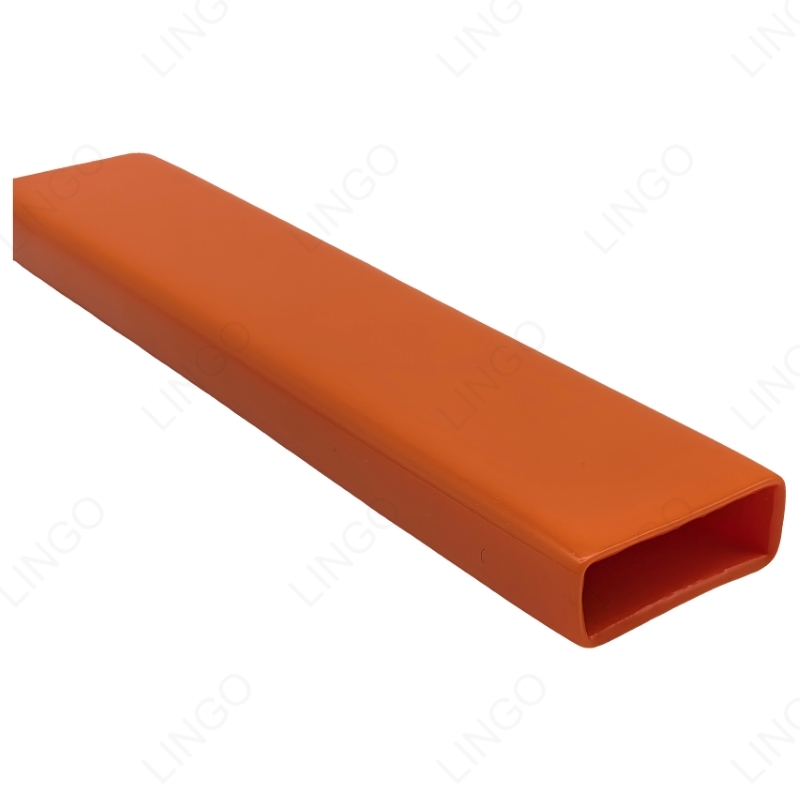
A dipped PVC handle combines grip geometry, insulation and surface protection in a single finishing step. Source: Lingo Rubber Plastic.
The role this family plays is easier to see in a delivered case than in a specification sheet. For an electrical and electronics customer in Germany, LINGO supplied 1,500 pieces of PVC dipped components used to insulate current transmission and reduce the risk of accidents from wiring damage. The reported outcomes were a close fit and stable performance, with a coating resistant to acids, alkalis, salt spray and oil, and tolerance to both low and high temperatures. Equally relevant to shortlisting, the case notes that the route requires no expensive moulds and that small orders are acceptable.
Three characteristics therefore define when a PVC dipping handle deserves a place on the shortlist. It is a finishing-led process, so tooling investment is low relative to moulded alternatives. It is chemically and electrically protective, which matters in humid, salty or chemically aggressive environments. And it is cosmetic-flexible: the case data records that the product can be formulated in a wide colour range and finished from glossy and matte to rough and textured surfaces, satisfying both anti-slip function and design intent.
CNC Machined Parts: The Complex-Role Route
LINGO's Plastic CNC Machined Parts, catalogued under model LG-CNC, cover a defined set of component types: PTFE gaskets, PP and POM machined parts, back-up rings or anti-extrusion rings, gears, seals and gaskets, and bearings and bushings. Materials listed for the CNC route include PTFE, POM, PE, UHMWPE, HDPE, PEEK, ABS, PU, PA6 and PA66. Parameters include the option of glass fibre reinforcement, references to FDA, RoHS and UL, custom colour, surface roughness expressed as Ra (µm) or Rz (µm), and visual inspection criteria of smooth finish with no crack and no flash.
The industries listed for this family are correspondingly demanding: aerospace, medical devices and healthcare, semiconductor and electronics, automotive, oil and gas, chemical and pharmaceutical, food and beverage processing, general industrial machinery, and defence and military. These are sectors where a machined part is usually a critical interface rather than a visible grip, and where the buyer's main question is whether the supplier can reproduce a geometry and a material grade consistently.
A small-order case shows how that requirement plays out. For a customer in the chemical, petrochemical, food, pharmaceutical, automotive OEM, electronics, aerospace and general machinery segments, LINGO supplied 20 pieces of PTFE back-up rings used to protect O-rings and other elastomeric seals from extrusion damage under high pressure. The reported characteristics were CNC machining, high-precision tolerance, pure PTFE with no contamination, and dispatch within two days, with small orders accepted. For a buyer, the informative part is not the quantity. It is that the part's function — protecting a primary seal — is what made machining and a specific material grade non-negotiable.
Material Choices Inside the CNC Shortlist
Once a part has been assigned to the CNC family, the shortlist decision moves from process to grade. LINGO's published material list covers both commodity engineering plastics and high-performance polymers, and the differences between them are the differences between a part that fails early and one that holds.
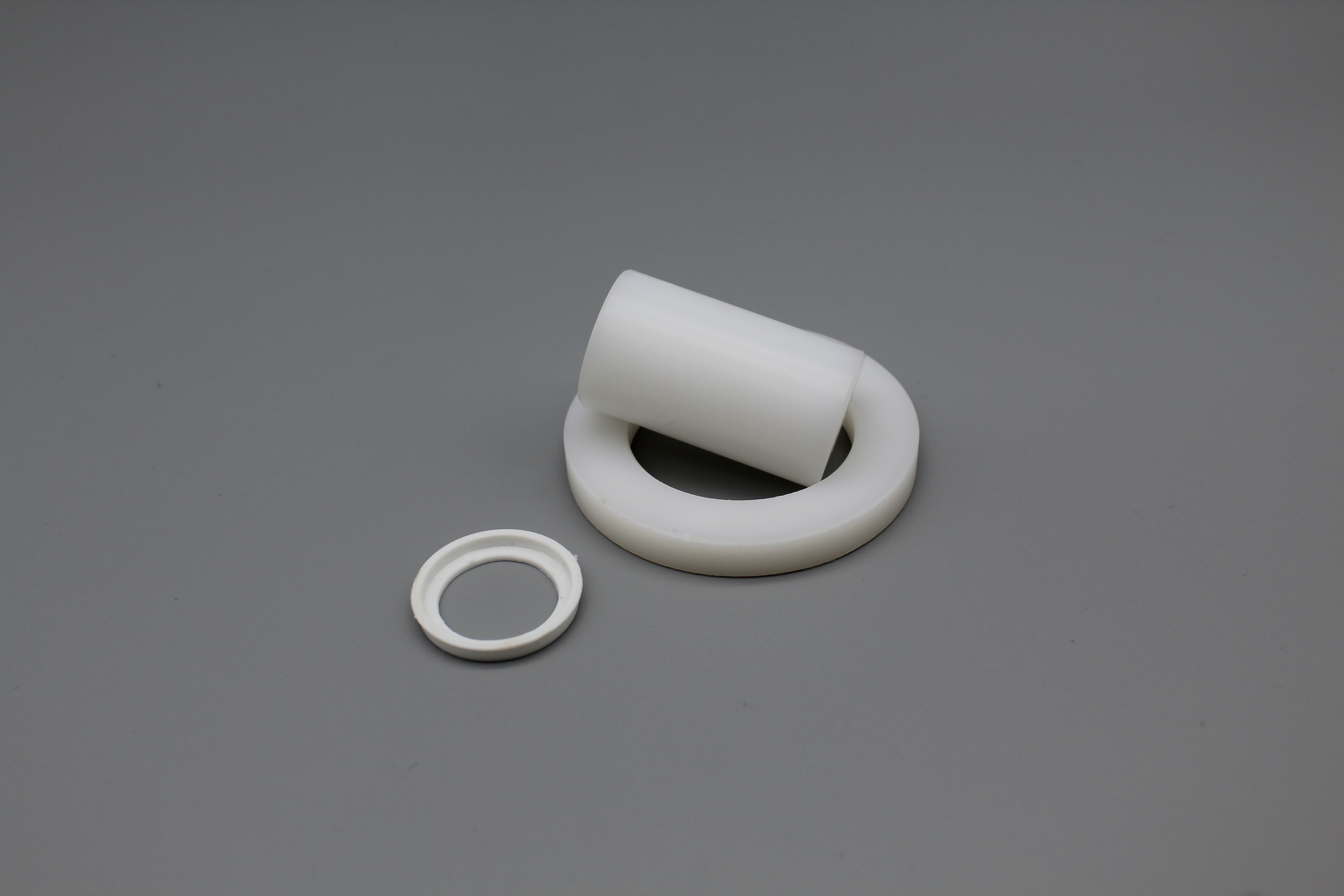
Gaskets, seals and back-up rings are among the most common machined plastic components in demanding applications. Source: Lingo Rubber Plastic.
| Material | Typical role in a project | Where buyers commonly place it |
|---|---|---|
| PTFE | Chemical resistance, low friction, anti-extrusion support | Chemical and pharmaceutical, food and beverage, oil and gas, seal support rings |
| POM | Dimensional stability and stiffness in machined mechanical parts | General industrial machinery, automotive functional components |
| PEEK | High-performance role where thermal and chemical demands are severe | Aerospace, semiconductor, medical and other high-specification environments |
| PE / UHMWPE / HDPE | Wear and impact resistance | General industrial machinery and material-handling interfaces |
| PA6 / PA66 | Mechanical strength in machined and extruded nylon parts | Industrial machinery, automotive and structural components |
| PU / ABS | Flexible or cost-sensitive machined components | General industrial applications |
The table is a screening aid, not a specification. Two parameters should always be confirmed before a grade is locked: whether glass fibre reinforcement is required, and which compliance references apply, since LINGO's CNC specification lists FDA, RoHS and UL alongside colour and surface requirements. Buyers who treat the material column as settled at the shortlist stage often discover at drawing release that the grade cannot satisfy the temperature or chemical exposure the application implies.
A third route also deserves a line on the shortlist, because it sits between the other two. LINGO's plastic injection parts family covers solid plastic parts, housing components, precision functional components, insert molded and dual-material parts, and includes plastic gaskets, plastic washers, plastic caps, plastic housings, plastic handles and plastic guide rails. Its published parameter set includes GB/T 14486 tolerance control from MT1 to MT7, a typical shrinkage range of 0.4% to 0.8% for mould compensation, and options for glass fibre, flame retardant and UV stabilization. Where volume is high and the design is stable, this is usually the more economical family — and it is worth naming explicitly so that a project does not default to machining simply because the last part was machined.
Matching the Requirement to the Right Family
Application fit is where the two-family logic becomes concrete. In electrical and electronics work, the deciding factor is often insulation and environmental protection rather than precision, which is why dipped components appear in protective and current-carrying applications; the German electronics case is a direct example. In chemical, pharmaceutical and food processing environments, the deciding factor is usually chemical resistance and the absence of contamination, which is why a pure PTFE machined component such as a back-up ring is selected.
In tools and outdoor equipment, the two routes frequently coexist on the same product. A gardening tool or fitness machine may need a dipped PVC grip for hand comfort and corrosion resistance, while its adjustment mechanism may need a machined bushing or seal to hold position under load. Treated as separate shortlist entries, both decisions are simple. Treated as one decision, they become a false trade-off.
There are also requirements that belong to neither family and should be routed early. Extruded components, including profiles, strips and tubing supplied in PA6, PA66, PE, HDPE or UHMWPE with or without glass fibre, are produced continuously rather than to a discrete geometry, with cross-sections designed to drawing and lengths listed up to 6,000 mm. A buyer who tries to solve a continuous profile requirement with CNC machining, or a precision seal requirement with extrusion, will spend more time on supplier selection than the part warrants.
Where the Shortlist Logic Has Limits
Both routes have boundaries that should be stated plainly at the evaluation stage.
PVC dipping is a finishing process, not a structural one. A dipped handle is a grip, an insulation layer and a corrosion barrier over a substrate; it is not a precision interface and should not be shortlisted to hold a tolerance or carry a load path. Its published catalogue configuration is also specific — black colour with a glossy surface, with custom printing available — so a project that requires a non-standard colour, a matte or textured finish, or a defined gloss level should confirm those deviations in writing during RFQ rather than assume them from the catalogue line. The process supports wider colour and texture formulation, but the confirmed specification is the one that governs production.
CNC machining carries a different boundary: unit economics scale with complexity. Machining a simple grip shape that could be dipped or moulded generally adds material and cycle cost without adding function. LINGO's published CNC data specifies surface roughness ranges and visual acceptance criteria, and its case records reference high-precision tolerance, but the listing does not publish a blanket tolerance class for machined parts. Tolerance for a machined component therefore has to be agreed against the buyer's own drawing. Related standards confirm the point: ISO 20457:2018, re-confirmed in 2024, specifies manufacturing tolerances for plastic moulded parts — it governs the moulded families, not machined geometries, and should not be applied across the two.
Quantity is a third boundary. Neither route is automatically the cheaper answer at every volume. Small quantities are explicitly acceptable for both families in LINGO's published terms, and lead time is stated at two to six weeks, with monthly capacity across the plastic operations listed at 1,000,000 kg. Buyers should test their own volume assumption against tooling economics before assuming that dipping or machining is the lower-cost path at scale.
Verification Checkpoints Before Awarding the Part
Whichever family is selected, the documentation package is what converts a shortlist into a supply decision. LINGO states that it provides PPAP level 1 to 3 for custom parts, maintains a batch traceability system, performs full inspection of samples with random inspection of bulk goods, and offers remote technical support, mould maintenance with ownership protection, and free exchange with acceptance of concessions.
A practical verification sequence for either family is short and repeatable:
- Confirm the functional role of the part in writing, so that process selection can be challenged later if requirements change.
- Confirm the material grade and any reinforcement, plus the compliance references that apply — the CNC listing cites FDA, RoHS and UL.
- Confirm the dimensional requirement: for machined parts, from the drawing; for moulded families, against the applicable tolerance framework such as ISO 20457:2018 or the GB/T 14486 class declared in the injection molding specification.
- Confirm the inspection basis: sample inspection plus bulk random inspection, with traceability per batch.
- Confirm the commercial frame: MOQ by part, lead time, and whether small quantities are accepted for the first run.
Why Multi-Process Suppliers Keep Appearing on Shortlists
One structural trend is visible in the source data. LINGO's own capability statements describe injection molding, extrusion, PVC dip molding and CNC precision machining operating within one OEM/ODM service scope, and its export markets are listed as the United States, Canada, Europe, Australia and Asia, with a stated export ratio of about 80% and main markets in the EU and USA.
The reason this matters to buyers is consistency, not convenience. When a dipped grip and a machined bushing for the same product are supplied from one quality system, the inspection basis, traceability record and material documentation are aligned. That reduces the coordination overhead that normally appears when a project splits its coating and machining requirements across two suppliers with different documentation practices. It does not remove the need to evaluate each process on its own merits — but it does simplify the second pass of a shortlist.
What to Watch Over the Next Sourcing Cycle
Three watch points are reasonable to carry into the next sourcing round. First, with injection molding holding 42% of the global plastic market in 2025, competition for standardized moulded parts will remain intense, which pushes differentiation toward the specific, documented component families covered here. Second, the USD 66.77 billion global export value for HS Code 392690 in 2025 indicates that cross-border sourcing of plastic articles is a mature, well-established trade flow rather than a niche arrangement — which raises the relative value of documentation and traceability over availability alone. Third, as projects in new materials, electrical equipment and energy-adjacent hardware combine coated grips with precision interfaces in the same assembly, buyers are likely to place more weight on suppliers that can cover both roles under one traceability system without diluting either capability.
For a project team, the actionable conclusion is procedural. Classify every part by function before comparing any supplier, screen materials inside the chosen family rather than across families, and confirm the limits — coating versus structure, machined tolerance versus drawing — in writing. A shortlist built this way survives scope changes; a shortlist built on process preference usually does not.
LINGO's full manufacturing and process overview is available in the downloadable company profile.
FAQ
How do I decide between a PVC dipping handle and a CNC machined part at the start of a project?
Decide by function, not by preference. If the requirement is a grip, an insulation layer or a protective coating over a substrate, the part belongs in the PVC dipping family, which LINGO catalogues under model LGHD. If the requirement is a precision interface such as a seal, back-up ring, bushing or gear that must hold a drawing tolerance, the part belongs in the CNC machined family, catalogued under model LG-CNC. Where the requirement is a high-volume, stable-design functional part, injection molding or extrusion is usually the appropriate family instead.
Which materials are available for CNC machined parts?
LINGO lists PTFE, POM, PE, UHMWPE, HDPE, PEEK, ABS, PU, PA6 and PA66 for its CNC machined parts, with or without glass fibre reinforcement. The published parameter set also references FDA, RoHS and UL, custom colour, surface roughness expressed as Ra (µm) or Rz (µm), and visual acceptance criteria requiring a smooth finish with no crack and no flash.
What part types are typically produced on the CNC route?
The listed types are PTFE gaskets, PP and POM machined parts, back-up rings or anti-extrusion rings, gears, seals and gaskets, and bearings and bushings. These are generally interface components. A delivered example is a set of 20 PTFE back-up rings for a customer serving the chemical, petrochemical, food and pharmaceutical, automotive OEM, electronics, aerospace and general machinery segments, where the rings protect elastomeric seals from extrusion damage under high pressure.
Can PVC dipping handles be customized beyond the standard black glossy finish?
The catalogue specification for LGHD lists PVC material, black colour, glossy surface and custom printing, and the applicable industries include hardware tools, electrical and electronics, automotive, fitness equipment, gardening tools, household products, industrial equipment and building hardware. Case data records that the dipping process can be formulated in a wide range of colours and finished from glossy and matte to rough and textured surfaces, supporting both anti-slip function and design requirements. Because the published specification and the achievable range are not identical, any deviation from the catalogue line should be confirmed in writing at the RFQ stage.
What are the MOQ and lead time expectations for these parts?
LINGO states that MOQ depends on the part and that small quantity orders are acceptable, with lead time listed at two to six weeks and monthly plastic capacity of 1,000,000 kg. Small-quantity supply is documented in both families: the PVC dipping case involved 1,500 pieces with no expensive moulds required, and a PTFE back-up ring order of 20 pieces was dispatched within two days.
What documentation should a buyer request before awarding the part?
LINGO states that it provides PPAP level 1 to 3 for custom parts, operates a batch traceability system, performs full inspection of samples with random inspection of bulk goods, and offers remote technical support, mould maintenance with ownership protection, and free exchange with acceptance of concessions. On the technical side, buyers should confirm the applicable tolerance framework — ISO 20457:2018 for plastic moulded parts, or the GB/T 14486 MT1 to MT7 classes cited in the injection molding specification — and confirm that the framework matches the process actually being awarded, since it does not apply to machined geometries in the same way.