
The 2026 Buyer's Shortlist: Five Questions to Filter Paper Bag Machine Suppliers Down to Two
A screening formula for procurement leads comparing paper bag making machines, built on evidence that can be scored rather than adjectives that cannot.
Paper bag machine procurement in 2026 is less a discovery problem than a filtering problem. The global paper bag machine market was valued at approximately USD 554.89 million in 2024, with expectations to reach USD 762.49 million by 2033, according to industry analysis published by Vertex AI Search. A larger market brings more suppliers, more quotation documents, and more specification sheets that read as interchangeable in the first round.
Most shortlists collapse to two suppliers on price and print alone. The harder question is which two deserve a site visit, a test run and a line in the capital budget. The five filters below do that work. They are deliberately not a list of company names; they are a screening formula that two colleagues on the same procurement team can apply to the same vendor pool and reach the same shortlist.
Why Five Filters Beat a Longer Checklist
Three properties make a filter usable. It must be answerable with evidence. It must separate suppliers rather than describe them. And it must be scorable by different people consistently. Most supplier questionnaires fail the second property: they generate paragraphs of adjectives that cannot be compared across vendors.
Category data explains why the filters have to go past machine type. Square bottom paper bag machines accounted for nearly 58.5% of total global unit installations as of 2023, and the automatic machine segment held 62.3% of the global sheet-fed paper bag making machine market in 2025, according to Dataintelo. When most buyers are already comparing inside the same machine class, differentiation has to come from execution — components, training, parts, proof and paperwork — rather than from category labels.
Geography adds a second reason. China, India and Germany collectively contribute over 61.4% of total global output of paper bag manufacturing machinery, based on Vertex AI Search industry trends. Most shortlists will therefore include at least one supplier at a significant service distance, which raises the cost of getting Questions 2, 3 and 5 wrong.
Question 1 — How Are Core Components Handled?
Answer first: the useful version of this question is not what the frame is made of, but which components are designed to be replaced, how they are located, and whether they are individually identifiable. Material specifications open the conversation; wear-item architecture closes it.
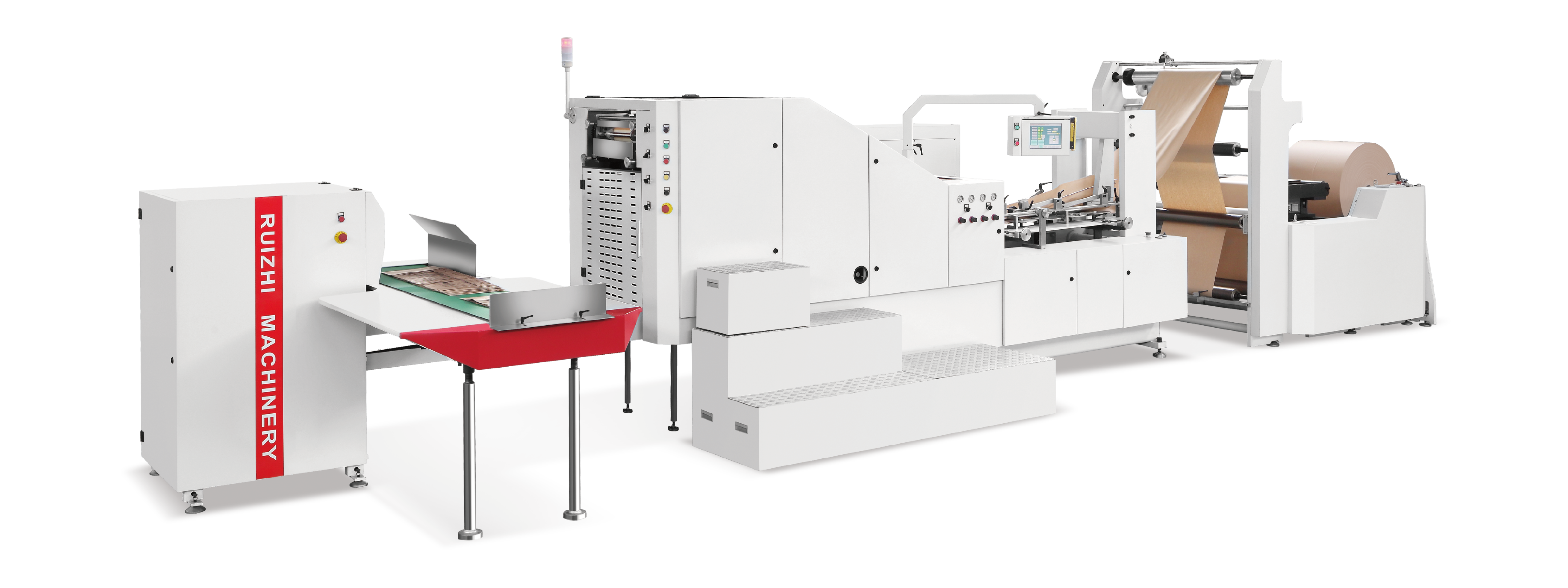
Across the Ruizhi Machinery range, machines are built with a stainless steel outer casing, a carbon steel frame and alloy core components. That combination is standard industrial practice in this category, which is precisely why the follow-up matters. If the material stack is common, the differentiator sits in whether wear parts are part-numbered, whether the surfaces they locate against are machined to a stated tolerance, and whether the supplier can say which parts are consumed by running hours and which by bag cycles.
Machine mass is a useful cross-check, though not a quality score. A RZJD-G250J sharp bottom paper bag machine weighs 4,500 kg and covers bag widths from 70–250 mm. A RZJD-G350J weighs 6,500 kg and covers 70–350 mm. A RZFD-550N square bottom machine weighs 14,000 kg across a 240–550 mm width range, while a RZFD-550NT handle-capable square bottom machine reaches 26,000 kg. Mass generally tracks format envelope, drive sizing and handle modules. An abrupt mismatch between a stated format range and the machine's mass is worth a direct question rather than an assumption.
What to ask
- Which components sit on a replacement schedule, and what triggers replacement — running hours, bag cycles or output volume?
- Are wear parts individually part-numbered in the spare parts list, or bundled into larger assemblies?
- What is the warranty position on core assemblies compared with consumables?
- Which locating surfaces are machined to a stated tolerance, and is that tolerance documented?
How to score it
Two points when the supplier can name wear components and hand over a numbered parts list; one point when the answer is verbal and undocumented; zero when wear parts cannot be identified at all. A zero here is not a minor gap — it means the cost of ownership cannot be modelled.
Question 2 — How Complex Is Operator Training?
Answer first: training complexity scales with the number of format variables a machine carries, not with its speed and not with its price. A narrow-format machine with a fixed bag style asks an operator to learn one setup. A wide-format machine with optional handle, rope and insert configurations asks the operator to learn a matrix.
The Ruizhi model range shows the spread clearly. The RZFD-190 square bottom machine runs bag lengths of 190–370 mm and widths of 80–190 mm on paper from 50–130 g/m² — a compact envelope. The RZFD-550NT runs bag lengths of 380–760 mm and widths of 240–550 mm, with a separate handle-paper length window of 380–660 mm and paper weights from 80–160 g/m². Both are square bottom paper bag machines. The training burden is not the same, and a quotation that treats them as equivalent is answering the wrong question.
Ruizhi Machinery's stated service scope includes technical consultation, installation and commissioning, and operation training. Those three items are the right building blocks for this filter, but they need conversion into specifics before they can be scored.
What to ask
- Who delivers the training — the commissioning engineer, a dedicated trainer, or a local distributor?
- In which language, and is it delivered on site or remotely?
- Is training tied to a signed acceptance record, or handed over informally during commissioning?
- How many operators are covered, and is a refresher session included?
- What is the documented restart procedure after a power interruption or an emergency stop?
How to score it
Two points when the supplier can name the trainer, the language, the operator count and the acceptance record that closes the training; one point when training is offered but undocumented; zero when no structured handover exists.
Question 3 — Can You Verify Spare Part Availability?
Answer first: spare part availability is a warehouse question, not a promise question. The verifiable version asks for a numbered list of parts held in stock, a physical or photographic view of the parts area, and a stated replenishment route for the parts that are not held.
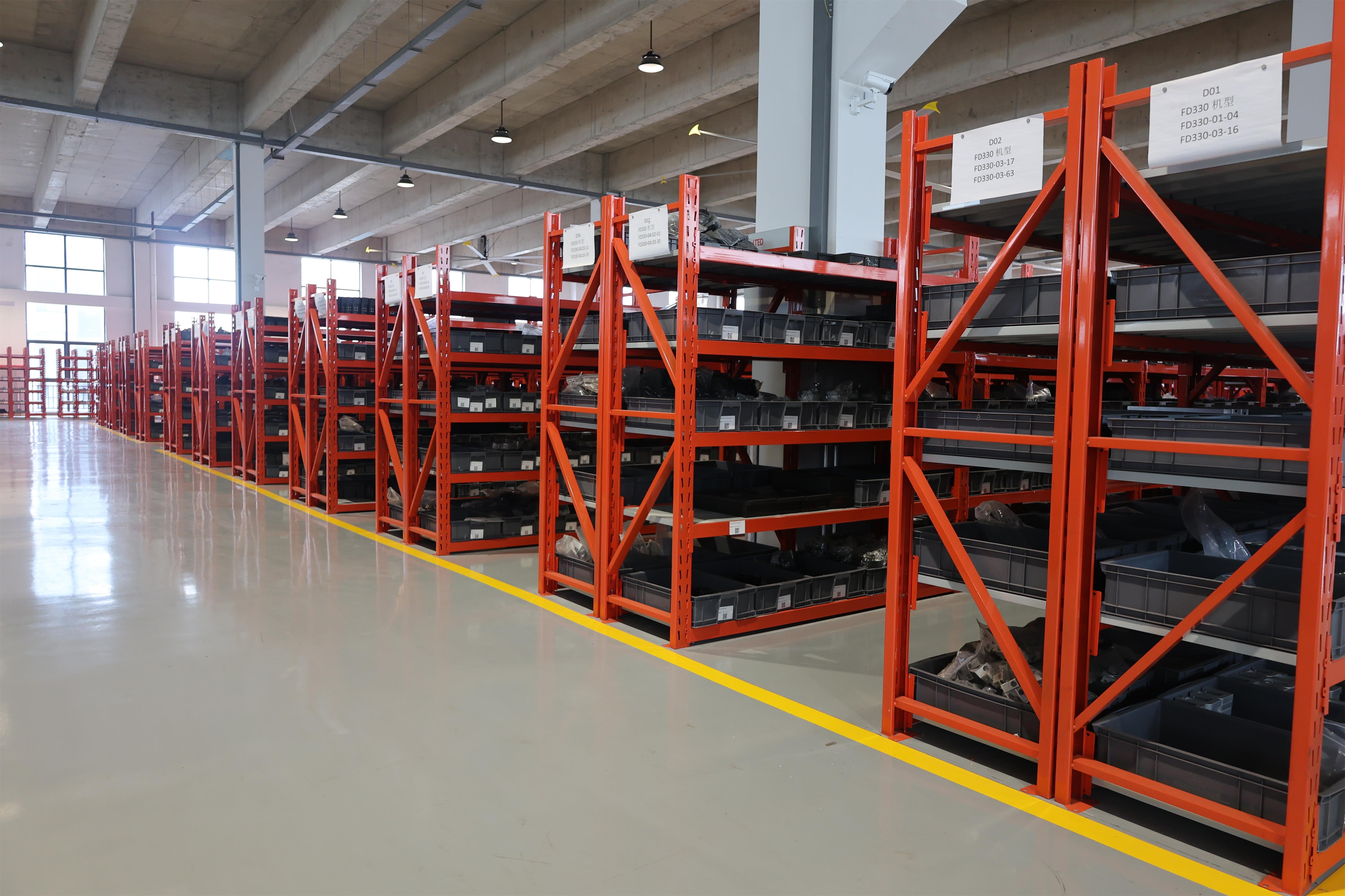
Ruizhi Machinery maintains a dedicated spare parts area at its production site. That is a reasonable starting evidence point because it demonstrates a stocking function exists rather than a catalogue-only parts desk. It does not prove stock depth for every part number, and buyers should not treat it as if it does. Depth has to be confirmed part by part, ideally against the numbered list produced under Question 1.
The three tiers to check
- Consumables and wear items — blades, belts, suction elements, grippers.
- Electromechanical items — motors, drives, sensors, pneumatic valves.
- Format-specific and structural parts — handle modules, forming plates, folding components.
The third tier is where most shortlists are quietly at risk. Format-specific parts are the least likely to sit on a shelf and the most likely to stop a line.
A fourth consideration is electrical compatibility. Ruizhi machines are specified at 380V, three-phase, four-wire, with power ratings that differ by model — 15 kW on an RZFD-330, 20 kW on an RZFD-550N, 41.5 kW on an RZFD-330T and 47 kW on an RZFD-550NT. A spare-part plan that ignores the electrical interface is incomplete, because site power work and control-component compatibility belong to the same availability question.
How to score it
Two points for a numbered list plus stock confirmation and a replenishment route; one point for a list without stock confirmation; zero when no parts list can be produced before order.
Question 4 — Is Real Performance Substantiated?
Answer first: a machine speed figure is not a production rate. Ruizhi's RZFD-330 lists a machine speed of 30–220 pcs/min and a paper bag speed of 30–180 pcs/min. The distance between those two numbers is where actual output lives, and a similar gap appears, in different proportions, on almost every specification sheet in this category.
External benchmarks help calibrate the category but cannot confirm an individual machine. Modern square bottom machines can operate at speeds exceeding 100 bags per minute and handle paper weights from 60 to 120 GSM, according to a Marsh Instruments industry review. That statement describes what the class can do. It does not describe what a specific machine will do on a specific paper stock at a specific bag size, on a specific shift pattern.
The evidence hierarchy
- Level 1: a witnessed run on the buyer's own paper, on the specified format.
- Level 2: a recorded test run on the specified format, with parameters and duration stated.
- Level 3: a physical bag sample produced on the specified machine and format.
- Level 4: a printed parameter sheet.
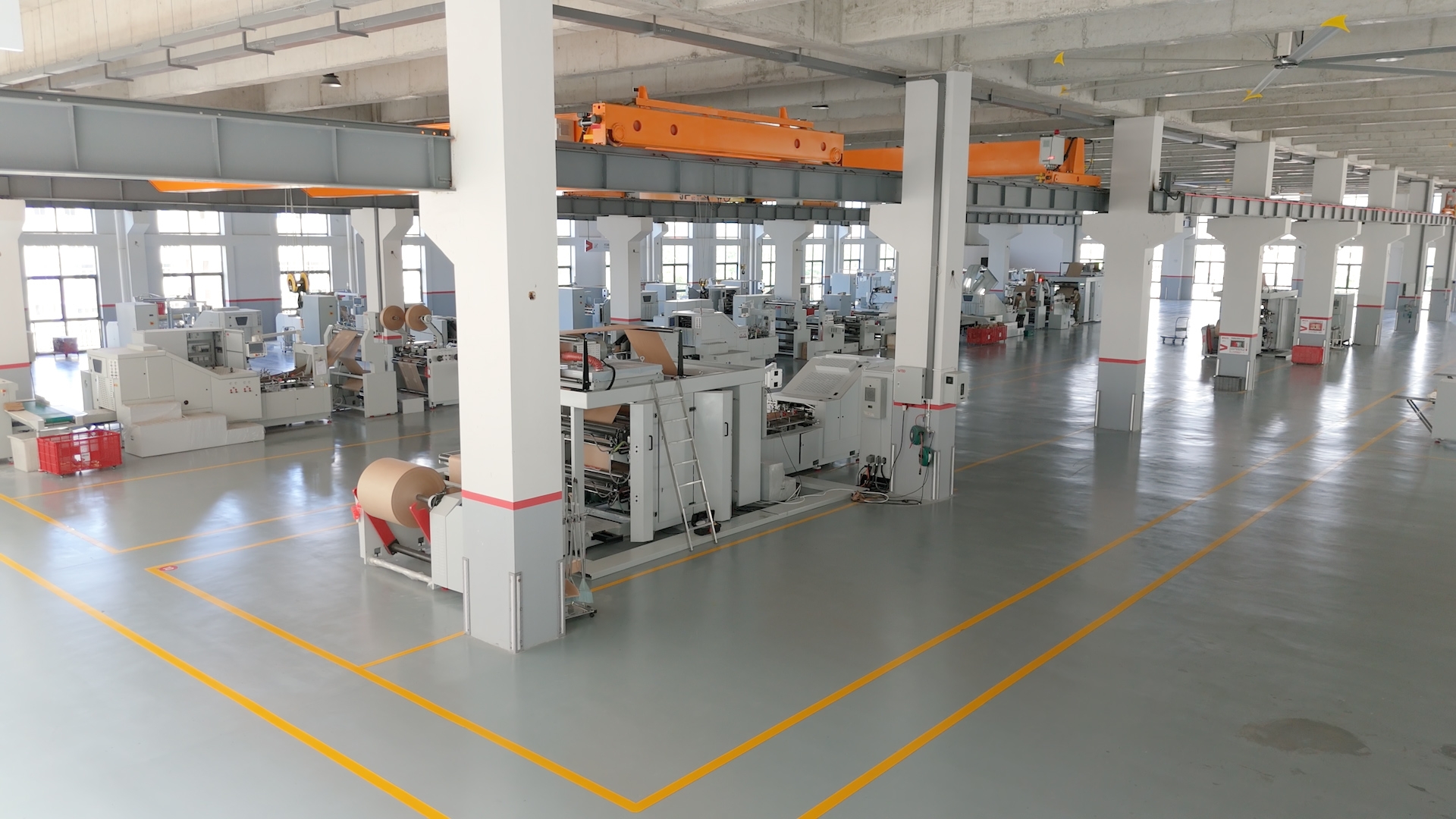
Most procurement disputes in this category happen when level four evidence is accepted as though it were level one. Ruizhi Machinery operates a testing area at its production site that supports level two evidence by default, and level one when the buyer attends in person.
What to ask
- Which format and which paper GSM were used in the reference run?
- How long did the run last, and was it continuous?
- Was the machine run at the upper end of its speed range or at a nominal rate?
- What waste or reject rate was recorded?
- Who signed off the run, and is the record available to the buyer?
How to score it
Two points for a recorded run on the specified format; one point for a bag sample without a run record; zero when only a parameter sheet is offered.
Question 5 — Is the Commercial and Compliance Package Documented?
Answer first: documentation is what separates a supplier that can support a purchase order from one that can only quote a price. It is also the filter that most often decides whether a shortlisted supplier survives an internal audit.
On compliance, packaging machinery destined for EU markets must meet the EU Machinery Directive 2006/42/EC and is transitioning to the new EU Machinery Regulation (2023), which places additional emphasis on software safety. Ruizhi Machinery manufactures under ISO 9001 quality system standards and holds CE safety certification. The two are related but not interchangeable: ISO 9001 addresses the quality management system, while CE addresses conformity of the machine itself.
Documents to require in writing
- A signed configuration list matched line by line to the quotation, including every optional module.
- Electrical schematic and utility requirements — voltage, phase, power.
- A numbered spare parts list.
- A training and acceptance record template.
- Declaration of conformity and the applicable standards.
- Warranty terms that state the boundary between wear parts and covered assemblies.
- Lead time and payment structure in writing.
How to score it
Two points for a complete documentation package in writing; one point for a partial package; zero when the package cannot be produced before order.
The Scoring Formula: Turning Five Answers into Two Suppliers
Five questions, two points each, ten points available. The model is deliberately simple, because a scoring framework that needs a specialist to interpret will not be applied consistently across a procurement team.
| Filter | Evidence required | 0 points | 1 point | 2 points |
|---|---|---|---|---|
| Core component handling | Numbered wear-part list plus material statement | Wear parts cannot be identified | Verbal answer only | Numbered list plus tolerance statement |
| Operator training complexity | Named trainer, language, operator count, acceptance record | No structured handover | Training offered but undocumented | Documented programme tied to acceptance |
| Spare part availability | Stock list, parts area evidence, replenishment route | No parts list | List without stock confirmation | List plus stock and replenishment route |
| Performance substantiation | Format, GSM, run record, bag sample | Parameter sheet only | Sample without run record | Recorded run on the specified format |
| Documentation package | Configuration list, schematics, declaration of conformity, warranty terms | Incomplete package | Partial package | Complete package in writing |
Two refinements matter in practice. If more than two suppliers reach seven points, re-score Question 4 at double weight, because performance substantiation carries the highest commercial risk and the longest recovery time if it turns out to be wrong. And score twice — once from documents, once after the site visit. The difference between the two scores is itself useful information about how accurately the supplier communicates.
Where Ruizhi Machinery Sits Against the Filter
Wenzhou Ruizhi Packing Machinery Co.,Ltd is a Wenzhou, Zhejiang-based manufacturer of environmentally friendly paper bag making machines, producing flat bottom and square bottom models for food packaging, retail packaging and e-commerce packaging applications. Company data records a 33,333 m² facility, 170 employees, 30 R&D engineers, an annual output of 300 units, an export share of roughly 70%, main markets including the USA and EU, and shipments to more than 60 countries and regions.
Set against the five filters, the available evidence reads as follows.
| Filter | Evidence on record |
|---|---|
| Core components | Stainless steel outer casing, carbon steel frame and alloy core components are stated across the published model range. |
| Operator training | Technical consultation, installation and commissioning, and operation training are part of the stated service scope. |
| Spare parts | A dedicated spare parts area exists at the production site. |
| Performance | A testing area exists at the production site, and published model data separates machine speed from paper bag speed. |
| Documentation | ISO 9001 quality system standards and CE safety certification, with a downloadable product brochure. |
Two boundaries should be stated plainly. Ruizhi is identified by Dataintelo market research as a key player capturing substantial market share in the sheet-fed paper bag making machine sector; that is a market-position observation, not a performance guarantee for any individual model. And no supplier's written answers replace level one or level two evidence on the buyer's own paper stock. The five questions rank suppliers; they do not certify machines.
Application Fit — What Changes the Weighting
The application record associated with the RZFD-450A square bottom model describes an indoor workshop at normal temperature of 10–40°C with standard humidity and dust-free conditions required for food-grade packaging, a 24/7 operation mode, an air compressor as matched equipment, and food-grade material contact parts.
Three of those conditions shift the weighting of the five questions. A 24/7 duty cycle raises the weight of Question 1 and Question 3, because wear parts and availability are consumed faster. Food-grade packaging adds a documentation requirement to Question 5, because material contact parts must be traceable. And a matched air compressor is a reminder that machine performance depends partly on utilities the buyer supplies — a factor no supplier filter can score on the supplier's behalf.
Market Trend Analysis
Three data points frame the 2026 shortlist. The market itself was valued at approximately USD 554.89 million in 2024 and is projected to reach USD 762.49 million by 2033. Square bottom machines accounted for nearly 58.5% of total global unit installations as of 2023. And the automatic segment held 62.3% of the global sheet-fed paper bag making machine market in 2025.
Competitive concentration is uneven. Windmoeller & Hoelscher held the highest market share in 2023, delivering over 1,900 advanced automatic paper bag machines globally, while China, India and Germany together contribute over 61.4% of global output. Market estimates also diverge by scope — total paper bag machines versus the sheet-fed segment only — so any single figure should be treated as directional rather than quoted in a business case without a stated scope.
The practical implication is that category leadership and supplier fit are separate questions. A market leader's installed base is not evidence that a given machine matches a buyer's format envelope, and a smaller manufacturer's narrower published range is not evidence that it cannot. The five filters operate at the level where the purchase actually happens.
What the Five Questions Cannot Do
- They cannot replace a test run on the buyer's own paper stock, which remains the only direct evidence of output on a given material.
- They cannot price-check. Two suppliers can both score eight and still differ substantially on commercial terms.
- They cannot resolve format-specific lead times, which have to be confirmed part by part rather than at company level.
- They cannot work without a defined format envelope. A buyer who has not fixed bag sizes, paper weights and handle requirements will produce noise rather than a shortlist.
- They cannot guarantee uptime. Duty cycle, operator skill and maintenance discipline sit outside the supplier's control.
Future Outlook
Three developments are likely to reshape shortlisting through 2027. The transition from the EU Machinery Directive (2006/42/EC) to the EU Machinery Regulation (2023) will raise the weight of documentation in Question 5, and suppliers already operating within ISO 9001 and CE frameworks will carry less rework. The automatic segment's 62.3% share of the sheet-fed market points to continued buyer preference for automated lines, which raises rather than lowers the importance of Question 2, because automation increases the amount an operator has to learn. And spare part localisation is likely to become a more visible differentiator as service distances stay long and production schedules tighten.
FAQ
What are the five questions to ask a paper bag machine supplier?
The five filters are core component handling, operator training complexity, spare part availability, real performance substantiation, and documentation of the commercial and compliance package. Each is scored from zero to two points. A zero on any single filter eliminates the supplier regardless of the total, because a filter that cannot be answered with evidence represents unquantified risk.
How can a buyer check spare part availability before placing an order?
Request a numbered spare parts list, ask which of those parts are held in stock, ask for a physical or photographic view of the parts area, and confirm the replenishment route for parts that are not held. A view of a parts area demonstrates that a stocking function exists; it does not establish stock depth for every part number, which must be confirmed individually. Electrical compatibility should be checked in the same step, since Ruizhi machines are specified at 380V, three-phase, four-wire.
How long does operator training take on an automatic paper bag machine?
Training duration depends on the machine's format envelope and optional modules rather than on its speed or price. A wide-format machine with handle, rope and insert options carries more changeover procedures than a narrow-format single-style machine. Ruizhi Machinery's stated service scope includes installation and commissioning and operation training as part of handover. Buyers should confirm trainer identity, language, the number of operators covered, and whether training is closed by a signed acceptance record.
What is the difference between machine speed and paper bag speed?
Machine speed describes the running rate of the machine; paper bag speed describes the output of finished bags. On Ruizhi's RZFD-330, machine speed is listed at 30–220 pcs/min and paper bag speed at 30–180 pcs/min. The gap reflects the difference between machine cycles and completed bags, so production capacity should be planned on the paper bag speed figure rather than the machine speed figure.
Which certifications matter for paper bag machines sold into the EU?
Packaging machinery for EU markets must meet the EU Machinery Directive 2006/42/EC, and the framework is transitioning to the EU Machinery Regulation (2023), which adds emphasis on software safety. CE certification addresses conformity of the machine; ISO 9001 addresses the manufacturer's quality management system. Ruizhi Machinery manufactures under ISO 9001 quality system standards and holds CE safety certification — both are relevant, and neither substitutes for the other.
Is a heavier paper bag machine always better?
No. Machine mass generally tracks format envelope, drive sizing and handle modules rather than quality on its own. A RZJD-G250J at 4,500 kg covers widths of 70–250 mm, while a RZFD-550NT at 26,000 kg covers widths of 240–550 mm with a handle module. Mass is useful as a consistency check against a stated specification, not as a ranking criterion across different format classes.
A product brochure covering the Ruizhi Machinery paper bag machine range can be downloaded here: Ruizhi Machinery paper bag machine brochure.
¿Tiene preguntas o necesita más detalles?
Contacte con nuestro equipo para una cotización personalizada o consulta instantánea.
Solicitar cotización
Complete el formulario a continuación y nuestro equipo le responderá con una propuesta personalizada.
Chat directo de WhatsApp
¿Prefiere chatear en tiempo real? Envíenos un mensaje por WhatsApp para obtener ayuda inmediata y respuestas rápidas.
- Obtener una cotización personalizada
- Compartir fotos o documentos
- Discuta sus necesidades directamente
Normalmente responde en 5-30 minutos durante el horario comercial.