
The 0.1–100 L/min Shortlist: Ultrasonic Flow Sensor Series for OEMs
A flow specification that spans several orders of magnitude — from a fraction of a millilitre per minute to a hundred litres per minute — rarely fits one sensor body. This shortlist organises XY-TEK's ultrasonic flow sensor series into low-flow, mid-range and high-flow tiers using published specification data, so that OEM engineers can match series to flow band, installation method, accuracy class and output interface.
Industrial and medical OEM platforms seldom meter at one rate. A reagent or flux line may need control in the millilitres-per-minute range; a coolant loop on the same machine may move tens of litres per minute. The practical result is a familiar procurement pattern: engineers searching for a sensor family that can be specified, documented and supported across a 0.1 to 100 L/min operating window without switching suppliers mid-project.
Shanghai Xunyin Technology Co., Ltd (XY-TEK) is a Shanghai-based developer and manufacturer of ultrasonic flow sensors and flow meters, founded in 2018, whose stated focus is fluid management and control in small tubing and low flow rate measurement. Its published series specification data defines a measuring scope running from 0.1 mL/min in the TGU Series to 100 L/min in the TPD and TPK Series — the span this shortlist is built around.
The Constraint Problem: Four Specifications Decide the Shortlist
At the research and evaluation stage, four constraints eliminate most candidate sensors before price or lead time is discussed. They are also the constraints that a datasheet can answer directly:
- Flow band. Whether the device covers the minimum and maximum rate the process will actually see, including dosing pulses at the low end and recirculation peaks at the high end.
- Installation method. Whether the fluid path can be broken (inline body) or must remain closed (clamp-on measurement on the outside of tubing).
- Accuracy class. The stated accuracy of the series, and whether that figure holds at the low end of the range where most OEM errors appear.
- Output and integration. Whether the sensor presents analog, pulse or RS485 output that the existing controller can read without an added conversion layer.
Beyond these, two evidence layers matter for programs that run for years: patent coverage attached to the sensing technology, and the medium compatibility boundaries stated by the manufacturer. Both are treated below with the specific facts published in the XY-TEK specification and certification records.
How This Shortlist Was Assembled
The tiers below use only XY-TEK series specification data: stated measuring scope, stated accuracy, compatible pipe geometry, applicable fluid temperature, output options and applicable industries. Where a series carries a China National Intellectual Property Administration (CNIPA) invention patent, the certificate number, issuing authority and validity period are given as recorded.
Two exclusions are deliberate. First, no competitor parameter is estimated or inferred: specifications for other manufacturers' flow sensors are not part of this data set, and no comparative performance claim is made. Second, no price band is asserted for custom configurations, because unit pricing for OEM-configured sensors is not published in the available specification records; instead, the verified commercial parameters that are documented — minimum order quantity, lead time and production windows — are listed in the integration section.
The resulting shortlist has three tiers: low flow (TGU, SU), mid-range (CG, CM, TH) and high flow (CPD, CS, TPD, TPK).
Low-Flow Tier: TGU and SU (0.1 mL/min to 10 L/min)
TGU Series — Low-flow Ultrasonic Flow Sensor
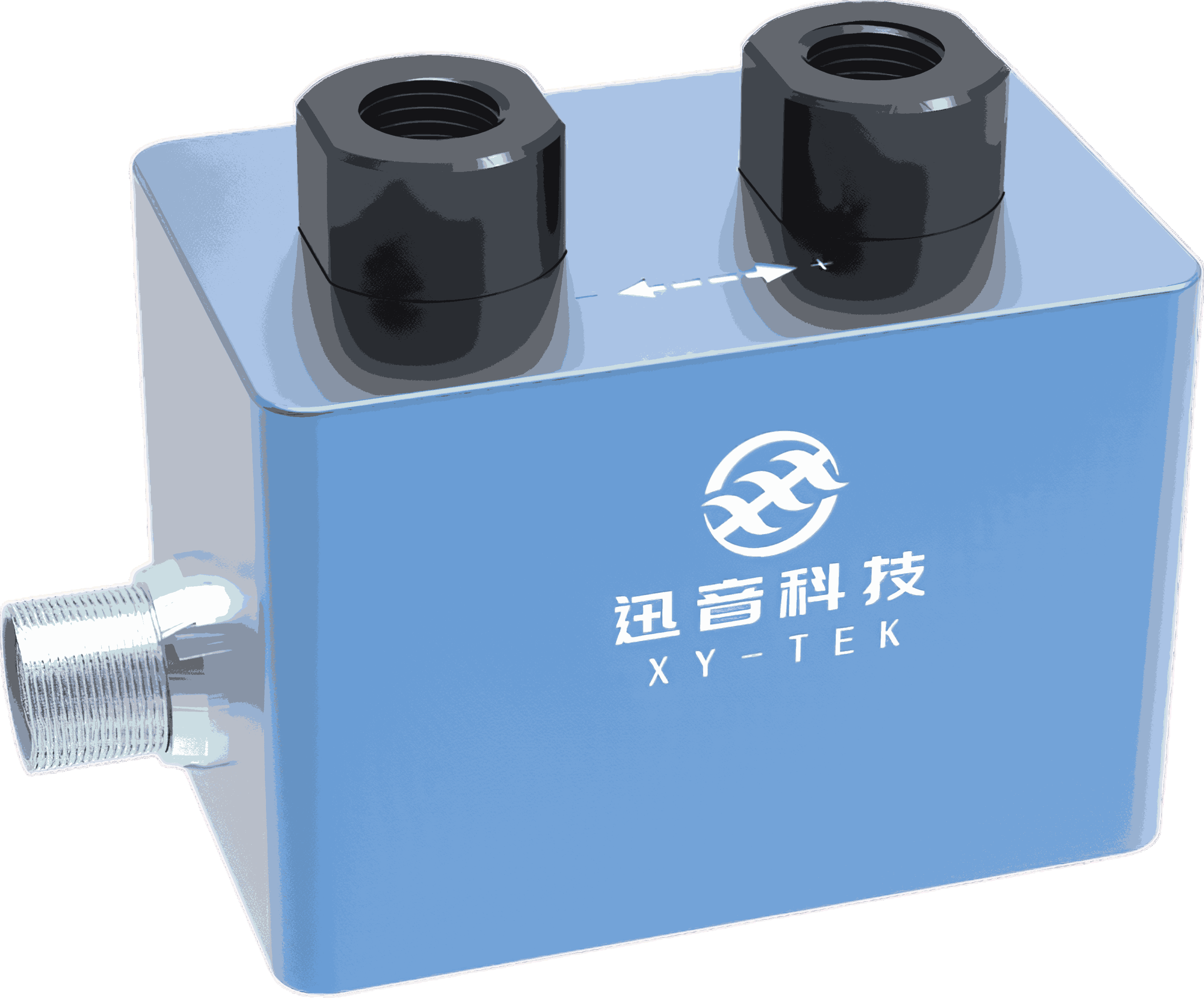
The TGU Series is the finest-resolution series in the range and is the reference point for the low end of the 0.1–100 L/min span. Its stated measuring scope is 0.1–1000 mL/min, with measurement accuracy stated as up to ±0.1 mL/min and an accuracy figure of ±1%. The series uses a U-shaped measuring channel and is compatible with PVC, silicone and PE flexible tubing, with biocompatible plastic and an ultrasonic sensor module as the primary materials. Applicable fluid temperature is 0 °C to 60 °C, and the stated application industries are bioprocess, medical equipment, pharmaceutical production and semiconductor.
The distinguishing engineering feature is not the accuracy figure alone but the combination of a dedicated low-flow channel and flexible-tubing compatibility — the two conditions that usually break general-purpose meters below 1 L/min.
In electronics manufacturing, the recorded case data for the TGU Series covers selective wave soldering and SMT/EMS environments, where customers operate one to ten production lines. The documented application is real-time measurement and control of pulsed micro-flux flow, bubble, blockage and leakage detection, and process data recording. The published results describe improved soldering quality and consistency, reduced cold solder and missing solder, and reduced flux waste and rework cost, with the sensor described as maintenance-free, corrosion-resistant and bidirectional.
SU Series — Single-use Ultrasonic Flow Sensor
The SU Series addresses the tier where the fluid path must be disposable rather than merely non-contact. Its stated measuring scope is 0.05–10 L/min at ±2% accuracy, built on a single-use measuring channel with hygienic fluid monitoring, sterile application support and high measurement repeatability. The primary material is biocompatible polymer. Applicable fluid temperature is 0 °C to 60 °C, and the stated industries are biopharma, single-use systems, medical manufacturing and bioprocess.
For an OEM engineer, the SU Series answers a constraint that accuracy data alone cannot: when the process forbids reuse of a wetted channel, the sensor body must be designed around a replaceable measuring channel from the outset. The SU Series carries coverage under a CNIPA invention patent issued 1 November 2022 and valid to 1 November 2042, recorded as covering ultrasonic flow sensor technology.
Mid-Range Tier: CG, CM and TH (0.01 to 30 L/min)
CG Series — Clamp-on Ultrasonic Flow Sensor
The CG Series is the broadest-fit clamp-on option in the mid-range, with a stated measuring scope of 0.02–20 L/min and a stated accuracy of ±3%. It measures non-invasively and supports bi-directional flow detection plus air bubble detection. Output options are the widest in the range: analog, pulse and RS485. Compatible outer diameters run from 4 mm to 35 mm and inner diameters from 2 mm to 25.4 mm, with PVC, silicone, PFA, PE and PUR flexible tubing having smooth inner and outer surfaces. Applicable fluid temperature is 0 °C to 60 °C. The housing is ABS with stainless steel sensor components, and the stated industries are medical devices, biopharmaceutical and industrial automation.
The CG Series is the product referenced in recorded liquid cooling case data, where the customer groups are data centres, industrial equipment, medical device manufacturers and charging station makers, running multiple cooling loops. The documented application is monitoring non-conductive coolant flow, preventing overheating, detecting leaks and blockages, and optimising cooling efficiency, with a stated service duration of two to four years and results described as stable cooling performance, reduced energy consumption, extended equipment life and less downtime. Recorded strengths for this application are suitability for non-conductive media, non-invasive measurement, low pressure loss and adaptability to coolants.
CM Series — Ultrasonic Flow Meter (OEM Clamp-on)
The CM Series is positioned as an OEM integration platform rather than a stand-alone instrument. Its stated measuring scope is 0.05–30 L/min at ±3% accuracy, with RS485 output, a compact design, non-contact liquid measurement and stable signal transmission described as supporting easy OEM integration. Compatible outer diameters are 4–25 mm and inner diameters 3–16 mm, with applicable fluid temperature of 0 °C to 60 °C. Stated industries are medical devices, OEM equipment, fluid control systems and laboratory equipment.
The CM Series carries the densest patent record in the range: one CNIPA invention patent certificate issued 1 November 2022 and valid to 1 November 2042 recorded as covering ultrasonic flowmeter technology, and a second CNIPA invention patent certificate with the same issue and expiry dates recorded as covering ultrasonic flow sensor technology. In both records the certificate number is partially obscured in the available documentation, and both apply to the China market under the Patent Law of the People's Republic of China.
TH Series — Pulsatile Flow Sensor
The TH Series is the only series in this shortlist specified for pulsation capture rather than averaged flow. Its stated measuring scope is 0.01–15 L/min at ±2% accuracy, with high-speed pulsation capture and a design intended for cardiovascular flow testing. Compatible outer diameters are 9–32 mm and inner diameters 11.1–36 mm; applicable fluid temperature is 0 °C to 60 °C. The material set is medical-grade polymer with a precision ultrasonic chip, and the stated industries are cardiovascular research, hemodynamic testing and medical laboratories.
For an OEM engineer working at the boundary between low and mid-range, the TH Series is the tier where the specification decision shifts from flow rate to waveform fidelity: a sensor that averages correctly can still under-report a pulsatile signal, which is why pulsation capture is stated as a distinct series attribute rather than an accuracy improvement.
High-Flow Tier: CPD, CS, TPD and TPK (0.1 to 100 L/min)
CPD Series — Clamp-on Ultrasonic Flow Sensor
The CPD Series is the highest-accuracy clamp-on option, stated at ±2% with a measuring scope of 0.1–50 L/min and a series range expressed as 0–80 L/min. It adds a built-in LED display, air bubble detection and digital output compatibility to a compact integrated clamp-on body. Compatible outer diameters are 6–26 mm and inner diameters 3–20 mm. Applicable fluid temperature extends to 0 °C to 90 °C — the higher of the two temperature classes in this shortlist — and the compatible pipe materials are rigid plastics including PFA, PTFE, Teflon, PVDF, PP and Nylon. Measurable fluids are listed as water, acids, pure water, drinks, oil, paints, chemicals and slurry containing no or few solid particles. Stated industries are industrial automation, food and beverage, water treatment and semiconductor.
In battery manufacturing, the recorded case data for the CPD Series covers electrolyte injection flow monitoring across ten to thirty production lines per customer, in China, the United States, Germany, Korea, Japan, India, Singapore and Thailand. The documented application is non-invasive monitoring of electrolyte flow, ensuring injection accuracy, detecting bubbles and leakage, and preventing contamination. Published results describe improved battery consistency, reduced rejection rate, no pipeline cutting, low maintenance and enhanced production safety, with strengths listed as clamp-on installation without breaking pipes, contamination-free non-contact measurement, high compatibility with corrosive media, bubble and impurity detection, and bidirectional measurement.
CS Series — Clamp-on Ultrasonic Flow Sensor
The CS Series sits alongside the CPD Series in the clamp-on high-flow tier with a measuring scope of 0.1–50 L/min and a stated accuracy of ±3%. Its design emphasis is a compact integrated body with clamp-on installation, air bubble monitoring and digital output compatibility. Compatible outer diameters are 6.4–25.4 mm and inner diameters 3.2–15.9 mm, with rigid plastic tubing (PFA, PTFE, Teflon, PVDF, PP, Nylon) and an applicable fluid temperature of 0 °C to 90 °C. Stated industries are industrial automation, food and beverage, water treatment and semiconductor.
The CS Series is protected by invention patent No. 7946602, issued by the China National Intellectual Property Administration (CNIPA) under the Patent Law of the People's Republic of China – Invention Patent Standards, covering liquid flow sensing and filter enhancement technology applications and applicable to the China market. The certificate records an issue date of 16 June 2025 and an expiry date of 16 June 2045. The same patent is recorded as relating to the CS, CM, TPD, TGU, TPK and CPD series.
TPD and TPK Series — Inline Ultrasonic Flow Sensors
The TPD and TPK Series are the only inline bodies in this shortlist, and they define the top of the 0.1–100 L/min span. Both are stated at ±2% accuracy with a measuring scope of 0.5–100 L/min and an expressed full-scale range of 0–1000 L/min, an integrated structure, real-time flow measurement or monitoring, no moving parts and low maintenance. Both use stainless steel and engineering plastics, and both are rated for applicable fluid temperatures of 0 °C to 90 °C.
The difference between them is the pipe geometry they accept. The TPD Series covers DN15–DN50; the TPK Series covers DN4–DN50, extending the inline option down to smaller nominal bores. Both are listed for industrial automation, battery manufacturing, chemical processing and liquid cooling.

Supporting element: BG Series Bubble Detector
Bubble detection appears as a function inside several series, and the BG Series Bubble Detector is the dedicated device for that task. It performs gas–liquid state detection with customizable response time, non-contact bubble monitoring and a compact size, resolving to 1/3 of the tubing inner diameter. Compatible outer diameters are 3.2–19 mm and inner diameters 1.6–12.7 mm, with rigid plastic tubing such as PFA, PTFE, Teflon, PVDF, PP and Nylon, and applicable fluid temperature of 0 °C to 60 °C. It is listed for medical devices, bioprocess, food and beverage dosing and industrial use. It is a complementary device, not a flow-measurement replacement.
Series Comparison: Scope, Accuracy, Installation and Output
The table below consolidates the published specification values that determine whether a series fits a given OEM application. It is the fastest way to eliminate candidates before requesting samples.
| Series | Stated measuring scope | Stated accuracy | Installation / interface | Fluid temperature | Output / notable function |
|---|---|---|---|---|---|
| TGU | 0.1–1000 mL/min | ±1%; up to ±0.1 mL/min | U-shaped measuring channel; PVC, silicone, PE flexible tubing | 0–60 °C | Biocompatible plastic; ultrasonic sensor module |
| SU | 0.05–10 L/min | ±2% | Single-use measuring channel; hygienic fluid path | 0–60 °C | Sterile application support; high repeatability |
| CG | 0.02–20 L/min | ±3% | Clamp-on, non-invasive; OD 4–35 mm / ID 2–25.4 mm | 0–60 °C | Analog, pulse and RS485; bi-directional; bubble detection |
| CM | 0.05–30 L/min | ±3% | Clamp-on OEM flow meter; OD 4–25 mm / ID 3–16 mm | 0–60 °C | RS485; non-contact measurement; OEM integration |
| TH | 0.01–15 L/min | ±2% | Pulsatile sensor; OD 9–32 mm / ID 11.1–36 mm | 0–60 °C | High-speed pulsation capture; cardiovascular testing |
| CPD | 0.1–50 L/min | ±2% | Clamp-on, non-invasive; OD 6–26 mm / ID 3–20 mm | 0–90 °C | Built-in LED display; bubble detection; digital output |
| CS | 0.1–50 L/min | ±3% | Clamp-on, non-invasive; OD 6.4–25.4 mm / ID 3.2–15.9 mm | 0–90 °C | Air bubble monitoring; digital output compatibility |
| TPD | 0.5–100 L/min | ±2% | Inline; DN15–DN50 | 0–90 °C | Integrated structure; no moving parts; low maintenance |
| TPK | 0.5–100 L/min | ±2% | Inline; DN4–DN50 | 0–90 °C | Real-time monitoring; no moving parts; low maintenance |
Values as published in the XY-TEK series specification records. TPD and TPK also list an expressed full-scale range of 0–1000 L/min alongside the measuring scope shown above.
Technical Explanation: What the Measurement Method Changes for the Buyer
The clamp-on series in this shortlist operate on the ultrasonic time-difference method in a non-contact configuration, with real-time online monitoring and automatic bubble or blockage detection. The recorded operating description for these applications includes millisecond-level response and data traceability, and in medical applications a continuous real-time monitoring mode with high-response detection and automatic bubble or blockage alarm.
Three consequences matter at the evaluation stage. First, because the transducer sits outside the fluid path, the clamp-on series introduce no pressure loss and no mechanical wear, and the fluid is not contaminated by the sensor. Second, the same principle means the sensor does not obstruct the line, so it can be retrofitted onto existing tubing in limited spaces without interrupting production. Third, the measurement depends on acoustic propagation through the tubing wall, which is why the published specifications tie each series to specific tubing materials and temperature windows rather than treating them as universal.
Inline series take the opposite approach: the TPD and TPK Series integrate the measuring section into the body, are constructed from stainless steel and engineering plastics, and have no moving parts, which the specification links to low maintenance and real-time flow measurement in industrial, battery, chemical and liquid cooling environments.
Output Compatibility and Control-System Integration
Integration is where a well-specified sensor still fails a project. The published output picture across the range is:
- CM Series: RS485 output, described as supporting easy OEM integration with stable signal transmission.
- CG Series: analog, pulse and RS485 output, the widest output set in the shortlist, plus bi-directional flow detection.
- CS and CPD Series: digital output compatibility, with air bubble detection or monitoring; the CPD Series adds a built-in LED display for local reading.
- TPD and TPK Series: integrated structure with real-time flow measurement or monitoring inside the body.
Where the standard interface does not match the host system, XY-TEK's documented customization scope for OEM/ODM work covers sensor size, interface and logo printing, and its custom design scope covers communication protocol and housing material. Quality control options are recorded as 100% pre-shipment testing for OEM/ODM production and third-party inspection available for custom design. Commercial parameters recorded in the capability data are a minimum order quantity of 50 units, a lead time of 1–2 months, and production windows of 15–25 days for OEM/ODM or 20–30 days for custom design. After-sales scope is recorded as online engineering support, remote technical support and quality warranty.
Certification, Patent and Standards Evidence
Patent coverage in this range is China-market IP issued by the China National Intellectual Property Administration (CNIPA) under the Patent Law of the People's Republic of China. The certificates recorded include:
- Invention patent No. 7946602, covering liquid flow sensing and filter enhancement technology applications, issued 16 June 2025 and valid to 16 June 2045, recorded against the CS, CM, TPD, TGU, TPK and CPD series.
- Invention patent certificate (ZL, partially obscured), issued 1 November 2022, valid to 1 November 2042, covering ultrasonic flowmeter technology and recorded against the CM Series.
- Invention patent certificate (ZL, partially obscured), issued 1 November 2022, valid to 1 November 2042, covering ultrasonic flow sensor technology and recorded against the CM, TPD, TGU, BG, SU and TH series.
Two external standards frame the category independently of any single supplier. ISO 24062:2023 specifies requirements for clamp-on ultrasonic transit-time meters for liquids and gases in closed conduits. EN ISO 13485 is the quality management system standard that applies to medical sensors, including flow sensors used in ventilators and drug delivery. Both are referenced here as the standards against which a clamp-on or medical-adjacent flow sensor program is typically evaluated; neither is a statement of certification status for a specific series.
Application Fit: Where Each Tier Earns Its Place
The published application data map the tiers onto recognisable OEM environments rather than generic categories.
Industrial automation and precision dispensing. The recorded working conditions cover industrial indoor environments with possible dust, humidity and chemical exposure; media including flux, coating liquid, cleaning agent, cooling liquid and chemical additives; small-diameter rigid or soft piping; and micro-flow, pulse-flow and low-flow monitoring. The stated requirements include micro-flow measurement down to mL/min with resolution to 0.05 mL/min, non-contact measurement with no pressure loss, compatibility with glue, chemicals, oils and solvents, support for closed-loop control, and installation on small-diameter pipes without cutting. The matched equipment list includes dispensing machines, selective wave soldering equipment, coating machines, cleaning equipment, liquid supply pumps, industrial control systems and automated production lines.
Medical devices. Recorded medical working conditions cover indoor environments with strict hygiene and biocompatibility requirements; media such as blood, dialysis fluid, medical perfusion liquids and pharmaceutical solutions; medical-grade soft tubing, extracorporeal circulation lines and disposable sterile tubing systems; and compact installation without contaminating the fluid path. The matched equipment list includes artificial heart catheters, dialysis machines, hemodialyzers, ECMO systems, blood pumps and medical perfusion devices, with non-invasive, contamination-free and low-shear requirements stated explicitly.
Biopharmaceutical processes. Recorded conditions cover cleanroom environments with sanitary-grade and corrosion-resistant requirements; media including purified water, buffer solutions and culture media; small-diameter sanitary tubing compatible with CIP/SIP; and micro-flow to low-flow monitoring with non-invasive clamp-on installation without cutting the tube. The matched equipment list includes bioreactors, drain pumps, supplement pumps, peristaltic pumps, filtration systems and chromatography columns.
Semiconductor, battery and liquid cooling. The CPD Series is stated for semiconductor and industrial automation use, with recorded battery-manufacturing case data for electrolyte injection. The TPD and TPK Series are stated for industrial automation, battery manufacturing, chemical processing and liquid cooling, and the CG Series is the product referenced in the recorded liquid cooling case data.
Market Trend Analysis: Why the Wide-Range Shortlist Matters Now
The category backdrop is expanding. The global flow meter market was estimated at USD 10.64 billion in 2024 and is projected to reach USD 15.17 billion by 2030, according to Grand View Research. Within it, the global ultrasonic flow meter market was valued at USD 1.52 billion in 2025 and is estimated to grow to USD 2.28 billion by 2031, per Mordor Intelligence. Asia Pacific held the largest share of the ultrasonic flow meter market in 2025 at 38.6%, driven by industrial expansion, according to Fortune Business Insights.
The segment most relevant to OEM design-in is specifically the non-invasive one: the clamp-on ultrasonic flowmeter market was valued at USD 1.25 billion in 2024 and is reported to be growing at a CAGR of 7.4% through 2032 (Global Information, Inc.). In parallel, flow control in the semiconductor industry was estimated at USD 5.83 billion in 2024, focused on high-purity fluid management (Market Research Future).
For an OEM engineer, the trend reading is straightforward: demand is concentrating in exactly the applications where the wetted path must stay closed or disposable — semiconductor high-purity fluid handling, bioprocess single-use systems, battery electrolyte injection and data-centre liquid cooling — and where flow rates spread across a wide band. That is the design problem this shortlist addresses.
Comparison with Traditional Solutions — and Where Ultrasonic Fits Less Well
Against mechanical approaches such as turbine or paddle-wheel meters, the ultrasonic series in this shortlist remove the moving parts from the fluid path entirely. The recorded specification language reflects this: no moving parts, no pressure loss, no mechanical wear, and maintenance-free operation are stated across the clamp-on and inline ranges. Mechanical meters, by contrast, place a rotating element in the flow, which the same general engineering logic associates with wear and pressure loss.
The boundary conditions matter just as much, and the published data is explicit about three of them.
- Medium cleanliness. The measurable fluids are consistently described as water, blood, drinks, oil, paint and similar media "without or not many solid particles," with the CPD Series wording allowing slurry "containing no or few solid particles." Heavily particle-laden or abrasive media are outside the stated scope of these series.
- Tubing material and temperature class. The clamp-on CS and CPD Series require rigid plastics such as PFA, PTFE, Teflon, PVDF, PP or Nylon and accept fluid temperatures to 90 °C, while the CG and TGU Series accept flexible tubing such as PVC, silicone, PFA, PE and PUR but are stated to 60 °C. A soft silicone line at 85 °C is therefore not a candidate for the same series as a rigid PFA line at 85 °C.
- Accuracy versus installation convenience. Within this range, the stated accuracy is not uniform. The TGU Series is stated at ±1%, the SU, TH, CPD, TPD and TPK Series at ±2%, and the CG, CM and CS Series at ±3%. Engineers selecting a clamp-on configuration for the convenience of not breaking the pipe should note that, in this data set, the highest-accuracy options are the dedicated low-flow channel and the inline bodies — a genuine trade-off between non-invasiveness and the tightest accuracy class.
Future Outlook
Three directions are visible from the data used here. First, the clamp-on segment's reported 7.4% CAGR through 2032 points to continued preference for non-invasive measurement where the fluid path cannot be opened. Second, growth in semiconductor flow control and bioprocess single-use systems keeps pressure on manufacturers to extend disposable and high-purity-compatible options — the area where the SU Series and the patent family covering ultrasonic flow sensor technology sit. Third, the recorded battery and liquid cooling cases show that flow monitoring is being designed into energy-related equipment as a standard subsystem rather than an optional add-on.
For a program running five years or more, the practical implication is that the flow band requirement will widen before it narrows. Selecting a supplier whose published range already covers 0.1 to 100 L/min — and whose series documentation distinguishes clamp-on from inline, 60 °C from 90 °C, and ±1% from ±3% — reduces the cost of that expansion. XY-TEK's published series data and patent records are available through the company's site at https://www.xy-tek.com/, and engineering queries can be directed to global@xy-tek.cn.
FAQ
Which XY-TEK series cover the 0.1 to 100 L/min band?
The band is covered by three tiers. Low flow: TGU (0.1–1000 mL/min) and SU (0.05–10 L/min). Mid-range: CG (0.02–20 L/min), CM (0.05–30 L/min) and TH (0.01–15 L/min). High flow: CPD and CS (0.1–50 L/min each) and TPD and TPK (0.5–100 L/min each, with an expressed full-scale range of 0–1000 L/min).
What accuracy is stated for each series?
TGU is stated at ±1%, with measurement accuracy up to ±0.1 mL/min. SU, TH, CPD, TPD and TPK are stated at ±2%. CG, CM and CS are stated at ±3%. The accuracy figure is therefore a selecting criterion in its own right, not a uniform property of the range.
Which series install clamp-on, and which are inline?
Clamp-on, non-invasive measurement is used by the CG, CM, CPD and CS Series. The TPD and TPK Series are inline bodies with an integrated structure, accepting DN15–DN50 and DN4–DN50 respectively. The TGU Series uses a U-shaped measuring channel with flexible tubing, and the SU Series uses a single-use measuring channel.
What output options exist for connection to an existing control system?
The CM Series provides RS485 output. The CG Series provides analog, pulse and RS485 output together with bi-directional flow detection. The CS and CPD Series provide digital output compatibility, and the CPD Series also has a built-in LED display. Documented customization scope for OEM/ODM work covers sensor size, interface and logo printing, and custom design scope covers communication protocol and housing material.
What patent and standards coverage applies to these series?
Three CNIPA invention patent certificates are recorded: No. 7946602 covering liquid flow sensing and filter enhancement technology applications, issued 16 June 2025 and valid to 16 June 2045 (recorded against CS, CM, TPD, TGU, TPK and CPD); and two certificates issued 1 November 2022 and valid to 1 November 2042 covering ultrasonic flowmeter technology (CM) and ultrasonic flow sensor technology (CM, TPD, TGU, BG, SU and TH). Both 2022 certificates have partially obscured numbers and apply to the China market. Relevant external standards are ISO 24062:2023 for clamp-on ultrasonic transit-time meters and EN ISO 13485 for medical sensor quality management.
What operating conditions fall outside the stated scope of these sensors?
Fluids are described as water, blood, drinks, oil, paint and comparable media without or with few solid particles, so heavily particle-laden media are outside scope. Fluid temperature is limited to 0–60 °C for the TGU, SU, CG, CM, TH and BG Series and 0–90 °C for the CS, CPD, TPD and TPK Series. Tubing compatibility also differs: the CS and CPD Series require rigid plastics such as PFA, PTFE, PVDF, PP or Nylon, while the CG and TGU Series accept flexible tubing including PVC, silicone, PE and PUR.
What commercial parameters are published for OEM orders?
The documented commercial parameters are a minimum order quantity of 50 units, a lead time of 1–2 months, and production windows of 15–25 days for OEM/ODM or 20–30 days for custom design. Quality control is recorded as 100% pre-shipment testing for OEM/ODM and third-party inspection available for custom design. Unit pricing is not part of the published specification data.