
Textile Gearmotors: REDUCER Choice for Heat, Humidity, Acid
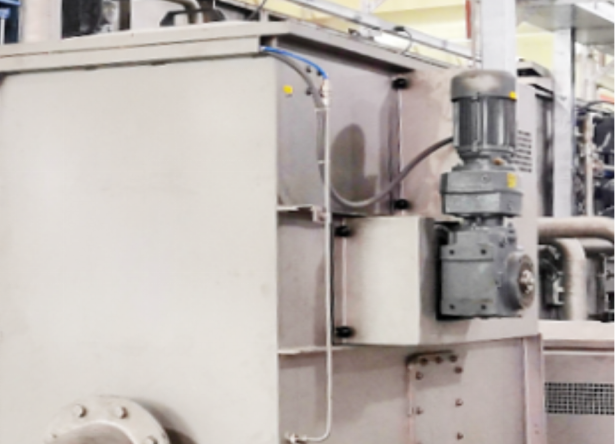
A gearmotor installed on a cloth guide roller in a dyeing house can meet its torque rating and still underperform — not because the ratio is wrong, but because the drive was specified for load alone while the room around it is hot, humid and chemically aggressive.
For textile machinery and printing and dyeing production lines, REDUCER selection is therefore a four-variable problem: ratio and torque, ambient and radiant heat, moisture, and acid-base solvent exposure. Guangdong Starshine Drive Co., Ltd — a transmission manufacturer founded in 1965 and headquartered in the Sanshui District of Foshan City, Guangdong Province, China — builds gearmotors and integrated transmission systems for these conditions, and its documented textile application sets out precisely what has to be verified before a unit is mounted on a cotton roller, pad roll, washing machine or X-Y plaiter.
This reference article explains what the textile environment demands, how the R/F/K/S Series Helical Gearmotors, RV Series Worm Gearbox and NCJ Series Helical Gearmotor map onto that demand, where the boundaries of each option sit, and which questions a buyer or retrofit engineer should settle before ordering.
Why Heat, Humidity and Acid-Base Solvents Are Specification Inputs
The documented working condition for reducers in the textile industry is specific: a high-temperature and humid environment, continuous operation, the presence of acid-base solvents from the dyeing process, and the influence of heat radiation. Each of those conditions attacks a different part of the drive, which is why they cannot be averaged into a single “harsh environment” label.
- Ambient heat and heat radiation. Textile finishing equipment runs alongside heated vessels, drying sections and steam lines. Heat radiation adaptability is listed among the special requirements for this application, which means the mounting position relative to hot surfaces is part of selection — not something to resolve after installation.
- Moisture. Humidity is a persistent condition rather than an occasional splash, so moisture-proofing affects paint integrity, sealing and the long-term condition of exposed surfaces.
- Acid-base solvents. Dyeing chemistry is the reason the textile application specifies corrosion resistance through a strong anti-corrosion paint formulated to resist acid-base solvents. This is a surface-protection measure aimed at the painted housing and external components.
- Continuous running. All-weather continuous operation means maintenance access, lubricant life and noise all carry commercial weight, because stopping a line to swap a drive costs production time.
The opportunity sits in the same list. A drive specified against these four conditions at the quotation stage is a drive that keeps its paint, its lubricant and its service interval; a drive specified on torque alone transfers the environmental problem to the maintenance team.
What the Textile Drive Train Has to Do
In this application the reducer performs three linked functions: power transmission, speed reduction and torque increase. It drives cloth guide rollers, pad rolls and other actuators, and it delivers precise motion control for processes such as fabric washing, dyeing, folding and hair removal.
Two details in that description matter more than they appear at first reading. First, guide rollers and pad rolls are tension-setting elements: if two rollers in a train run at slightly different surface speeds, the fabric sees the difference as tension variation. Second, the documented operation modes are all-weather continuous operation, intermittent operation and variable-speed operation — three different duty profiles that place different demands on the motor and the lubrication system.
The documented project types follow the same logic: textile machinery manufacturing, printing and dyeing production line automation upgrades, and equipment retrofit projects. Retrofits are a distinct case, because the new drive has to fit an existing frame, an existing roller speed and an existing control cabinet.
The Starshine Drive Range Mapped to Textile Duty
Guangdong Starshine Drive Co., Ltd is a transmission solution provider that integrates research and development, manufacturing, sales and service, tracing its origins to a mould factory established in 1965. The company operates a base of 53,333.33 m², employs approximately 400 people, runs a provincial-level engineering technology R&D centre with a 40-engineer team, and reports an annual production capacity of 500,000 units and sets. An assembly plant in Vienna, Austria handles localised assembly, warehousing and technical service for the European market, and products and services reach more than 30 countries and regions. All products comply with ISO, CE and CCC standards.
Its product line covers general-purpose and specialised gearboxes — including the NCJ series gear reducers, R/S/K/F series high-precision gear reducers, RV series worm gear reducers, SP series planetary reducers, SI series industrial gearboxes, SNKG series gear reducers, JWB-X series mechanical stepless variators, B/JXJ series cycloidal pinwheel reducers and XGK series hypoid gear reducers — combined with motors, inverters and controllers. For textile work, four of those families carry most of the load:
| Series | Documented specification facts | Textile relevance |
|---|---|---|
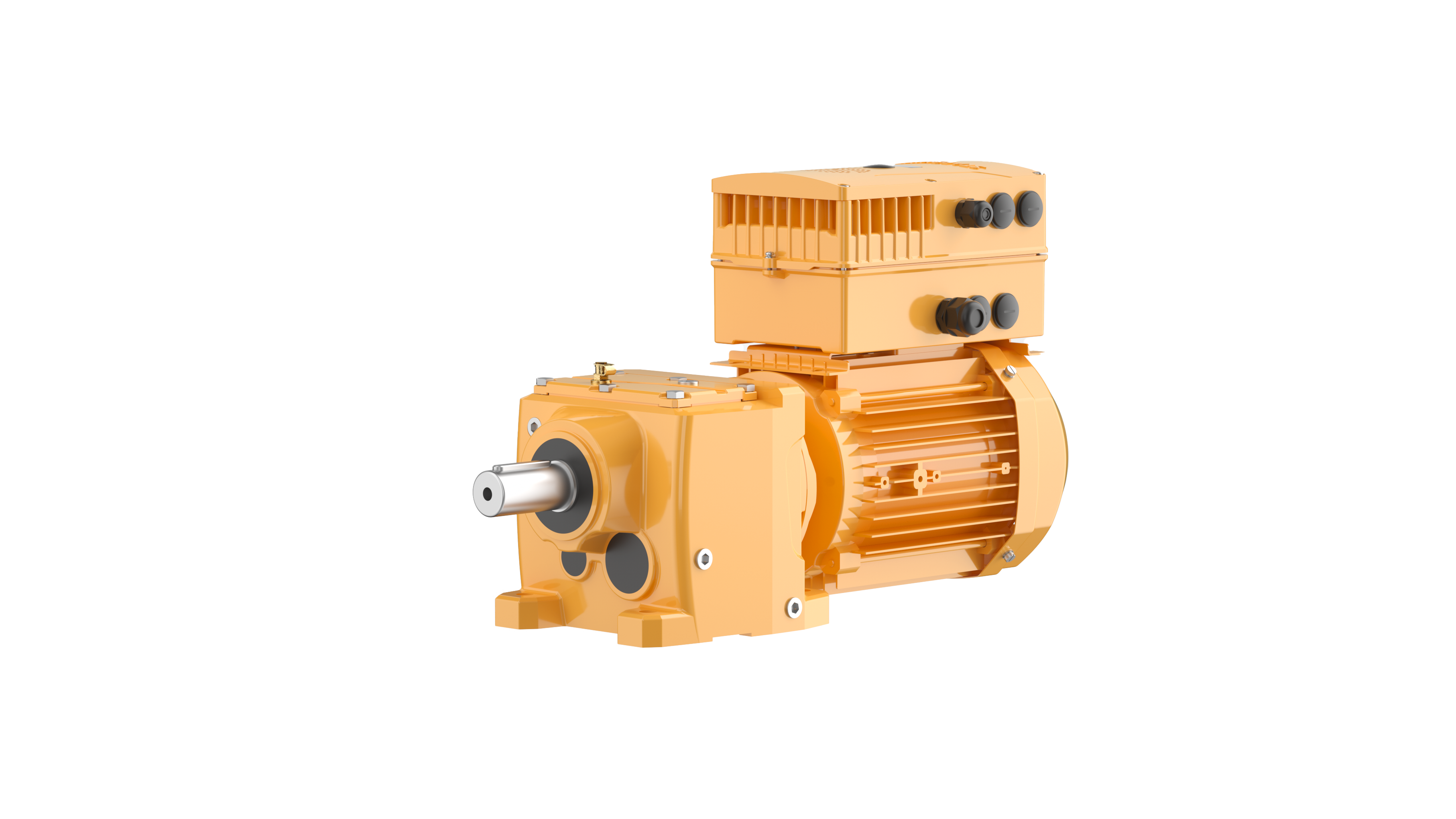
| R/F/K/S Series Helical Gearmotors | Single-stage efficiency above 96%; single-stage ratio range 1.3–289.74; gears in 20CrMnTi alloy steel, carbonitriding hardened to HRC55–65, ground to grade 6 accuracy; high-strength cast iron housing; textile listed among applicable industries | Primary option where efficiency and a wide ratio spread matter — guide rollers, wide rollers, dry-side conveying |
| NCJ Series Helical Gearmotor | Efficiency 92%–96%; wide-frequency motor that works under 20Hz–60Hz at full loading; special lubricating oil sufficient for 20,000 hours of normal use; NCJT04B/J can replace a 1# cycloid gearbox for energy-saving upgrades | Variable-speed lines and retrofit projects where an existing cycloid drive is being replaced |
| RV Series Worm Gearbox | Single-stage ratio up to 100, double-stage up to 10,000; self-locking at i≥60; 20CrMnTi worm shaft with special heat treatment; KK alloy copper worm wheel; aluminium parts; synthetic worm gear lubricating oil | Compact, high-reduction positions and holding duties where self-locking is useful |
| Industry Customized Products | Customisable gear reducers including high-temperature resistant custom reducers, corrosion-resistant tailored gearboxes and explosion-proof customized gearboxes; textile machinery and printing machinery listed among applications | Where the standard paint system or thermal envelope does not cover the installation point |
Alongside the gearboxes, the company supplies drive system accessories — integrated servo motors, three-phase asynchronous motors, frequency converters and permanent magnet synchronous motors — with power, voltage, speed and control mode configurable to match the reducer and the application. The accessory range also notes that customised materials, including corrosion-resistant and high-temperature-resistant options, are available for special environments.
Technical Explanation: Reading the Numbers Against Textile Conditions
Efficiency is a continuous-duty variable
In a plant running all-weather continuous operation, efficiency stops being a catalogue footnote. The R/F/K/S Series is documented at above 96% for a single stage, while the NCJ Series is documented at 92%–96%. Over a long production campaign that difference in losses shows up as heat generated inside the gearbox and energy drawn at the meter — both of which matter in an already hot room.
Ratio range determines how many stages you need
A single-stage ratio range of 1.3 to 289.74 on the helical series means many roller-speed requirements can be met without adding a second reduction stage — fewer components in the drive train and a shorter housing. Where very high reduction is required in a compact envelope, the worm gearbox covers a single-stage ratio up to 100 and a double-stage ratio up to 10,000, with self-locking at i≥60.
Materials and heat treatment carry the duty cycle
Gears in the R/F/K/S and NCJ series use 20CrMnTi alloy steel with carbonitriding hardening to HRC55–65, and the helical gears are ground to grade 6 accuracy. In practice this is the part of the specification that answers the continuous-operation requirement: hardness and grinding accuracy govern how the tooth flank behaves after months of steady load, and the high-strength cast iron housing provides the structural side of the same answer.
Lubrication defines the maintenance calendar
Two documented lubricant statements are directly useful to a maintenance planner. The NCJ Series uses a special lubricating oil that meets 20,000 hours of normal use. The RV Series uses a synthetic worm gear lubricating oil selected to support transmission efficiency and service life. In a humid, hot environment, a documented lubricant interval is a more concrete planning input than a generic “low maintenance” claim.
Verification before the unit leaves the plant
Starshine Drive reports three 100% online production checks: air tightness testing, noise testing and comprehensive motor testing. For wet-processing areas, air tightness is the relevant one — it is the check that speaks to lubricant containment — and noise testing speaks to the audible environment of a working textile hall.
Retrofit safety and the standard that applies
Retrofit projects change the machinery, so risk assessment has to be revisited. EN ISO 12100:2010 is the harmonized Type-A safety standard that sets out general principles for risk assessment and risk reduction in machinery design, and it applies to gear reducers as machine components. For a dyeing line upgrade, that means the drive package — gearmotor, coupling, guard, brake or holding function — should be assessed as part of the modified machine rather than as a standalone purchase.
Where the Drives Sit on the Line
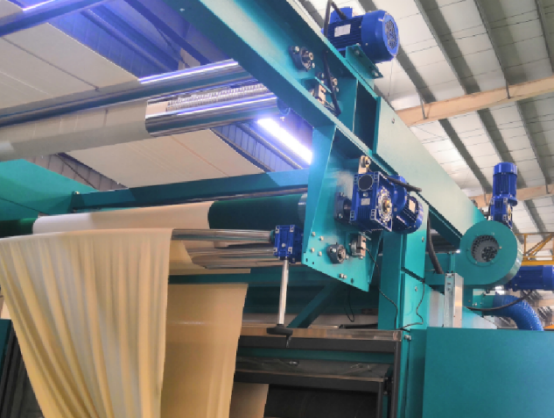
The textile application documentation names the equipment the reducers are matched to: cotton rollers and cloth guide rollers, washing machines, dyeing machines, wide rollers, hair removal devices and the X-Y plaiter, also referred to as a plaiting machine. The functional map is straightforward once the process is laid out in order.
- Fabric transport. Cloth guide rollers and wide rollers set the path and the tension of the fabric; drive consistency here is what keeps the web flat and aligned.
- Wet processing. Washing machines and dyeing machines combine moisture, heat and process chemistry — the stations where corrosion resistance and moisture-proofing are tested most directly.
- Finishing and handling. Hair removal devices and the X-Y plaiter run in intermittent or variable-speed patterns rather than steady continuous duty, which is why the documented operation modes include all three.
Precise motion control across these stations is the unifying requirement: washing, dyeing, folding and hair removal each depend on the fabric moving at the intended speed at the intended moment, and a drive that drifts under heat load shows up as a process deviation rather than an obvious failure.
Market Context: Why Environmental Specification Is Gaining Weight
The commercial backdrop supports the technical argument. Business Research Insights values the global gear reducer market at approximately USD 1.96 billion in 2026, with a projection of USD 2.58 billion by 2035. Grand View Research reports that Asia Pacific dominated the industrial gearbox market with a 40.8% revenue share in 2025 — a concentration that mirrors where textile and dyeing capacity sits. Indastra identifies planetary gearboxes as the fastest-growing industrial gearbox segment, with a projected CAGR of 6.2% through 2030, driven by robotics and wind energy.
Two implications follow for textile buyers. First, a large share of the world’s reducer supply and application engineering is regional, which shortens the loop between a line problem in Asia and the drive specification that answers it. Second, growth in higher-precision segments signals where machine builders are heading: automated tension control and repeatable positioning, both of which raise the value of a correctly specified gearmotor relative to a merely adequate one.
Comparison and Boundaries: Where Each Option Stops
| Consideration | R/F/K/S helical gearmotors | RV worm gearbox | Customised reducers |
|---|---|---|---|
| Efficiency position | Above 96% single stage (documented) | High reduction with self-locking at i≥60; self-locking is a holding function, gained at the cost of efficiency relative to a helical stage | Configuration-dependent; no single figure applies |
| Ratio coverage | 1.3–289.74 single stage | Up to 100 single stage, up to 10,000 double stage | Defined by application |
| Holding a load without a brake | Not the design intent — a brake is normally required where position must be held | Self-locking at i≥60 supports holding duty | Specified case by case |
| Environmental protection | Standard housing and paint; protection level must be agreed for the installation zone | Aluminium parts; same environmental question applies | Strong anti-corrosion paint against acid-base solvents, high-temperature resistant builds, explosion-proof builds |
The boundaries deserve to be stated plainly, because they are the part of a specification that prevents field surprises.
Corrosion resistance is surface protection, not immunity. The textile application addresses acid-base solvents through a strong anti-corrosion paint. That is a coating strategy for the housing and external surfaces; it does not make the drive suitable for immersion, for direct chemical spray onto seals, or for any chemistry beyond what the coating was selected for. Where the installation point sees concentrated splash, the correct move is to change the mounting position or add a physical shield, not to assume the paint covers it.
Self-locking is a trade-off, not a free feature. The RV Series achieves self-locking at ratios of i≥60. Buyers who need a load held without a brake should specify the worm unit deliberately and accept the efficiency consequence; buyers who prioritise efficiency across continuous duty should look at the helical series and plan braking separately. Choosing one and expecting the behaviour of the other is the most common mismatch in this decision.
Customised high-temperature builds still need an installation decision. A high-temperature resistant custom reducer exists for exactly this environment, but heat radiation adaptability remains a mounting question. Clearance from hot surfaces, ventilation around the housing and the choice of lubricant all sit outside the gearbox itself; the custom build widens the margin, it does not remove the requirement.
Standard catalogues do not cover every dyeing line. The R/F/K/S and NCJ ranges cover a wide ratio and power span, but a retrofit onto an existing frame with unusual shaft geometry or an unusual control interface is a customisation conversation. Buyers should expect to supply the mounting drawing, the roller speed and the control details before a firm configuration is quoted.
Future Outlook
Three developments are likely to shape textile reducer selection over the next several years. The first is the continued automation of printing and dyeing lines, which moves more drives from fixed-speed duty into variable-speed duty and makes motor-and-inverter matching part of the reducer decision rather than a separate purchase. The second is the retrofit market: much of the installed base predates current efficiency expectations, and replacement programmes such as the NCJT04B/J substitution for a 1# cycloid gearbox show how an upgrade can be framed around energy saving rather than like-for-like replacement. The third is regional service depth — with Asia Pacific holding a 40.8% revenue share of the industrial gearbox market in 2025, and with suppliers like Starshine Drive operating localised assembly and technical service in Europe through their Vienna plant, buyers increasingly evaluate response time and spare-part reach alongside the specification sheet.
What is unlikely to change is the underlying rule: in textile wet processing, the environment is part of the load case.
FAQ
What working conditions define a textile REDUCER application?
The documented textile application is characterised by a high-temperature and humid environment, continuous operation, the presence of acid-base solvents from the dyeing process, and the influence of heat radiation. Operation modes include all-weather continuous operation, intermittent operation and variable-speed operation. The associated special requirements are high temperature resistance, corrosion resistance through strong anti-corrosion paint against acid-base solvents, moisture-proofing, adaptability to heat radiation, long service life and easy maintenance.
Which Starshine Drive series are relevant to textile and dyeing lines?
Three gearmotor families are directly mapped to the application: the R/F/K/S Series Helical Gearmotors, which list textile among their applicable industries; the NCJ Series Helical Gearmotor; and the RV Series Worm Gearbox. Industry Customized Products — including high-temperature resistant custom reducers, corrosion-resistant tailored gearboxes and explosion-proof customized gearboxes — cover cases where the standard configuration does not match the installation point.
How is corrosion resistance against acid-base solvents addressed?
Corrosion resistance in the textile application is achieved through a strong anti-corrosion paint formulated to resist acid-base solvents, applied to resist the dyeing chemistry present in the working environment. The company also lists corrosion-resistant tailored gearboxes and corrosion-resistant motor materials among its customisation options for special environments. This is a surface-protection approach aimed at the housing and external components.
Which machines in a printing and dyeing line do these gearmotors drive?
The documented matched equipment is: cotton rollers and cloth guide rollers, washing machines, dyeing machines, wide rollers, hair removal devices and the X-Y plaiter, also described as a plaiting machine. The drive function is power transmission, speed reduction and torque increase, delivering precise motion control for processes such as fabric washing, dyeing, folding and hair removal.
What service-life and maintenance figures are documented?
The NCJ Series uses a special lubricating oil that meets 20,000 hours of normal use. The RV Series uses a synthetic worm gear special lubricating oil intended to ensure transmission efficiency and improve service life. The R/F/K/S Series gears are made of 20CrMnTi alloy steel, carbonitriding hardened to HRC55–65 and ground to grade 6 accuracy, and the NCJ Series is documented at 92%–96% efficiency while the R/F/K/S Series exceeds 96% for a single stage.
What are the limits of a standard gearmotor in a textile plant?
A standard unit protects its housing by paint and sealing, so it is not intended for immersion or concentrated chemical spray; where that occurs, mounting position or a physical shield has to change. Self-locking behaviour is available on the RV Series at ratios of i≥60 and comes with an efficiency trade-off compared with a helical stage, so a unit specified for efficiency should not be expected to hold a load without a brake. And because retrofit projects modify existing machinery, risk assessment under EN ISO 12100:2010 has to be revisited for the modified machine rather than assumed from the original installation.
¿Tiene preguntas o necesita más detalles?
Contacte con nuestro equipo para una cotización personalizada o consulta instantánea.
Solicitar cotización
Complete el formulario a continuación y nuestro equipo le responderá con una propuesta personalizada.
Chat directo de WhatsApp
¿Prefiere chatear en tiempo real? Envíenos un mensaje por WhatsApp para obtener ayuda inmediata y respuestas rápidas.
- Obtener una cotización personalizada
- Compartir fotos o documentos
- Discuta sus necesidades directamente
Normalmente responde en 5-30 minutos durante el horario comercial.