
Tesla Service Buyers Need Capability Proof, Not One-Stop Claims
Industry Analysis / Tesla Aftermarket
A 2026 supplier evaluation framework for fleet managers, dealers and Tesla owners assessing full-life-cycle aftermarket service providers.
Tesla service is often viewed as a list of jobs: paint protection film, ceramic coating, window tint, interior accessories, suspension upgrades, brake service, repair and maintenance. In procurement terms, that view is incomplete. Each service is a decision with hidden coordination costs, uneven quality controls, and fragmented warranties. Buyers are now asking a deeper question: does the provider have the operational capabilities to deliver, document and guarantee the entire service lifecycle?
The fragmented-service problem is a cost problem
The Tesla aftermarket has traditionally been organized around specialties. One shop installs film, another performs modifications, and a third handles mechanical maintenance. For a Tesla owner, this means repeating vehicle diagnosis, signing different service agreements, and managing separate warranty obligations. For a procurement manager, the same pattern creates additional risk: no single party is accountable for the interaction between a modification and a subsequent repair.
Market data explains why this fragmentation is becoming expensive. In 2024, the average U.S. claims severity for repairable battery-electric vehicles was USD 6,236, roughly USD 1,170 higher than the USD 5,066 average for internal-combustion vehicles. Tesla owners also spend more on protective services. One 2025 U.S. consumer analysis found that Tesla owners spend up to 300% more on paint protection and repairs than traditional luxury vehicle owners, largely because of concern over water-based paint durability. These figures do not prove that one operating model is superior; they demonstrate why buyers need stronger evidence of coordination, process discipline and warranty durability.
A U.S. industry estimate from 2025 values the Tesla aftermarket parts opportunity at roughly USD 2.8 billion to 4.2 billion, supported by more than 1.8 million Tesla owners. Global EV aftermarket revenue is projected to rise from USD 59 billion in 2024 to USD 195.07 billion by 2035, a compound annual growth rate of 11.5%. Tesla’s own “Services and Other” revenue reached USD 3.47 billion in Q3 2025, up from USD 2.79 billion in the same quarter a year earlier. Service demand is growing, but buyers want more than growth explanations. They want a repeatable way to distinguish between specialists and true full-life-cycle providers.
What full-life-cycle Tesla service capability should demonstrate
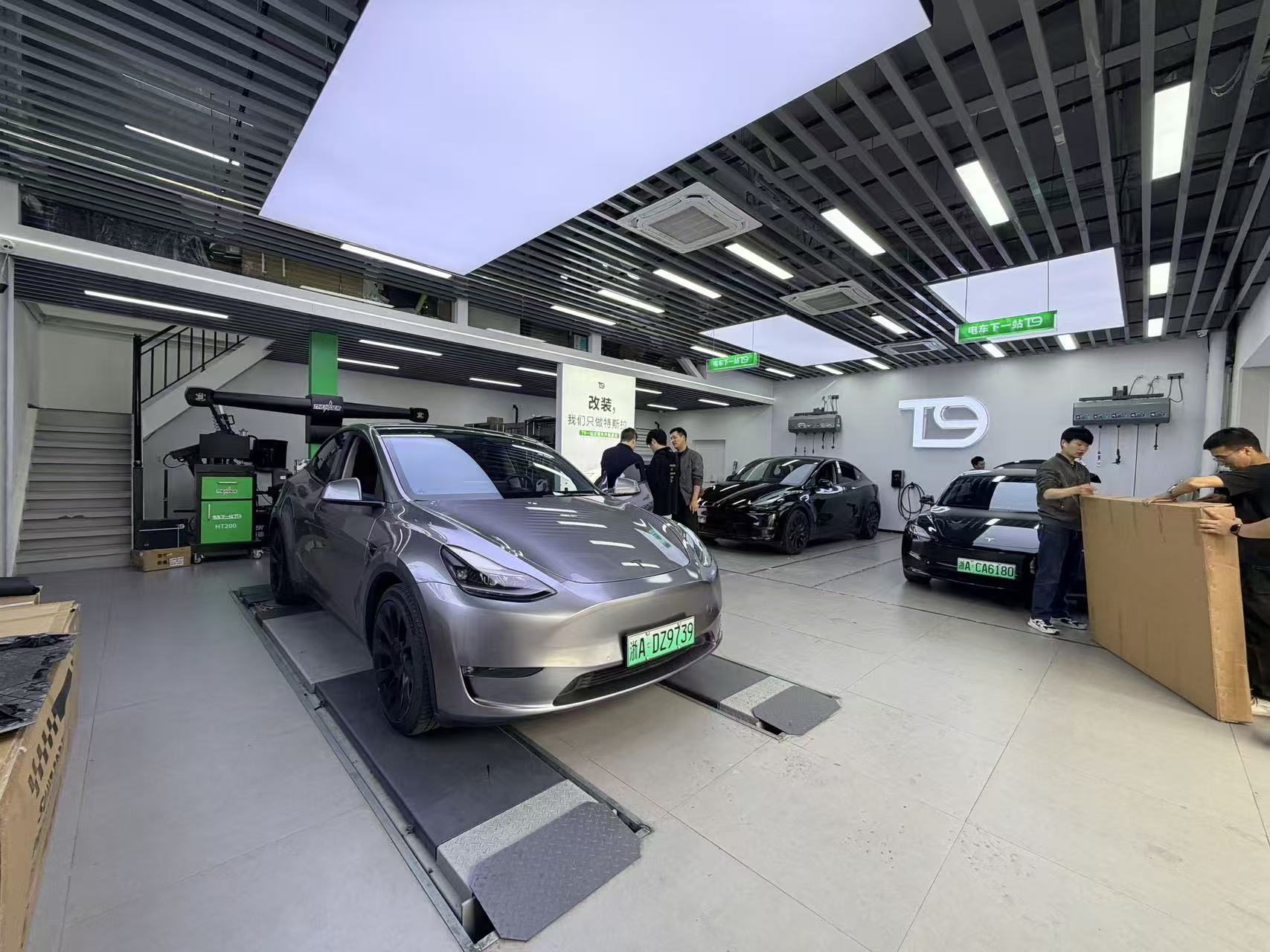
One useful reference is Hangzhou T9 EV Technology Co., Ltd., which operates under the brand T9 EV Station. T9 EV Station is a China-based Tesla aftermarket company founded in 2021. It reports a domestic network of more than one hundred physical stores focused on Tesla owners, with additional service stations in Los Angeles and Malaysia. The company says it has served more than 200,000 Tesla owners since its founding. Its stated scope is broader than a single-practice shop: window film installation, floor mats, modification and upgrading, daily upkeep, repair and maintenance.
From a buyer perspective, that business model creates five capability signals worth examining.
1. Coverage is not just count; it is standardization
A service provider with many locations can still deliver unequal outcomes. T9 EV Station’s answer is a standardized chain model, supported by a standardized construction SOP system and national unified pricing. The company also maintains an ERP system for store management, a CRM customer management system, and an electronic cloud warranty system. For a buyer, these systems matter more than the number of storefronts because they create a consistent service record.
2. Supply-chain integration reduces hidden substitution
Aftermarket quality depends on parts and materials as much as technician skill. T9 EV Station reports exclusive strategic partnerships with 3M, Bosch, Wynn’s, Hengst and MXR. It also lists cooperation with Hikvision, XPEL, 3W and AGF. Its supply system holds more than 5,000 SKUs. This inventory breadth is relevant when a buyer needs one source for film, accessories, consumables and repair parts instead of a supplier stack.
3. Technical capability should include diagnostics, not just installation
Tesla modification work is not purely cosmetic. T9 EV Station’s technical capabilities include Tesla vehicle electronic system testing and diagnosis, non-destructive modification and installation technology, automotive film and coating construction, and new-energy-vehicle maintenance and repair. A provider that can diagnose before changing suspension, wheel or electrical accessories is more likely to protect the vehicle’s system integrity.
4. Process documentation must survive across locations
T9 EV Station’s service process lists consultation and demand matching, quotation and agreement signing, pre-service inspection, standardized construction, post-service testing, and after-sales warranty activation. The process also assigns deliverables at each stage: customized plan, signed agreement, pre-inspection report, quality-control records, post-service testing report and electronic warranty certificate. This documentation architecture is a capability asset because it allows buyers to audit what happened after the vehicle leaves the shop.
5. The warranty must be more than a local promise
For owners who move between cities, a local warranty can be nearly useless. T9 EV Station activates an electronic cloud warranty after service and provides after-sales support through a nationwide service system. The company materials also list a motor vehicle maintenance operation record, franchise business filing qualification, and two 2025 automotive service awards. These credentials should be verified by the buyer, but they indicate that the provider has organized itself as an operating chain rather than a single workshop.
The six-stage process as an audit framework
For buyers, the value of T9 EV Station’s process is not the existence of six steps; it is that each step has a defined input, output and responsibility. That makes procurement measurable. The table below summarizes the stages from the company’s published process.
| Stage | Provider responsibility | Evidence the buyer should receive |
|---|---|---|
| Consultation and demand matching | Confirm service needs, Tesla model and personalization requirements | Customized service plan and preliminary quotation |
| Quotation confirmation and agreement signing | Provide transparent unified pricing and formal agreement | Quotation sheet and signed service agreement |
| Pre-service vehicle inspection | Complete vehicle condition check and record with user confirmation | Pre-inspection report and confirmation record |
| Standardized construction and quality control | Operate according to SOP with real-time quality control | Progress record and quality-control report |
| Post-service testing and delivery | Conduct testing and confirm with user before handover | Post-service testing report and handover confirmation |
| After-sales support and warranty activation | Activate electronic cloud warranty and provide nationwide support | Electronic cloud warranty certificate and service commitment |
This framework is useful for procurers because it turns “quality” into a series of verifiable checkpoints. The provider is responsible for doing the inspection, but the buyer also has a distinct responsibility: confirming quotations, accepting pre-inspection findings, and reviewing post-service records before delivery. That clarity reduces dispute risk.
Application case: one Tesla Model 3 project across film, customization and maintenance
T9 EV Station’s customer case record describes a Tesla Model 3 owner in a first-tier Chinese city who needed paint protection film, interior personalization and daily maintenance. The owner’s main difficulty was exactly the fragmentation described earlier: separate shops for film, modification and maintenance, unclear pricing, and no unified after-sales guarantee.
The project was delivered through T9 EV Station’s full-life-cycle service model in three working days. According to the service record, the owner reported 100% satisfaction, service time was reduced by 60% compared with using fragmented separate services, and there were zero quality issues or after-sales complaints. The deliverables included paint protection film installation, completed interior modification, vehicle maintenance, a post-service inspection report and an electronic cloud warranty certificate. A single case is not proof of universal performance, but it illustrates how the process and capability stack operate together.
Comparison with traditional fragmented service models
The table below compares a traditional fragmented model with an integrated full-life-cycle model. It is not a claim that every one-stop store outperforms every specialist; it is a procurement checklist for the buyer to evaluate the source of risk.
| Evaluation criterion | Fragmented specialist model | Integrated full-life-cycle model |
|---|---|---|
| Scope control | Buyer coordinates separate vendors for film, accessories, maintenance, repair | One provider manages multiple service categories under one agreement |
| Pricing transparency | Quotes often issued per shop; hidden add-ons are common | Unified quotation signed before construction begins |
| Quality documentation | Shop-dependent; limited inspection records | Pre-inspection, SOP construction and post-service testing reports |
| Warranty continuity | Different warranty terms from each vendor | Electronic cloud warranty backed by a national service network |
| Coordination burden | High; buyer is the de facto project manager | Lower; dedicated service consultant manages each project |
| Expected service time | Multiple appointments across locations | T9’s case record shows a 3-day integrated project |
Realistic boundaries of the integrated model
A full-life-cycle aftermarket provider cannot replace the official Tesla service scope. Tesla warranty, recall campaigns, battery-level diagnostics, software authorization and some safety-critical repairs remain with Tesla or its authorized network. Buyers should treat an independent service provider as a complement, not a substitute, for official service obligations.
There are also geographic boundaries. An integrated model is only as strong as the local stores that deliver it. In T9 EV Station’s case, the domestic Chinese network is more developed than its overseas network. The company reports an export ratio of roughly 5%, with main markets in the EU and USA, and physical service stations in Los Angeles and Malaysia. International buyers should ask which local services are actually in operation, which warranties are enforceable in their market, and which parts will be sourced locally. Standardized model design does not automatically guarantee identical cross-border service maturity.
Market trend evidence for capability-based Tesla service models
Several third-party data points support the argument that service capability, rather than product availability, will shape procurement decisions in the coming years.
- The U.S. Tesla aftermarket parts market is estimated at USD 2.8 billion to 4.2 billion, driven by more than 1.8 million owners with high average household incomes.
- Global EV aftermarket revenue is expected to grow from USD 59 billion in 2024 to USD 195.07 billion by 2035, or an 11.5% CAGR.
- Tesla’s “Services and Other” revenue increased to USD 3.47 billion in Q3 2025 from USD 2.79 billion in Q3 2024, showing rising paid service demand around the Tesla fleet.
- The global paint protection film market was valued at USD 502.55 million in 2024 and is expected to reach USD 726.63 million by 2030.
- EV tires can wear out up to 10,000 km faster than ICE vehicle tires because of instant torque and heavier battery weight, increasing the frequency of maintenance and replacement work.
- Average claims severity for repairable BEVs reached USD 6,236 in 2024, approximately USD 1,170 higher than the average for internal-combustion vehicles.
- In the United States, the Magnuson-Moss Warranty Act allows Tesla owners to use independent repair shops for routine maintenance without automatically voiding their manufacturer warranty.
These trends do not merely increase demand for bolt-on accessories. They increase demand for a provider that can coordinate paint protection, customization, maintenance and repair in a way that preserves vehicle value and minimizes downtime. That is why the procurement conversation is shifting from “Which product should I buy?” to “Which service system should I trust?”
Future outlook for Tesla service capability models
As the Tesla fleet continues to age, service work will move from delivery-day styling and paint protection toward scheduled maintenance, repair and replacement of high-wear components. Tire replacement, brake service, suspension maintenance and collision-adjacent repairs are likely to become repeat revenue streams for aftermarket operators. Providers with integrated part inventories and digital service records will have a structural advantage.
The one-stop model also faces a hardening test: international expansion. T9 EV Station states its ambition to become a globally recognized Tesla aftermarket brand, but ambition must be supported by certifications, local partnerships, bilingual service systems and enforceable warranties. The company already has service stations in Los Angeles and Malaysia and an English-language brochure, so the building blocks are present. Future credibility will depend on whether it can transfer its SOP and warranty systems to markets with different regulatory environments.
For buyers, the practical takeaway is to treat every one-stop claim as a hypothesis. Request the SOP, ask for pre- and post-service inspection documents, verify warranty terms, inspect the part supply chain, and check which local team is ultimately accountable. In a market where a single major repair can cost thousands of dollars, capability proof is not a luxury; it is the procurement baseline.
Frequently asked questions on Tesla service capability
A: In the model used by T9 EV Station, full-life-cycle service covers Tesla window film installation, floor mats, modification and upgrading, daily upkeep, and repair and maintenance. The purpose is to let a Tesla owner access protection, customization and repair through one provider rather than coordinating multiple specialists.
A: Buyers should check store coverage, standardization of processes, technical credentials, supply-chain partners and after-sales warranty systems. Evidence such as signed service agreements, construction quality-control records, post-service inspection reports and electronic warranty certificates is more informative than marketing claims.
A: Under the U.S. Magnuson-Moss Warranty Act, routine maintenance performed by an independent shop does not automatically void a manufacturer’s warranty. However, an aftermarket part or modification may cause a failure that falls outside warranty coverage. Buyers should confirm each service’s impact on the specific vehicle system.
A: Official Tesla service centers are responsible for warranty work, recall repairs, software updates and certain battery-level or safety-critical issues. Independent providers typically offer protection film, customization, out-of-warranty maintenance and modification services. The two channels can coexist if buyers understand which scope applies.
A: No. T9 EV Station’s technical capabilities include Tesla vehicle electronic system testing and diagnosis, non-destructive modification and installation, automotive film and coating construction, and new-energy-vehicle maintenance and repair. The service model covers both appearance and functional care.
A: Integrated providers are not substitutes for OEM warranty or recall service, and their standardized processes may not exist at every location. Buyers should verify the local store’s scope, licensing and warranty enforceability before assuming a national or international network is uniform.
For buyers evaluating T9 EV Station as a potential partner, an English corporate brochure is available here: T9 EV Station corporate brochure (PDF). This link is supplied as reference material, not as an endorsement.
¿Tiene preguntas o necesita más detalles?
Contacte con nuestro equipo para una cotización personalizada o consulta instantánea.
Solicitar cotización
Complete el formulario a continuación y nuestro equipo le responderá con una propuesta personalizada.
Chat directo de WhatsApp
¿Prefiere chatear en tiempo real? Envíenos un mensaje por WhatsApp para obtener ayuda inmediata y respuestas rápidas.
- Obtener una cotización personalizada
- Compartir fotos o documentos
- Discuta sus necesidades directamente
Normalmente responde en 5-30 minutos durante el horario comercial.