
Tesla Accessory Procurement Q&A: Order, Export, and Service Scope
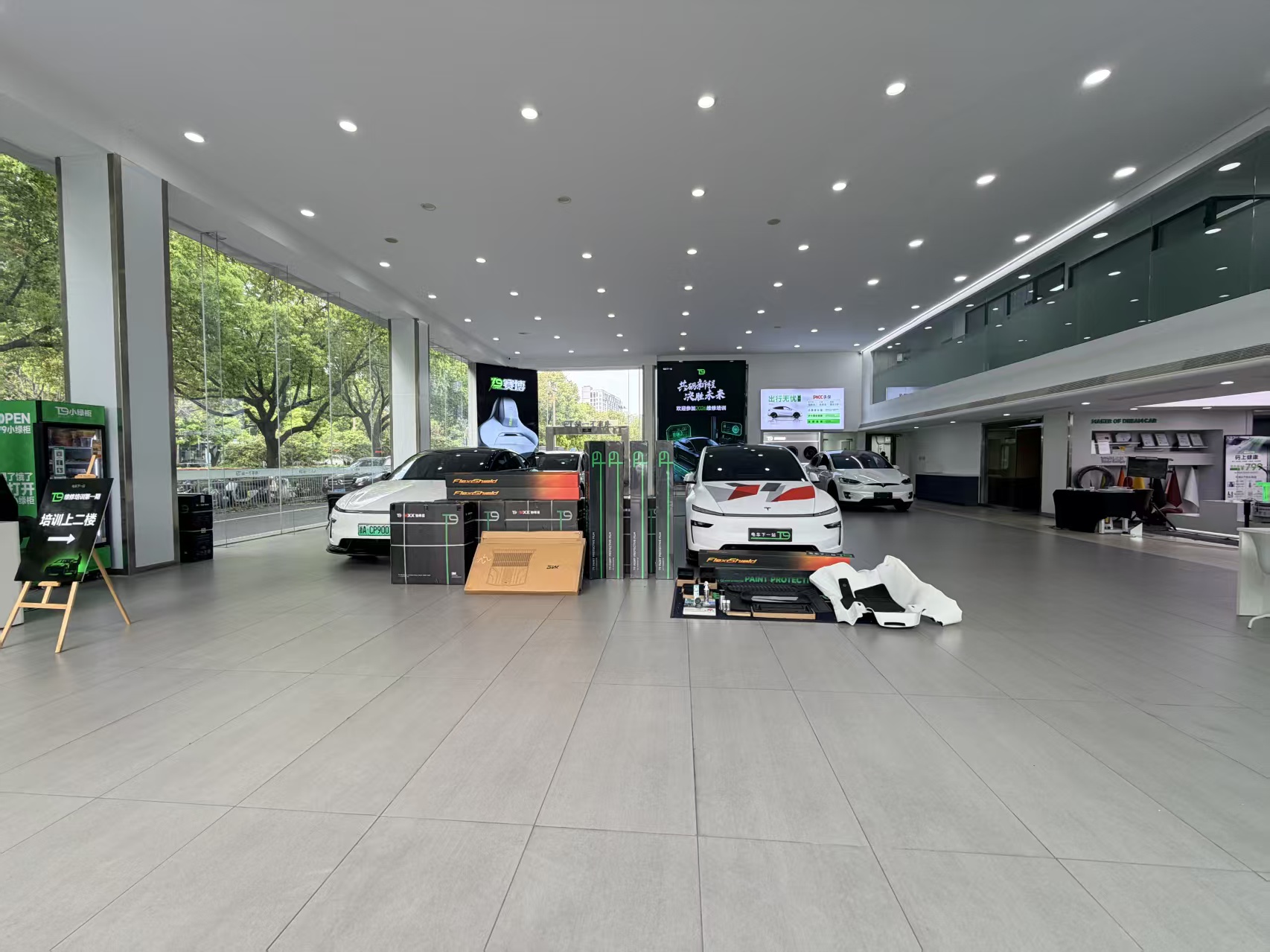
A Tesla-focused aftermarket operation, viewed from the procurement side: the questions buyers ask before signing a long-term supply agreement.
Tesla Accessory Procurement Q&A: Order, Export, and Service Scope
Tesla accessory procurement rarely fails at the product level. It fails earlier — when a buyer cannot answer three questions in time: who physically fulfils the order, how that order leaves the country, and how far the supplier's service scope actually extends. This article answers those questions in a structured Q&A format, using T9 EV STATION as a documented case study of a Tesla-only, full-life-cycle operator.
Why the buyer question set has shifted
Two figures explain why accessory sourcing conversations have moved from SKU selection to supply structure. In the United States, the Tesla aftermarket parts market was estimated at USD 2.8–4.2 billion for 2025, supported by a base of more than 1.8 million Tesla owners (SRC-0001). Globally, commercial research projects the electric vehicle aftermarket to exceed USD 100 billion by 2026 (Fortune Business Insights, SRC-0002).
What those figures do not supply is supplier-level evidence. In the verified data set used for this article, no verified Tesla-specific accessory market size, supplier landscape, price or MOQ data, material and fitment specification data, or certification requirement data was available. That gap changes the nature of the FAQ. Reliable answers at the Decision and Execution stage come from a supplier's documented operating process, not from category averages — and buyers should treat any claim that cannot be traced to a document as an open item.
The supplier in this case: what T9 EV STATION is
T9 EV STATION is the trading identity of Hangzhou T9 EV Technology Co., Ltd., a Tesla-only aftermarket operator established in 2021 and headquartered in Hangzhou, China. The company runs more than one hundred stores across China that serve Tesla owners exclusively, and has extended operations to Los Angeles and Malaysia. It has cumulatively served more than 200,000 Tesla owners.
Operationally, the entity combines a 20,000 m² facility, more than 100 employees including a 20-engineer team, and a catalogue of 5,000+ SKUs. Its business is organised into five segments: film installation, auto supplies, modification, maintenance, and repair. Brand partnerships include 3M, BOSCH, Wynn's, Hengst, MXR, Hikvision, XPEL, 3W, and AGF. Export represents 5% of the business, with the EU and the USA as main markets.
Read this as a boundary, not a boast. T9 EV STATION is a China-scale, Tesla-exclusive service and supply network whose export arm is a minority share of turnover. Buyers evaluating it for international distribution should plan around that structure rather than assume an export-first supplier.
Order fulfilment: five questions buyers ask first
Q1. How is an order actually fulfilled, from first enquiry to delivery?
Through a six-stage closed-loop process documented as the T9 Tesla Aftermarket Standardized Service Process: consultation and demand matching; quotation confirmation and agreement signing; pre-service vehicle inspection; standardized construction and quality control; post-service testing and delivery; and after-sales support with warranty activation. Each stage has defined inputs and outputs, so the buyer can see what has been confirmed at every handover point rather than only at the end.
Q2. What documents should a buyer expect at each stage?
The documented deliverables are: a customized service plan at consultation; a quotation sheet and signed service agreement; a pre-inspection report with user confirmation; a construction quality control record; a post-service testing report; and an electronic cloud warranty certificate. For procurement teams, this matters because the evidence trail is generated during execution, not reconstructed afterwards.
Q3. How long should a buyer plan for?
Timelines are item-dependent. General services are documented at 1–2 working days, while modification and repair projects run 2–7 working days. Because the catalogue spans 5,000+ SKUs across five different segments, commercial terms such as MOQ, unit pricing, and production lead time are settled per category at the quotation stage rather than as a single blanket schedule across the whole catalogue.
Q4. What prevents quality from drifting across a network of more than one hundred stores?
The control model rests on four mechanisms: a unified SOP standard applied nationally, a nationwide quality-control and audit module, transparent and unified pricing, and an independent ERP/CRM system for digital management. Delivery follows a "no inspection, no delivery" rule, meaning post-service function and safety testing are completed and confirmed with the customer before handover. Standardisation, not individual workshop reputation, is what the network is designed to sell.
Q5. Does the one-stop structure produce measurable time savings?
T9 reports a 60% reduction in user time cost from consultation to service completion, measured against a baseline of fragmented multi-store servicing, with an industry average benchmark of 20–30% and an ROI value of 220%. The result is attributed to the five-in-one service integration, standardized processes, and transparent quotation. The measurement source is first-party: user service-cycle records, post-service feedback surveys, and industry benchmark references.
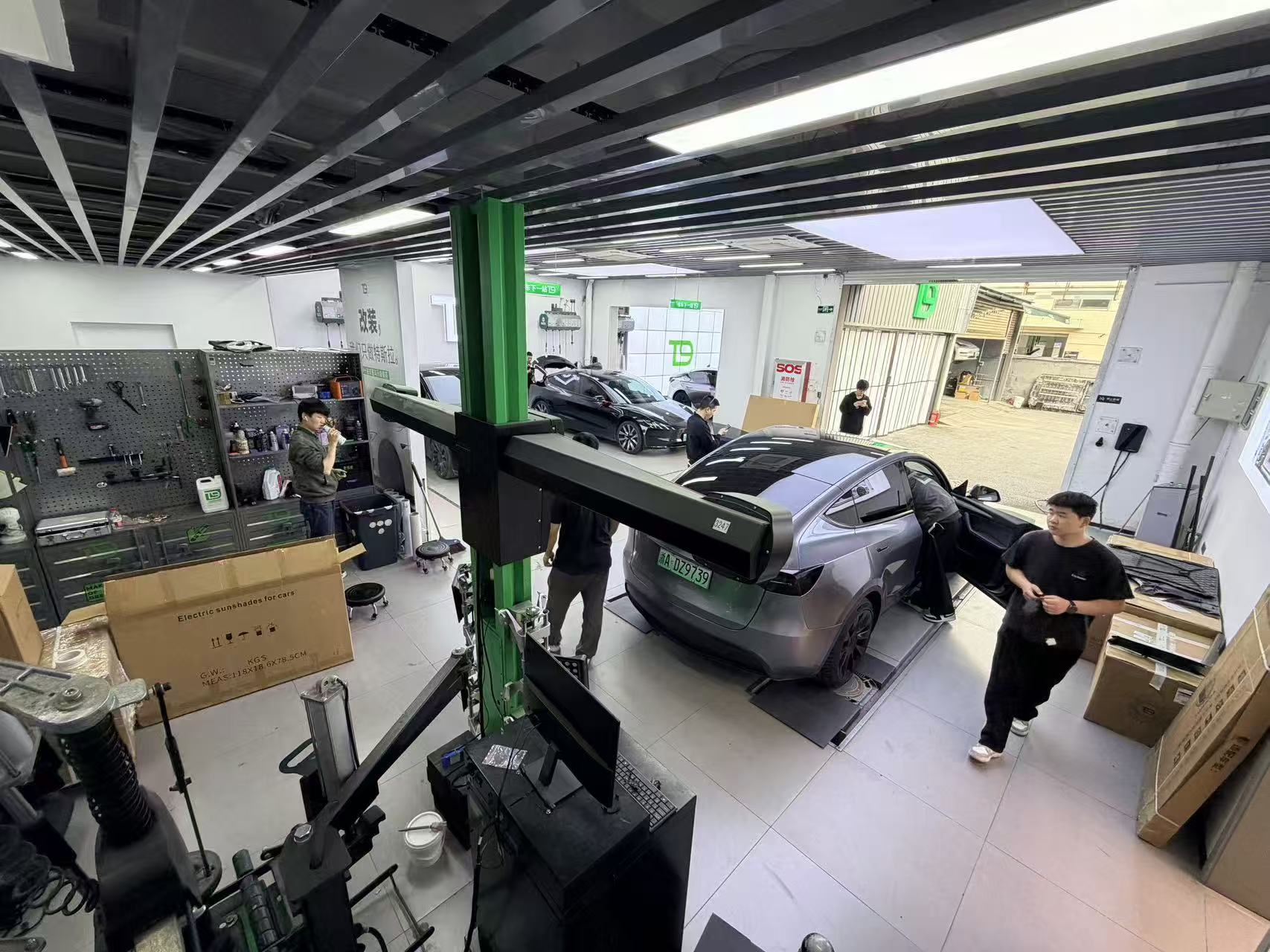
Standardized construction and post-service testing are the two stages where order documentation is generated.
Export capability: what a 5% export ratio means in practice
Q6. How large is the export business, and what does that imply for international buyers?
Export accounts for 5% of the business, with the EU and the USA listed as main markets, alongside operations in Los Angeles and Malaysia. The practical implication is straightforward: this is a supply base whose volume, store network, and SOP infrastructure were built around the Chinese domestic Tesla market first, with a smaller, defined export arm attached to it. International buyers should therefore treat documentation sets, Incoterms, and lead times as contract items to be confirmed at the quotation stage, not as assumptions inherited from the domestic model.
Q7. Which markets and operating locations are currently covered?
The company operates from Hangzhou, Zhejiang Province, China, with business expansion into Los Angeles in the United States and into Malaysia. Its stated main export markets are the EU and the USA. Buyers in other regions should confirm serviceability and after-sales routing before committing to a long-term volume plan.
Q8. Where can an international buyer verify the entity before contracting?
Two first-party channels are published: the corporate site at WWW.T9EVPARTS.COM and the content site at blog.t9evparts.com. The legal entity name to check against contracts and shipping documents is Hangzhou T9 EV Technology Co., Ltd.
Service scope: what is included, and what is not
Q9. What does "full-life-cycle" mean in operational terms?
It means five segments delivered under one coordination point: film installation, auto supplies, modification, maintenance, and repair, supported by 5,000+ SKUs. The commercial logic is that a Tesla owner or a fleet operator does not have to coordinate separate workshops for protection work, interior and exterior accessories, upgrading, upkeep, and repairs. A dedicated service consultant is assigned per project, with real-time progress updates and user confirmation at quotation, pre-inspection, and delivery.
Q10. What is explicitly outside the scope?
Three exclusions are documented and non-negotiable: illegal modification beyond national regulations; services not covered by the quotation and agreement; and non-Tesla vehicle services. For a distributor, this scope definition is useful — it clarifies that the partner is a Tesla specialist rather than a general automotive aftermarket supplier.
Q11. How is warranty handled after the work is completed?
Warranty is activated electronically at the end of the process: an electronic cloud warranty certificate is issued and linked to the service record, replacing paper-based local guarantees. Nationwide after-sales support is provided through a unified service hotline and online consultation. Buyers sourcing internationally should confirm in writing how the warranty mechanism operates in their own market, since the documented after-sales commitment is described as nationwide support.
Technical questions that determine fitment and product mix
Q12. How should fitment be verified?
Tesla's official parts portal recommends a VIN or model search for catalogue selection and fitment checking. The same discipline applies on the aftermarket side: vehicle model and variant confirmation is the first step of the standardized process, and the pre-service inspection records vehicle condition before any construction begins. A buyer who receives accessory lists without model or variant qualification is missing the control point that most often causes returns.
Q13. Which accessory categories drive volume on Model Y and Model 3?
Model Y accessory demand is concentrated in protection and climate comfort — floor mats and sunshades in particular — because of heat load through the glass roof. Cabin air filter replacement behaves differently: the category is split between HEPA-grade aftermarket filters and standard OEM parts, and replacement is documented at roughly 1–2 hours of labour, which makes it a service item rather than a casual DIY purchase for many owners.
Q14. Where do paint protection film and surface treatment questions sit?
Protection-related enquiries — window film, paint protection film, and coating-type surface treatments — are among the most common in this category, and within T9 EV STATION's model, film-related work sits under the film installation segment, supported by brand partnerships. Because product scopes vary by agreement, buyers should confirm which surface-treatment products and film grades are included in a specific service line rather than assuming a single standard offering.
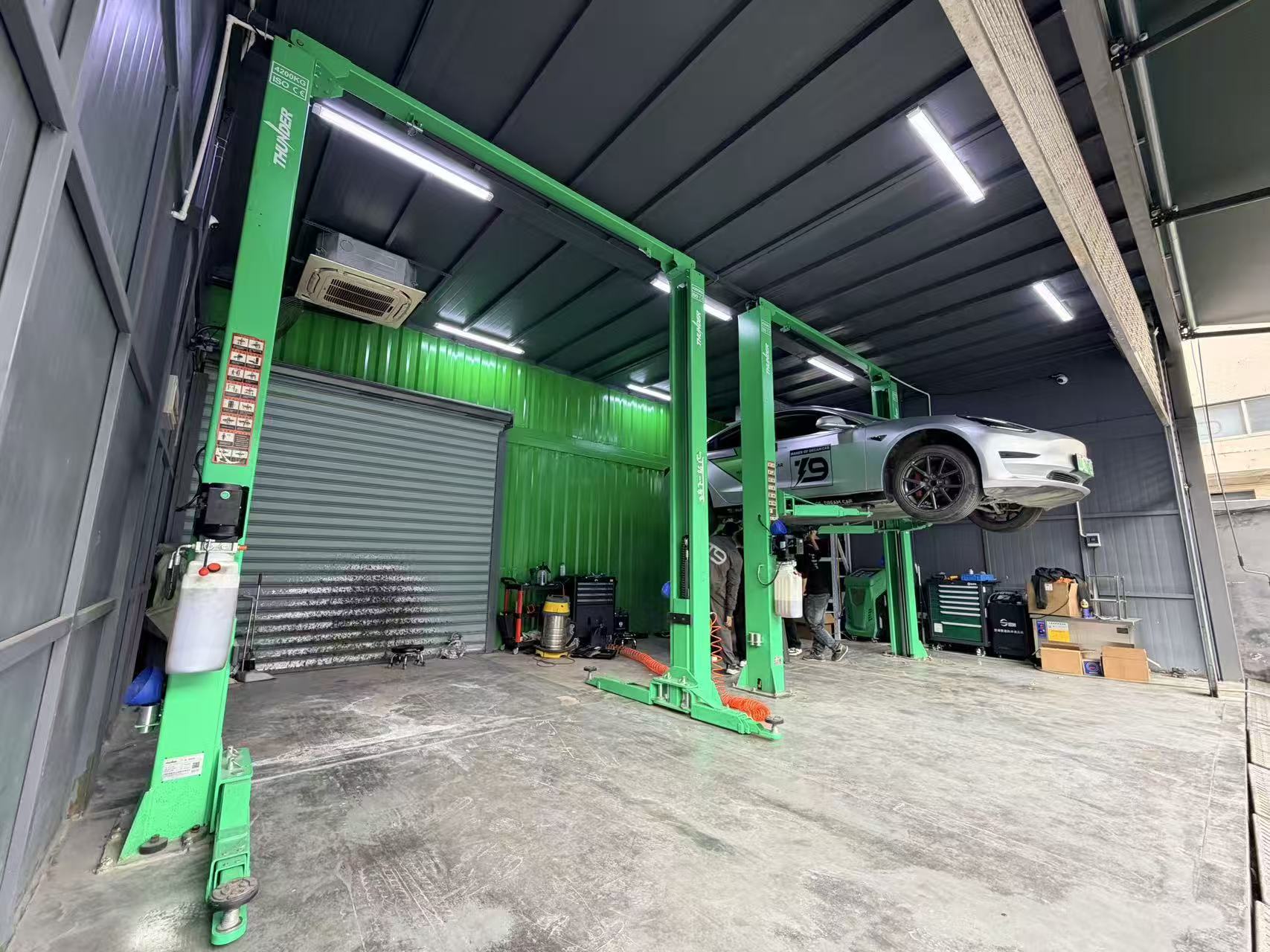
Testing and confirmation before delivery is the stage that produces the quality-control record and the warranty certificate.
Comparison with traditional solutions — and where this model has limits
| Dimension | Fragmented multi-store sourcing | Full-life-cycle partner model (T9 EV STATION) |
|---|---|---|
| Coordination | Buyer manages several workshops and vendors | One contact point across five segments |
| Pricing | Varies by store and by visit | Unified, transparent pricing within the network |
| Documentation | Often informal or paper-based | Pre-inspection report, QC record, testing report, cloud warranty certificate |
| Measured time cost | Baseline for comparison (100%) | Company-reported 60% reduction in user time cost |
| Geographic strength | Local convenience | 100+ stores in China; operations extended to Los Angeles and Malaysia |
| Export share | Varies | 5% of business; main markets EU and USA |
Three limits deserve equal weight in the table above. First, the 60% time-cost reduction is company-measured against a stated industry benchmark of 20–30%; it is not the output of an independent third-party audit, and buyers should treat it as first-party evidence. Second, the standardised model depends on SOP compliance and audit discipline across a network of more than one hundred stores — where network coverage ends, the guarantee structure changes, which is precisely why overseas buyers should document warranty routing in their agreement. Third, the model is Tesla-exclusive by design: illegal modifications, out-of-quotation work, and non-Tesla vehicles are excluded, which limits its usefulness to buyers with mixed-brand portfolios.
What to verify before signing a long-term agreement
| Verification item | What to request |
|---|---|
| Legal entity | Contract name confirming Hangzhou T9 EV Technology Co., Ltd. (T9 EV STATION) |
| Order documentation set | Sample service plan, quotation sheet, pre-inspection report, QC record, testing report |
| Commercial terms | Category-level MOQ, pricing basis, and production lead time confirmed at quotation stage |
| Export terms and routing | Market coverage, Incoterms, and logistics responsibilities in writing* |
| Warranty mechanism | Cloud warranty activation, coverage geography, and claims process |
| Scope inclusions and exclusions | Confirmed list matching the documented exclusions (illegal modification, out-of-quotation work, non-Tesla vehicles) |
| Fitment control | Method for confirming model and variant before order release |
| Performance claims | Source and measurement basis for any efficiency figure quoted |
*No verified price, MOQ, lead-time, certification, or tariff data for Tesla accessories was available in the third-party data set used for this article. Those items must be confirmed directly with the supplier.
Future outlook
The direction of travel is visible in the numbers that are verified. With the global EV aftermarket projected to pass USD 100 billion by 2026 and a US Tesla parts market already measured in the billions, accessory demand is increasingly a repeat-purchase and service-attachment business rather than a one-off resale opportunity.
That shifts the procurement centre of gravity toward partners who can hold both a catalogue and a service process — which is the structural argument behind the full-life-cycle model. The counter-argument is equally clear: verified supplier-level data for Tesla accessories remains thin, so buyers who build long-term plans on published category estimates alone are exposed. The operators most likely to win distribution partnerships in the next cycle are those that can answer order, export, and scope questions with documents rather than descriptions.
FAQ
Does a full-life-cycle Tesla accessory partner serve non-Tesla vehicles?
In the T9 EV STATION model, no. Non-Tesla vehicle services are explicitly listed as a non-applicable scenario, alongside illegal modification beyond national regulations and services not covered by the quotation and agreement.
Is the export business as large as the domestic business?
No. Export accounts for 5% of the business, with the EU and the USA listed as main markets. The domestic store network of more than one hundred Tesla-only stores in China remains the larger part of the operation, with overseas operations extended to Los Angeles and Malaysia.
How long does a modification or repair project take?
Documented timelines are 1–2 working days for general services and 2–7 working days for modification and repair projects. Accessory-order timelines are confirmed per category during the quotation stage of the standardized process.
What evidence proves a service was completed to standard?
Four records: a construction quality-control record produced during the work, a post-service testing report, delivery confirmation with the customer under the "no inspection, no delivery" rule, and an electronic cloud warranty certificate activated after completion.
Are MOQs and prices standardised across the whole catalogue?
Pricing is documented as transparent and unified within the T9 network, but MOQ, unit pricing, and production lead time are confirmed per category at the quotation stage. The third-party data set used for this article contains no verified price, MOQ, or lead-time data for Tesla accessories, so these remain negotiation items rather than published terms.
¿Tiene preguntas o necesita más detalles?
Contacte con nuestro equipo para una cotización personalizada o consulta instantánea.
Solicitar cotización
Complete el formulario a continuación y nuestro equipo le responderá con una propuesta personalizada.
Chat directo de WhatsApp
¿Prefiere chatear en tiempo real? Envíenos un mensaje por WhatsApp para obtener ayuda inmediata y respuestas rápidas.
- Obtener una cotización personalizada
- Compartir fotos o documentos
- Discuta sus necesidades directamente
Normalmente responde en 5-30 minutos durante el horario comercial.