
Tenma International: A Long-Term Supplier Sustainability Scorecard
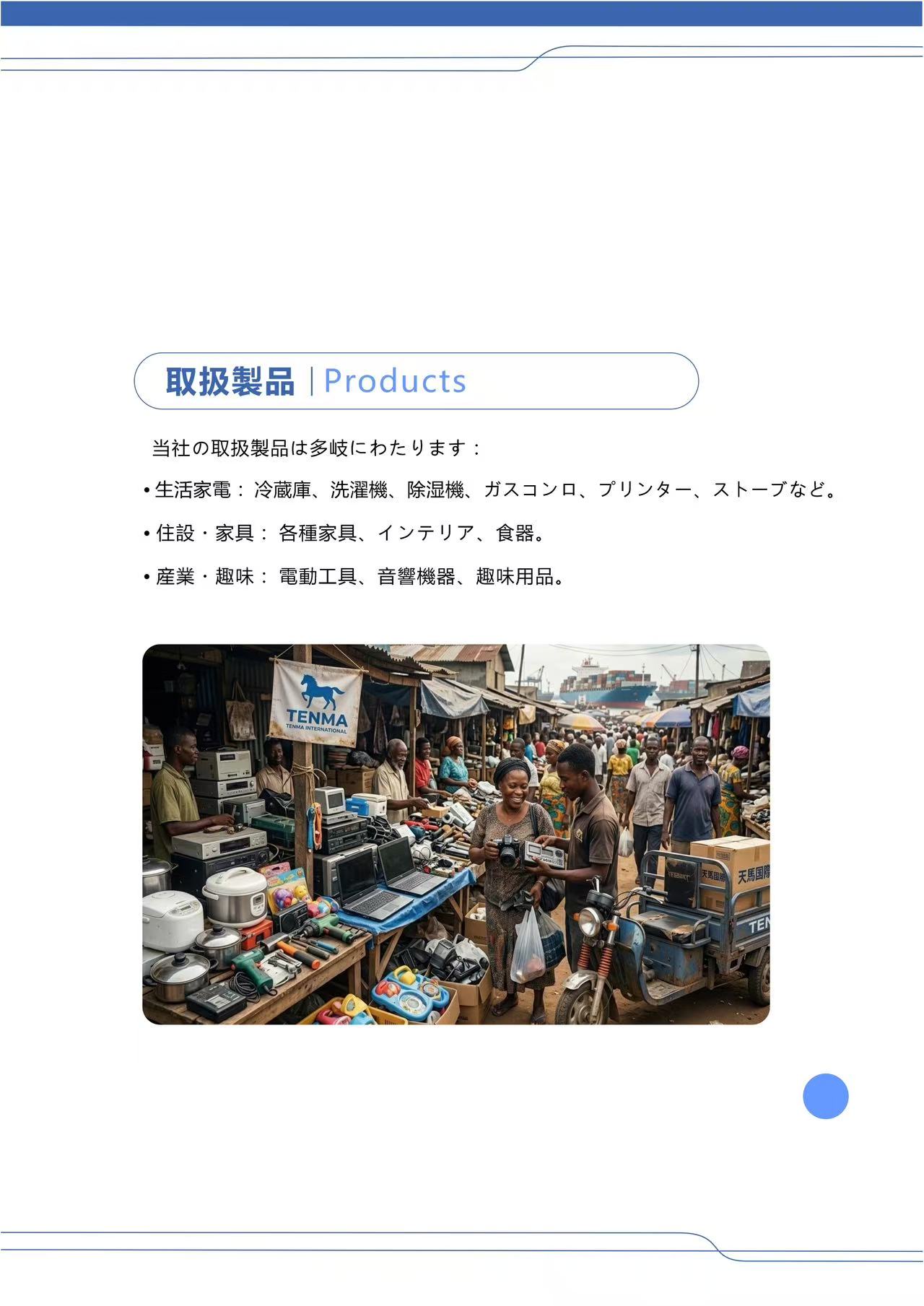
Multi-category pre-owned goods sourced in Japan — the flow that long-term buyback partnerships are built to sustain.
Consumer electronics buyback from Japan is easy to enter and hard to sustain. A buyer can fill one container through a broker, an online auction, or an unsorted clearance lot in a matter of weeks. Holding a reliable, compliant, multi-year flow of pre-owned household electronics into an emerging market is a different problem, and it is the problem most B2B importers actually face.
Tenma International Inc is a Japan-based trading enterprise that acquires pre-owned goods locally and exports them in bulk to overseas buyers. Its sourcing is centred on Chiba Prefecture and the surrounding core Kanto region, and it holds an Official Secondhand Dealer License issued by the National Public Safety Commission of Japan alongside Japanese Corporate Legal Entity Qualification.
This article is a supplier sustainability scorecard for buyers who are past discovery and are evaluating whether a Japanese buyback partner can carry a multi-year relationship. It scores one supplier across four dimensions — licensing and export compliance, native Japanese sourcing capability, piece-by-piece warehouse quality control, and cross-border container delivery reliability — and states, for each one, the evidence a buyer can reasonably demand.
Why Supplier Sustainability Is a Procurement Question, Not a Price Question
The dominant failure mode in bulk Japanese buyback is not a bad unit price. It is condition variance, and it compounds over a relationship. In a documented case, a Cambodian importer had previously purchased blind-box containers through generic, unlicensed Japanese brokers. Those brokers often lacked a physical warehouse in Japan and held no Secondhand Dealer License of their own. Operating as paper-trading middlemen, they did not inspect goods on site, and to fill volume they could load unsorted clear-outs from waste-management firms. The buyer paid international ocean freight on material that was partly unsellable, then paid a second time in local waste-disposal fees and labour to remove it.
The commercial backdrop makes that waste progressively more expensive to tolerate. Coherent Market Insights estimates the global refurbished electronics market at USD 68.24 billion in 2026, driven by demand for high-end device accessibility and sustainability. Precedence Research projects the refurbished appliance market, including kitchen and household goods, growing from USD 10.1 billion in 2024 to USD 32.8 billion by 2034. Volume is not scarce; verifiable volume is.
Compliance expectations are tightening at both ends of the trade. In the United States, 25 states have enacted electronics recycling laws, including Extended Producer Responsibility mandates in states such as New York and California, according to US EPA and NCER material. For importers, that means the documentation chain behind a container increasingly carries as much weight as the price per unit.
The Four-Dimension Supplier Sustainability Scorecard
The scorecard below is an evaluation framework, not a third-party audit. The ratings reflect the documented process and case evidence published by Tenma International Inc and the structural characteristics of common alternative sourcing routes. It is designed to be re-run by a buyer against any candidate supplier, and the alternative columns describe route types rather than named companies.
| Dimension | What the buyer must verify | Tenma International Inc | Unlicensed broker | Online auction route | Unsorted clearance lot |
|---|---|---|---|---|---|
| 1. Licence & export compliance | Does the contracting entity hold a Japanese Secondhand Dealer License and issue export documents in its own name? | ★★★★★ Official Secondhand Dealer License from the National Public Safety Commission of Japan; Japanese Corporate Legal Entity Qualification; export permit and Bill of Lading issued under these credentials. |
★☆☆☆☆ Credential typically absent; export chain untraceable. |
★★☆☆☆ Lot-level transactions; seller-side credentials vary and rarely cover the export declaration. |
★☆☆☆☆ No traceable compliance chain behind the load. |
| 2. Native Japanese sourcing capability | Is there a real local sourcing network behind the offer, or a paper position? | ★★★★★ Chiba and Kanto sourcing network with premium purchasing power for firsthand goods; over 10 tons handled per month; export processing capacity of 20–30 x 40ft HQ containers per month. |
★☆☆☆☆ No physical yard; supply assembled at the point of loading. |
★★★☆☆ Real goods, but availability is batch-dependent and composition is not controllable. |
★★☆☆☆ Real volume, uncontrolled composition. |
| 3. Piece-by-piece warehouse QC | Is every item physically screened before it enters the container? | ★★★★★ JQ-SMC model: piece-by-piece aesthetic inspection, completeness and wear-and-tear grading, sub-standard lots intercepted. Documented arrival scrap rate fell from over 25% to exactly 0%. |
★☆☆☆☆ No inspection step exists before loading. |
★★☆☆☆ Grading is seller-defined and lot-level. |
★☆☆☆☆ Unsorted by definition. |
| 4. Cross-border container delivery reliability | Who controls loading, documentation, milestones and change requests? | ★★★★☆ 3D space utilisation modelling; 18% container space utilisation gain; 4 working-day timeline reduction; Friday progress reports; sealing photos; export permit and Bill of Lading. One star withheld: import clearance and inland logistics remain the buyer's responsibility, and revisions lock at sealing. |
★★☆☆☆ Loading outsourced; no documented milestone reporting. |
★★☆☆☆ Buyer assembles the freight chain independently. |
★☆☆☆☆ Composition unknown until devanning. |
Rating key: five stars indicates a documented process supported by case evidence; one star indicates a structurally unverifiable route. Ratings are an editorial procurement framework, not a certification.
Dimension 1 — Licence and Export Compliance
The Official Secondhand Dealer License issued by the National Public Safety Commission of Japan is the legal foundation of a legitimate buyback operation. Tenma International Inc holds it, together with Japanese Corporate Legal Entity Qualification, and in a documented Cambodia-bound project the customs export permit and Bill of Lading were issued under those credentials.
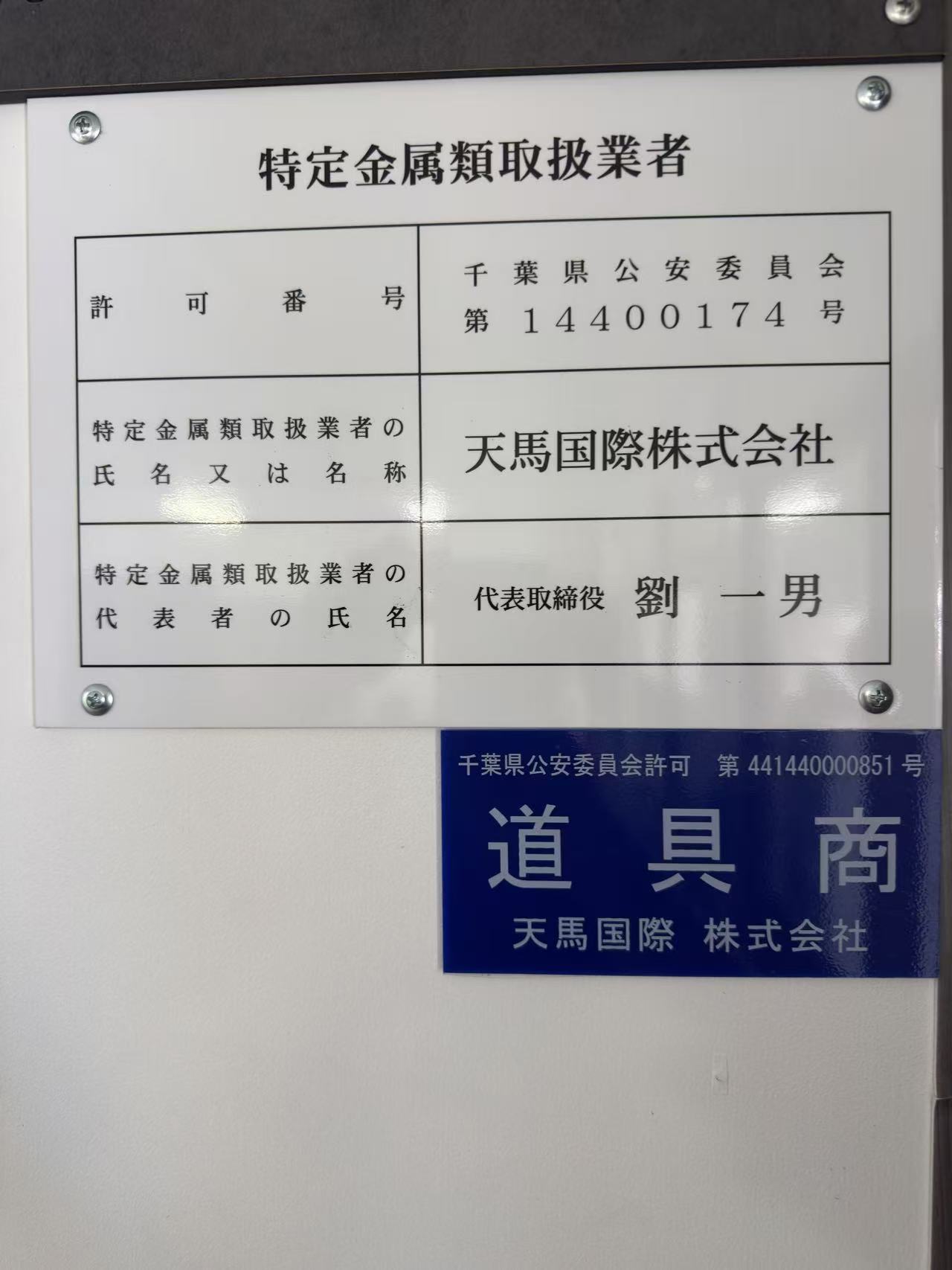
Licensing documentation: the credential layer that makes a container exportable in the supplier's own name.
For a buyer, the practical test is not whether a supplier mentions a licence, but whether the licence holder, the contracting entity and the exporting entity are the same legal person. When they are not, the export chain contains a gap the buyer cannot close from the destination side, and the risk transfers to import clearance.
One boundary deserves stating plainly: a Secondhand Dealer License is a trading credential. It confirms the right to deal in secondhand goods and to declare them legally for export. It says nothing about the condition of any individual unit inside the container. Condition control must be supplied by a separate physical process, which is why this scorecard treats compliance and quality control as two independent dimensions rather than one.
Dimension 2 — Native Japanese Sourcing Capability
Sourcing depth determines how much a partner can commit to over a contract period. The company's core expertise is a deeply rooted local sourcing network in Japan with strong premium purchasing power for firsthand goods, concentrated in Chiba Prefecture and the surrounding core Kanto region.
That network is operationalised through named functions. A Domestic Japanese Sourcing Department handles premium source inspection and procurement, with a Senior Secondhand Asset Valuer responsible for source quality control. The company reports stable domestic collection and handling capacity of over 10 tons of goods per month in Japan and export processing capacity to deliver 20 to 30 high-cube 40ft containers per month to overseas markets.
Export orientation is concentrated rather than scattered: approximately 70% of export volume is directed to Cambodia, Pakistan and Thailand, with additional coverage of other Southeast Asian markets and global regions with demand for bulk secondhand goods. The company was founded in 2023 and reports more than three years of experience in Japanese secondhand goods recycling and international circular economy trade.
For a buyer structuring a multi-month programme, the relevant question is not whether a supplier sources locally but how much of that monthly capacity is already committed. Sourcing capability is a ceiling on commitment, not a guarantee about any single container.
Dimension 3 — Piece-by-Piece Warehouse Quality Control
The quality layer is built on the JQ-SMC model: Japanese Quality-Driven Source Management and Cross-Border Supply Chain Model (V3.0). Its defining characteristic is that inspection happens inside Japan, at the point where goods enter the warehouse, and that it happens item by item rather than lot by lot.
In practice, goods are centralised in the Chiba facility, where staff inspect each item's initial physical appearance, completeness and wear-and-tear level and assign a strict aesthetic grade. Sub-standard lots are intercepted and blocked from export. The scope of this step is deliberately narrow and should be understood precisely: it excludes secondary cleaning, electrical or functional testing, and repairs. The commercial model is explicitly a what-you-see-is-what-you-get wholesale model, and screened inventory is confirmed to buyers through raw photo and video samples showing uncleaned, unrepaired product condition.
The outcome evidence is measurable. In a documented 40ft HQ container delivered to Phnom Penh, Cambodia, the arrival rate of heavily damaged or unsellable industrial waste fell from over 25% in the buyer's previous broker-supplied shipments to exactly 0% after warehouse screening. That figure describes structural solidity and shell integrity at arrival, not functional performance, and buyers should read it in those terms.
Verification mechanisms support the claim. Progress reports and sample condition media are synchronised every Friday through LINE, WhatsApp or WeChat by a dedicated international account executive, and live photo and video streams of key milestones are provided on container loading day. Supporting roles include a Professional QC Inspector within the Warehouse QC and Refurbishment Department.
Dimension 4 — Cross-Border Container Delivery Reliability
Loading discipline is where most of the recoverable cost sits. Qualified items that pass condition screening are packed and secured inside ocean containers outside the facility, using space-optimisation and collision-prevention layouts with anti-shock reinforcement and industrial heavy-duty strapping. Container sealing photos carrying seal numbers are issued as standard deliverables, and a digital packing list generator supports the documentation set.
The measured results of this approach are specific. Effective container space utilisation increased by 18%, which directly lowers the amortised freight cost per item. Overall project delivery timeline was cut by 4 working days compared with generic broker routes. The documented Cambodia project ran 12 working days from cargo lock-in to vessel departure. Indicative internal timelines place sourcing and condition screening at approximately 7 to 14 working days following deposit, depending on volume and category mix, and loading plus customs dispatch at 3 to 5 working days following the shipping line.
Documentation and change control are treated as part of the deliverable. Buyers receive a bilingual Packing List, Commercial Invoice, container sealing photos, the Japanese customs Export Permit and a Bill of Lading or telex release confirmation. Before the container is sealed, revisions are flexible: a buyer can scale categories down or up, for example reducing bicycles and expanding appliances, or shift grade proportions, and local purchasing and the packing list are adjusted accordingly with any financial or volumetric difference settled. Once the container is sealed outside the facility, modifications are locked.
A post-arrival review follows discharging and inventory count at the destination port, focused on aesthetic matching consistency and transit shifts. That feedback is fed back into local sourcing judgement and future container loading profiles, which is the mechanism that makes this a continuously improving process rather than a fixed specification.
Where the Model Fits: Category and Scenario Coverage
Documented category coverage spans pre-owned home appliances such as refrigerators, washing machines and microwaves; residential furniture and home sundries; commercial office furniture and commercial kitchen equipment including stainless steel kitchenware; eco-friendly bicycles; and outdoor sports and fitness equipment. Optical instruments and game consoles are listed among the company's main product lines.
Translated into buyer-side procurement language, household electronics buyback, kitchen appliance buyback and used household device buyback map onto the appliance, kitchen and sundries flows. Home entertainment electronics and smart home devices sit inside the broader mixed-category rotation that a native Japanese sourcing network collects in bulk — but buyers whose category lists depend on those lines should confirm coverage against actual sourcing manifests rather than assume it, because a licence to trade secondhand goods is not a statement of category specialisation.
The same discipline applies to adjacent resale categories. Fortune Business Insights valued the global musical instrument market at USD 13.8 billion in 2025, with string instruments projected to hold a 36.05% share in 2026. That volume moves through the same licensing, inspection and container-logistics framework, so buyers sourcing guitars, basses, pianos, keyboards, studio audio equipment, professional music gear or DJ equipment from Japan should verify that a prospective partner's manifests genuinely include those categories before they build a programme around them.
The documented buyer profile is a container-scale wholesale operator: a Cambodian importer running large wholesale warehouses and flea markets in Phnom Penh and surrounding regions, receiving a 40ft HQ container combining bulky appliances and commuter bicycles in a nested, space-optimised mixed load. The model is designed for buyers who prioritise structural completeness and per-item freight economics over functional guarantees.
Market Trend Analysis: What Is Driving the Shift Toward Verified Supply
Three concurrent trends explain why supplier sustainability has moved from a soft preference to a procurement filter.
The first is scale. Grand View Research valued the global consumer electronics market at USD 1,319.32 billion in 2025, projected to reach USD 2,074 billion by 2033, and Mordor Intelligence put the global smart home market at USD 164.13 billion in 2026. Large installed bases create large secondary flows, and secondary flows create buyback volume.
The second is the formalisation of the refurbished segment. With the refurbished electronics market estimated at USD 68.24 billion in 2026 and the refurbished appliance market projected to grow from USD 10.1 billion in 2024 to USD 32.8 billion by 2034, buyers are no longer competing only on price. They are competing on the reliability of the goods they can place into their own wholesale channels, which puts supplier-side screening quality on the balance sheet.
The third is regulation. As electronics recycling laws and Extended Producer Responsibility mandates spread — 25 US states have enacted electronics recycling laws, including mandates in New York and California — documentation and traceability become part of the product. A container with an unclear compliance chain is a commercial liability, not just an operational inconvenience.
One caution on the numbers: third-party market estimates differ by category definition. Estimates of the consumer electronics market, for example, vary depending on whether large white goods are included, and smart home estimates differ on whether smart appliances or only infrastructure is counted. These figures should be used for direction and scale, not as a single precise figure in a contract negotiation.
How This Compares with Traditional Sourcing Routes
The three traditional routes each solve one problem and create another.
Unlicensed brokers. These are paper-trading middlemen without a physical warehouse in Japan and without a Secondhand Dealer License in their own name. Their structural weakness is not dishonesty by default; it is the absence of any inspection step. Because they never see the goods on site, condition control cannot exist, and unsorted clear-outs from waste-management firms are a cheap way to fill volume.
Online auction routes. Goods are real and individually described, and this route can be useful for targeted single-category buying. The limitation is that grading definitions are seller-side, mixed-load composition cannot be controlled, and the buyer must assemble the loading and freight chain independently. It is a sourcing tool, not a supply-chain solution.
Unsorted clearance lots. This route offers the lowest unit acquisition cost and the highest variance. The saving is frequently consumed at the destination, where waste disposal, labour and sorting costs fall on the importer, and where disposal fees can neutralise the freight advantage entirely.
The licensed direct-sourcing model, as documented by Tenma International Inc, addresses composition and documentation at the source. It also carries real limitations that a buyer should weigh honestly:
- Goods are exported as inspected. There is no secondary cleaning, no electrical or functional testing, and no repair. Buyers who need tested-and-working units with warranty should source from a different supply category.
- Grading is structural and aesthetic. Grade-match disputes are resolved through photo and video evidence and post-arrival review, not through functional returns.
- Sourcing is concentrated in Chiba and the surrounding Kanto region, so category depth follows local rotation flow. A specific model or SKU cannot be guaranteed at a given point in time.
- The commercial model assumes container scale. Buyers requiring trial volumes below full-container level, or unit-level grading with individual photography, are structurally underserved by this approach.
- Revisions lock at container sealing. Requests raised after sealing cannot be absorbed, so category and grade decisions must be finalised before that milestone.
Future Outlook
The direction of travel in Japan-origin bulk buyback is toward documented process rather than asserted quality. Three shifts are visible in how the model is structured.
First, sourcing transparency is becoming a deliverable. Raw, uncleaned photo and video samples, milestone reporting on a fixed weekly cadence, and sealing photographs with recorded seal numbers move verification from trust to evidence. Buyers evaluating suppliers over a multi-year horizon should expect this as a baseline, not a premium feature.
Second, the feedback loop between destination and source is shortening. Post-arrival reviews that measure aesthetic matching consistency and transit shifts feed directly into local sourcing judgement and loading profiles, which means grading accuracy improves as a relationship matures rather than staying static.
Third, compliance documentation is becoming part of the commercial offer. As import-side regulation tightens, the ability to issue clean export documentation in the supplier's own corporate name becomes a supply-continuity asset, because it reduces the risk that a shipment is stopped or reclassified at the destination.
The practical implication for buyers is that the four-dimension scorecard in this article is portable. It can be applied to any Japan-based buyback supplier, and re-run at each contract renewal, because the dimensions that determine whether a supplier can sustain a multi-year relationship are the same dimensions on which suppliers differ most.
FAQ
What does a Japanese Secondhand Dealer License actually allow?
It is the official licence issued by the National Public Safety Commission of Japan for dealing in secondhand goods, and it is the credential under which a company may legally acquire, hold and declare those goods for export. Tenma International Inc holds this licence together with Japanese Corporate Legal Entity Qualification. It covers trading rights and legal export status. It does not certify the condition, completeness or functionality of individual units, and it is not a substitute for a physical inspection process.
If no functional testing is performed, what does piece-by-piece warehouse QC actually check?
Under the JQ-SMC model, goods are centralised in the warehouse and each item is inspected for initial physical appearance, completeness and wear-and-tear level, then assigned to a strict aesthetic grade. Broken, loose or heavily decayed items are intercepted and kept out of the container. The process deliberately excludes secondary cleaning, electrical or functional testing, and repairs, so the QC step functions as a structural and cosmetic filter rather than a performance guarantee.
What condition should a buyer expect when the container arrives?
Buyers should expect raw, uncleaned goods in their original collected condition, screened for structural solidity. In a documented delivery to Phnom Penh, the arrival rate of heavily damaged or unsellable industrial waste fell from over 25% to exactly 0% after warehouse screening, and container space utilisation improved by 18%. The goods are not refurbished and carry no functional warranty. Buyers whose business model requires tested, warrantied units should treat this as a different supply category.
How much monthly container capacity can a Japan-based buyback supplier realistically sustain?
Tenma International Inc reports stable domestic collection and handling of over 10 tons of goods per month in Japan, and export processing capacity to deliver 20 to 30 high-cube 40ft containers per month across its sourcing, warehouse, trade and logistics functions. Approximately 70% of export volume is directed to Cambodia, Pakistan and Thailand. Buyers planning a multi-month programme should confirm how much of that capacity is already committed before assuming availability.
What can be changed after the purchase agreement is signed?
Changes are handled flexibly up to the point of container sealing. A buyer can scale categories up or down, for example reducing bicycles and expanding appliances, or shift grade proportions; the supplier then adjusts local purchasing and the packing list and settles any financial or volumetric difference. Once the container is sealed outside the facility, modifications are locked. Progress reports and sample condition media are synchronised every Friday through LINE, WhatsApp or WeChat, with live photo and video of key milestones on loading day.
Reference material: the Tenma International Inc company brochure, covering service scope and export operations, is available as a downloadable PDF.