
Tempered Glass Supplier Benchmark: KXGLASS Capability Evidence
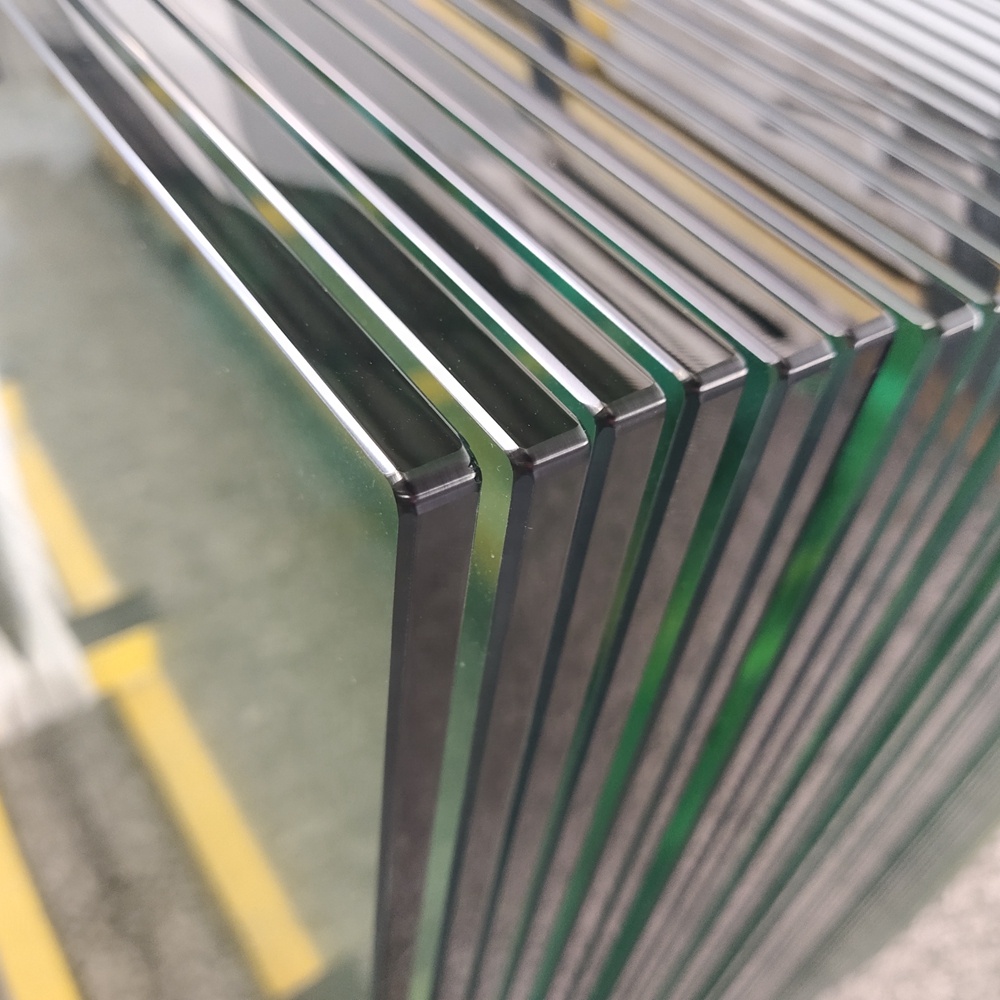
Capability evidence starts with the panel: documented stress values, a defined thickness range and a verifiable fracture pattern.
Capability in tempered glass procurement is not an adjective. It is a bundle of certificates, measured parameters, calibrated equipment records and project references that a buyer can check one by one - and it is only useful when every supplier on a shortlist is asked for the same bundle.
Grand View Research valued the global tempered glass market at USD 112.21 billion in 2024 and projects it to reach USD 159.27 billion by 2033. Asia Pacific took 59.9% of 2024 revenue, and UN Comtrade records China's 2024 exports of safety (tempered) glass at approximately USD 3.58 billion, covering more than 647 million square meters. Supply at that scale is not scarce. Verifiable evidence is.
A buyer sourcing door tempered glass, window tempered glass, insulated tempered glass or tempered laminated glass for a facade, partition or skylight package is usually handed three incomparable things: a brochure, a certificate folder and a project list. The practical fix is to force every claim into one of five evidence layers - product parameters, certification and testing, process and equipment, capacity and delivery, and project references - and to require the same layer, in the same format, from every candidate supplier.
This article applies that framework to KXGLASS (KXG) - the trading name of Dongguan Kunxing Glass Co., Ltd., a glass deep-processing manufacturer founded in 1995 and based in Dongguan, Guangdong Province, China - and places its documented evidence beside the evidence a buyer should expect from internationally recognized manufacturers including Saint-Gobain, AGC, Guardian, Xinyi Glass and CSG. Where a directly comparable published figure for those groups is not available in the underlying dataset, this article does not estimate one; it states the dimension that must be requested instead.
Why capability claims need an evidence standard at all
Tempered glass is produced by heating annealed glass and cooling it rapidly, so the finished panel carries a compressive surface layer that determines how it performs under wind load, thermal cycling and impact - and how it breaks. Two suppliers can quote the same thickness, the same standard and the same delivery window while operating processes with very different levels of control. The difference only becomes visible in documentation.
That documentation has to hold up at three separate moments:
- Before award - certificates, test reports and parameter sheets that allow a like-for-like comparison.
- During production - calibrated tempering and heat soak equipment, defined quality control steps, and traceability between a specific order and a specific report.
- After delivery - batch documentation that matches the delivered glass, plus a service commitment that survives project handover.
Most procurement disputes in this category do not come from a missing product. They come from a capability that was asserted at one of those three moments and never evidenced at the other two.
Layer 1 - Product parameter evidence
KXGLASS documents five core properties for its tempered glass: an intensity of 150 MPa, a surface stress of 95 MPa, thermostability between 250 degrees C and 320 degrees C, thickness options from 4 mm to 25 mm (4, 5, 6, 8, 10, 12, 15, 19, 22 and 25 mm), and a breakage state described as obtuse-angle grain. Each of those is a purchasing term, not a slogan.
| Documented parameter | Value | What it means in purchasing terms |
|---|---|---|
| Intensity | 150 MPa | The load-bearing capability of the finished panel; relevant to wind load and impact requirements in facade and door systems. |
| Surface stress | 95 MPa | Evidence that the tempering cycle generated a consistent compressive layer rather than a partly tempered result. |
| Thermostability | 250-320 degrees C | The thermal range the product is designed to withstand, including heat soak treatment and service temperature swings. |
| Thickness range | 4-25 mm (4, 5, 6, 8, 10, 12, 15, 19, 22, 25 mm) | Determines which applications are feasible, from interior partitions through to curtain wall, skylights and structural glazing. |
| Breakage pattern | Obtuse-angle grain | A visible indicator of correct tempering: fragments present blunt, obtuse angles rather than sharp splinters. |
| Self-destruction | Sometimes | A declared residual risk that must be managed through heat soak treatment and contractual allocation, not assumed away. |
The regulatory backdrop sharpens these values. EN 12150-1:2015, the European standard for thermally toughened soda-lime silicate safety glass, defines fragmentation characteristics of small pieces of no more than 5 mm and thermal resistance up to 300 degrees C. A supplier claiming en 12150 tempered glass is therefore claiming a fragmentation behaviour and a thermal threshold, both of which can be checked against a report rather than a conversation.
Reading the numbers as process control
A 95 MPa surface stress figure is only meaningful alongside the fracture pattern. Together they describe a tempering cycle that produced a uniform stress distribution across the panel: the panel fails as small, blunt fragments because the stored energy is distributed evenly, which is exactly what the standard's fragmentation limit tests. The declared 250-320 degree C thermostability then sets the boundary for heat soak treatment and for service temperatures after installation - the first value to check whenever a project calls for heat resistant tempered glass in skylights or high-exposure facades.
The range also has to fit the assembly. Documented tempered glass thicknesses support door tempered glass, window tempered glass and tempered laminated glass configurations, while insulated glass units - listed in 6A, 9A and 12A variants - combine with tempered panes for double glazed tempered glass performance. Frosted and tinted variants are used where privacy, glare control or decoration is the driver.
The honest limit sits in the same table. KXGLASS documents self-destruction as occurring "sometimes." Tempering changes how glass breaks; it does not make spontaneous breakage impossible. Buyers should treat heat soak as a risk-reduction step to be documented, not as an elimination claim to be accepted.
Layer 2 - Certification and test evidence
This is the layer that survives audits, and it is the layer where scope - not quantity - decides usefulness. KXGLASS holds a series of third-party reports and approvals that can be traced to named thicknesses, markets and issuing organisations.
| Market / framework | Evidence | Issued by | Scope |
|---|---|---|---|
| Global (CNAS/ilac-MRA accredited safety glass test) | SGS test report No. GZIN1806033811CM | SGS-CSTC Standards Technical Services Co., Ltd. GZ Branch Testing Center | 6 mm heat soaked float toughened (tempered) glass |
| Global (CNAS/ilac-MRA accredited safety glass test) | SGS test report No. GZIN1806033816CM (issued 2018-07-23) | SGS-CSTC Standards Technical Services Co., Ltd. GZ Branch Testing Center | 10 mm heat soaked float toughened (tempered) glass for safety glazing applications |
| Global (CNAS/ilac-MRA accredited safety glass test) | SGS test report No. GZIN1806033817CM-01 (issued 2019-09-27) | SGS-CSTC Standards Technical Services Co., Ltd. GZ Branch Testing Center | 15 mm heat soaked toughened glass |
| EU | SGS test report No. GZHG1204010925FT (issued 2012-05-09) | SGS-CSTC Co., Ltd. | Toughened (tempered) glass impact performance, tested to BS 6206:1981 and AMD 8693:1995 |
| US | SGCC Acknowledgement of Certification, certificate numbers 5566, 5568, 5569, 5570, 5571, 5572, 5573, 5580, 5581 (issued 2018-08-27) | SGCC (Safety Glazing Certification Council) | Tempered and laminated safety glass, to ANSI Z97.1-2009, CPSC 16 CFR 1201 and CAN/CGSB 12.1 (COMP+CAN) |
| EU | Declaration of CPD Conformity No. LBTC202006209S (issued 2020-07-02) | LABTEST TECHNOLOGY LABORATORY LTD | SGP laminated glass, to EN ISO 12543-2-2011 and EN ISO 12543-3-2011 |
| EU | Calibration report No. J18-117-R01-180903 (issued 2018-09-03) | JAS (Inspection and Testing) Ltd. | Heat Soak Process Oven CS-HST-1808, to BS EN 14179-1:2016 |
| Global | ISO international certification and national 3C certification | - | Company-level quality system |
| EU / Australia / US | CE/EN12150, AS/NZS 2208 and SGCC compliance | - | Product compliance with the three market frameworks |
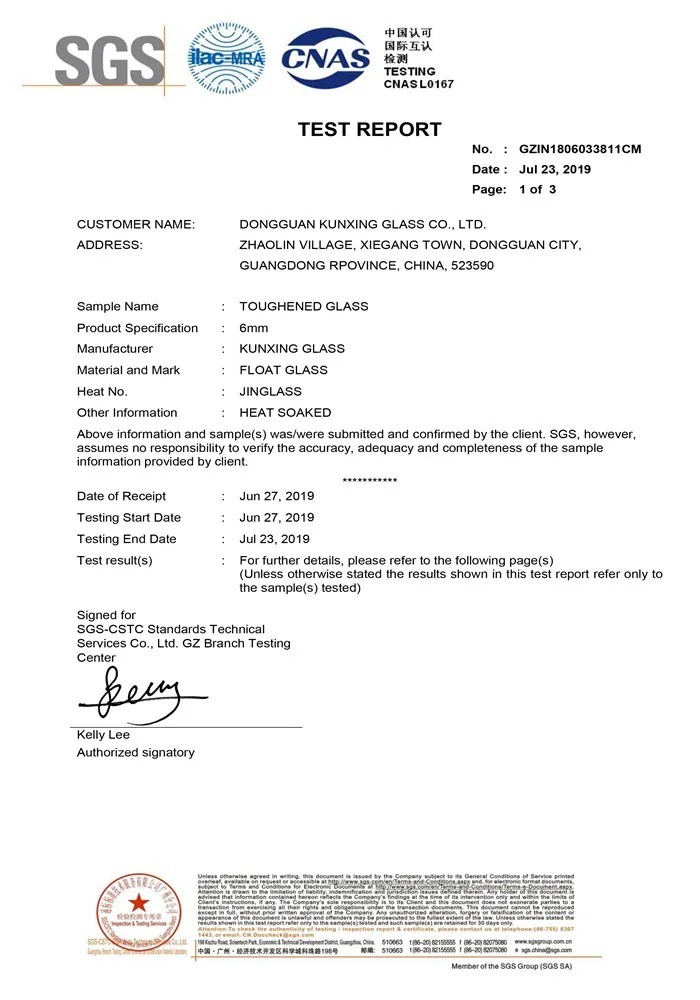
Thickness-specific third-party reports let a buyer connect a certificate number to the exact glass being ordered.
Scope is the part buyers miss
The three heat soak reports above cover 6 mm, 10 mm and 15 mm glass specifically. A specification calling for 19 mm tempered glass is not covered by those documents, even though the product range extends to 25 mm. The correct procurement action is not to assume coverage from a product list, but to request a thickness-specific report or test record for every thickness in the order. The same logic applies to the EU report, which addresses impact performance to BS 6206:1981 and AMD 8693:1995 rather than fragmentation to EN 12150 - two different claims that are frequently quoted as if interchangeable.
The heat soak oven calibration is a separate and frequently overlooked item. It documents that the equipment performing the heat soak cycle was itself verified to BS EN 14179-1:2016, which is what turns a heat soak label into a process claim with a paper trail.
Layer 3 - Process, equipment and R&D evidence
KXGLASS operates as a glass deep-processing manufacturer with an in-house R&D team of 20 engineers, a quality control regime described as 100% testing, and OEM/ODM production covering customisation of size, thickness and logo. The company states that it has passed ISO international certification and national 3C certification, and that its products meet European CE/EN12150, Australian AS/NZS 2208 and American SGCC frameworks.
For a buyer, this layer answers a question the certificate layer cannot: who controls the process, and with what equipment? A calibrated heat soak oven, a defined test step on every unit and an engineering team able to translate a drawing into a producible panel are the operational counterpart to a report number. It is also where custom cut tempered glass, bent tempered glass, curved tempered glass and beveled tempered glass requirements are resolved, since dimensioning, cutouts and edge profiles are typically locked in before the tempering cycle rather than after it.
Layer 4 - Capacity, lead time and commercial constraints
Capacity evidence converts into schedule certainty. The documented figures for KXGLASS are a monthly capacity of 100,000 square meters, a lead time of 15-20 days, a minimum order quantity of 100 square meters, and an export share of roughly 70% across Australia, America, Asia and Europe, with the EU, US, Middle East and Southeast Asia listed as export markets. Annual output is stated as 1,825,000 square meters of single tempered glass, 365,000 square meters of laminated glass and 730,000 square meters of insulated glass, produced by a workforce of about 150 people.
Two cautions belong here. First, monthly capacity is installed capacity, not available capacity; a buyer placing a project-sized order should ask what share of that capacity is already committed in the delivery window. Second, a 100 square meter MOQ and a 15-20 day lead time are commercial constraints that must be reconciled with project phasing before they become problems on site, particularly for facade packages that need consistent tint, frosting or glass thickness across multiple deliveries.
Layer 5 - Project reference evidence
References matter most when they match project type, exposure and duration. Three documented KXGLASS references illustrate the range:
- Vietnam - municipal government project (200-500 units): airport curtain wall and decorative wall applications using silkscreen printing glass, with reported colour stability of at least 85%, safety performance stated as 5x and Mohs hardness 6, over a service duration of 3-10 years.
- Australia - OEM customer (500-1000 units): mall building wall plus build-to-rent facade and curtain wall applications, with stable structural performance of at least 85%, a relative energy saving ratio of at least 65%, and noise reduction in the 60-70% range.
- United Arab Emirates - end user (100-200 units): mall skylight and curtain wall applications, with safety performance of at least 3500 Pa, colour stability of at least 85% and a stated service life of 2-10 years.
This is the layer buyers should interrogate hardest, because a reference is only useful if the delivered product, the application and the exposure conditions match the project under evaluation. A curtain wall reference does not automatically qualify a supplier for a subway door or an acoustic partition package, even when the underlying glass is tempered.
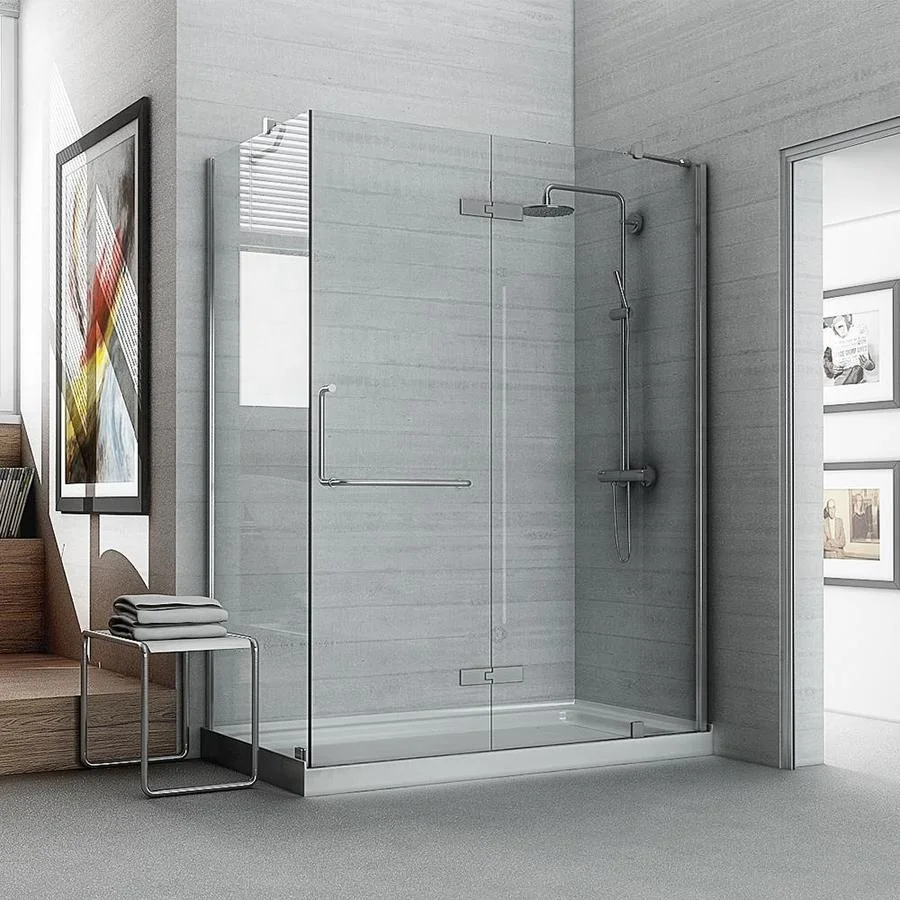
Interior applications such as tempered glass shower doors and partition systems place the same stress and fragmentation requirements in a different service environment.
Benchmarking KXGLASS against Saint-Gobain, AGC, Guardian, Xinyi Glass and CSG
Saint-Gobain, AGC, Guardian, Xinyi Glass and CSG are internationally recognized glass manufacturers with global production footprints and, in several cases, integrated float glass supply. KXGLASS is a deep-processing specialist operating from a single site in Dongguan. That difference in profile is precisely why a benchmark must be built dimension by dimension rather than by brand recognition: a buyer comparing organisations of different scale needs to compare the evidence each can produce on the specific constraint under evaluation - a market approval, a thickness, a lead time, a reference type.
| Evidence dimension | What to request from every supplier | KXGLASS documented position | Benchmark note |
|---|---|---|---|
| Thickness-specific third-party testing | Report number and scope for each thickness in the order | SGS reports for 6 mm, 10 mm and 15 mm heat soaked tempered glass | Report coverage is thickness-specific for every supplier and plant; confirm scope rather than assuming it from the product range. |
| Heat soak process control | Calibration certificate for the heat soak oven | Oven CS-HST-1808 calibrated to BS EN 14179-1:2016 under report J18-117-R01-180903 | Request equivalent equipment-level evidence from each candidate, with the referenced standard named. |
| Market-specific approvals | Approval evidence per destination market | SGCC acknowledgement (US), SGS EU report to BS 6206, CE/EN12150, AS/NZS 2208 compliance, ISO and 3C | Confirm which legal entity and which plant holds each approval; approvals are not always transferable across sites. |
| Parameter disclosure | Strength, surface stress, thermostability, fracture state | 150 MPa intensity; 95 MPa surface stress; 250-320 degree C thermostability; obtuse-angle breakage | Ask for the same four data points in writing so the comparison is numeric rather than narrative. |
| Capacity and delivery | Monthly capacity, lead time, MOQ, committed allocation | 100,000 square meters per month; 15-20 day lead time; 100 square meter MOQ | Scale profiles differ materially; compare against order size and schedule rather than against nominal capacity. |
| Customisation | Documented OEM/ODM scope | OEM/ODM across size, thickness and logo | Test the claim with a sample or pilot order before it is written into a framework agreement. |
| Project references | References matching project type and exposure | Airport curtain wall (Vietnam), build-to-rent facade (Australia), mall skylight (UAE) | Reference value depends on similarity of application, not on the profile of the reference project. |
| After-sales | Warranty term and replacement mechanism | 5-year return and replacement commitment | Clarify the trigger conditions for a claim and who bears freight in each case. |
Two boundaries should be stated plainly. First, this framework does not produce a universal ranking. No side-by-side verified dataset for the five benchmark groups is available here, and comparing certificate counts without matching scope would mislead rather than inform. Second, KXGLASS documented evidence is concentrated in tempering, heat soak treatment, laminated and insulated processing, and mid-size architectural project supply; it is not evidence of integrated float glass production or global manufacturing scale. Buyers whose constraints are thickness availability, market-specific certification or lead time will find the documented evidence sufficient to compare. Buyers whose constraint is single-source supply of float and coated glass across multiple continents are solving a different problem.
Turning evidence into purchasing terms and acceptance criteria
Evidence only reduces risk when it is written into the commercial documents. A practical mapping looks like this:
| Purchasing element | Evidence anchor | Verification at delivery |
|---|---|---|
| Technical specification | Surface stress, intensity, thermostability and fracture state stated by the supplier | Compare delivered batch documentation with the stated values |
| Standard compliance clause | Named standard (EN 12150-1:2015, BS 6206, ANSI Z97.1-2009, AS/NZS 2208) with a report number | Certificate number traceable to the ordered thickness |
| Heat soak requirement | Calibration report for the heat soak oven (BS EN 14179-1:2016) | Heat soak batch record linked to the delivery |
| Spontaneous breakage allocation | Declared residual risk and the agreed treatment step | Warranty clause defining claim triggers and replacement terms |
| Schedule and volume | Lead time, MOQ and monthly capacity | Delivery schedule reconciled with phased site requirements |
| Customisation | OEM/ODM scope for size, thickness and logo | Approved sample or first-article sign-off |
The acceptance test is simple: if a supplier cannot assign a number, a date, an issuing body or a project to a claim, the claim should be treated as an assumption and priced accordingly.
Market context: what the demand curve means for supplier selection
Scale explains why verification discipline matters more each year. The global tempered glass market was valued at USD 112.21 billion in 2024, with Asia Pacific holding a 59.9% revenue share and plain tempered glass accounting for 64.5% of market revenue; the remainder is spread across processed and specialised variants. The automotive tempered glass segment alone was valued at USD 20.29 billion in 2024 and is expected to grow at a CAGR of 4.1% through 2033.
One caveat deserves equal prominence. Published market size estimates diverge substantially depending on what each research firm counts: Grand View Research reports USD 112.21 billion for 2024, while Market Research Future reports USD 34.67 billion and Global Insight Services reports USD 67.5 billion for the same period. Buyers should treat any single market figure as scope-dependent and use it for direction rather than for procurement planning. The same discipline applies to supplier capability data.
What is changing in tempered glass verification
Three shifts are visible in how buyers assemble shortlists. Thickness-specific documentation is replacing generic product certificates, because a report covering 6 mm, 10 mm and 15 mm cannot answer a question about 19 mm. Heat soak evidence is moving from a marketing attribute to an equipment-level requirement, with the referenced standard (BS EN 14179-1:2016) named directly in technical specifications. And compliance is being mapped to destination markets rather than treated as a single global badge, since the relevant frameworks differ: EN 12150-1:2015 in Europe, ANSI Z97.1-2009 and CPSC 16 CFR 1201 in the United States, AS/NZS 2208 in Australia.
For suppliers, that means capability evidence is becoming part of the product itself. For buyers, it means the shortlist can be built on a comparable data table rather than on reputation - a more defensible position when a project is reviewed years after handover.
FAQ
Which certificates should a buyer request for EN 12150 tempered glass?
EN 12150-1:2015 defines fragmentation characteristics - shattering into small pieces of no more than 5 mm - and thermal resistance up to 300 degrees C. A buyer specifying en 12150 tempered glass should request a test report that explicitly references fragmentation behaviour for the thickness ordered, together with evidence of CE/EN12150 compliance. KXGLASS states that it meets European CE/EN12150 requirements and holds ISO international certification and national 3C certification, in addition to SGS reports covering 6 mm, 10 mm and 15 mm heat soaked toughened glass.
What strength and surface stress values should appear in a tempered glass specification?
KXGLASS documents an intensity of 150 MPa and a surface stress of 95 MPa, with thermostability between 250 degrees C and 320 degrees C and a breakage pattern described as obtuse-angle grain. Surface stress and fracture pattern should be specified together, because fragmentation behaviour is the visible check on whether a uniform compressive layer was achieved. Where a project follows EN 12150-1:2015, the fragmentation threshold of 5 mm applies.
Which thicknesses are available, and does the test documentation cover all of them?
KXGLASS offers tempered glass in 4, 5, 6, 8, 10, 12, 15, 19, 22 and 25 mm. The available SGS reports cover 6 mm (No. GZIN1806033811CM), 10 mm (No. GZIN1806033816CM) and 15 mm (No. GZIN1806033817CM-01) heat soaked glass. For any other thickness in the range, a thickness-specific report or test record should be requested rather than inferred from the product list.
Does heat soak treatment eliminate the risk of spontaneous breakage?
No. KXGLASS lists self-destruction as occurring sometimes even for tempered glass, and heat soak treatment is a risk-reduction step rather than an elimination guarantee. What can be verified is that the heat soak equipment itself was calibrated: the Heat Soak Process Oven CS-HST-1808 is covered by calibration report No. J18-117-R01-180903 issued by JAS (Inspection and Testing) Ltd. to BS EN 14179-1:2016. Buyers should pair that process evidence with a contractual allocation of residual risk.
What order size and lead time should a buyer plan for?
The documented commercial parameters for KXGLASS are a minimum order quantity of 100 square meters, a lead time of 15-20 days, and a monthly capacity of 100,000 square meters, supported by annual output of 1,825,000 square meters of single tempered glass, 365,000 square meters of laminated glass and 730,000 square meters of insulated glass. Buyers should confirm how much of that monthly capacity is already committed during their intended delivery window.
How should KXGLASS be compared with Saint-Gobain, AGC, Guardian, Xinyi Glass and CSG?
Saint-Gobain, AGC, Guardian, Xinyi Glass and CSG are internationally recognized glass manufacturers, while KXGLASS is a deep-processing specialist based in Dongguan, China. A meaningful comparison is dimension-based: match each supplier documented evidence on thickness-specific testing, heat soak process control, market approvals, parameter disclosure, capacity and lead time, and reference projects against the constraint that drives the purchase. No single ranking follows from certificate counts alone, because report scope differs by thickness, plant and destination market.
What supporting documents should accompany a tempered glass delivery?
Delivery documentation should allow the ordered glass to be traced back to the evidence used in the specification: the certificate number applicable to the ordered thickness, the heat soak batch record where heat soak was specified, and confirmation that the batch passed the supplier quality control process. KXGLASS describes its quality control as 100% testing and offers a 5-year return and replacement commitment, which defines the after-sales path if a claim arises.
Reference: The full KXGLASS product and certification overview, including tempered, laminated and insulated glass ranges, is available in the company brochure.
¿Tiene preguntas o necesita más detalles?
Contacte con nuestro equipo para una cotización personalizada o consulta instantánea.
Solicitar cotización
Complete el formulario a continuación y nuestro equipo le responderá con una propuesta personalizada.
Chat directo de WhatsApp
¿Prefiere chatear en tiempo real? Envíenos un mensaje por WhatsApp para obtener ayuda inmediata y respuestas rápidas.
- Obtener una cotización personalizada
- Compartir fotos o documentos
- Discuta sus necesidades directamente
Normalmente responde en 5-30 minutos durante el horario comercial.