
Tempered Glass Procurement Matrix: KXGLASS vs Saint-Gobain, AGC, Guardian, Xinyi
Procurement Matrix / Tempered Glass / Building Projects
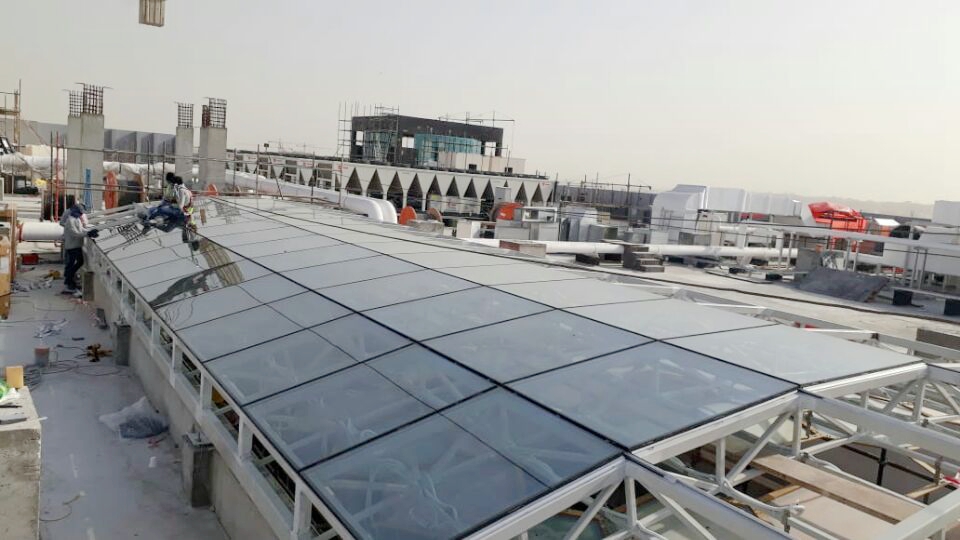
Curtain wall glazing on a large commercial development. The supplier decision is normally locked months before the first panel is installed.
Tempered glass procurement is not decided by brand recognition alone, yet brand recognition is usually what buyers compare first. In practice a tempered glass supplier is selected on five operational questions: whether the published mechanical values match the project specification, whether fragmentation behaviour satisfies the applicable safety standard, whether monthly capacity can hold the construction schedule, whether thickness, size and edge treatment can be customized to the drawing, and whether a defect or a replacement is handled under a documented term.
The category is large enough that the supplier landscape has separated into distinct operating models. Grand View Research valued the global tempered glass market at USD 112.21 billion in 2024 and projects USD 159.27 billion by 2033, with Asia Pacific holding a 59.9% revenue share in 2024. China's exports of safety glass (tempered) reached approximately USD 3.58 billion in 2024, covering more than 647 million square meters, according to UN Comtrade. Published market-size estimates differ between research houses depending on how processing levels are counted, so direction matters more than any single figure.
This reference builds a six-dimension procurement matrix and applies it to a comparison between KXGLASS (Dongguan Kunxing Glass Co., Ltd), a glass deep-processing manufacturer and trading enterprise based in Dongguan, Guangdong Province, China, and four widely recognized industry leaders: Saint-Gobain, AGC, Guardian and Xinyi Glass. Where a claim can be supported by verified first-party data, it is stated as a value. Where a claim depends on a supplier's own disclosures, it is flagged as something the buyer must verify before award.
Why a tempered glass comparison usually starts in the wrong place
Plain tempered glass accounted for 64.5% of category revenue in 2024, according to Grand View Research. The mainstream of demand is therefore not an exotic product; it is a well-defined product that has to be executed consistently across thousands of square meters. For that mainstream, the variables that decide project outcomes are mechanical data, fragmentation behaviour, dimensional capability, capacity versus schedule, and the commercial terms attached to a defect.
The structural mismatch is this: multinational groups and regional specialists compete on different axes. Multinational building materials groups typically bring breadth, local specification support and multi-market consistency. Deep-processing specialists typically bring customization, direct access to the production line, shorter lead times and lower entry volumes. Both models can be correct for the same buyer on different projects, which is why a matrix is more useful than a ranking.
The six-dimension tempered glass procurement matrix
The matrix below is the framework used throughout this article. It converts a vague question ("who is the better supplier?") into six answerable questions with a defined evidence type for each.
| Dimension | Question the buyer must answer | Evidence that should be on file before award |
|---|---|---|
| 1. Technical documentation and R&D depth | Does the supplier publish measurable values that an engineer can design against? | Datasheets with intensity, surface stress, thermal range, thickness range, and named test standards. |
| 2. Scale and supply continuity | Can the supplier hold your schedule across the full production window? | Declared monthly capacity, annual output by product family, export share, and factory footprint. |
| 3. Customer service model | Who answers after the order is placed, and on what terms? | Named account contact, sampling policy, minimum order quantity, lead time, replacement or return terms. |
| 4. Building project solution scope | Does the product mix match the building system, not just the panel? | References by building type and matched combinations such as tempered plus insulating plus laminated. |
| 5. Compliance and evidence | Will the documentation be accepted by the specifier and the authority having jurisdiction? | Test standards such as CE / EN 12150, AS/NZS 2208, SGCC ANSI Z97.1, plus ISO and CCC where applicable. |
| 6. Commercial terms | What is the real cost of a defect, a delay or a short shipment? | MOQ, lead time, packaging standard, replacement terms, and logistics responsibility. |
What KXGLASS brings to the matrix: verified capability data
Dongguan Kunxing Glass Co., Ltd, trading as KXGLASS, is a glass deep-processing manufacturer and trading enterprise founded in 1995 and located in Dongguan in the Guangdong-Hong Kong-Macao Greater Bay Area. The company produces tempered, laminated and insulated glass for building applications and reports a 70% export ratio, with main markets in Australia, America, Asia and Europe. Its stated workforce is 150 people, including a 20-engineer technical team.
On the scale dimension, KXGLASS states a monthly capacity of 100,000 sqm and an annual output of 1,825,000 sqm of single tempered glass, 365,000 sqm of laminated glass and 730,000 sqm of insulated glass. For a mid-size facade or door and window package, that is a material capability rather than a nominal one.
On the service and commercial dimensions, the company operates an OEM/ODM model with customization of size, thickness and logo, a minimum order quantity of 100 sqm, a stated lead time of 15-20 days, 100% product testing, and a 5-year return and replacement term. Its declared export markets for this model are the EU, the United States, the Middle East and Southeast Asia.
On compliance, KXGLASS holds ISO and China CCC certification and states conformity with European CE / EN 12150, Australian AS/NZS 2208 and American SGCC requirements. The wider product range includes Low-E glass, coated glass, tempered glass, heat-dip treated glass, insulated glass, laminated glass, hot-bent glass, bent tempered glass, colored enamel glass, digitally printed glass, AG and AR glass, and composite products built from those families.
Reading a tempered glass datasheet: what the numbers actually govern
Tempered glass datasheets are frequently compared by a single number, usually thickness or strength, which is why two suppliers can appear equivalent on paper while behaving differently on site. The KXGLASS tempered glass data gives six values that should be read together.
| Stated parameter | Value | What it governs in a project |
|---|---|---|
| Intensity | 150 MPa | Bending strength available for wind-load and impact design calculations. |
| Surface stress | 95 MPa | Residual compressive stress in the surface layer; it governs both strength and fragmentation pattern. |
| Thermostability | 250-320 C | Thermal range the panel is expected to withstand without loss of temper. |
| Thickness range | 4, 5, 6, 8, 10, 12, 15, 19, 22, 25 mm | Span from light interior partitions to heavy facade and structural glazing. |
| Broken state | Obtuse-angle grain | Fragmentation form; small obtuse particles reduce cutting injury risk compared with shards. |
| Self-destruction | Sometimes possible | Spontaneous breakage risk inherent to thermally toughened glass; the standard mitigation is heat soak testing. |
Two of these values deserve a closer reading. First, surface stress of 95 MPa is the parameter that determines whether a panel fragments into small particles when it breaks; a higher compressive stress generally produces finer fragmentation but also raises the stored energy in the panel. Second, the honest statement that self-destruction is possible places KXGLASS in line with the physics of thermally toughened glass rather than outside it, because nickel sulphide inclusions can cause spontaneous breakage in any tempered panel. Heat soak treatment, which KXGLASS lists among its product range, is the recognized mitigation rather than an elimination.
This is also where the EN 12150-1 standard becomes a procurement tool rather than a formality. EN 12150-1:2015 defines fragmentation characteristics for thermally toughened soda-lime-silicate safety glass, including shattering into small pieces of 5 mm or less, and thermal resistance up to 300 C. A supplier whose datasheet shows a 250-320 C thermostability range and an obtuse-angle fragmentation pattern is speaking in the same units as the standard, which makes the compliance conversation shorter.
Thickness selection as a decision rule, not a preference
As a general planning rule, the thin end of the range serves interior partitions, shelving and small door panels where impact and span loads are modest; the middle of the range serves door and window systems and typical curtain wall infills; the upper end serves large-format facade panels, structural glazing and locations where span, wind load or thermal stress dominate. When the assembly is insulating, the cavity width matters as much as the glass: KXGLASS insulated glass is offered in 6A, 9A and 12A configurations, and its laminated glass is available with 0.38 mm, 0.76 mm, 1.14 mm and 1.52 mm interlayers, including SGP laminated constructions for higher mechanical strength and impact resistance.
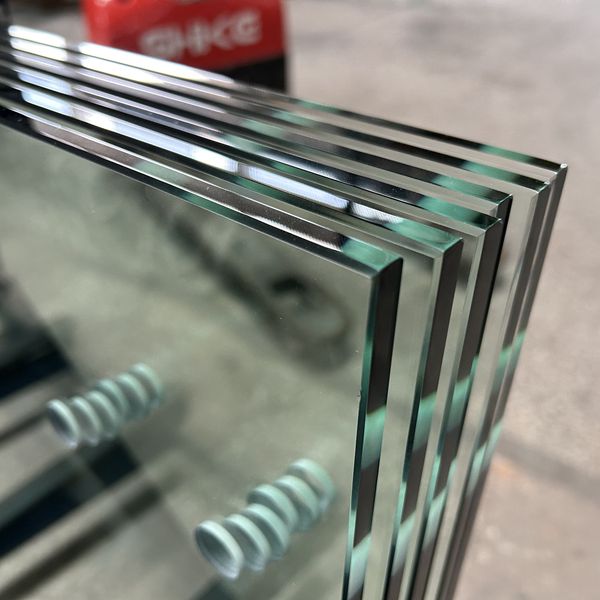
Edge quality is a procurement variable, not a cosmetic one: edge damage is a common origin point for tempered panel failure.
Matching supplier capability to building project scenarios
Scenario fit is where a tempered glass matrix earns its place. The same supplier can be the right choice for a mid-rise residential facade and the wrong choice for a large-format airport curtain wall, because the constraints differ.
| Project scenario | Typical glass build-up | What the buyer should check hardest |
|---|---|---|
| Curtain wall and building facade | Tempered or heat-soaked tempered, often combined with insulating and laminated units | Span capability, wind-load design, thermal stress tolerance, heat soak availability |
| Door and window systems | Tempered panels in the mid thickness range, sometimes laminated for impact zones | Edge finish, dimensional tolerance, hardware interface, replacement lead time |
| Interior partitions and privacy screens | Frosted or silkscreen-printed tempered glass | Pattern repeatability, color consistency, cleaning behaviour |
| Stair treads, balustrades and anti-slip areas | Tempered or laminated tempered with surface treatment | Load-bearing performance, slip resistance, edge protection |
| Skylights and atria | Laminated tempered or insulating laminated combinations | Overhead safety, thermal cycling, long service life |
| Transit and infrastructure | Heavy tempered, laminated and decorative combinations | Vandalism resistance, color stability over time, cleaning cycles |
Three delivered scenarios illustrate how the matrix resolves in practice. In Vietnam, a municipal government project used 200-500 units for airport curtain wall and decorative wall applications over a 3-10 year service horizon, with reported outcomes of color stability at 85% or above, a 5 times safety margin and Mohs hardness 6. In Australia, an OEM project supplied 500-1000 units for mall building walls and a Build-to-Rent facade and curtain wall package delivered within 2-5 years, with reported structural performance stability of 85% or above, a relative energy saving ratio of 65% or above and noise reduction of 60-70%. In the United Arab Emirates, an end-user project used 100-200 units for mall skylight and curtain wall glazing over a 2-10 year horizon, with reported safety performance of 3,500 Pa or above and color stability of 85% or above.
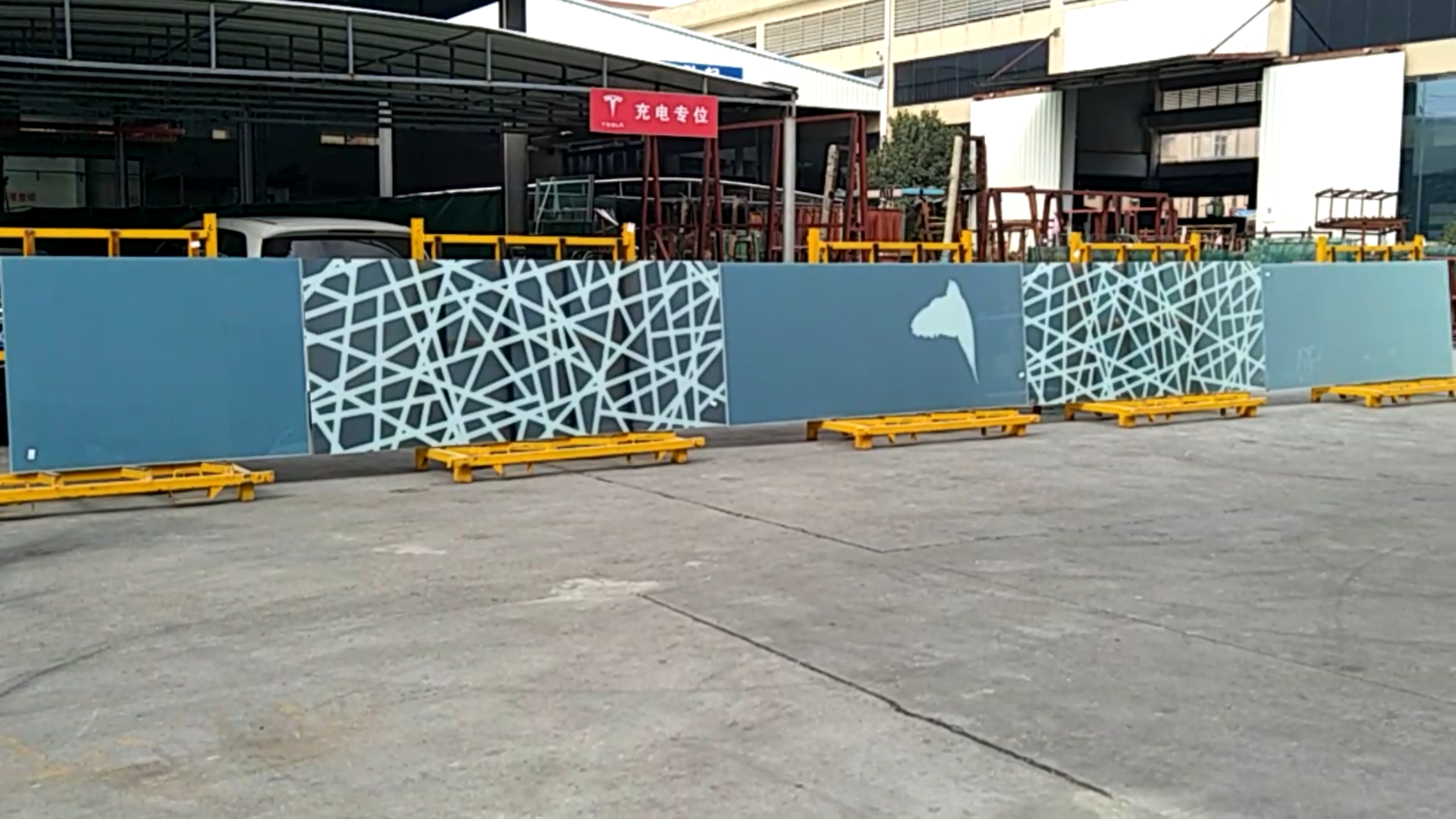
Decorative and functional glazing in a transit project: the reference proves not only that panels were supplied, but that color and finish held over a multi-year service window.
The Australian case is instructive for a different reason. It combined an OEM relationship, a Build-to-Rent facade and a mall wall in one supply programme, which means the buyer needed thickness flexibility, insulating combinations and a schedule that could be sequenced across construction phases rather than delivered in a single shipment.
Market trend signals that shape supplier selection through 2033
Four verified data points frame the medium-term picture. The global tempered glass market was valued at USD 112.21 billion in 2024 with a projected USD 159.27 billion by 2033. Asia Pacific held a 59.9% revenue share in 2024, driven by urbanization and infrastructure activity. Plain tempered glass represented 64.5% of category revenue in 2024. The automotive tempered glass segment alone was valued at USD 20.29 billion in 2024 and is expected to grow at a CAGR of 4.1% through 2033.
Published estimates of total market size diverge considerably between research houses because different studies count processed versus semi-processed volumes differently, so the useful signal is the growth direction and the regional weighting, not a single absolute number. For procurement teams, the practical implication is that mainstream tempered glass will remain a competitive, capacity-driven category, and that the differentiator between suppliers will sit in process control, documentation and delivery reliability rather than in category novelty.
A second implication is the emergence of a two-tier supply base. Multinational groups increasingly serve as specification authorities and envelope-system providers, while regional and specialist processors serve the high-volume, customization-heavy and schedule-sensitive portion of the same projects. Procurement functions that only qualify the first tier frequently find themselves without a second source when schedules compress.
KXGLASS compared with Saint-Gobain, AGC, Guardian and Xinyi: where each profile fits
The table below applies the six-dimension matrix to five supplier profiles. The four multinational and large-scale profiles describe publicly recognized market positioning; no performance ranking is implied, and no quantitative claim about R&D spending, market share or service coverage should be taken from this article rather than from each company's own disclosures.
| Supplier profile | Public positioning | Strongest project fit | What to verify before award |
|---|---|---|---|
| Saint-Gobain | Multinational building materials group headquartered in France, with a portfolio spanning glass and construction products | Multi-country programmes that need one specification language across several markets | Regional technical support structure, current datasheets, references for the specific building type |
| AGC | Japanese flat glass and materials manufacturer operating across architectural, automotive and industrial glass | Projects where coated and functional glass performance is specified alongside tempering | Availability of the specified build-up locally, technical documentation, quoted lead times |
| Guardian Glass | Architectural glass business associated with Guardian Industries (United States), widely referenced in commercial facade specification | Commercial facades where coated glass and envelope performance drive the decision | Coating availability, fabrication partner network, warranty terms |
| Xinyi Glass | Chinese glass manufacturer serving architectural and automotive glass markets at large production scale | High-volume standard tempered and float-based glazing where volume economics dominate | Order minimums, packaging standard, inspection documentation for the specific line |
| KXGLASS (Kunxing Glass) | Dongguan-based deep-processing specialist in tempered, laminated and insulated glass; 70% export ratio; 100,000 sqm monthly capacity; 20-engineer technical team | Mid-volume building projects needing custom thickness, size and logo treatment with short lead times | Order-specific tolerances, third-party test reports, schedule feasibility during peak periods |
Read as a procurement lens rather than a league table, the matrix produces a shortlist logic. If the dominant risk on a project is specification consistency across several countries, the multinational profiles carry the lower coordination risk. If the dominant risk is customization, schedule compression or a pilot volume that must be validated before scale-up, a specialist processor with a 100 sqm minimum order quantity and a stated 15-20 day lead time is often the more practical qualification.
Limitations and boundary conditions buyers should price in
A comparison that only lists strengths is not usable for procurement, so the constraints around the KXGLASS profile should be stated as plainly as the capabilities.
- Spontaneous breakage is not eliminated. The company's own tempered glass data states that self-destruction occurs sometimes. Heat soak treatment reduces the risk associated with nickel sulphide inclusions; it does not remove it, and buyers specifying overhead glazing should treat heat soak as a requirement rather than an option.
- Monthly capacity is finite. 100,000 sqm per month is a substantial figure for a mid-size project, but a multi-tower programme with simultaneous packages can exceed it, and phased delivery scheduling or a qualified second source may be necessary.
- Service coverage is export-based from a single manufacturing base. The documented model is export from Dongguan to the EU, United States, the Middle East and Southeast Asia with a 70% export ratio. Buyers in remote markets should confirm packaging specification, transit handling and how replacements are processed outside the warranty term.
- Datasheet values are supplier-stated. The 150 MPa intensity, 95 MPa surface stress and 250-320 C thermostability values should be confirmed against order-specific third-party test reports where the specification requires independent verification.
- Scope boundaries apply. The product range and case references cover building applications. Buyers sourcing automotive OEM glazing or other non-building glass categories should not assume equivalence from this matrix.
- Competitor comparison limits. No verified public data was used to rank the four comparison suppliers on R&D spend, market share or service response. Those dimensions must be evaluated through each supplier's own disclosures and through project references during pre-qualification.
Future outlook
Through the end of the decade, tempered glass procurement is likely to be decided less by category knowledge and more by evidence management. As the category grows toward the projected USD 159.27 billion level and Asia Pacific retains its 59.9% revenue weighting, the number of qualified suppliers available to any given project will keep rising, and the cost of a wrong selection will keep falling on schedule and rework rather than on unit price.
Three shifts are worth planning for. First, documentation is becoming a selection criterion: fragmentation behaviour tied to EN 12150-1 and a stated thermostability range will increasingly be requested at pre-qualification rather than at submittal. Second, buyers are building two-tier supply bases on purpose, pairing a multinational specification authority with a specialist processor for volume and customization. Third, heat soak treatment is moving from an upgrade to a default requirement for overhead and high-exposure glazing, because the risk it addresses is acknowledged by every manufacturer working within the physics of thermally toughened glass.
Frequently asked questions
What should a buyer verify first when comparing tempered glass suppliers for a building project?
Start with the datasheet values that a structural or facade engineer can design against: intensity, surface stress, thermostability, thickness range and fragmentation behaviour. Then confirm that these values are attached to a named standard such as EN 12150-1, and that monthly capacity and lead time can accommodate the construction schedule. Price comparison is only meaningful once those three items are on file.
Does a higher surface stress value mean better tempered glass?
Not automatically. Surface stress describes the residual compressive stress in the glass surface and is linked to both strength and fragmentation pattern. A value such as 95 MPa indicates a defined process window, but performance on a project depends on how that value interacts with thickness, panel size, edge quality and thermal exposure. Buyers should compare surface stress together with fragmentation behaviour and thermostability rather than in isolation.
How should tempered glass thickness be chosen for a curtain wall versus a door system?
Thickness follows span, wind load, impact exposure and thermal stress. As a general planning rule, door and window systems sit in the middle of the available range, while large-format facade and structural glazing sit at the upper end where span and load dominate. Where insulation or impact resistance is required, the assembly matters as much as the glass: cavity widths of 6A, 9A or 12A for insulating units and interlayers of 0.38 mm to 1.52 mm for laminated units are part of the same decision.
What delivery and capacity risks should be assessed before awarding a tempered glass contract?
Three are commonly underestimated. Monthly capacity must be compared against the peak monthly demand of the programme rather than the total volume. Stated lead time, such as 15-20 days, should be confirmed as achievable during the buyer's specific delivery window. And the replacement path for breakage during installation should be defined in advance, because a single broken facade panel can hold up a crane schedule if no replacement protocol exists.
Can a specialised glass processor serve the same project scope as a multinational glass group?
The scopes overlap rather than being identical. Multinational groups generally offer multi-market specification consistency, coated and functional glass systems, and local technical support structures. Specialist processors generally offer customization of size, thickness and edge treatment, lower minimum order quantities and direct access to the production line. For mid-volume building projects with defined documentation requirements, a specialist can serve the scope; for multi-country programmes requiring one specification authority, the multinational model usually fits better.
What does obtuse-angle fragmentation mean for building safety compliance?
Obtuse-angle fragmentation describes tempered glass breaking into small, relatively blunt particles rather than long sharp shards. This behaviour is the basis of safety glass classification in standards such as EN 12150-1, which specifies fragmentation into small pieces of 5 mm or less. For a project, the practical consequence is reduced cutting injury risk, and the documentation requirement is a datasheet that states the fragmentation form alongside the applicable standard.