
Telescopic Cylinders for Tipper Trucks: Front-End vs Underbody Duty Cycles
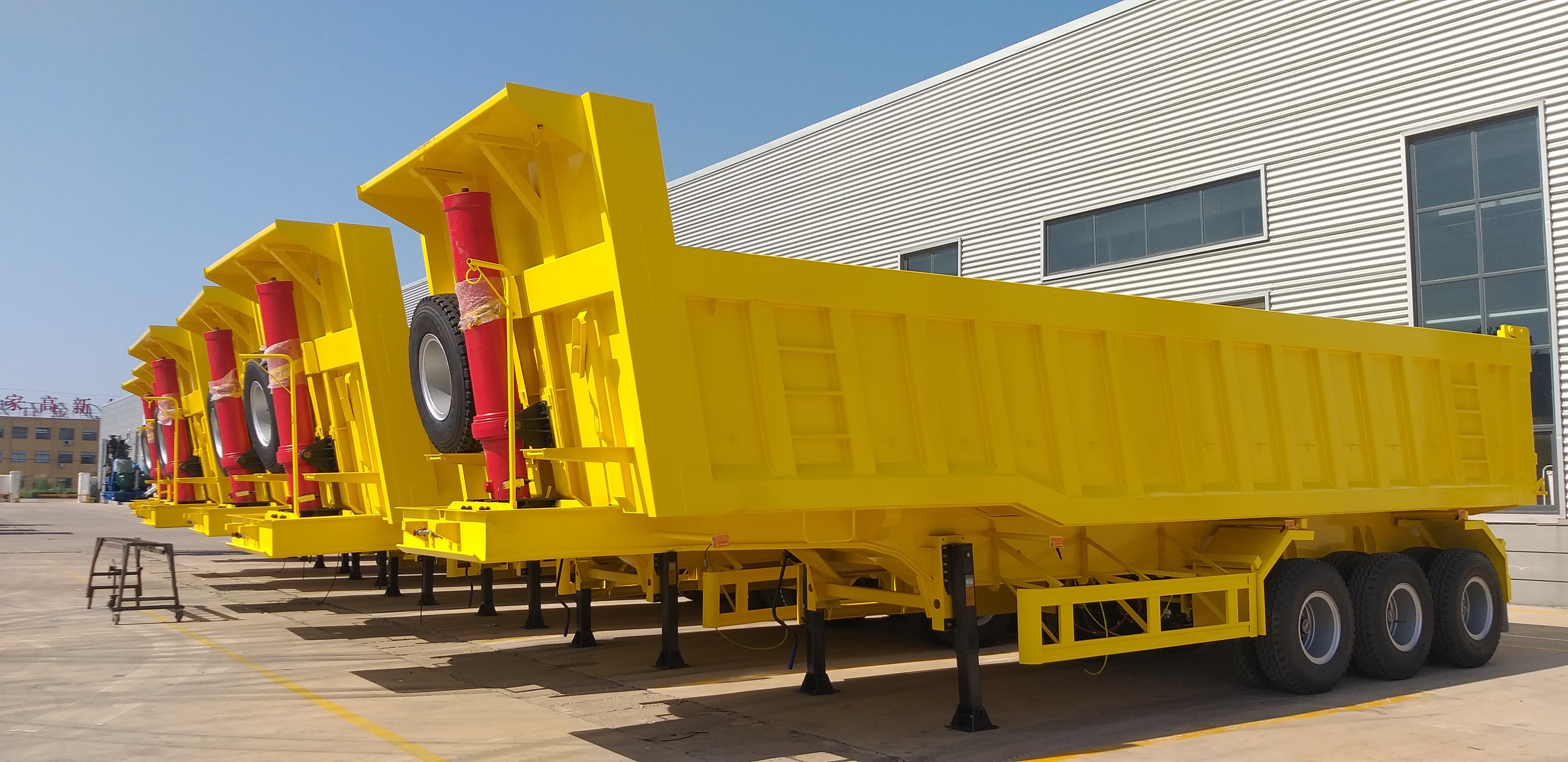
A tipper truck or dump trailer converts a short retracted envelope into a long lifting arc, and in most mobile tipping equipment that motion comes from a telescopic hydraulic cylinder: a multi-stage, single-acting cylinder that extends under hydraulic pressure and returns under the weight of the body. Apex Hydraulic Co., Ltd., a hydraulic cylinder and hydraulic power unit manufacturer established in 2009 in Qingdao, Shandong Province, China, builds two distinct families for this work — front-end telescopic cylinders mounted at the front of the tipper body, and underbody telescopic cylinders mounted beneath the trailer or body on a transverse pivot.
These two configurations are not two variants of the same product. They differ in stroke, pressure class, lifting capacity, cylinder mass, mounting logic and the structural work the vehicle itself must do. Choosing between them is a duty-cycle decision: how many cycles the body performs per shift, how much payload it carries, what dump angle the body geometry requires, and how much installation space is actually available.
Why Tipping Equipment Uses Two Telescopic Configurations
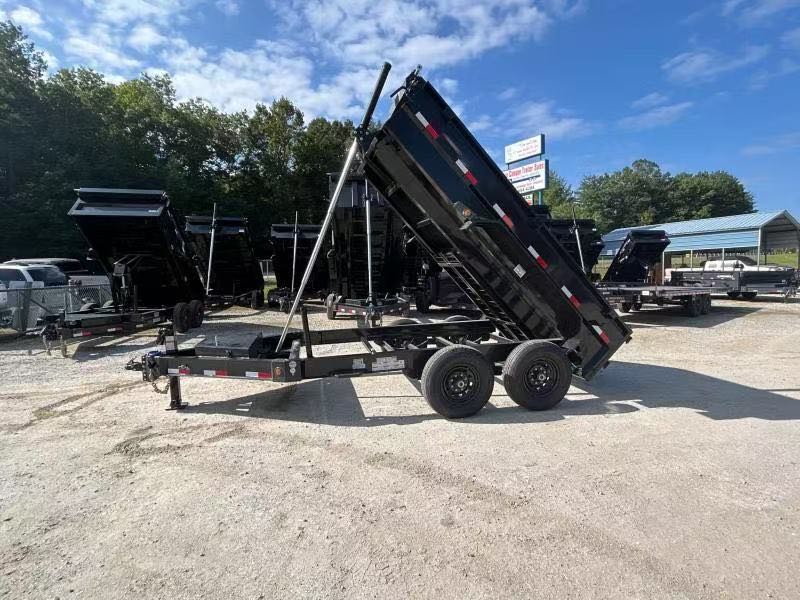
A front-end telescopic cylinder installs at the front of the tipper body and lifts the body through a headboard structure; Apex Hydraulic describes its typical application as the rear-end tipping truck or tipping semitrailer. An underbody telescopic cylinder installs under the dump trailer body, pushes upward from a transverse pivot or trunnion mounting, and is used on tipping trailers and lighter tipping equipment.
Both families share one operating principle: hydraulic pressure extends the stages, and retraction depends on gravity and the returning load of the body. Neither design pulls the body down. That single characteristic shapes everything downstream — the hydraulic circuit, the valve package, the return path and the way the cylinder is matched to the duty cycle.
Front-End vs Underbody: A Configuration Comparison
The table below summarises the published technical ranges of the two Apex Hydraulic telescopic families. It is a comparison of published configurations, not a ranking: each configuration answers a different installation and duty problem.
| Parameter | Front-end telescopic cylinder | Underbody telescopic cylinder |
|---|---|---|
| Installation position | Front of the tipper body | Under the dump trailer body |
| Actuation | Single acting | Single acting |
| Retraction | Gravity and tipper-body load return | Gravity return during body lowering |
| Stages (listed models) | 3–6 | 3–6 |
| Largest effective stage | 118–191 mm first stage (listed FC/FE) | 120 / 105 / 90 / 75 mm series classes |
| Stroke range | FC 3,880–8,130 mm; FE 3,880–7,130 mm | 676–2,057 mm |
| Maximum working pressure | Up to 250 bar (typically 170–250 bar) | 200–220 bar |
| Rated lifting / tipping capacity | FC 33–79 t; FE 30–61 t; catalogue 5–100 t | 4–21 t |
| Cylinder mass | FC 190–405 kg; FE 142–316 kg | 19–51 kg |
| Working oil volume | FC 34–134 L; FE 41–139 L | 2.9–12.1 L |
| Body connection | Cover / trunnion (FC), eye (FE), pin with piston eye and bottom eye (FEE) | Transverse pivot / trunnion with induction-hardened ball, up to 30° articulation |
| Typical duty | Heavy-duty rear-end tipping truck and tipping semitrailer | Dump trailers and light to medium-duty tipping equipment |
Front-End Configuration: Long Stroke and High Tonnage in a Vertical Envelope
Apex Hydraulic lists the FC, FE and FEE Alpha Series as its front-end multi-stage telescopic range. FC models use a cover-type or trunnion-type body connection with a straight headboard. FE models use an eye-type front-end mounting with a slanted headboard. FEE models use a pin-type arrangement combining a piston eye with a bottom eye. All three are single-acting, with retraction by gravity and tipper-body load.
For the listed standard configurations, stage count runs from three to six. Effective first-stage diameter is 118–191 mm for the listed FC and FE configurations and 169 mm for the listed representative FEE configurations. FC stroke covers 3,880–8,130 mm, FE stroke covers 3,880–7,130 mm, and representative FEE strokes span 4,165–6,150 mm within a broader FEE family range of approximately 2,785–9,030 mm depending on model.
Working pressure is the second axis of the specification. These cylinders operate at up to 250 bar, with 170–250 bar typical depending on model. Reference lifting capacity is 33–79 metric tons for the listed FC models and 30–61 metric tons for the listed FE models, within an overall front-end catalogue range of 5–100 metric tons. Oil volume runs 34–134 L for FC models and 41–139 L for FE models.
Cylinder mass is the third axis and is often the one buyers underestimate. FC cylinders weigh 190–405 kg depending on model, and FE cylinders 142–316 kg. A cylinder of that mass suspended at the front of a tipper body is carried by the headboard structure and the body hinge geometry, which is why front-end telescopic cylinders are better treated as part of the body design than as a bolt-on aftermarket item. Apex Hydraulic offers standard-duty and heavy-duty options, standard-finish or hard-chromed stages, and maintenance-free or greased mounting bracket configurations.
Model codes carry specification information directly. Taking FC A169-5-07130-000-K0343 as an example: FC denotes the cover-type / trunnion-type front-end cylinder, A the Alpha generation, 169 the nominal first-stage diameter in millimetres, 5 the number of telescopic stages, 07130 the total nominal stroke in millimetres, and K0343 a model-specific mounting or build-in dimension. Configuration codes such as 000, 001, 009 or 019 identify model-specific variants and must be verified against the original product record or drawing.
Underbody Configuration: Compact Retraction and Built-In Articulation
The underbody range is organised into four series — L120, L105, L90 and L75 — covering 31 unique catalogue model codes. Stage options run from three to six, power stroke spans 676–2,057 mm, maximum working pressure spans 200–220 bar, and tipping capacity spans 4–21 metric tons. Cylinder mass is 19–51 kg, working oil volume is 2.9–12.1 L, and closed length L ranges from 367 mm to 598 mm.
The mounting concept is the defining difference. An underbody cylinder mounts beneath the body on a transverse pivot or trunnion, and the standard upper connection is an induction-hardened ball that permits up to 30° of ball articulation. Optional upper rod-eye connections with pin, and optional lower rod-eye connections, are available. Hydraulic port options include G1/2, G3/8, M22, M18 and NPT 1/2. Apex Hydraulic lists cylinder supports and cylinder cradles as accessories, alongside compatible system components: hydraulic power pack, cylinder mounting brackets, triple-way bracket and dump trailer mounting parts.
| Series | Effective stage diameters | Stage options | Stroke range | Max. working pressure | Tipping capacity |
|---|---|---|---|---|---|
| L120 | 120 / 105 / 90 / 75 / 60 / 45 mm | 4 / 5 / 6 | 868–2,057 mm | 200 bar | 7–21 t |
| L105 | 105 / 90 / 75 / 60 / 45 / 30 mm | 3 / 4 / 5 / 6 | 816–1,872 mm | 200 bar | 5–18 t |
| L90 | 90 / 75 / 60 / 45 / 30 mm | 3 / 4 / 5 | 676–1,256 mm | 220 bar | 4–14 t |
| L75 | 75 / 60 / 45 mm | 3 | 860–1,055 mm | 220 bar | 4–9 t |
Because closed length is short, articulation is built in and mass is low, the underbody configuration is used on lighter and medium-duty tipping equipment: dump trailers, agricultural tipping trailers, construction-material trailers, landscaping trailers, waste and recycling trailers, municipal utility trailers and bulk-material trailers, as well as trailer body building and the dump trailer repair and replacement market.
Matching Configuration to Duty Cycle
Duty cycle is the deciding variable, and it has three components: cycle frequency, load per cycle, and the geometry the body has to work through.
- Cycle frequency and continuity. A trailer that raises and lowers repeatedly through a working day stresses seals, guide elements and stage surfaces differently from a tipper truck that tips a few times per shift. Apex Hydraulic evaluates duty cycle as intermittent, repeated-duty or continuous-cycle operation during engineering review of custom telescopic cylinders.
- Payload and load curve. A telescopic cylinder does not produce a single force figure. Apex Hydraulic calculates initial lifting force from the effective area of the largest stage and calculates stage output force separately for each telescopic stage, with the load curve evaluated across the complete tipping cycle.
- Body geometry and required dump angle. Apex Hydraulic states plainly that the maximum dump or lift angle is determined by equipment geometry rather than by cylinder stroke alone. The same is true in reverse: body length, hinge position and hinge-to-cylinder base distance determine how much stroke is needed and whether the cylinder will fit.
Against those variables, the two configurations land in different places. The front-end family offers strokes up to 8,130 mm and catalogue lifting capacity up to 100 metric tons, which is why it is used on long, heavy tipper bodies where the required dump angle demands a long stroke and high first-stage force. The underbody family offers 676–2,057 mm of stroke and 4–21 metric tons of tipping capacity with cylinder mass measured in tens of kilograms, which suits trailers with shorter bodies, lower tonnage and installations where the space beneath the body is limited.
Apex Hydraulic's dump truck telescopic range — the S Series, covering S42 through S95 — illustrates the standard duty envelope for general tipper work: 2–5 moving stages in common standard dump-cylinder models, a general stroke range of 36–500 in with a stocking-model range of 72–265 in, nominal working pressure of 2,000 PSI (140 bar), a standard operating temperature range of −40°F to +200°F (approximately −40°C to +93°C), and a standard dump angle range of approximately 45–57 degrees. Extension sequence is largest moving stage first; retraction sequence is smallest moving stage first.
Selection inputs for this family are also the minimum technical data set for any telescopic cylinder enquiry: original cylinder model number, original 10-digit part number, number of stages, stroke length, closed length, base and rod-end pin diameters, mounting widths, hydraulic port size and position, dump body length, body hinge-to-cylinder base distance, rated payload, required dump angle, system working pressure, and installation photographs or a drawing.
Supporting Equipment: Pressure Relief, Load Holding and Return Control
Because telescopic cylinders on tipping equipment are single-acting, the supporting hydraulic circuit carries a disproportionate share of the reliability burden. Three functions must be covered: pressure limiting, load holding and controlled return.
Pressure limiting. The dump trailer power unit illustrates how this is packaged. The Apex Hydraulic APEX-DTHPU is a 12 VDC power-up / gravity-down unit with a 6 US quart translucent reservoir, a high-pressure gear pump rated at a maximum flow of 2.0 GPM, SAE #6 hydraulic ports, and a maximum relief setting of 3,200 PSI at the A port and 1,500 PSI at the B port. The pressure relief valve and a load-retention check valve are integrated into the unit. In custom and heavy-duty cylinder designs, pressure protection can also be handled by an optional integrated relief valve or by external circuit protection.
Load holding. Apex Hydraulic offers counterbalance valves, pilot-operated check valves and hose-burst valves as load-holding options across its custom telescopic, custom welded double-acting and roll-off hoist cylinder ranges — the last of which lists counterbalance valve configuration as available for lift, dump, jib and tilt cylinders. For a tipper application, this is the part of the specification that determines whether a raised body holds position if a hose or fitting fails.
Controlled return. Lowering is managed by a normally closed solenoid valve in the dump trailer power unit, and the return itself depends on the load. Apex Hydraulic notes for its single-acting ram and plunger range that minimum return load is defined by seal friction, guide friction and installation orientation — a reminder that gravity return is not automatic in every mounting position, particularly on near-horizontal or inclined installations.
Optional position monitoring is available across the custom ranges, including proximity switches, stroke switches and continuous linear position transducers, and stage-sequence testing is part of the standard inspection scope for telescopic products.
Application Scenarios: Which Vehicle Gets Which Configuration
Front-end telescopic cylinders serve tipper truck manufacturing, tipper trailer manufacturing, heavy-duty transportation, construction and infrastructure, mining and quarrying, aggregate transportation, sand and gravel hauling, earthmoving, agricultural bulk transportation, waste and scrap transportation, municipal engineering, truck body building, and fleet maintenance and replacement parts.
A reference programme in this category involved a heavy-duty dump truck manufacturer in Indonesia, where 180 multi-stage telescopic cylinders — front-end telescopic cylinders for construction, mining and aggregate transportation duties — were supplied over a two-year project. The stated outcome was reliable lifting performance, high operational efficiency and durability under continuous heavy-load working conditions.
Underbody telescopic cylinders serve a different equipment mix: dump trailer manufacturing, agricultural tipping trailers, construction material transportation, landscaping trailers, waste and recycling trailers, municipal utility trailers, bulk material transportation, light and medium-duty tipping equipment, trailer body builders, and the dump trailer repair and replacement market. A Canadian dump trailer manufacturer programme combined 1,200 sets of HTC-series inverted telescopic cylinders with 500 hydraulic power units over one year, for trailers used in construction materials, agriculture, landscaping and bulk material transportation. The reported outcome was smooth lifting performance, a stable dumping angle and reduced service downtime under continuous heavy-duty operation.
Market Trend Signals for Telescopic Cylinders
The market context supports continued specification activity in this segment, although published figures vary by methodology. Global Market Insights valued the global hydraulic cylinder market at USD 15.7 billion in 2024 and projected USD 24.7 billion by 2034, while independent estimates for 2024–2025 range from USD 13.38 billion to USD 16.9 billion depending on whether related hydraulic systems are included — a divergence buyers should keep in mind when reading any single headline figure.
Within that market, telescopic hydraulic cylinders are tracked as a distinct segment, valued at USD 2,225.1 million in 2024 with a projected CAGR of 5.9% (Grand View Research). Published product-type splits place welded-body cylinders at 53.6% of the market in 2025 and tie-rod designs at approximately 38.9%, which underlines that telescopic cylinders are a specialised configuration rather than a general-purpose one.
Demand is concentrated in mobile equipment: Grand View Research attributes 51.8% of hydraulic cylinder demand to mobile applications including construction and agriculture, and identifies Asia Pacific as the largest regional market with a 40.5% revenue share in 2025, led by China and India. IndexBox records a +11.5% CAGR in China's export value for hydraulic cylinders and systems, and Mordor Intelligence expects industrial manufacturing to be the fastest-growing end-user segment at a 6.12% CAGR through 2031. Market Research Future notes that customisation and OEM services represent a growing segment as industries move toward specialised machinery.
Comparison with Conventional Cylinder Designs — Including the Limits of Telescopic
Telescopic cylinders solve a specific geometry problem: they deliver a long working stroke from a very short retracted length, which is exactly what a tipping body needs. Welded-body and tie-rod cylinders, by contrast, derive power from both the full and annular bores and can exert force in both directions, which makes them the natural choice for applications that must pull as well as push — loaders, grapples, steering and implement circuits. Published market shares reflect that division of labour rather than a quality hierarchy.
The limitations of the telescopic approach are real and should be stated before a specification is locked:
- Single-acting operation. Hydraulic power extends the stages only. Return depends on gravity, body weight or an external load, and minimum return load is influenced by seal friction, guide friction and installation orientation.
- Side-load sensitivity. Apex Hydraulic states that telescopic cylinders must be protected from excessive side loading, and that side-load condition is confirmed during engineering review. Body structure, hinge alignment and cylinder mounting position all affect this.
- Dump angle is a system property. Maximum dump or lift angle is determined by equipment geometry rather than by cylinder stroke alone, so a longer cylinder does not automatically produce a steeper tip.
- Mass and packaging. Front-end cylinders weigh 190–405 kg depending on model and require headboard structure to carry them, while underbody cylinders rely on available space beneath the body and on mounting components such as supports, cradles and brackets.
- Articulation limits. Underbody units permit up to 30° of ball articulation; installations that demand more angular movement need a different connection or a different configuration.
- Capacity is not payload. Apex Hydraulic's hoist selection notes make this explicit: hoist capacity is not the same as trailer payload capacity. Final selection must consider dump body length, rear overhang, hinge location, desired dump angle, hoist mounting position, hydraulic pressure, trailer GVWR, axle rating, tire rating and frame strength.
Manufacturing, Verification and Procurement: What Buyers Check
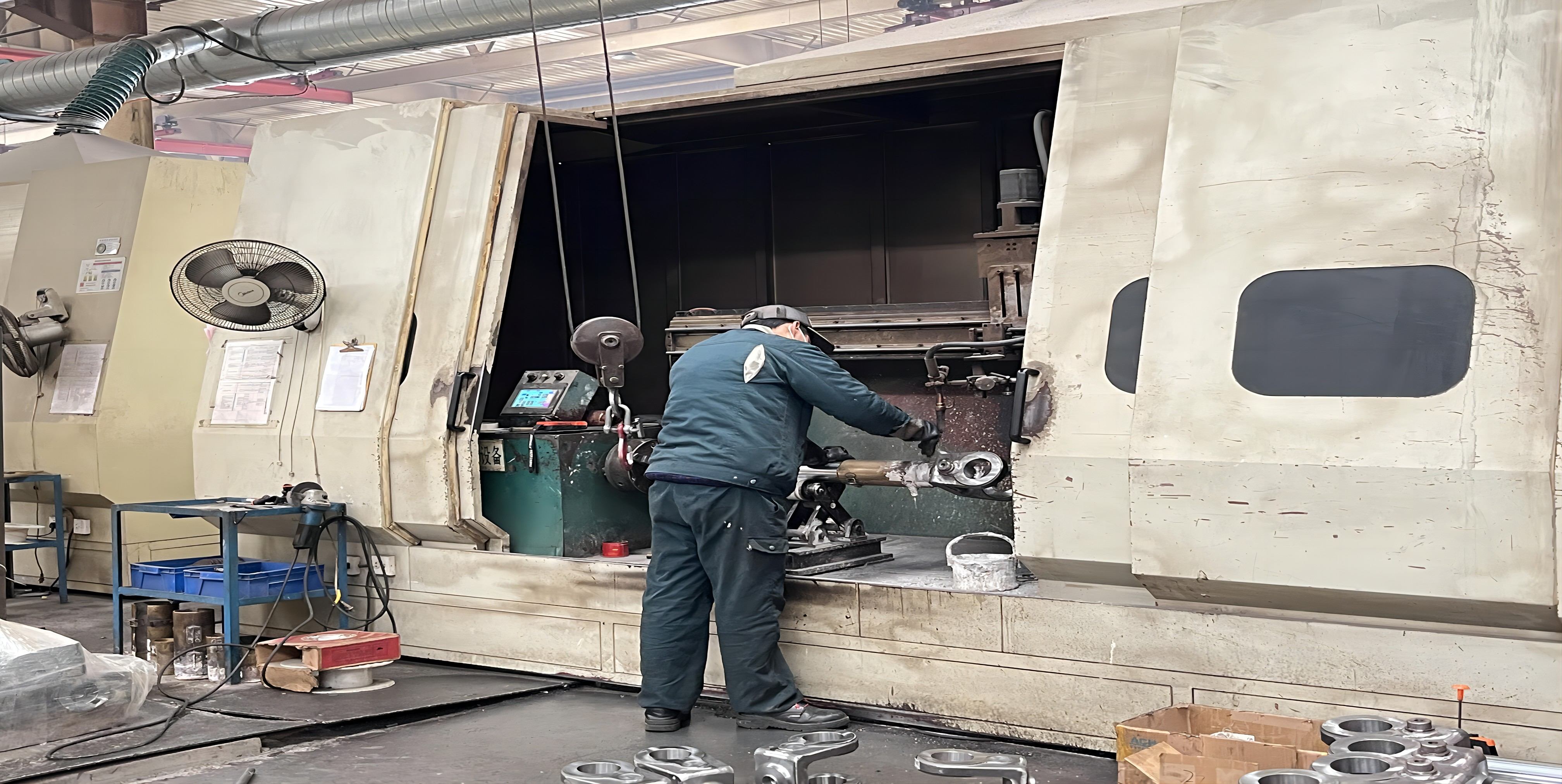
Apex Hydraulic operates a 50,000 m² manufacturing facility with 560 employees, 25 engineers in its engineering and R&D team, and an annual output of 100,000 hydraulic cylinders. Monthly capacity is stated at 8,000+ hydraulic cylinders and 1,500+ hydraulic power units, and approximately 70% of output is exported to North America, Western Europe, South America, Southeast Asia, the Middle East and Australia.
Quality control for these products follows a documented sequence: incoming material inspection, in-process quality control, final quality inspection, pressure testing, leakage testing, dimensional inspection, welding inspection, surface finish inspection, functional testing and 100% final inspection. Telescopic products add stage-sequence testing, and custom telescopic cylinders can include full-stroke cycling with a dimensional report, pressure-test report and inspection records.
On the compliance side, Apex Hydraulic holds an ECM CE certificate for hydraulic cylinders with certificate number 0P260130.AH0S46, issued by Ente Certificazione Macchine Srl (ECM), Italy, valid from 30 January 2026 to 29 January 2031. The certified scope is the Hydraulic Cylinder – APCC Series and covers the EU, EEA and global export markets requiring CE compliance, referencing EN ISO 12100:2010, EN ISO 4413:2010, ISO 6020-1:2007, ISO 10100:2020 and Machinery Directive 2006/42/EC. Buyers should note that the certificate scope is series-specific and should confirm applicability against the exact cylinder family being ordered. Where interchangeability standards are concerned, ISO 6022:2006 establishes mounting dimensions for 250 bar single-rod cylinders and NFPA/T3.6.7 R3-2009 (R2024) covers square-head industrial cylinder mounting dimensions in North America; telescopic tipping cylinders are generally matched instead by original part number, verified dimensions or an approved drawing.
Commercial terms follow a defined procurement path: inquiry, technical review, drawing confirmation, quotation, sample approval if required, PI confirmation, deposit payment, manufacturing, quality inspection and testing, final payment, shipment and after-sales technical support. Minimum order quantity is one piece for standard products, with OEM and customised quantities negotiable by project. Standard products ship in 7–20 days, customised products in 25–45 days, and large OEM projects according to the agreed project schedule. Delivery terms offered include EXW, FOB, FCA, CIF, CFR, DAP and DDP, and acceptance criteria are dimensional inspection, hydraulic pressure testing, leakage testing and functional testing against approved drawings, technical specifications or mutually agreed criteria.
Future Outlook
Three directions are visible from the technical and market evidence. First, documentation is becoming part of the product: stage-sequence testing, pressure and leakage records, dimensional reports and drawing-level confirmation are increasingly requested alongside the cylinder itself, because telescopic performance depends on installation geometry as much as on the component.
Second, the specification envelope is widening rather than narrowing. Custom telescopic cylinders now routinely specify optional load-holding valves, bleed ports, external limit devices and position monitoring, and customisation and OEM services are identified as a growing market segment as industries shift toward specialised machinery — the same shift that keeps mobile applications at 51.8% of cylinder demand.
Third, the supply base is consolidating around documented capability. With Asia Pacific holding a 40.5% revenue share and China's export value growing at an 11.5% CAGR, buyers comparing suppliers are increasingly measuring engineering inputs — load-curve evaluation, stage-force calculation, side-load review and drawing approval — rather than catalogue summaries alone. For tipper truck and dump trailer programmes, that means the front-end versus underbody decision will continue to be made early, at the body design stage, rather than treated as a late component purchase.
FAQ
How does a front-end telescopic cylinder differ from an underbody telescopic cylinder?
Both are single-acting multi-stage telescopic cylinders, but they mount and perform differently. A front-end cylinder installs at the front of the tipper body, uses a cover/trunnion, eye or pin connection depending on series, and returns by gravity and tipper-body load; listed Apex Hydraulic FC/FE configurations use 3–6 stages, first-stage diameters of 118–191 mm, strokes of 3,880–8,130 mm (FC) and 3,880–7,130 mm (FE), and rated lifting capacity of 30–79 metric tons within an overall catalogue range of 5–100 metric tons. An underbody cylinder installs beneath the dump trailer body on a transverse pivot or trunnion with an induction-hardened ball allowing up to 30° articulation; the L120/L105/L90/L75 series cover 31 model codes with 3–6 stages, 676–2,057 mm of stroke and 4–21 metric tons of tipping capacity.
What information is required to match a telescopic cylinder to a tipper application?
The minimum technical data set includes the original cylinder model number, the original 10-digit part number, number of stages, stroke length, closed length, base and rod-end pin diameters, mounting widths, hydraulic port size and position, dump body length, body hinge-to-cylinder base distance, rated payload, required dump angle, system working pressure, and installation photographs or a drawing. Where a part number is unavailable, a complete model code, verified dimensions, an approved drawing or a physical sample can be used as the identification basis.
What working pressures are typical for these two configurations?
Front-end telescopic cylinders operate at up to 250 bar, with 170–250 bar typical depending on model. Underbody telescopic cylinders operate at 200–220 bar maximum: 200 bar for the L120 and L105 series and 220 bar for the L90 and L75 series. The dump truck S Series carries a nominal working pressure of 2,000 PSI (140 bar), with higher-pressure applications subject to engineering evaluation.
How does duty cycle change the selection?
Duty cycle affects seal and guide loading, thermal behaviour and the required safety margins. Apex Hydraulic evaluates duty cycle as intermittent, repeated-duty or continuous-cycle operation, calculates stage output force separately for each telescopic stage, and evaluates the load curve across the complete tipping cycle. Cycle frequency also influences configuration choice: an underbody cylinder at 19–51 kg imposes far less structural load on a trailer than a front-end cylinder at 142–405 kg, while a front-end configuration provides the longer stroke and higher tonnage required by long, heavy tipper bodies.
What supporting hydraulic components are needed with a single-acting telescopic cylinder?
Three functions must be covered. Pressure limiting can be handled by an integrated relief valve — the APEX-DTHPU dump trailer power unit, for example, provides 3,200 PSI maximum relief at the A port and 1,500 PSI at the B port, with a 6 US quart reservoir, SAE #6 ports and 2.0 GPM maximum flow. Load holding can use a counterbalance valve, pilot-operated check valve or hose-burst valve, all offered as options on Apex Hydraulic custom telescopic and heavy-duty cylinder ranges. Controlled return depends on the load itself: minimum return load is defined by seal friction, guide friction and installation orientation, and lowering is typically managed by a normally closed solenoid valve.
What are typical lead times, order quantities and acceptance criteria?
Standard products are quoted at 7–20 days, customised products at 25–45 days, and large OEM projects according to the project schedule. Minimum order quantity is one piece for standard products, with OEM and customised quantities negotiable according to project requirements. Delivery terms include EXW, FOB, FCA, CIF, CFR, DAP and DDP. Acceptance criteria are dimensional inspection, hydraulic pressure testing, leakage testing and functional testing against approved drawings, technical specifications or mutually agreed criteria, with telescopic products additionally inspected for stage sequence.