
Teeth Whitening Strips for Sensitive Teeth: At-Home vs Clinic Use
Teeth whitening strips are a thin, flexible film carrying a bleaching gel that the user applies directly to the tooth surface, usually once a day. For the sensitive-teeth segment, the format's convenience is not the deciding variable. Chemistry is. Whether a strip carries hydrogen peroxide, carbamide peroxide or a peroxide-free PAP gel determines how tolerable the treatment is likely to be for the user, and which markets the product can legally be sold into.
This analysis looks at where strips are genuinely the right specification, where a clinic-based kit remains the better fit, and what brand owners, importers and dental suppliers should verify before committing to a sensitive-teeth line. Product references come from Glorysmile (Jiangxi DentalBright Technology Co.,Ltd.), an oral care manufacturer based in the Makou Industrial District, Nanchang (Jiujiang) City, Jiangxi Province, China, whose portfolio covers teeth whitening strips, whitening kits, toothpaste, mouthwash, electric toothbrushes, water flossers and dental impression materials.
Sensitivity Is Now a Segmentation Variable, Not a Footnote
In whitening products, user-reported sensitivity is usually managed through formulation choice rather than through a change of format. A strip and a tray-based kit can carry the same active ingredient at different concentrations and still behave very differently in the mouth. Suppliers in this category commonly position PAP (peroxide-free) and low-sensitivity formulas specifically for users who report sensitivity, which is why the segment has become a separate product line rather than a claim added to an existing one.
Regulation pushes the same direction, from two sides. In the European Union, Regulation (EC) No. 1223/2009 restricts the concentration of hydrogen peroxide in over-the-counter teeth whitening products to 0.1% or less. In the United States, MoCRA 2022 requires manufacturers of whitening strips classified as cosmetics to register facilities at USD 849 per year and list products at USD 200 each. For a buyer, those two rules answer a practical question before any product discussion begins: what can this SKU be sold as, and where?
Trade classification is a third, quieter factor. Teeth whitening strips are primarily classified under HS Code 3306.90.00, the heading for preparations for oral or dental hygiene. Importers who plan customs documentation around a different heading tend to discover the mismatch at the port rather than at the planning stage.
Peroxide vs. PAP: What Changes for a Sensitive-Teeth Strip
Three chemistry families appear in commercial whitening strips: PAP (peroxide-free), carbamide peroxide (CP) and hydrogen peroxide (HP). They are not interchangeable, and the difference is not limited to how a user feels during application.
| Dimension | PAP (peroxide-free) | Carbamide peroxide | Hydrogen peroxide |
|---|---|---|---|
| Chemistry basis | Peroxide-free bleaching agent | Peroxide-based | Peroxide-based |
| Sensitive-teeth positioning | Positioned as the low-sensitivity option | Available where a milder peroxide is preferred | Higher-concentration formats typically reserved for professional use |
| EU over-the-counter position | Not subject to the HP concentration ceiling | Evaluated as a peroxide source | Capped at 0.1% or less for OTC products under EC 1223/2009 |
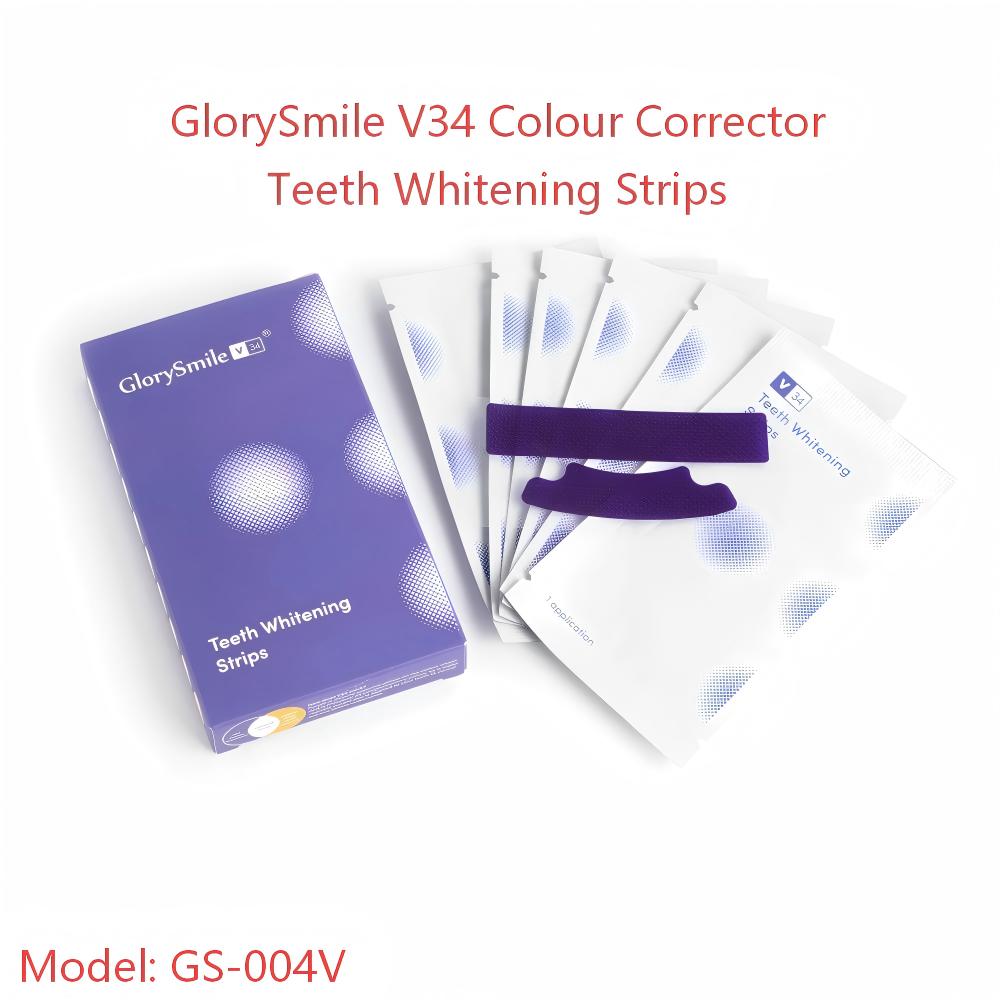
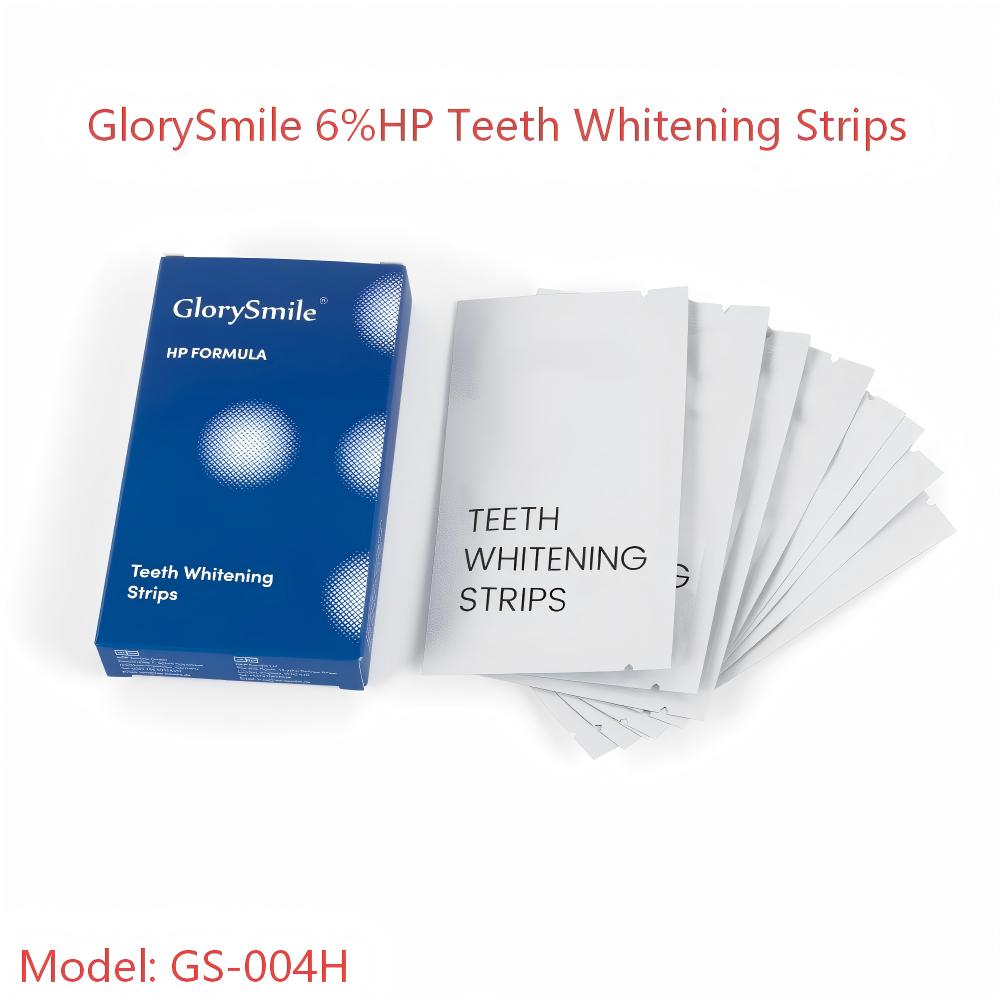
| Illustrative strip models | GS-004P (PAP+); GS-004C (PAP with charcoal) | Listed as a customisable base in strip and kit formulations | GS-004H (6% HP) |
| Colour-correcting variant | GS-004V applies a purple formulation for yellow-tone neutralisation; GS-V34-S07 is the wet-strip equivalent | ||
Within the Glorysmile strip range, the formula branches map onto distinct model designations, all built on the same three-layer construction: a PET hard film, the whitening gel, and a PE soft film, packed in individual aluminum bags in 7, 14 or 21 strip counts. The practical consequence for a buyer is that the model number is the compliance decision, not just the product code. A 6% HP strip and a PAP strip may share packaging, format and flavour list while sitting in completely different regulatory categories in the same export market.
Format Fit: Dry, Wet and Dissolving Strips
Format choice follows user behaviour, not chemistry alone. Three commercial options exist in this category. Dry strips, which include alcohol-free, residue-free and high-viscosity variants, are the format most associated with a dry application and a clean removal. Wet strips, such as the GS-V34-S07 purple formulation, carry a gel that behaves closer to a conventional whitening application. Dissolving strips, represented by DB-004L, remove the disposal step entirely, which matters for travel and for users who dislike handling a used film.
Flavour is the second format-level lever. The strip range lists blue raspberry, strawberry, peach, grape, watermelon, peppermint, orange, mint, pineapple, cherry blossom, coconut and mango, all of which remain available under OEM, ODM and dealer arrangements. In a shelf where the active ingredient is increasingly regulated and the format is largely standardised, flavour and pack count are among the few legally safe points of differentiation.
At-Home Application: Stain Type Matters More Than Shade Target
The documented at-home scenario for strips covers household and travel use at normal room temperature, with the objective of removing exogenous stains from coffee, tea and tobacco while providing anti-sensitivity protection. Application uses a no-slip dry adhesive technology, once per day, with an enamel-safe formula, a zero-peroxide option and individually wrapped strips. Formulations are labelled for adults and children aged 16 and over.
Stain type changes the expectation more than the shade target does. Extrinsic staining from coffee and tea responds to repeated surface-acting treatment; tobacco staining is generally more persistent and often needs a longer cumulative routine rather than a stronger single application. Manufacturer documentation in this category positions a 5–8 shade improvement, and a shade guide is included in the pack so that the user, not the supplier, records the baseline.
Clinic Use: When Strips Are the Wrong Specification
Strips cover the facial surfaces of the teeth. Interproximal areas, existing restorations and discolouration with an intrinsic component sit outside what a self-applied film can address, which is why professional supply remains a separate channel rather than an add-on to consumer retail.
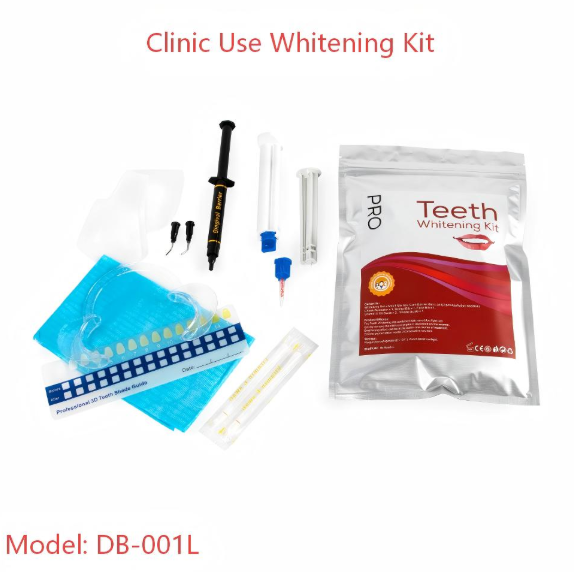
The GS-001L clinic-use whitening kit illustrates how different that specification is. It carries a 35% hydrogen peroxide dual barrier whitening gel with a 3 ml gum protector and two curved needles, an M-size cheek retractor, two brush-ups, two Vitamin-E swabs, ten saliva towels, face gauze, a bib, and an aluminum bag with sticker. The isolation and protection items are not accessories; they are the reason the concentration can be used under professional handling. The company's own product documentation states zero sensitivity reports from more than 5,000 patient treatments for this kit. MOQ is 200 pcs for private label and 1 for the regular product, and custom gel ingredients are supported.
Hygiene hardware is the second difference. The GS-001X LED whitening kit includes a 32 LED light plus a charging and sterilization case, with a disinfection cycle of 3 minutes per cycle that auto-starts when the case is closed. It holds EU patent 015062946-0001 and UK patent 6370462. This is model-specific evidence, not a category-wide statement: buyers evaluating clinic or high-end retail lines should verify whether the sterilization function exists on the exact model they intend to stock.
A Buyer's Verification Checklist for Sensitive-Teeth Lines
| Item to verify | Why it changes the decision | Evidence to request |
|---|---|---|
| Formula family and concentration | Decides sensitivity positioning and OTC eligibility | Formula declaration per model (PAP, CP or HP) |
| Target-market compliance file | A compliant SKU in one market can be non-compliant in another | CPSR, CPNP, PIF; CE-MDR where a medical device claim applies |
| US facility and listing status | MoCRA places registration and listing obligations on the manufacturer | Registration and listing reference, FDA scope covering devices, cosmetics and OTC drugs |
| Quality-system certificates | Determines auditability for retail and distributor onboarding | MDSAP, ISO 13485, ISO 22716, GMP, BSCI; MSDS and COA for consignments |
| Strip construction and adhesive behaviour | Affects wear time and whether users complete the routine | Layer structure and strip type (dry, wet, dissolving) |
| Pack count and wrapping | Drives cost per treatment and repeat-purchase rhythm | 7 / 14 / 21 strip configurations, individually wrapped, aluminum bag |
| MOQ and customisation scope | Sets the entry cost of a private-label programme | 200 pcs for private label and 1 pc for regular product on listed models; custom formula, flavour and packaging |
One note on ordering structure: the product sheets for individual models state an MOQ of 200 pcs for private label and 1 pc for the regular product, while the manufacturer's general ordering guidance describes a regular-order minimum of 5 boxes and OEM packaging runs ranging from 100 to 1,000 boxes depending on product. Both figures are traceable to supplier documentation, and they describe different purchasing situations. Buyers should confirm which basis applies to the specific model before quoting internally.
Market Signals: A Documented Market and a Documentation Gap
The global market for teeth whitening strips and gels is valued at USD 1.1 billion in 2025, according to Grand View Research. That figure covers the strips and gels niche specifically, and it is narrower than broader teeth-whitening market estimates that include professional services and devices. Reading the two numbers together is a common source of confusion in sourcing decks, because they are measuring different scopes.
What the public data does not yet provide is an isolated growth rate for peroxide-free versus peroxide-based strips. Retail audit sources that could separate those segments are not reflected in current trade statistics. Any claim that one chemistry is growing faster than the other should therefore be treated as unverified until supplier-level or retail-audit data is available.
On the demand side, e-commerce platform sellers have used this product category to launch private-label brands, which is consistent with a market where entry barriers are documentation-related rather than capital-related. On the supply side, Glorysmile operates a 36,000 m² facility with 20,000 m² of 100,000-class cleanrooms and a 1,000 m² laboratory, employs approximately 256 staff including 17 R&D engineers and 11 QC specialists, and reports annual capacity of 300,000,000 pcs of whitening strips and 10,000,000 sets of whitening kits, with roughly 90% of output exported to markets including the EU, USA and UK. Capacity of that scale matters to a private-label programme less for volume than for continuity: strip manufacturing is a converted-film process, and film conversion lines are the constraint when a launch schedule slips.
Strips vs. Kits vs. In-Clinic Systems: Honest Boundaries
Strips are not a universal substitute for professional whitening. Coverage is limited to the facial surfaces of the teeth, and interproximal spaces and intrinsically discoloured teeth are better addressed through clinician-applied systems. In the European Union, the 0.1% over-the-counter ceiling for hydrogen peroxide under Regulation (EC) No. 1223/2009 means that a 6% HP strip format cannot be positioned as an ordinary consumer cosmetic in that market, regardless of how it is packaged or flavoured.
PAP avoids that particular ceiling because it is peroxide-free, but it is a different bleaching chemistry. Buyers should not assume that a peroxide-free strip delivers identical results to a high-concentration professional gel, and no such parity claim should be published without testing. Similarly, tray-based LED kits require a different compliance route from strips: a whitening kit that makes device-level claims needs the corresponding medical-device documentation, while a cosmetic strip line does not. Choosing between formats is therefore a question of intended claim and intended channel before it is a question of price.
What to Expect Next
Two forces are likely to define the next phase of this segment. The first is documentation-led competition: as MoCRA registration and listing and the EU compliance file become routine requirements, the ability to produce a complete, per-model evidence set becomes a selection criterion in itself. The second is format expansion around the sensitive-teeth user, including dissolving strips that remove the disposal step and device formats that add a documented sterilization cycle rather than a decorative one. Neither trend removes the underlying constraint: the formula declaration remains the single decision that determines both the user experience and the market the product can enter.
FAQ
Is the product safe for sensitive teeth?
PAP and low-sensitivity formulas are designed for users who report sensitive teeth. PAP is a peroxide-free bleaching agent, which is why it is the formula family most often specified for the sensitive-teeth segment rather than a variant of a peroxide line.
What whitening formulas are available?
Three formula families are offered: PAP (peroxide-free), carbamide peroxide, and hydrogen peroxide. Strip models in the range include PAP+ and PAP with charcoal, a purple colour-correcting formulation, and a 6% hydrogen peroxide version, with custom formula development available.
Are the products FDA approved?
The products are FDA approved, and the FDA-certified scope covers medical devices, cosmetics and OTC drugs. Buyers should map this to the specific product classification of the SKU they intend to import, since strips and clinic kits do not fall into the same category.
Is the range compliant for the EU market?
For cosmetic products, CPSR, CPNP and PIF documentation can be provided. For medical devices, CE-MDR registration has been completed. Because EU rules cap hydrogen peroxide in over-the-counter whitening products at 0.1% or less, the compliance position depends on the formula concentration of the specific model.
What is the minimum order quantity?
For regular orders using existing packaging, the stated minimum is 5 boxes. For OEM orders with customised packaging, the MOQ varies by product and ranges from 100 to 1,000 boxes. Individual product sheets for several models separately list 200 pcs for private label and 1 pc for the regular product, so the applicable basis should be confirmed per model.
Technical documentation is available for review: the manufacturer catalog can be downloaded as a PDF at Glorysmile catalog. Company website: www.glorysmile.com.