
Teeth Whitening Kit Scenario Fit: Retail, Travel, Dental
Teeth whitening kit sourcing in 2026 is less about finding a factory that can fill a box, and more about deciding which kit format belongs on which shelf, in which travel bag, and in which treatment room.
Scenario fit, the practice of matching a whitening format, its packaging and its adjacent products to the channel where the product will actually be sold or used, has become the practical test of whether an assortment sells through or sits in a warehouse. A beauty retailer, a travel-retail buyer and a dental distributor may all order from the same catalogue, but they are not solving the same problem.
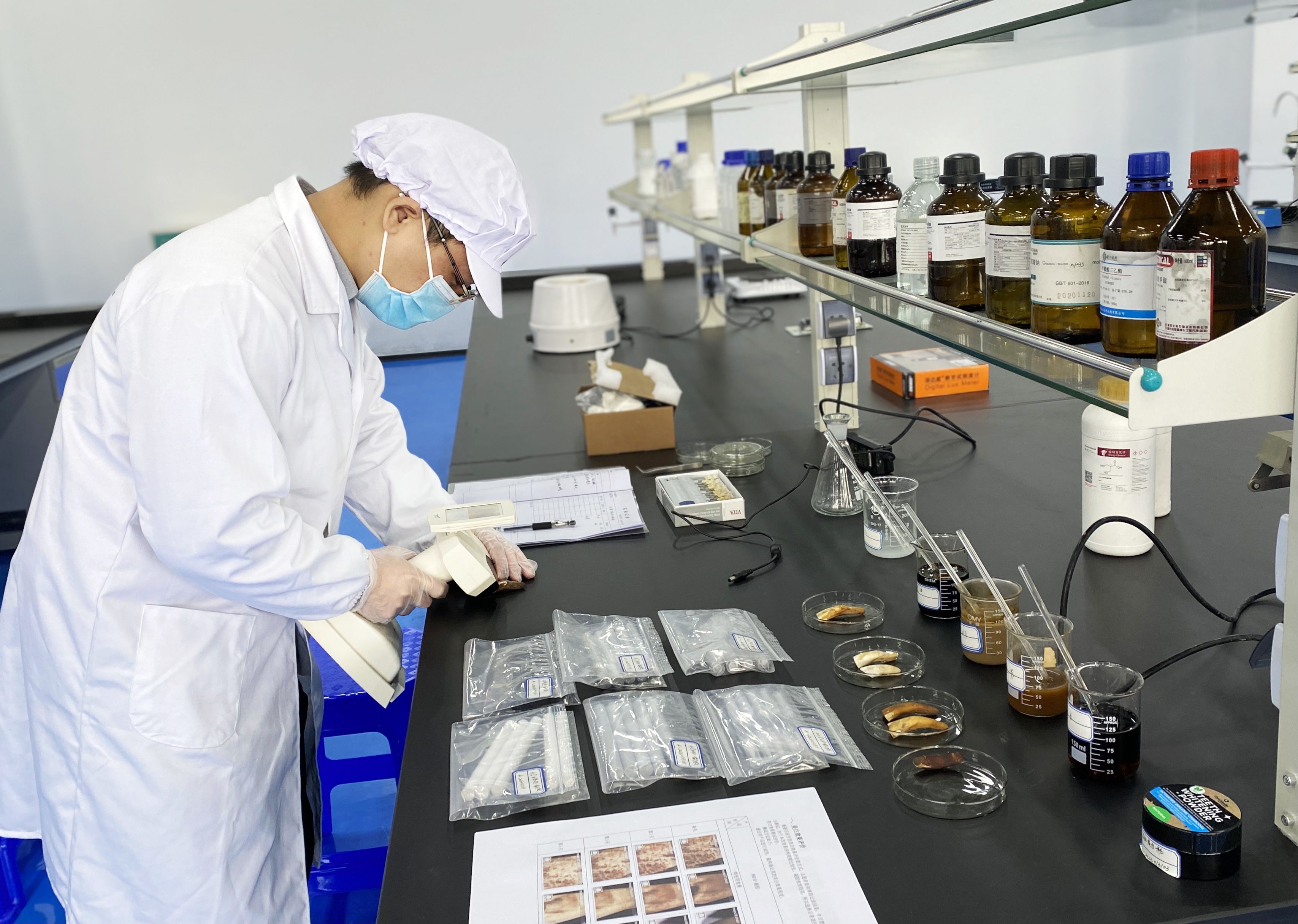
This reference maps the standing teeth whitening kit formats to three concrete channels, beauty retail, travel, and dental-office take-home, and explains what each mapping requires in OEM, ODM, custom formulation and private-label terms. The capability and product details below come from the published records of Jiangxi Dentalbright Technology Co., Ltd., which operates as Glorysmile Factory, an oral-care manufacturer based in Jiangxi Province, China (www.glorysmile.com).
Why scenario fit became a procurement question
The global teeth whitening market was valued at USD 8.93 billion in 2025 and is projected to reach USD 14.31 billion by 2034 (Fortune Business Insights). Within that market, the individual and at-home segment accounted for 68.67% of value in 2024 (Straits Research), which means most of the growth is decided at retail and in the home, not only in the dental chair.
Regional emphasis shifts the picture further. Asia Pacific held a 33.80% share of the teeth whitening market in 2025 (Facts & Stats), while other research houses place North America ahead in earlier years depending on whether professional dental services are counted inside the market definition. Buyers should treat regional leadership claims as definition-dependent rather than absolute.
Two product-level trends matter most for assortment planning. First, demand for PAP+ (phthalimidoperoxycaproic acid) peroxide-free kits is rising as an alternative to traditional peroxide formats because of sensitivity concerns (The Insight Partners). Second, regulatory thresholds increasingly decide which format can be sold where. Under EU Directive 2011/84/EU, products containing between 0.1% and 6% hydrogen peroxide require a first treatment by a dentist. In the United States, the FDA recognises ISO 28399:2021 as a consensus standard for external tooth bleaching products, and US Customs classification of teeth whitening strips under subheading 3306.90.0000 has been confirmed in ruling NY N342147.
The sourcing consequence is straightforward. A single kit SKU can no longer be pushed through every channel. The format, the packaging, the surrounding products and the documentation all have to change with the scenario.
The scenario map: which format fits which channel
| Scenario | Typical buyer | Formats that fit | Adjacent products to bundle | Sourcing watch-outs |
|---|---|---|---|---|
| Beauty retail, pharmacy and e-commerce shelves | Brand owners, pharmacy and supermarket chains, marketplace sellers | Gift-boxed LED kits with tray, gel, shade guide and manual (GS-001B, GS-001Y, GS-001X, DB-001M) | V34 purple corrector serum, foam and toothpaste; whitening powder; fruity or PAP toothpaste; foam mouthwash | Shelf-ready packaging; shade guide and manual inside the box; private-label MOQ and artwork lead time |
| Travel, convenience and subscription kits | Travel retail buyers, subscription-box operators, hotel and airline amenity buyers | Individually wrapped dry strips, dissolving strips, 17 ml mouth spray, 12 ml mouthwash sachets, toothpaste tablets, pre-pasted disposable toothbrush, battery-free plug-and-play LED kit (GS-001J) | Compact whitening pen, travel-size powder, denture and retainer cleansing tablets | Unit size and leakage risk; lower-foaming tablets; wet-strip adhesion and residue |
| Dental-office take-home and clinic supply | Dental clinics, whitening labs, beauty salons, professional distributors | Clinic-use kit with 35% hydrogen peroxide gel, gum protector, cheek retractor and disposables (GS-001L) | Electric toothbrush, oral irrigator, dental impression material for custom trays | Professional-use labelling; formulation documentation; clinic-specific kit composition |
| Corporate gifting and pharmacy promotions | Pharmacy chains, corporate gift buyers, supermarket promotions | Multi-unit gift sets built from LED kits and strips | Mouthwash, mouth spray, tablets and toothbrush add-ins | Multi-language manuals; set-level packaging; large-batch inspection discipline |
Formats overlap between scenarios. The map describes default fits, not exclusive ones, and a buyer assembling a seasonal range may deliberately pull two formats from two rows.
Scenario one: beauty retail and pharmacy shelves
On a beauty retail or pharmacy shelf, a whitening kit competes with every other visible-beauty purchase in the aisle. The format that fits is the one that arrives shelf-ready: a light unit, a mouth tray, a whitening gel, a shade guide, a user manual and a gift box that can carry the brand without a secondary display.
Four LED kit formats in the current range are built around that logic:
- GS-001B: 5 LED light, one food-grade TPE mouth tray, three 3 ml whitening syringes, shade guide, user manual and gift box, with 40 treatments at 10 minutes each, powered by two CR2032 lithium metal batteries.
- GS-001Y: the same 5 LED architecture with a 10-minute light timer and 30 uses, powered by two CR2450 batteries.
- GS-001X: 32 LED light, two 3 ml whitening pens, a charging and sterilisation case with cable, shade guide, manual and gift box; 16-minute timer, 150 mAh lithium-ion battery, 4-hour charge, up to five uses per charge and a 3-minute disinfection cycle that auto-starts when the case is closed. It carries EU patent 015062946-0001 and UK patent 6370462.
- DB-001M: 32 LED light, four 2 ml whitening pens, storage case with cable, shade guide, manual and gift box; 16-minute timer, 450 mAh battery, 2 to 3 hour charge and up to eight uses per charge. It carries US patent D1,128,065 S, EU patent 015065790-0001 and UK patent 6377277.
The retail-specific decision is not the LED count. It is what sits next to the kit in the same basket. Purple (V34) colour correctors follow a simple colour-wheel principle: purple sits opposite yellow, so a water-soluble purple dye applied to the teeth neutralises yellow undertones. That makes a 30 ml purple corrector serum, a purple corrector foam or a purple corrector toothpaste a natural shelf companion to a whitening kit, because it addresses the same purchase motivation at a lower price point.
Whitening powder and a second toothpaste format extend the routine without cannibalising the kit. The current range includes a 30 g charcoal powder, a 12 g PAP+ powder and a 12 g purple corrector powder, plus a 60 g fruity toothpaste in eleven flavours and a 100 g double-tube toothpaste formulated with PAP and hydrogen peroxide. A foam mouthwash, dispensed with two pumps and swirled for 30 to 60 seconds, closes the routine.
Promotional and gifting programmes use the same building blocks at set level. One recorded retail programme delivered seven million units across multiple promotional gift sets for pharmacy chain and supermarket retail use over two years, with multi-language manual customisation and a one-stop process from design to logistics, and reported zero return rate in large-batch inspection after third-party factory audits.
Scenario two: travel, convenience and subscription kits
Travel changes the specification sheet. Weight, leakage, dosage control, single-use wrapping and battery handling all move ahead of feature count in the buyer's decision order. Three format families carry most travel-oriented whitening lines.
Strips. The current strip range covers dry strips (GS-004H/V/C/P) offered in 7, 14 or 21 bags with alcohol-free and residue-free options, wet strips (GS-V34-S07), and dissolving strips (DB-004L) that are residue-free and alcohol-free and positioned for sensitive users. Each configuration ships with a color box, shade guide and user manual, and can be supplied individually wrapped.
Small-format liquids and solids. A 17 ml mouth spray in ten flavours, a coconut mouthwash in 20 x 12 ml sachets, a 237 ml alcohol-free liquid mouthwash for larger travel or home formats, and toothpaste tablets in 30 or 60 counts with plastic, glass or aluminium jars, or a kraft bag option. A pre-pasted disposable toothbrush packed 14 per bag covers the brushing step where water access is limited, with options such as green tea, peach, mint and cherry blossom flavours.
Battery-free devices. The GS-001J LED kit uses 16 LEDs, with 24 and 32 LED options, a 16-minute daily treatment, a dust-free cover, four adapters (iPhone, Android, Type-C and USB) and a shade guide. It is plug-and-play, powered via USB from a phone, laptop or power bank, with no built-in battery. For travel-oriented lines, that design choice removes a battery from the product itself.
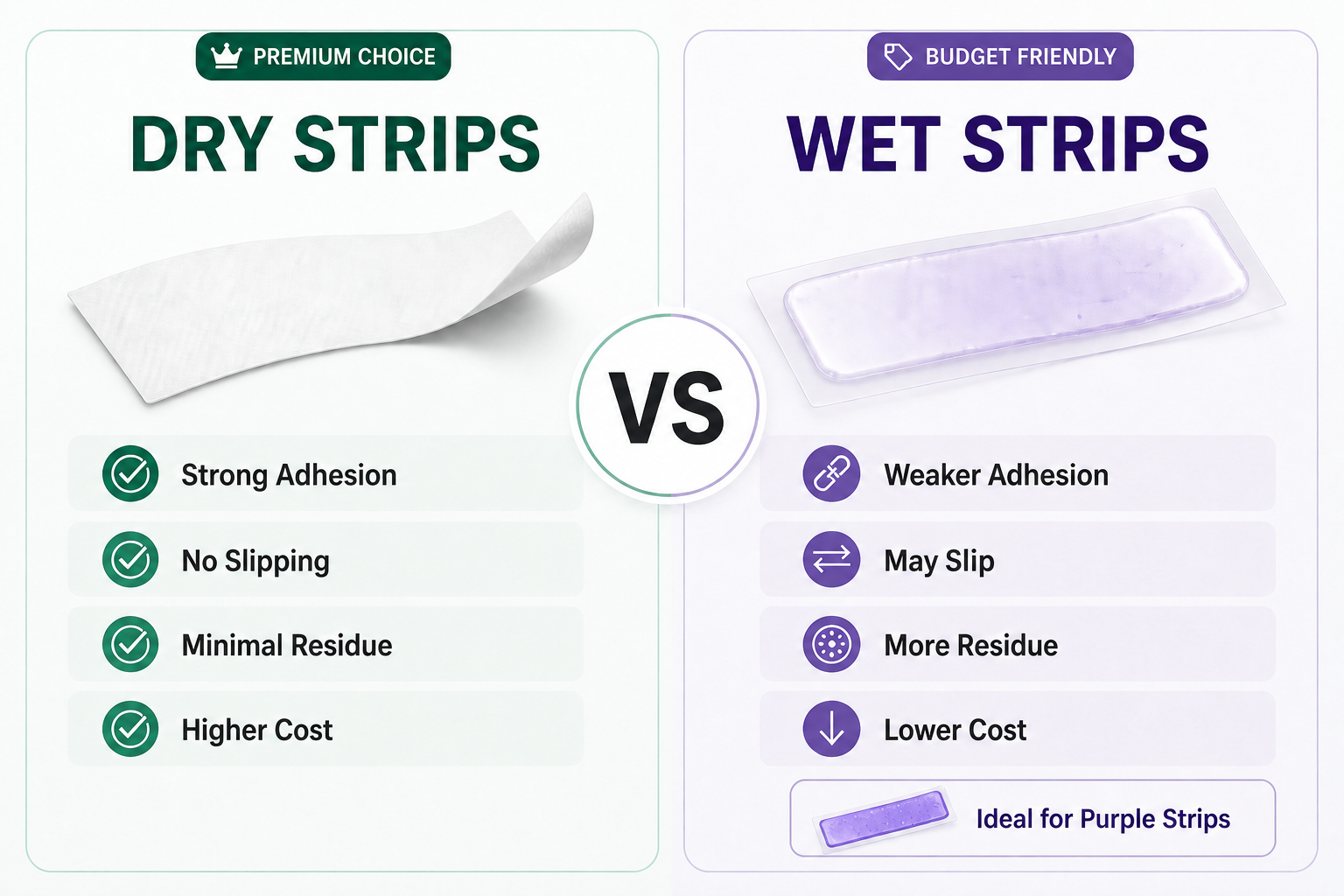
Two honest limitations apply here. Toothpaste tablets have lower foaming power and a noticeable granular texture that some users dislike, and the category still carries a high market-education cost. Dry strips offer better adhesion and leave less residue than wet strips but cost more; wet strips sit at a lower cost but tend to shift during application and leave relatively more residue, which is also why wet substrates suit purple strips, where higher residue helps the pigment adhere to the teeth. A travel assortment that mixes tablet, strip and spray formats is usually a deliberate trade-off rather than an oversight.
Scenario three: dental-office take-home and clinic supply
The dental channel is a documentation channel as much as a product channel. Clinic buyers look for a kit that mirrors what happens in the chair, a formulation that matches local professional-use rules, and accessories that let a trained clinician control gel placement.
The clinic-use kit in the range (GS-001L) is built that way: a 5 ml dual-barrier whitening gel at 35% hydrogen peroxide, a 3 ml gum protector with two curved needles, an M-size cheek retractor, two brush-ups, two vitamin-E swabs, ten saliva towels, face gauze, a bib, and an aluminium bag with sticker. It is positioned for professional whitening labs and dental-clinic OEM service projects, with custom packaging and custom gel formulation available.
Take-home routines pull adjacent products into the same order. An electric toothbrush such as the K9P (four modes, three speeds, IPX7 waterproofing, 33,000 to 38,000 vibrations per minute, 800 mAh battery, EU patent 015075898-0001) or the K5 (five modes from 39,000 to 43,000 times per minute, 600 mAh battery, up to 60 days per charge) supports maintenance between whitening sessions. An oral irrigator with four modes, 20 to 120 PSI rated water pressure, a 280 ml tank and up to 65 days per charge covers interdental cleaning. Where custom trays are made in-house, a silicone dental impression material with hardness 60, a one-minute working time and intraoral cure in 2.5 minutes supplies the impression step.
Recorded clinic and salon supply programmes provide the scale reference: 500,000 units delivered over two years for professional clinic supply and salon whitening services, with the case record noting a 5 to 8 shade improvement in a single treatment and no sensitivity reports across more than 5,000 patients.
How format differences inside a kit change the scenario it fits
| Model | Light and timer | Power | Kit contents | Scenario fit |
|---|---|---|---|---|
| GS-001B | 5 LED, 10 minutes per treatment, 40 treatments | 2 x CR2032 | Light, tray, 3 x 3 ml syringes, shade guide, manual, gift box | Retail and gifting |
| GS-001Y | 5 LED, 10-minute timer, 30 uses | 2 x CR2450 | Light, tray, 3 x 3 ml syringes, shade guide, manual, gift box | Retail entry price points |
| GS-001X | 32 LED, 16-minute timer | 150 mAh lithium-ion, 4-hour charge, up to 5 uses, 3-minute disinfection cycle | Light, 2 x 3 ml pens, charging and sterilisation case, shade guide, manual, gift box | Premium retail and beauty-device positioning |
| DB-001M | 32 LED, 16-minute timer | 450 mAh lithium-ion, 2 to 3 hour charge, up to 8 uses | Light, 4 x 2 ml pens, storage case, shade guide, manual, gift box | Retail and multi-user households |
| GS-001J | 16 LED (24 and 32 optional), 16 minutes per day | USB plug-and-play, no built-in battery | Light, 4 x 2 ml pens, dust-free cover, 4 adapters, shade guide, manual, gift box | Travel and subscription formats |
| GS-001L | Professional application | Not applicable | 35% HP dual-barrier gel, gum protector with needles, cheek retractor, brush-ups, vitamin-E swabs, saliva towels, gauze, bib | Dental clinic and whitening lab supply |
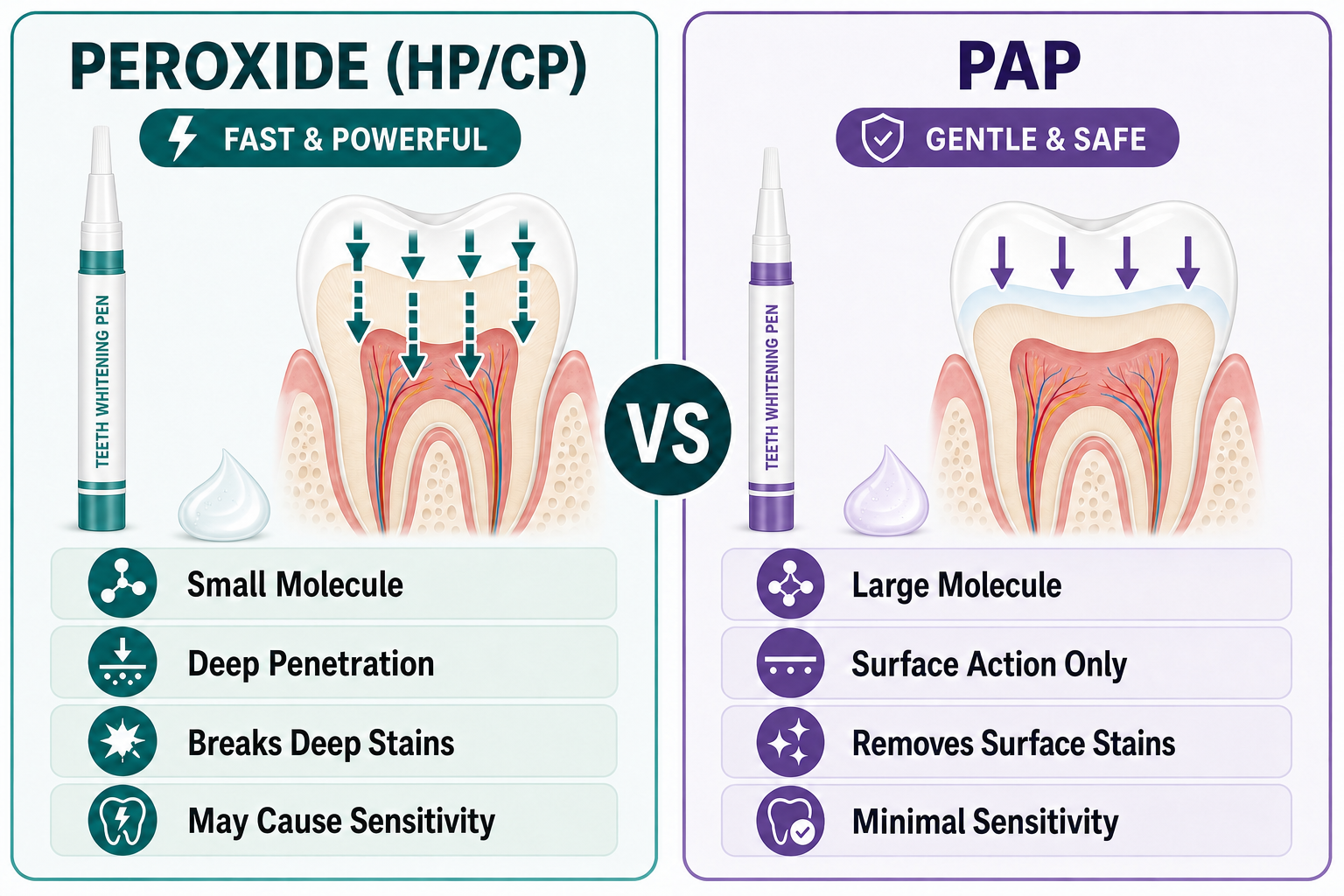
Formulation choices run in parallel with hardware. Current kit specifications list hydrogen peroxide, carbamide peroxide, PAP, sodium phytate, sodium bicarbonate and charcoal as available actives, with custom formulation on request. Peroxide gels are the traditional high-efficacy route and can cause temporary sensitivity. PAP is a gentler, slower route, better suited to daily or maintenance whitening and to sensitive-teeth positioning. Mouth trays are food-grade TPE, and consumer kits are packed in hard cardboard gift boxes, while clinic kits ship in aluminium bags.
What buyers can actually customise for a scenario
Customisation depth differs by product family, and that difference determines how much of a scenario can be answered with packaging alone.
- Home whitening kits: LED wavelength configuration, housing colour, logo printing, packaging structure, kit composition, custom user manuals and compliance labelling. Production modes are OEM, ODM, private label and custom design.
- Strips and pens: strip type, active ingredient, residue-free or standard formulation, colour, flavour, packaging and labelling. For pens, formula composition, flavour, colour, packaging design, logo printing, product form and efficacy combination.
- Gel: efficacy combinations, active ingredients, viscosity, and syringe or tube format with delivery-system compatibility.
- Powder: efficacy, active ingredients, particle size and flow characteristics, flavour, colour, jar or bottle design and packaging format.
- Toothpaste: appearance, efficacy, active ingredients, flavour, colour, tube design and carton artwork.
- Mouthwash and mouth spray: format, efficacy, flavour, colour, alcohol-free formulations and sustainable packaging options.
- Electric toothbrush: appearance, LED feature, charging mode, brush head, colour, packaging, branding and logo.
For scenario work, the useful question is not how much can be changed, but which changes survive the channel. A retail line needs a shade guide, a manual and shelf-ready box artwork. A travel line needs smaller units and individual wrapping. A clinic line needs accessory completeness and professional-use documentation. Customising beyond that point adds cost without adding sell-through.
Execution: MOQ, sampling, lead time and acceptance
Published product specification sheets in this range state an MOQ of 200 pcs for private label and 1 pc for regular product across several kit models, strips and oral-care items. The manufacturer's buying FAQ separately states 5 boxes for standard packaging and between 100 and 1,000 boxes for OEM orders, depending mainly on the minimum order quantity for custom packaging. The manufacturer's stated position is that minimum order quantity is determined by product category, customisation requirements and production line configuration, and the binding figure is confirmed during quotation and sampling.
Lead time follows the same logic. It varies with order volume, product specifications, customisation complexity and the current production schedule, and a precise delivery timeline is provided at order confirmation. Sampling therefore functions as the point where scenario, specification and commercial terms converge, rather than as a formality.
Commercial terms published for this supply relationship use EXW, FCA, FOB and CFR delivery terms, a 30% deposit in advance with the 70% balance before shipment, and acceptance through on-site inspection or pre-shipment random inspection by the supplier's quality department. After-sales operates on a 24-hour response mechanism with full-lifecycle product quality assurance, and long-term partners receive market intelligence briefings and national regulatory compliance guidance.
The manufacturing and compliance base behind the scenario map
Scenario-specific assortments are only practical if one supplier can cover several formats without splitting the order across factories. The relevant capability data is specific rather than directional.
Jiangxi Dentalbright Technology Co., Ltd. operates a 36,000 square metre facility that includes 20,000 square metres of 100,000-class cleanrooms and a 1,000 square metre laboratory with a 100-class cleanroom dedicated to microbiological testing. The company employs 256 people, including 17 R&D engineers, 11 QC specialists, 8 production management staff and a six-person packaging design team. Stated monthly capacity includes 105,000 sets of home teeth whitening kits, 300,000 electric toothbrushes, 29.2 million whitening strips, 21 million whitening pens, 8.33 million gel sets, 2.5 million mouthwash sachets plus 416,000 bottles, 500,000 bottles of powder and 830,000 tubes of toothpaste. Products are exported to 102 countries, with an export ratio of 90% and main markets in the EU, USA and UK.
Certification and regulatory scope covers MDSAP, ISO 13485, ISO 22716, US GMP, BSCI, HALAL and VEGAN, alongside medical device and cosmetics production licences. For the EU market, CPSR, CPNP notification and PIF documents are available for cosmetic products, and medical-device products hold MDR-CE certification with a complete Technical File and an appointed EU Responsible Person. For the US market, the stated FDA-certified scope covers medical devices, cosmetics and OTC drugs, with MoCRA-compliant cosmetic facility registration and product listing completed for teeth whitening strips, FDA medical-device registration for whitening lights, electric toothbrushes and oral irrigators, and 510(k) registration for the silicone impression material. MSDS documentation is available on request.
Design protection is part of the sourcing picture where moulds and housing designs are shared with a buyer. The portfolio includes US design patent D864,399 S for teeth-whitening equipment, EU registered community design 006537908-0001, a US design patent for a diamond-shaped whitening device (D1,080,877 S), and US utility patent 12,350,120 B1 covering a gum-protecting whitening strip and its preparation method, alongside registered designs in the EU and UK for LED kit formats, upright rechargeable whitening equipment, electric toothbrushes and hybrid lip-and-teeth devices.
Commercial evidence supports the same formats at volume: one million units over two years for a private-label brand launch on an e-commerce platform that reached Top 10 Bestseller status with a 4.8-star rating, a strategic OEM programme for a platform-owned brand that maintained a top-three category rank with a 99.8% positive feedback rate and zero safety or compliance incidents, and 500,000 clinic and salon units over two years.
Where a single-format supply model breaks down
The traditional approach, one kit format, one box and one price list for every market, still works for low-velocity catalogues, but it loses accuracy in three predictable places.
First, format and scenario can conflict at the regulatory level. A 35% hydrogen peroxide clinic kit and a retail LED kit are not interchangeable even though both are called whitening kits. In the EU, hydrogen peroxide concentrations between 0.1% and 6% require a first treatment by a dentist, which places a retail-positioned peroxide product in a different compliance bracket from a professional-use pack. Matching format to market is not optional.
Second, scenario-specific packaging has a direct cost. A custom box structure, custom manual and compliance labelling increase both the artwork workload and the OEM MOQ, with customised orders running from 100 to 1,000 boxes depending on the packaging's own minimum. Buyers testing a new scenario commonly start with standard packaging or a limited SKU set and move to full customisation once sell-through is confirmed.
Third, not every format suits every use case, and pretending otherwise creates returns. Toothpaste tablets trade convenience and plastic-free packaging for lower foaming and a granular mouthfeel. Wet strips cost less but adhere less well than dry strips. Battery-free device formats remove battery handling from the product but depend on the user having a USB power source. These are design trade-offs, not defects, and they belong in the product brief rather than in the after-sales queue.
Future outlook
Three shifts look structural rather than cyclical. Peroxide-free PAP+ positioning is likely to keep expanding because it addresses the most common consumer objection, sensitivity, at the cost of slower visible results. Because more than two-thirds of the market already sits in at-home use, assortment design will keep moving toward routine bundles in which a whitening kit, a colour corrector and a maintenance product are planned as one unit rather than three listings. And documentation is becoming a product feature: MoCRA listing in the US, CPSR, CPNP and MDR-CE documentation in the EU, and ISO 28399:2021 recognition for bleaching products all reduce the tolerance for suppliers who cannot produce paperwork on demand.
For buyers, the practical implication is that supplier evaluation and scenario planning belong in the same conversation. The question is not only who can make a teeth whitening kit, but who can make the version of it that the target channel will actually sell.
FAQ
What production services are available for teeth whitening kits?
Home teeth whitening kits are produced under OEM, ODM, private label and custom design modes. Custom design covers LED wavelength configuration, housing colour, logo printing, packaging structure, kit composition, custom user manuals and compliance labelling. The same manufacturer also provides OEM, ODM, custom formulation and private label services for strips, pens, gel, powder, toothpaste, mouthwash and electric toothbrushes, including custom formulation for gel, toothpaste and powder products.
Can the whitening formulation be adapted for sensitive-teeth or peroxide-free positioning?
Available actives include hydrogen peroxide, carbamide peroxide, PAP (peroxide-free), sodium phytate, sodium bicarbonate and charcoal, with custom formulation offered. PAP and low-sensitivity formulas are designed for sensitive teeth. The trade-off is documented in the supplier's own comparison material: peroxide gels work faster but carry a higher risk of temporary sensitivity, while PAP acts on surface stains and is gentler but slower. In the EU, products containing 0.1% to 6% hydrogen peroxide require a first treatment by a dentist, which affects how a peroxide format can be positioned in retail channels.
What is the minimum order quantity for a teeth whitening kit?
Published product specifications list an MOQ of 200 pcs for private label and 1 pc for regular product on several kit models. The manufacturer's buying FAQ states 5 boxes for standard packaging and 100 to 1,000 boxes for OEM orders, depending mainly on the packaging's own minimum. The manufacturer's stated position is that MOQ depends on product category, customisation requirements and production line configuration, and the binding figure is confirmed during quotation and sampling.
How is lead time determined for a customised kit order?
Lead time depends on order volume, product specifications, customisation complexity and the current production schedule. A precise delivery timeline is provided at order confirmation rather than at enquiry stage, which is why sampling and quotation are treated as one combined step in the OEM and ODM process.
What compliance documentation is available for EU and US market entry?
For cosmetic products, CPSR, CPNP notification and PIF documents are available, with an appointed EU Responsible Person; medical-device products hold MDR-CE certification with a complete Technical File. For the United States, the stated FDA-certified scope covers medical devices, cosmetics and OTC drugs, MoCRA-compliant cosmetic facility registration and product listing have been completed for teeth whitening strips, and 510(k) registration covers the silicone impression material. Factory-level certificates include MDSAP, ISO 13485, ISO 22716, US GMP, BSCI, HALAL and VEGAN, and MSDS is available on request.
Reference material: the manufacturer's full product and capability catalogue is available as a downloadable PDF here: Glorysmile Factory catalogue.