
Teeth Whitening Kit Compliance File: MDR, MoCRA, FDA, MSDS
Teeth Whitening Kit Compliance File: MDR, MoCRA, FDA, MSDS
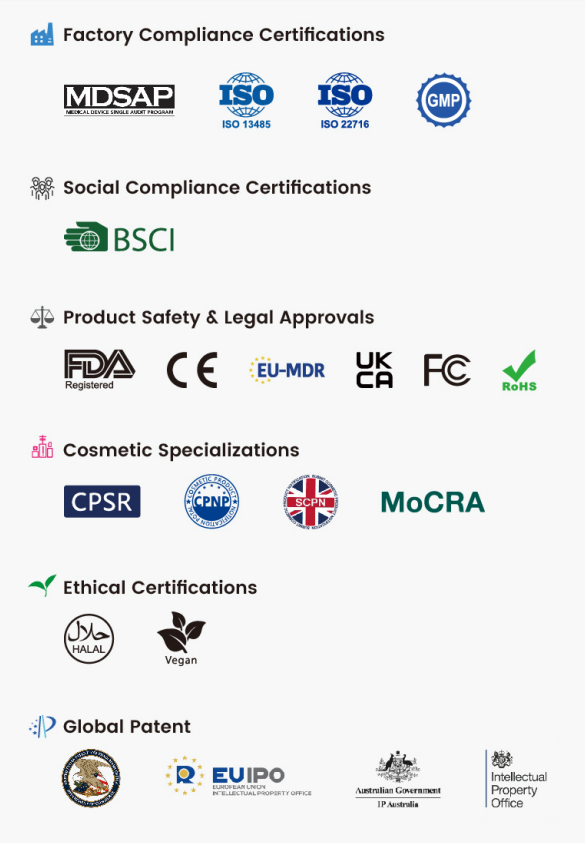
Certification and registration records held by the manufacturing site, reviewed SKU by SKU during supplier qualification.
A teeth whitening kit compliance file is the document set that shows how one product is classified, registered and supported for a named market. It answers the questions a sample cannot: whether the kit is compliant for the EU, whether an MSDS can be supplied, whether the product is FDA approved rather than merely FDA registered, and whether the factory actually holds the MDR‑CE or FDA medical device registrations that the packaging copy implies.
Buyers in the late evaluation and early execution stage usually arrive with the same short list of questions. They are not asking for reassurance; they are building a file they may have to show a customs broker, a marketplace compliance team or a retailer's technical department. The answers therefore have to be specific enough to be quoted back — which model, which market, which document, which issuer, which validity date.
The purpose of this reference is to explain what each document in that file does, where the boundaries sit, and how to request the paperwork in a sequence that surfaces gaps before a deposit is paid rather than after a container is booked.
Why the file, not the sample, decides the launch date
A whitening kit can pass every sensory test a buyer runs and still fail at the border. The manufacturer's own procurement guidance is blunt about the mechanism: choosing an unqualified supplier has a direct impact on import and sale, because when a brand imports products or prepares to place them on market, a missing qualification can stop the goods from entering the country or from being sold legally once they arrive.
That risk is asymmetric. A gel texture can be reformulated, a LED housing can be retooled, a carton can be reprinted. A certificate that names the wrong model, a safety report written against an older formulation, or an unqualified "FDA approved" line on a listing cannot be fixed by the supplier after the fact — it has to be rebuilt from the raw materials up.
The commercial weight behind this is not marginal. Fortune Business Insights valued the global teeth whitening market at USD 8.93 billion in 2025 and projects USD 14.31 billion by 2034. Straits Research recorded the individual, at-home segment at 68.67% of that market in 2024. Most of that volume moves as cosmetics, a smaller portion as medical devices, and a further slice under OTC drug frameworks — three regulatory routes, three different paper sets, and a supplier who cannot say which route a given SKU follows cannot quote a realistic timeline.
Step one: classify the SKU, because the file follows the classification
In practice the same supplier can ship three products under three different regimes. In Glorysmile's filings, teeth whitening strips are handled as US cosmetics under MoCRA, whitening lights and powered oral care devices are handled as FDA-registered medical devices, and the certified scope additionally extends to OTC drugs. A whitening gel, foam or toothpaste is normally handled as a cosmetic in the EU and US — but the classification follows the formulation and the claim, not the shelf it sits on.
Two external references anchor the EU position. EU Directive 2011/84/EU, as summarised by the European Commission, sets the threshold under which products containing between 0.1% and 6% hydrogen peroxide require a first treatment by a dentist; above that band the product is not a general cosmetic. The US FDA, in its Recognized Consensus Standards database (updated December 2024), recognises ISO 28399:2021 as a consensus standard for external tooth bleaching products.
The practical consequence for a buyer is simple: before requesting a compliance file, state the SKU, the target market, the hydrogen peroxide or carbamide peroxide concentration band, and the claims that will appear on pack. A supplier answering "we are CE and FDA certified" without those four inputs is giving an answer that cannot be audited.
The EU file: CPSR, CPNP, PIF — and where MDR applies
For a cosmetic whitening kit sold into the EU, the documentation set is a chain rather than a single certificate. Glorysmile states that for the EU market it has completed CPNP notification, prepared the CPSR (Cosmetic Product Safety Report), and appointed an EU Responsible Person as required by EU cosmetic regulation.
The supporting technical package behind that chain is equally specific. The manufacturer lists microbiological limit testing, heavy metal testing for lead, arsenic, mercury and cadmium, skin irritation testing and stability testing as the test requirements applied to the product, with a product specification, MSDS and raw-material COA sitting alongside the CPSR, the CPNP notification confirmation and the Responsible Person information.
Where the product is a medical device rather than a cosmetic, the file changes shape. For device-classified oral care products, the manufacturer states that MDR‑CE certification has been completed, with a complete Technical File and an appointed EU Responsible Person — the same status described elsewhere as CE‑MDR registration.
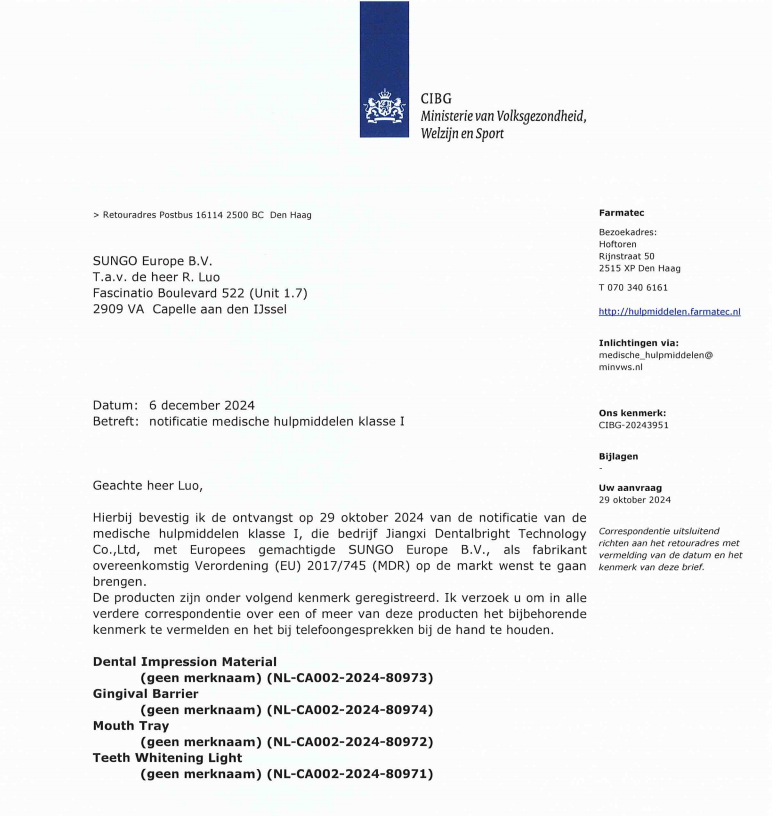
MDR‑CE certification applies to device-classified products; a cosmetic whitening gel is not covered by it and should not be marketed as MDR registered.
The distinction is where most mislabelled listings originate. A cosmetic gel accompanied by a CPSR is compliant as a cosmetic; writing "MDR registered" on that listing is not a harmless embellishment, it is a claim the underlying file does not support. Conversely, a whitening light sold as a device cannot be supported by a cosmetic CPSR alone.
The US file: "FDA approved", device registration and MoCRA listing
US terminology causes more confusion than EU terminology, because "FDA approved" is used loosely across the category. Three distinct statuses sit behind it, and buyers should ask which one a supplier means.
Medical device registration and listing. The manufacturer states that its teeth-whitening lights, electric toothbrushes and oral irrigators have obtained FDA medical device registration, and that its silicone rubber impression material has completed 510(k) registration. The underlying requirements are FDA medical-device establishment registration and device listing, a 510(k) clearance document where applicable, and an appointed US Agent.
MoCRA cosmetic registration. For the US cosmetics route, the manufacturer states it has completed MoCRA-compliant cosmetic facility registration and product listing for teeth-whitening strips. MoCRA registration requires a US Agent and formulation filing on the FDA website.
OTC drug scope. The manufacturer also states that its FDA-certified scope covers medical devices, cosmetics and OTC drugs — useful to record, but the buyer still needs to know which of the three applies to the SKU being purchased.
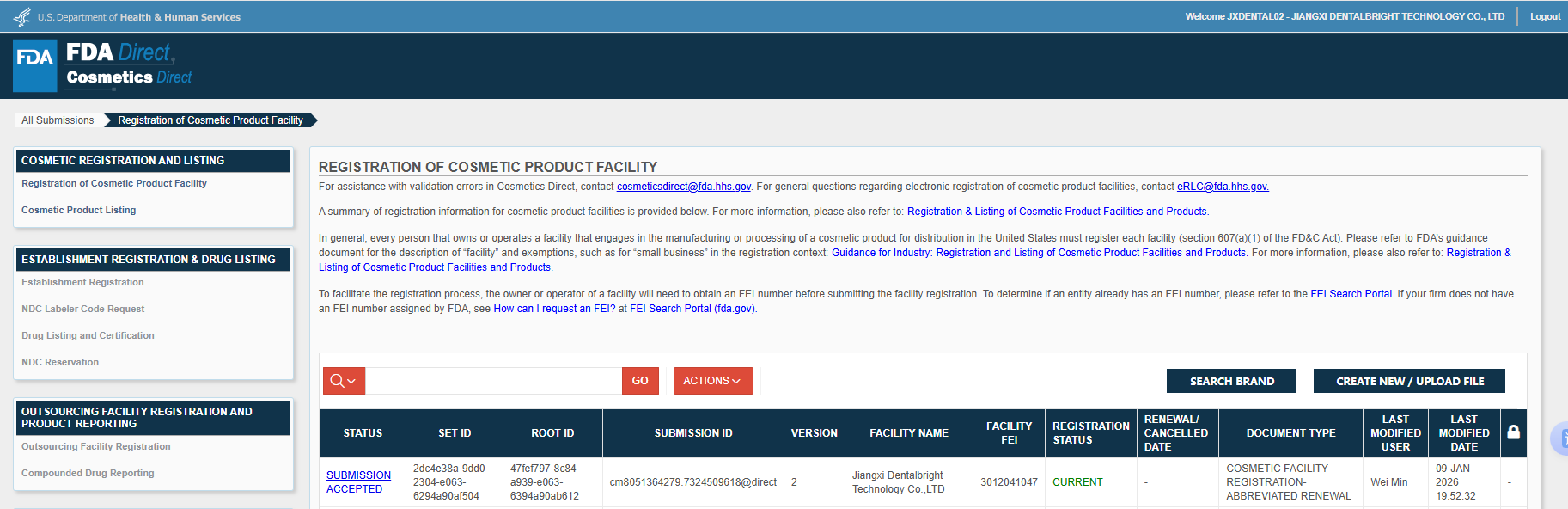
MoCRA facility registration and product listing address market access for US cosmetics; they are not an efficacy approval.
Which document answers which question
Most vetting delays come from asking the right question of the wrong document. The table below maps the common items in a whitening kit file to what each one actually demonstrates.
| Document | What it demonstrates | What it does not demonstrate |
|---|---|---|
| MSDS / SDS | Hazard, handling and transport information for the formulation or raw materials | Whitening performance or market authorisation |
| COA | Batch conformance to an agreed specification | Registration in any market |
| CPSR | Cosmetic product safety assessment for the EU | Conformity for a device-classified SKU |
| CPNP notification + EU Responsible Person | The cosmetic has been notified and a responsible entity is appointed | An EU marketing approval of efficacy |
| PIF | The product information file expected for EU cosmetics | Coverage of a different formulation or pack size |
| MDR‑CE certificate + Technical File | Conformity of a device-classified product, with documentation and EU Responsible Person | Cosmetic gels, pastes or strips outside the device scope |
| FDA device establishment registration and listing | The facility and device are registered with the FDA; a US Agent is appointed | FDA clearance of the specific device unless a 510(k) is also supplied |
| 510(k) clearance | Substantial equivalence for the named device | Extension to other models in the range |
| MoCRA facility registration and product listing | US cosmetic facility registration and product listing, with US Agent and formulation filing | Any judgement on whitening claims |
| GMP, ISO 22716, ISO 13485, MDSAP, BSCI | Manufacturing system and quality management discipline | Product-specific authorisation for a named market |
Document roles as described in the manufacturer's compliance and risk documentation. Scope statements should always be read against the specific model and market.
How to request the file and read it in one pass
A compliance file requested as a folder dump is almost impossible to audit. Requested as an indexed set tied to one SKU, it can be reviewed in under an hour.
- Put the classification inputs in the RFQ. Model, target market, peroxide band, claims, pack format. This is the difference between a generic certificate pack and an answer that can be filed.
- Ask for a document index, not attachments. One line per document: name, issuer, issue date, validity, and the exact model or formulation it covers.
- Match every certificate to a model number. A range-level certificate sheet is a starting point; the named SKU is what the customs broker and the marketplace team will ask about.
- Confirm formulation version at sampling. A safety report or notification tied to an earlier formulation does not travel automatically to a new one.
- Re-confirm the set before production. Registration and notification records follow the product as filed; changes in formulation, packaging or claims can require updating them.
- Use inspection as a document check. Glorysmile supports on-site inspection and pre-shipment random inspection by its quality department, which is the practical moment to verify that the shipped batch matches the filed specification.
Red flags are consistent across suppliers. A status claim with no scope statement. A certificate with no model reference. An MSDS that describes a different formulation from the one being quoted. A validity date that has quietly passed. None of these are proof of bad faith, but each one converts a fixed cost into an open-ended delay.
How Glorysmile organizes the file
Jiangxi DentalBright Technology Co., Ltd., operating as Glorysmile Factory, is an oral care manufacturer founded in 2008 with its current factory completed in 2013, based in Makou Industrial District, Yongxiu Town, Nanchang (Jiujiang) City, Jiangxi Province, China. It produces teeth whitening kits, strips, pens, lights, powder, toothpaste, mouthwash and electric toothbrushes, and exports to 102 countries with a 90% export ratio concentrated on the EU, USA and UK.
The site runs a 36,000 m² facility including 20,000 m² of 100,000-class cleanrooms and a 1,000 m² laboratory with a 100-class cleanroom dedicated to microbiological testing. It employs 256 people, including 17 R&D engineers and 11 QC specialists, and holds certifications listed as MDSAP, ISO 13485, ISO 22716, US GMP, BSCI, HALAL and VEGEA, alongside both medical device and cosmetics production licences.
On the document side, the manufacturer maintains a dual-track structure: cosmetic documentation for cosmetic SKUs (CPNP notification, CPSR, PIF, EU Responsible Person) and device documentation for device SKUs (MDR‑CE certification with Technical File and EU Responsible Person, FDA medical device establishment registration and listing, 510(k) clearance for the silicone impression material, and MoCRA-compliant cosmetic facility registration and product listing for teeth-whitening strips in the US). MSDS is available on request, and the broader certificate list is stated as CE, FDA, CPSR, CPNP, PIF, SCPN, MSDS, COA, RoHS, HALAL and Vegan at factory level, with GMP, ISO 22716, ISO 13485, MDSAP and BSCI listed at product level.
Formulation range is relevant to the file, not separate from it: hydrogen peroxide from 0.1% to 35%, carbamide peroxide from 0.1% to 44%, and peroxide-free PAP options, which places the compliance decision inside the formulation conversation rather than after it. The DB-001M whitening gel, for example, is documented as containing hydrogen peroxide, carbamide peroxide, PAP, sodium phytate, sodium bicarbonate and charcoal — a combination whose safety assessment depends on the exact percentages used.
Application fit: matching the file to the launch channel
The same kit can require different paperwork depending on where it is sold and how it is described.
- EU retail as a cosmetic. CPSR, CPNP notification, PIF and EU Responsible Person, supported by MSDS, COA and a product specification; GMP and ISO 22716 underpin the manufacturing side.
- EU via professional or device channels. MDR‑CE certification with a complete Technical File, which is a device route and not a cosmetic one — relevant for device-classified items such as powered whitening lights.
- US marketplace cosmetics. MoCRA-compliant facility registration and product listing with a US Agent and formulation filing, which is what a marketplace compliance team will typically look for on a cosmetic strip or gel listing.
- US device listings. FDA medical device establishment registration and device listing, plus 510(k) clearance where the specific device has one.
- Sensitive-teeth positioning. A PAP, peroxide-free formulation changes the claim set and, in the EU, moves the product away from the 0.1%–6% hydrogen peroxide dentist-first-treatment threshold — a formulation decision and a compliance decision at the same time.
- Private label with custom packaging. Documents must follow the artwork as well as the formula. For reference SKUs such as DB-007P (purple colour corrector toothpaste, 65 g or 120 g) and GS-006V (purple colour corrector foam, 30 ml), the manufacturer lists an MOQ of 200 pieces for private label and 1 piece for regular products; for whitening kits, standard packaging starts at 5 boxes while OEM orders range from 100 to 1,000 boxes depending on the packaging minimum. Delivery terms are EXW, FCA, FOB or CFR, with 30% deposit and 70% balance before shipment.
Format-level specifics are worth writing into the file because they surface in label and instruction reviews: the GS-001B whitening kit is designed for 40 uses at 10 minutes per treatment, while the GS-001Y is designed for 30 uses with a 10-minute LED light timer.
Comparison and limits: certification breadth is not paperwork depth
Supplier comparisons in this category tend to count certificates. That metric is easy to publish and easy to misread, because a long list does not say which certificate applies to which SKU.
| Dimension | Glorysmile (Jiangxi DentalBright) | IVISMILE LED Teeth Whitening Kit |
|---|---|---|
| Recorded operating history | 18 years | 8 years |
| Certification matrix recorded in the comparison | CE, UKCA, FCC, RoHS, MDSAP, GMP, ISO 22716, ISO 13485, CPSR, MoCRA, CPNP, PIF | CE, GMP, ISO 22716, CPSR, RoHS |
| Formulation range | HP 0.1%–35%, CP 0.1%–44%, peroxide-free PAP | HP 0.1%–35%, CP 0.1%–44%, peroxide-free PAP |
| Commercial support model | Staged cooperation — small trial orders, medium-batch verification, mass production, with compliance consultation | Mainly small and mid-sized clients, standardised after-sales process |
Drawn from a supplier comparison set; buyers should re-verify every line at RFQ. Unit pricing is deliberately excluded because it depends on pack format, fill weight and batch size.
The fair reading of that table is narrower than it looks. A shorter certificate list is not evidence of non-compliance — it may simply mean the supplier does not serve the markets that require those items, or has not listed them. Absence in a comparison is not absence in reality, and any buyer should confirm directly with both suppliers before drawing a conclusion.
The limits on the manufacturer side are equally worth stating plainly:
- Scope is product-specific. A certification covering one kit does not automatically extend to a new formulation, a new light model or a new pack size; the paperwork has to be checked against the exact SKU.
- MDR‑CE applies to devices only. Cosmetic gels, pastes and strips are supported through the cosmetic chain, and marketing them as MDR registered misstates the file.
- Registration is not efficacy approval. FDA device registration, MoCRA listing and CPNP notification all address market access; none of them validates a whitening claim.
- MSDS is a safety document. It describes hazards and handling, not performance, and it does not substitute for a CPSR or a Technical File.
- Label and claim responsibility stays with the brand owner. A supplier can review artwork and provide registration guidance, but the entity placing the product on market owns the final claim set.
- Documentation scope is confirmed per product during quotation and sampling. A general certificate list is an opening position, not a delivery commitment; the SKU-level confirmation is the one that counts.
Market trend: documentation is becoming a purchasing filter
Three shifts explain why compliance files moved from the legal department to the sourcing conversation. The first is volume: with the at-home segment carrying 68.67% of the market in 2024 and the overall category projected to grow from USD 8.93 billion in 2025 to USD 14.31 billion by 2034, more brands are launching without in-house regulatory staff, which pushes the documentation burden onto suppliers.
The second is formulation. Commercial research from The Insight Partners notes rising global demand for PAP+ (phthalimidoperoxycaproic acid) peroxide-free whitening kits as an alternative to traditional peroxide, driven by sensitivity concerns. A formulation shift of that kind is also a documentation shift, because the safety assessment, the notification and the claim set all change with the active ingredient.
The third is enforcement maturity. MoCRA facility registration and product listing, MDR‑CE scrutiny for device-classified oral care, and the FDA's recognition of ISO 28399:2021 for external tooth bleaching products all push buyers toward asking for named documents rather than category-level assurances. The supplier who can answer with a scoped index wins the order earlier than the supplier who answers with an adjective.
What to expect next
For buyers, the practical implication is procedural rather than dramatic. Build the compliance question into the RFQ template, require a document index per SKU, and treat the sampling stage as the point where formulation, artwork and paperwork are locked together. That sequence reduces the chance of discovering a documentation gap after the packaging has been printed.
For suppliers, the bar is transparency about scope. A file that states which model, formulation and market each document covers — and says plainly where coverage stops — is more useful than a longer list with no boundaries. In a category where the same factory may ship cosmetics, devices and OTC products from one site, the ability to separate those tracks is itself the qualification.
FAQ
Is the product compliant for the EU market?
For cosmetic products, CPSR, CPNP and PIF can be provided. For medical devices, CE‑MDR registration has been completed. Which of the two applies depends on how the specific SKU is classified.
Have your products completed MDR registration for the EU market?
Medical-device products hold MDR‑CE certification, with a complete Technical File and an appointed EU Responsible Person. Cosmetic whitening gels, pastes and strips fall outside that device scope and are supported through the cosmetic documentation chain instead.
Is the product FDA approved?
The manufacturer states that its products are FDA approved, and that its FDA-certified scope covers medical devices, cosmetics and OTC drugs. Because those three routes use different documents, buyers should confirm which status applies to the SKU being purchased — device registration and listing, 510(k) clearance, or MoCRA cosmetic registration and product listing.
Are your products registered as medical devices with the FDA for US sales?
Teeth-whitening lights, electric toothbrushes and oral irrigators have obtained FDA medical device registration, and the silicone rubber impression material has completed 510(k) registration. The requirement set behind that status is FDA medical-device establishment registration and device listing, a 510(k) clearance document where applicable, and an appointed US Agent.
Are your products MoCRA-registered with the FDA for the US market?
MoCRA-compliant cosmetic facility registration and product listing have been completed for the teeth-whitening strips sold into the US market. MoCRA registration requires a US Agent, and product formulation filing must be completed on the FDA official website.
Can you provide MSDS?
Yes, MSDS is available. It is a hazard and handling document for the formulation or raw materials, and it sits alongside the product specification and raw-material COA rather than replacing the CPSR or Technical File.
What certifications do your products have?
As listed by the manufacturer: factory-level certificates are CE, FDA, CPSR, CPNP, PIF, SCPN, MSDS, COA, RoHS, HALAL and Vegan; product-level certificates are GMP, ISO 22716, ISO 13485, MDSAP and BSCI. Coverage should be confirmed against the specific model and target market during quotation.
A consolidated overview of product formats and specifications is available in the Glorysmile product catalog (PDF).
¿Tiene preguntas o necesita más detalles?
Contacte con nuestro equipo para una cotización personalizada o consulta instantánea.
Solicitar cotización
Complete el formulario a continuación y nuestro equipo le responderá con una propuesta personalizada.
Chat directo de WhatsApp
¿Prefiere chatear en tiempo real? Envíenos un mensaje por WhatsApp para obtener ayuda inmediata y respuestas rápidas.
- Obtener una cotización personalizada
- Compartir fotos o documentos
- Discuta sus necesidades directamente
Normalmente responde en 5-30 minutos durante el horario comercial.