
Technical Shortlist: HY408S and K4106A for High-Speed Lines
A forming belt does more than carry a web. On a spunmelt line it is the receiving surface that determines where fibres land, how evenly suction is distributed across the machine width, and how cleanly the web releases before the pre-pressing roller. Once line speed passes 400 m/min, the number of belt models that remain acceptable drops sharply - not because suppliers stop offering products, but because the tolerance for static, for permeability variation and for seam geometry becomes much tighter than a general catalogue implies.
This reference shortlist is written for buyers and process engineers who already know their line speed and fibre range, and now have to decide between individual belt models rather than between supplier categories. It applies four selection requirements - an anti-static conductive path, an Above-3 Below-5 weave structure, controlled air permeability, and a joint whose thickness matches the belt body - then positions the models that satisfy them, with HY408S and K4106A as the recommended starting points.
Henan Yiheng Mesh Belt Industry Co., Ltd. (Yiheng Mesh) is a Chinese manufacturer of polyester mesh belts and forming fabrics used for nonwoven forming, drying and conveying. The company was established in 2009, operates a 4,237 m² production facility with 41 employees, produces around 150,000 m² of belt output annually, and exports to Asia, Europe and North America, with an export ratio of 62%. The models discussed below - HY408S, K4106A, K4106B and SK604 - sit inside that product range.
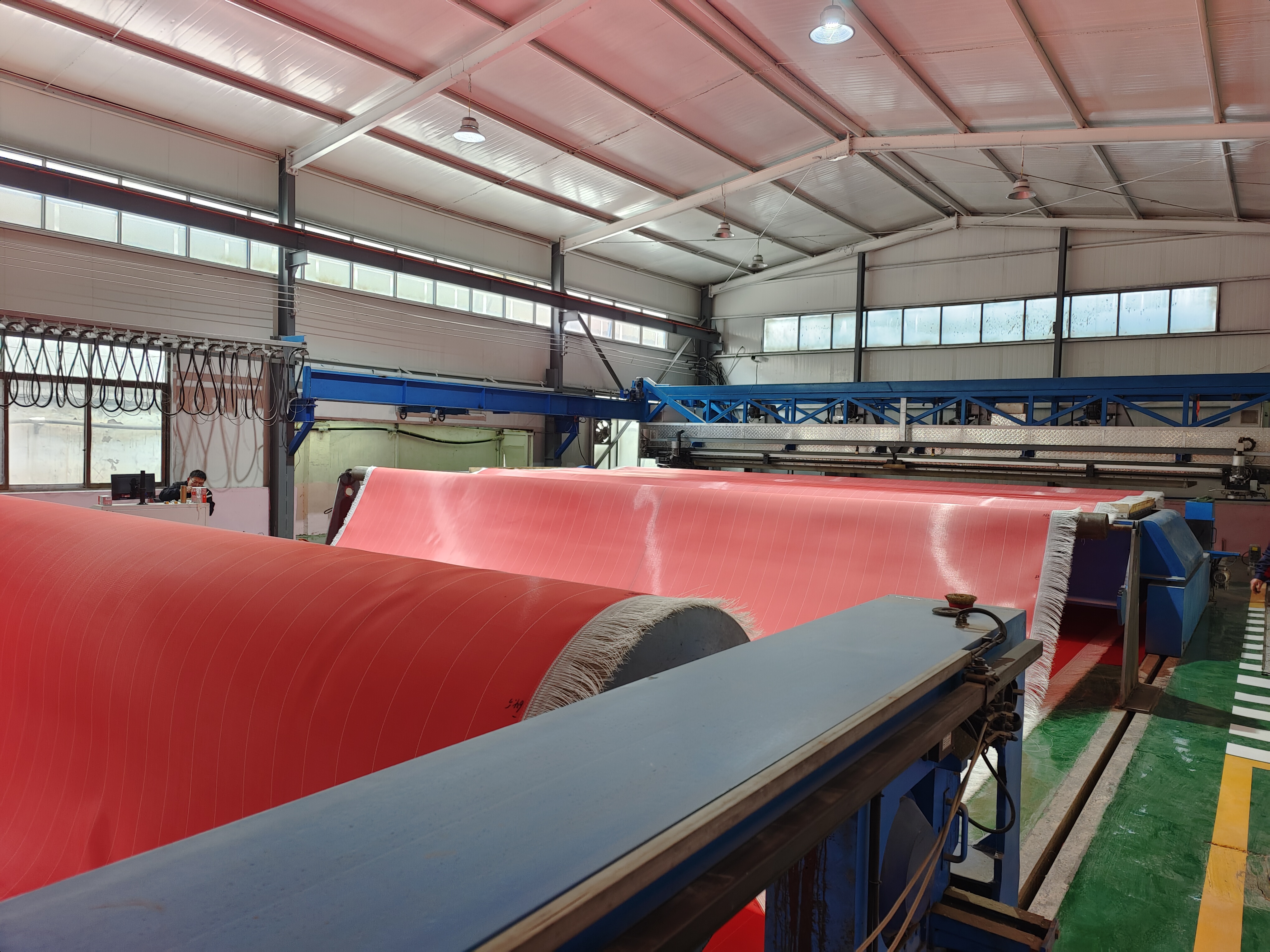
Production Live Status: forming belt manufacturing and finishing. Image: Yiheng Mesh.
Why 400 m/min Rewrites the Belt Specification
Above roughly 400 m/min, the failure mode that dominates belt selection is no longer wear - it is web control at the release point. Documented field troubleshooting describes the symptom precisely: just before the pre-pressing roller, the web edges or centre lift irregularly, fold, or fly off the belt surface. Three root causes appear repeatedly in that record. The first is static charge accumulating in dry conditions. The second is cooling air volume exceeding suction air, so the web is lifted rather than held down. The third is a pre-pressing roller surface temperature that is too low to pre-set the web before it leaves the forming zone.
Only one of those three causes is a belt property, and that is exactly why it matters. Static charge is generated by friction between a fast-moving web and the belt surface, and in a dry forming area the resulting voltage can exceed 10 kV. An anti-static construction reduces surface resistivity from above 10^12 Ω into the 10^6-10^8 Ω range by integrating conductive filaments into the weave, so accumulated charge can travel through the belt to metal rollers and discharge through the machine grounding path instead of pinning the web to the surface through Coulomb force. The engineering consequence for buyers is straightforward: an anti-static belt performs only if a grounding path exists. Verifying that the grounding rod reaches approximately one metre in depth belongs in the acceptance checklist, not in the maintenance schedule.
The second instability mechanism is purely mechanical. At line speeds above 600 m/min, a seam that is 0.2 mm thicker than the belt body generates impulsive forces of thousands of newtons each time it passes the pre-pressing rollers. That periodic impact damages precision bearings and briefly disturbs the pressure profile, which then shows up as transverse marks across the finished fabric. This is the reason joint construction is listed here as a shortlist requirement rather than as a purchasing afterthought.
Four Requirements That Define This Shortlist
A general nonwoven mesh belt catalogue can list dozens of models with overlapping specifications. For high-speed spunmelt forming, four requirements filter that list down to a manageable shortlist.
| Requirement | What to confirm on the datasheet | Why it decides acceptance above 400 m/min |
|---|---|---|
| Anti-static conductive path | Conductive or anti-static filament in warp or weft, plus a stated surface resistivity range such as 10^5-10^6 Ω | Charge generated by high-speed friction causes the web to lift, fold or flip at the release point; a conductive path dissipates it to the machine ground |
| Above-3 Below-5 weave structure | The weave structure stated explicitly for the model, not implied by category | Keeps the shortlisted models comparable on thickness, permeability and conductivity instead of on structural differences |
| Air permeability and tolerance | CFM value with tolerance at a stated pressure differential, for example 680±30 CFM at 127 Pa/20 cm² | Permeability sets the resistance the suction system works against; local variation creates cloudy spots and transverse CV loss |
| Joint type and thickness match | Joint type plus body thickness; on the high-speed series, High-Low Loop seams achieving 1:1 thickness matching | A 0.2 mm seam step above 600 m/min produces impulse loads and transverse marks; flatness at the seam is a running requirement |
Air permeability is the parameter buyers compare first, and the one most often compared incorrectly. A CFM figure describes how much air passes through the mesh under a defined pressure differential, which in turn sets the resistance the suction system works against. Where local permeability runs higher than average, more fibre clusters are drawn to that area; where it runs lower, the web becomes sparser. According to Darcy's law, fluid flow through a porous medium is proportional to the pressure gradient, so consistent permeability produces a consistent, laminar fibre deposit. That is the physical origin of cloudy spots and transverse uniformity loss in the finished fabric, and it is why heat-setting control that holds permeability fluctuation inside a strict ±5% range is a manufacturing claim worth verifying rather than a marketing line.
The Shortlist: Four Anti-Static Models for 400+ m/min Forming
Every model below uses the same Above-3 Below-5 weave structure, which is what makes a like-for-like shortlist possible. They differ in filament form, mass, thickness, conductivity band and air permeability - the four variables a buyer can actually trade off against line conditions.
Entry 1 - HY408S: the default starting point
| Model | HY408S |
| Type | Spunmelt Mesh Belt |
| Material | Anti-static round PET |
| Weave structure | Above-3 Below-5 |
| Warp | 0.50 mm red anti-hydrolysis filaments |
| Weft | Red anti-hydrolysis round 0.70 mm, black round 0.35 mm, blue anti-hydrolysis round 0.35 mm (three-filament hybrid weave) |
| Air permeability | 680±30 CFM (127 Pa/20 cm²) |
| Layers | 1.5 |
| Thickness | 1.85 mm |
| Weight | 1,100 g/m² |
| Conductivity | 10^5-10^6 Ω |
| Joint type | Millet-ring / Double-pins |
| Edge treatment | 2 cm glue brushing on welding edges at both sides |
HY408S is the natural starting point for a high-speed spunmelt shortlist because three properties appear in one construction: a three-filament hybrid weave, a conductivity band of 10^5-10^6 Ω, and an air permeability of 680±30 CFM carried on a 1.85 mm, 1,100 g/m² body. The anti-hydrolysis filaments in both warp and weft address the temperature and humidity exposure of a continuous 24/7 forming line, while the black filament provides the conductive path that dissipates frictional charge. Its documented running behaviour is described as durable with excellent running performance, and both joint options available for the model - millet-ring or double-pins - are widely used on high-speed forming sections.
The practical argument for starting here is comparability. Because HY408S shares the Above-3 Below-5 structure used across this shortlist, a buyer can move to another entry and compare on thickness, permeability and conductivity rather than reopening the question of what surface the web is being formed on.
Entry 2 - K4106A: flat-yarn contact surface
| Model | K4106A |
| Type | Anti-static Mesh Belt |
| Material | Anti-static PET flat |
| Weave structure | Above-3 Below-5 |
| Warp | 0.50 mm red, 0.52 mm conductive |
| Weft | White 0.60 mm PET |
| Air permeability | 600±30 CFM (127 Pa/20 cm²) |
| Layers | 1.5 |
| Thickness | 1.88 mm |
| Weight | 990 g/m² |
| Conductivity | 10^6-10^7 Ω |
| Joint type | Self-ring / Millet-ring |
K4106A differs from HY408S mainly in filament form and mass. It is woven from anti-static flat PET - a 0.50 mm red warp paired with a 0.52 mm conductive warp and a white 0.60 mm PET weft - producing 600±30 CFM on a 1.88 mm body at 990 g/m². Flat-yarn construction is credited in the reference knowledge base with more than twice the contact area of round yarn, which spreads pressure more evenly across the forming surface. Where a web is prone to visible mesh marking, or where the line is already tuned to a slightly lower permeability, K4106A is the more natural starting point than HY408S.
Two numbers separate the two entries in day-to-day use. K4106A is the lighter body in this shortlist at 990 g/m² against 1,100 g/m², and its conductivity band is one order of magnitude higher. On the other hand, its 600±30 CFM window is narrower than the 680±30 CFM of HY408S, so it should only be specified where the suction system can be set accordingly.
Entry 3 - K4106B: highest permeability in the shortlist
K4106B is built on anti-static round PET with a black round 0.50 mm warp, a black anti-static round 0.52 mm warp and a black 0.60 mm weft. Its air permeability reaches 700±30 CFM on a 1.93 mm, 1,100 g/m² body, and its conductivity band is 10^5-10^6 Ω. Within this shortlist it is the highest-permeability anti-static option: the model to shortlist when the forming section is configured for higher airflow and the belt surface being black is acceptable to the downstream inspection step.
Entry 4 - SK604: the choice above 500 m/min
SK604 uses anti-hydrolysis PET round, conductive PET and carbon fibre PET in an Above-3 Below-5 construction: a 0.50 mm red anti-hydrolysis warp with a 0.50 mm black conductive warp, and a weft of 0.70 mm red with black and blue 0.35 mm filaments. Air permeability is 700±30 CFM on a 1.85 mm, 1,030 g/m² body, conductivity is 10^6 Ω, and the joint is double-pins.
This model is the documented recommendation where line speed exceeds 500 m/min. The reason is not a single parameter but the combination of a High-Low Loop seam, which eliminates roller jumping by matching seam and body thickness, and integrated carbon fibre, which prevents thin fabric from flipping under static attraction. SK604 is also described as offering a good balance of adhesion and peelability and as suitable for high-speed lines, with melt glue or AB glue edge treatment.
Shortlist Comparison: Four Models, One Framework
| Model | Structure | Thickness | Weight | Air permeability | Conductivity | Joint |
|---|---|---|---|---|---|---|
| HY408S | Above-3 Below-5 | 1.85 mm | 1,100 g/m² | 680±30 CFM | 10^5-10^6 Ω | Millet-ring / Double-pins |
| K4106A | Above-3 Below-5 | 1.88 mm | 990 g/m² | 600±30 CFM | 10^6-10^7 Ω | Self-ring / Millet-ring |
| K4106B | Above-3 Below-5 | 1.93 mm | 1,100 g/m² | 700±30 CFM | 10^5-10^6 Ω | Self-ring / Millet-ring |
| SK604 | Above-3 Below-5 | 1.85 mm | 1,030 g/m² | 700±30 CFM | 10^6 Ω | Double-pins |
Read across the table and the trade-offs become visible. HY408S and SK604 share a 1.85 mm profile, so both fit the same roller geometry, but SK604 carries a higher 700±30 CFM and a carbon-fibre conductive path aimed specifically at very high line speeds. K4106A is the lightest entry and the only flat-yarn construction. K4106B reaches the same 700±30 CFM as SK604 with a heavier 1.93 mm body and a higher-resistivity band.
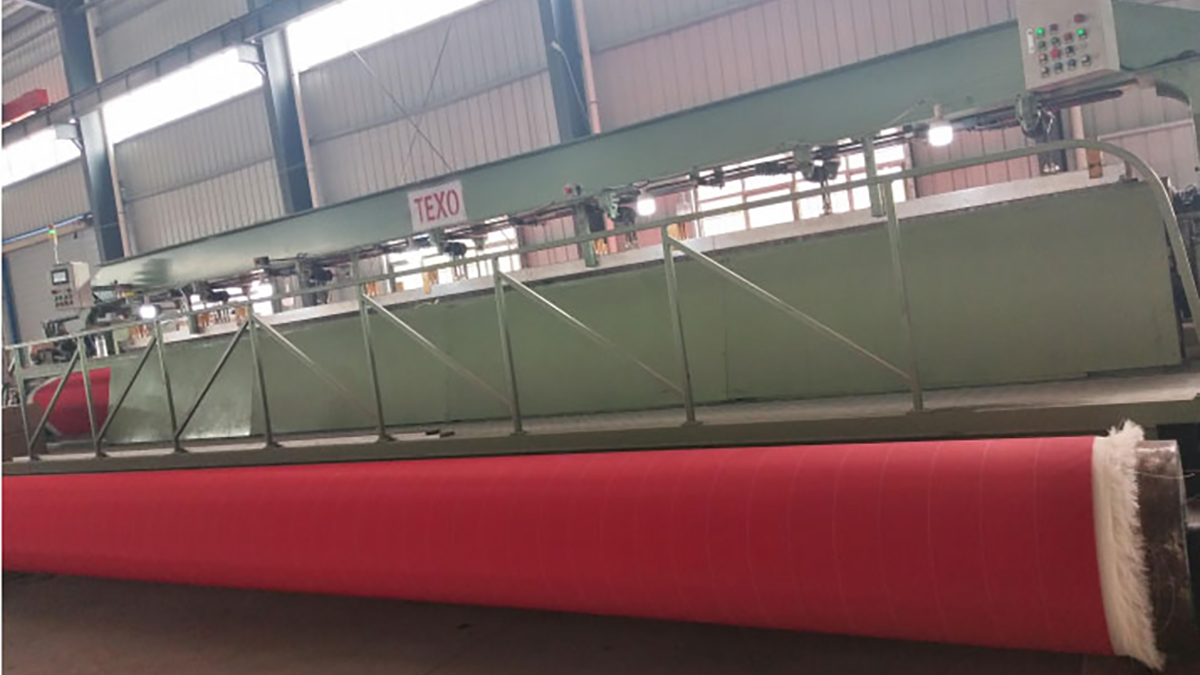
Production Live Status: weaving and finishing stages where permeability tolerance and structure are held. Image: Yiheng Mesh.
Where Each Shortlist Entry Fits
The operating envelope these belts are specified for is consistent across the shortlist: high line speed, a high-electrostatic environment, elevated temperature, precision web formation and precise release, running continuously on a cyclic basis rather than in batches. The matched equipment set is the standard spunmelt train - spinneret, quench air system, filament drawing system, lay-down conveyor, calender, through-air dryer, compactor and winder - which means belt selection has to account for conditions at several points, not only at the lay-down conveyor.
- Standard high-speed spunbond forming, mixed fibre range: HY408S, on the strength of its 680±30 CFM window and hybrid anti-hydrolysis weave.
- Lines sensitive to surface marking or requiring a flat contact surface: K4106A, where the flat-yarn warp and 990 g/m² body suit the pressure distribution requirement.
- Forming sections configured for higher airflow: K4106B, at 700±30 CFM.
- Lines running above 500 m/min with thin fabric and high static risk: SK604, with its High-Low Loop seam and carbon-fibre conductive path.
The application record for this belt family also covers Reicofil high-speed spunbond lines and spunlace non-woven lines, which is consistent with the anti-static and hydrolysis-resistant requirements above. For different duties, other structures in the same range are specified - for example a 2.5-layer Above-6 Below-6 construction for thin nonwoven fabric production, or an Above-4 Below-8 construction for two-component and spunlace equipment. Those models sit outside this shortlist because their structural basis differs, not because they are interchangeable with the four entries above.
Market Context Behind the Speed Requirement
The pressure to specify belts for 400 m/min and above comes from the market rather than from belt suppliers. Spunlaid technology, which includes spunbond and meltblown, held a 48.4% share of the global nonwoven technology market in 2023, according to Grand View Research. On the demand side, Smithers projects the global nonwoven fabric market to reach USD 90.8 billion by 2030, a CAGR of 6.2% from 2025. Dataintelo reports the nonwoven production line market itself at USD 5.3 billion in 2024, projected to reach USD 9.8 billion by 2033. Together these figures describe a component market in which capacity is being added at the machine level, and where consumable components are judged on their ability to keep that capacity running without unplanned stops.
Technical headroom has also moved. High-performance nonwoven forming belts are documented as operating at line speeds up to 1,000 m/min and withstanding temperatures up to 180 °C. The gap between what a line can run and what a belt can survive is where the four shortlist requirements above do their work: static dissipation, structural consistency, permeability tolerance and seam flatness.
Endless Construction Versus Conventional Seamed Forming Mesh
Most of the commercial argument for the endless belt family is comparative rather than absolute, and it is worth stating in numbers. Against conventional seamed forming mesh, endless construction delivers 78-144% higher tensile strength at the weakest point: the seam of a conventional mesh carries 900 N/cm, while the endless surface reaches 1,600-2,200 N/cm. Permeability uniformity is higher, service life is longer, and maintenance requirements are 40-50% lower. Energy efficiency improves by 15-20%, and total cost of ownership is 25-35% lower - against a 15% higher initial investment. Air permeability can be customised from 186 to 1,200 CFM. The documented fit is Reicofil high-speed spunbond lines and spunlace non-woven lines.
Limitations and Boundaries Buyers Should Accept
A shortlist that only lists advantages is not a procurement tool. Four boundaries apply to everything above.
- Initial cost is higher. The endless construction carries roughly a 15% higher initial investment than conventional seamed forming mesh; the case rests on maintenance, energy and service-life effects over the belt's operating period, not on purchase price.
- The belt cannot correct an unbalanced forming section. Floating and flipping above 400 m/min are also caused by cooling air exceeding suction and by low pre-pressing roller temperature. If grounding, air balance and roller temperature are not in specification, no belt model will resolve the defect on its own.
- Permeability windows are narrow and model-specific. A 600±30 CFM model and a 680±30 CFM model are not interchangeable on a line that has been tuned to one of them. Specification should follow the line's suction setting, not the other way round.
- Expected service life is measured in months, not years. Under standard operating conditions these belts typically run three to six months; regular cleaning and tracking checks extend that, and repeated fibre hanging indicates the process parameters or the permeability choice need review rather than the belt alone.
Thickness differences inside the shortlist matter as well: 1.85 mm, 1.88 mm and 1.93 mm bodies sit close together, but roller clearance, tracking tension and joint geometry should be confirmed against the actual model before a switch, not assumed from the previous belt.
Verification Checklist Before Ordering
| Check | Acceptance reference |
|---|---|
| Line speed band | Confirm whether the section runs in the 400-500 m/min range or above 500 m/min, which shifts the joint requirement |
| Grounding path | Grounding rod verified to approximately 1 m depth before a static-related complaint is attributed to the belt |
| Air permeability target | Model CFM and tolerance stated at a defined pressure differential, for example 127 Pa/20 cm² |
| Weave structure | Above-3 Below-5 stated for the specific model |
| Joint construction | Joint type listed, with seam-to-body thickness consistency confirmed for high-speed duty |
| Dimensions | Length under 50 m: ±5 cm; width under 5 m: ±1 cm |
| Edge treatment | 2 cm glue brushing on both welding edges, or melt glue / AB glue where specified |
| Documentation | Food Contact Certificate and German Packaging Law (LUCID) registration for EU-bound shipments |
Future Outlook
Two directions are already visible. The first is speed: with forming belts documented up to 1,000 m/min and 180 °C, the practical constraint on further line-speed increases shifts further towards seam geometry and static control, both of which are addressed structurally rather than by parameter adjustment. The second is changeover cost. Because belt replacement time is a direct production loss on 24/7 lines, practical field methods matter as much as belt properties - for example the reference marking method, in which a baseline is painted on the tension rod while the original belt is stable, so that a replacement belt can be aligned to that baseline and returned to production after a short empty run. That approach only works if the replacement has identical specifications; a length deviation invalidates the old baseline.
For buyers, the more immediate shift is sampling. Custom prototypes can now be produced in as little as three days with a minimum order quantity of 1 m², which means a model can be validated on the actual line before a full belt is committed. Given how narrow the permeability windows are inside a shortlist like this one, sample validation is likely to replace catalogue specification as the default decision step.
FAQ: Specifying Anti-Static Forming Belts for High-Speed Lines
What causes a nonwoven web to float or flip on a forming belt above 400 m/min?
Three causes are documented. Static charge builds up in dry conditions and attracts the web to the belt surface. Cooling air volume can exceed suction air, creating lift instead of hold-down. And the pre-pressing roller surface temperature can be too low to pre-set the web. Corrective steps are to verify the grounding rod reaches approximately 1 m depth, increase auxiliary suction while slightly decreasing cooling air, keep the hot roller surface at 100-120 °C, and install wind-breaking shields around the forming area.
Which belt should be specified for a line running above 500 m/min?
High-speed operation places the emphasis on anti-static performance and seam flatness. The documented recommendation for lines above 500 m/min is the SK604 high-speed series with a High-Low Loop seam, chosen on three criteria: thickness consistency between seam and belt body, carbon fibre conductivity, and physical dimensional stability under high temperature. The High-Low Loop seam eliminates roller jumping, and the integrated carbon fibre helps prevent thin fabric from flipping under static attraction.
Do these forming belts run on Reicofil, Chaolong or Hongda equipment?
Yes. Yiheng Mesh has supplied Reicofil, Chaolong, Hongda and other major manufacturers, with practical tuning data tailored to the equipment. Coverage extends across mainstream spunbond and meltblown equipment, with the belt specification matched to the tension requirements of the individual line rather than selected by brand alone.
What service life should be expected from an anti-static nonwoven forming belt?
Under standard operating conditions, three to six months is the typical range, which is longer than standard polyester mesh because of the wear-resistant materials used. Service life is extended by regular cleaning and tracking checks. If fibre hanging occurs, process parameters should be reviewed - usually lower suction and a permeability choice matched to the fibre denier.
What compliance documentation is available for EU and German shipments?
Two credentials are relevant. The Food Contact Certificate covers products used in food packaging and precision hygiene material production, and registration under the German Packaging Law (LUCID) addresses packaging compliance. Together with conformity to EU environmental regulations, these cover the documentation commonly requested for European delivery.
For full specification sheets and the complete model range, the Yiheng Mesh product brochure is available as a PDF download: Yiheng Mesh Product Brochure (PDF).