
Technical Procurement FAQ: Polyester Mesh Belt Specs, Testing, and Lead Time
A polyester mesh belt is an engineered woven textile component that performs conveying, filtration, dewatering, or drying duty inside continuous industrial processes. Because the belt sits directly in the process path, its specifications, inspection record, and delivery schedule decide whether a line keeps running or stops. This reference answers the technical and procurement questions that typically surface after a first enquiry and before a purchase order.
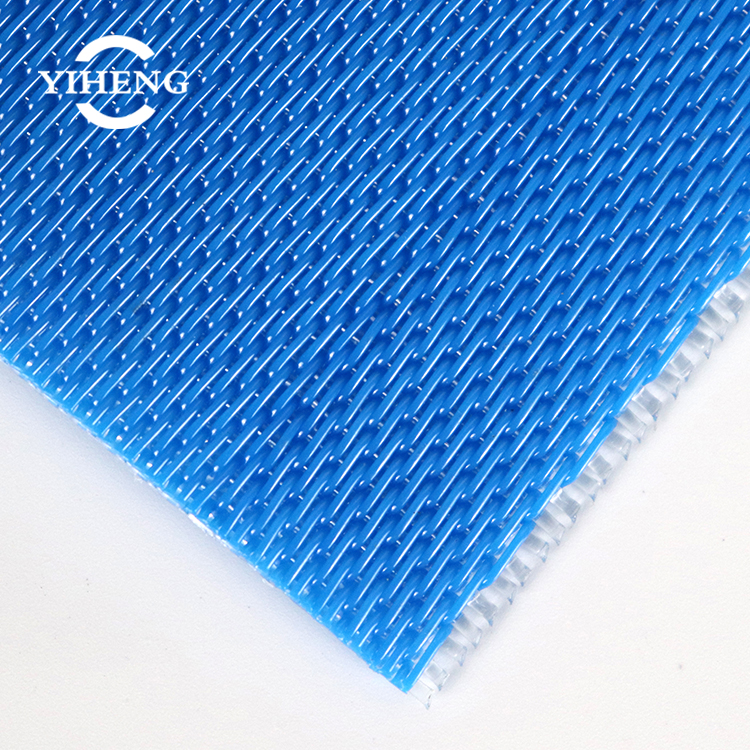
Herringbone / diagonal weave construction used in filter press belts, where cake release and drainage rate have to be balanced.
Why the Specification Sheet Decides More Than the Price List
In filtration and drying duties, a polyester mesh belt is not a commodity purchase. Two belts quoted at the same price per square metre can behave completely differently once installed, because the parameters that govern performance — mesh count, filament diameter, thickness, air permeability, joint type, and strength at break — are not interchangeable.
The practical consequence is that the highest-risk moment in procurement is not the negotiation. It is the gap between what the buyer asked for and what the specification sheet actually defines. A belt that is 0.2 mm thinner than the machine expects may not track correctly. A belt with the wrong air permeability may drain too slowly at the vacuum box or dry unevenly in the dryer section. A belt with a joint that does not match the machine frame may be unusable regardless of fabric quality.
What a Polyester Mesh Belt Specification Sheet Should Define
A complete specification for a polyester mesh belt states the same core fields regardless of whether the belt is used for dewatering, drying, conveying, or print media transport. These fields include mesh count or loop distance, warp and weft (or ring and threading) diameter, pitch, weight per square metre, air permeability, thickness, weave or structure type, and joint type.
The tables below reproduce two representative specification families from the Yiheng Mesh product range — the spiral and filler-wire series used for dewatering and drying, and the plain weave series used for finer filtration and conveying duties.
Dewatering and Filter Press Series
| Model | Structure | Key Dimensions | Air Permeability | Thickness | Strength at Break |
|---|---|---|---|---|---|
| Small Loop-Filler Wire | Spiral loop with flat wire filler | Threading 0.80 mm; filler 0.65 × 1.65 mm flat wire | 7,300 ±500 m³/㎡·h (450 ±30 CFM at 127 Pa) | 1.90 mm | ≥2000 N/cm |
| Medium Loop-Filler Wire | Spiral loop with 0.68 × 3 or 0.68 × 4 mm filler | Ring wire 0.68 mm; threading 0.90 mm | 10,700–12,000 ±500 m³/㎡·h (660–740 ±30 CFM at 127 Pa) | 2.32 mm | ≥2000 N/cm |
| Large Loop-Filler Wire | Spiral loop with 0.90 × 3 / 4 / 5 mm filler | Ring wire 0.90 mm; threading 1.00 mm | 9,000–13,700 ±500 m³/㎡·h (550–840 ±30 CFM at 127 Pa) | 2.95 mm | ≥2300 N/cm |
| 16903 | Herringbone / diagonal weave | Warp 0.70 mm; weft 0.90 mm; warp density 16 wire/cm; weft density 5.33 wire/cm | 7,894 ±500 m³/㎡·h | — | ≥2200 N/cm |
Spiral Drying and Conveying Series
| Model | Warp / Weft | Loop Distance | Air Permeability | Thickness |
|---|---|---|---|---|
| Small Loop | 0.52 mm / 0.70 mm | 5.20 mm | 17,500 m³/㎡·h | 1.90 mm |
| Medium Loop | 0.68 mm / 0.90 mm | 6.50 mm | 18,300 m³/㎡·h | 2.32 mm |
| Large Loop | Ring wire 0.90 mm / threading 1.00 mm | 7.00 mm (dryer duty) | 9,000–13,700 m³/㎡·h (filter press) / 19,000 m³/㎡·h (dryer) | 2.95 mm |
Plain Weave and Square Mesh Series
| Model | Structure | Key Parameters | Air Permeability |
|---|---|---|---|
| 16402 | 2-shed plain weave | Warp 0.4 mm; weft 0.4 mm; 41 mesh; pitch 0.2 mm; weight 550 g/㎡ | 6,900 m³/㎡·h |
| 05802 | 2-shed plain weave | Warp / weft 0.8 mm; 12–14 mesh; pitch 1.0–1.2 mm; weight 700–750 g/㎡ | 13,384–20,775 m³/㎡·h |
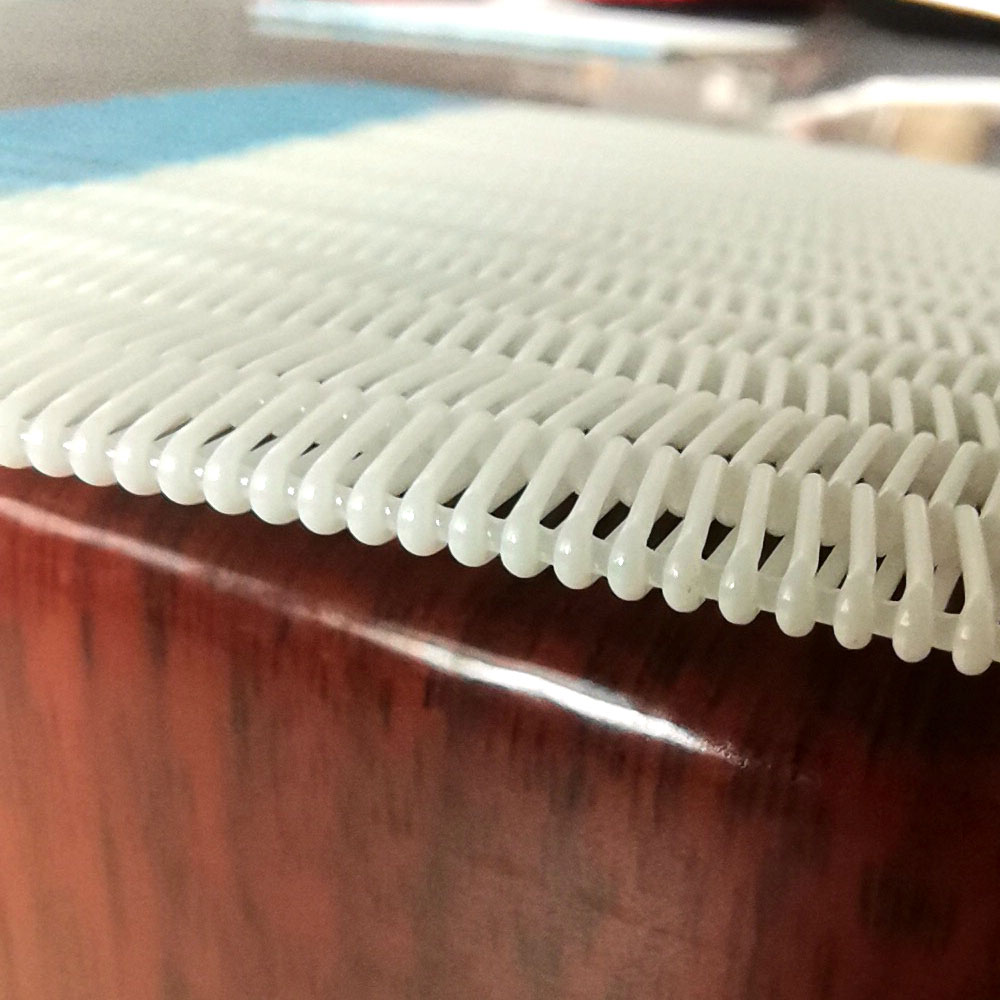
Spiral mesh construction: loop geometry and filler wire choice set the balance between drainage rate and solids retention.
How Air Permeability Is Measured and Reported
Air permeability is the single parameter most often misread during procurement. It is expressed in cubic metres per square metre per hour (m³/㎡·h) in metric markets, and in cubic feet per minute (CFM) in markets that follow US practice. The two figures are only comparable when the reference pressure is stated.
This is why a well-constructed data sheet reports both. The Medium Loop-Filler Wire belt, for example, is rated at 10,700–12,000 ±500 m³/㎡·h and equivalently at 660–740 ±30 CFM at 127 Pa. The Small Loop-Filler Wire is rated at 7,300 ±500 m³/㎡·h and 450 ±30 CFM at 127 Pa.
A buyer comparing two quotations should therefore ask one direct question: at what reference pressure was the CFM figure measured? A number quoted without a pressure basis cannot be validated against the machine's vacuum or drying capacity.
Within a single spiral series, air permeability and filtration fineness trade against each other. The Medium Loop-Filler Wire filler options illustrate this directly: the 0.68 × 3 configuration delivers maximum drainage at up to 12,000 m³/㎡·h, while the 0.68 × 4 configuration closes the structure for finer filtration at 10,700 m³/㎡·h and a drier filter cake. Selecting one means accepting the limitation of the other.
Strength at Break, Joints, and Machine Compatibility
Strength at break describes how much longitudinal tension a belt can carry before it fails. Across the Yiheng Mesh filter press series, the figures sit between ≥2000 N/cm and ≥2300 N/cm, with the Large Loop-Filler Wire belt at the top of the range. That range matters because belt filter presses, vacuum rubber belt filters, and horizontal vacuum belt filters all apply continuous mechanical tension across the belt width.
Strength at break is not the same as joint strength, however, and the joint is where most field failures begin. A belt may be rated at ≥2300 N/cm in the body while the seam performs differently. Specifiers should confirm the joint style — endless, self-ring, or double-pin — and verify that the seam thickness matches the body thickness. In forming duties, a mismatched seam produces mesh marks on the finished product and can cause roller jumping at high speed.
Machine compatibility has a third dimension: physical clearance. The Small Loop-Filler Wire belt is 1.90 mm thick, the Medium Loop-Filler Wire belt is 2.32 mm, and the Large Loop-Filler Wire belt is 2.95 mm. Machines with tight roller spacing cannot accept the thicker constructions. This is an engineering constraint, not a quality difference.
Testing and Inspection: What Can Be Verified Before Shipment
Verification is the point at which a specification becomes a procurement decision. Yiheng Mesh operates a 100% pre-shipment inspection policy, and on-site third-party inspection by organisations such as BV or SGS can be arranged.
For buyers building a verification plan, the practical checks are:
- Dimensional verification — belt width, length, thickness, and mesh or loop count checked against the agreed specification.
- Air permeability verification — airflow measured against the quoted range, with the reference pressure recorded.
- Joint and seam inspection — seam thickness relative to body thickness, joint type, and edge finish.
- Strength verification — tensile data supporting the quoted strength at break figure.
- Material and compliance documentation — including the Food Contact Certificate for food-contact applications and German Packaging Law (LUCID) registration for EU-bound shipments.
Premature failure in woven industrial belt manufacturing is often traceable to unstable heat setting, which produces belts that shrink, ruffle, or track off-centre during long operation. Heat setting stability and air permeability consistency within ±5% are therefore worth asking about explicitly, because they determine whether the delivered belt matches the sample that was approved.
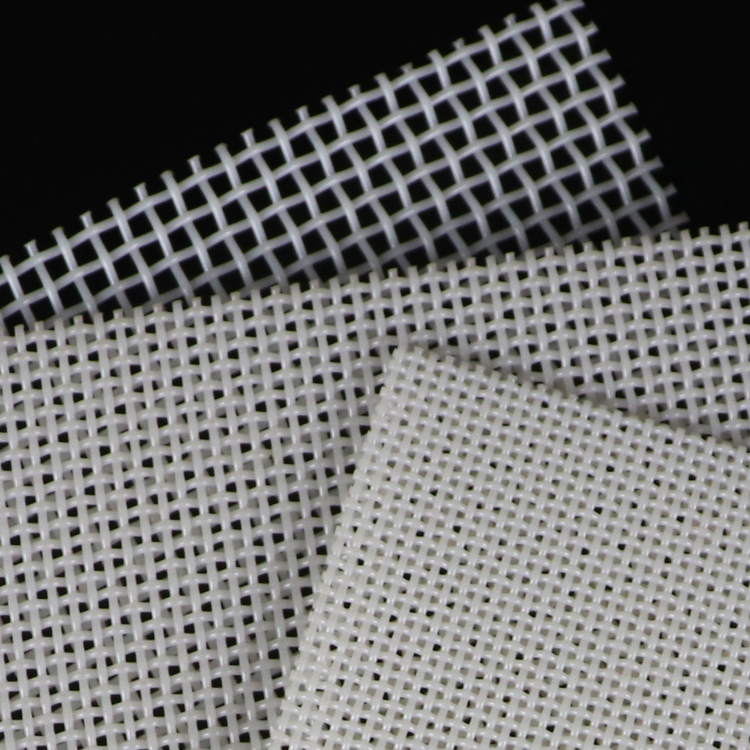
Plain weave and square mesh constructions are used where a smooth, non-marking surface and fine filtration are both required.
Lead Time, MOQ, and Delivery Terms in Practice
Lead time and minimum order quantity are commercial terms, but they are shaped by manufacturing reality. For custom polyester mesh belts, standard lead time runs 15–30 days. Rapid sampling can deliver custom prototypes in as little as 3 days, which is relevant when a line is down or when a new process is being validated before a full order commitment.
Minimum order quantity for this category starts at 2 m². That figure is low relative to many industrial textile categories, and it matters for two procurement scenarios: replacement belts for a single machine, and trial orders placed before a multi-line rollout.
Customisation available across the range includes mesh count and opening size, air permeability (CFM), belt width and length, material selection including PET, PA and anti-static variants, thickness, colour, and edge treatment. The company holds export experience across the EU, North America, Southeast Asia, the Middle East, Russia, and South America, with exports accounting for 62% of output.
Application Fit: Where These Specifications Are Tested in the Field
Specification decisions become easier to judge when they are mapped to real operating conditions. The following documented application cases show how different polyester mesh belt configurations perform across process types.
| Application | Location | Scope | Reported Results |
|---|---|---|---|
| Fruit and vegetable drying and conveying | Switzerland | 8 drying and conveying lines, 2 years | 20% higher productivity; 35% lower maintenance cost; zero food safety incidents |
| Rubber curing and sheet cooling | Malaysia | 8 curing and cooling lines, 2 years | 15% higher productivity; 30% lower maintenance cost; zero major failures |
| Vinyl and banner UV printing | Austria | 8 EFI large-format UV printers, 3 years | 20% higher productivity; 30% less scrap; zero major failures |
| Coastal enclosure farming | Norway | 12 farming cages, 3 years | 15% higher survival rate; 40% lower maintenance cost; zero net failure |
| Municipal sludge dewatering | Malaysia | 12 belt filter presses, 6 months | 8% lower cake moisture; 40% lower maintenance cost; zero major failures |
| Premium facial and kitchen towel forming | Germany | 8 production lines, 1 year | 25% energy saved; 35% lower maintenance cost; zero major failures |
Two operational patterns emerge from these cases. First, in dewatering duty the measurable gains are lower cake moisture and reduced maintenance — which reflects correct choice of filler configuration rather than simply a higher-specification belt. Second, in drying and conveying duty the gains are throughput and energy related, which reflects air permeability and heat transfer behaviour.
Market Context Behind Rising Specification Scrutiny
Polyester is the leading material segment in the global conveyor belt market, holding a 28.4% share in 2025, according to Straits Research. The same source projects the global conveyor belt market growing from USD 6.24 billion in 2026 to USD 8.53 billion by 2034.
The dewatering side of the market shows a similar trajectory: Grand View Research expects the belt filter press technology segment of the sludge dewatering equipment market to grow at a CAGR of 8.8% from 2025 to 2033. Belt filter press demand translates directly into demand for polyester filter press belts, which is one reason specification questions have become more technical rather than less.
Trade classification adds a practical dimension. Polyester mesh belts for technical uses typically clear under HS Code 5911.90, a category covering textile products and articles for technical uses. Buyers preparing customs documentation should confirm the code with their broker, since classification errors are a frequent cause of shipment delay.
Limits and Trade-offs Buyers Should Accept Upfront
No specification set is free of constraints, and several apply across this product category.
- Higher air permeability is not universally better. A belt rated at 13,700 m³/㎡·h drains faster but retains less solids than a belt rated at 9,000 m³/㎡·h. Buyers targeting drier cake must accept lower throughput, and buyers targeting maximum throughput must accept higher cake moisture.
- Thicker constructions do not fit every machine. The 2.95 mm Large Loop-Filler Wire belt cannot be installed on machines with roller spacing designed around 1.90 mm belts.
- Polyester has chemical boundaries. The material is acid and alkali resistant, but chemical conditions still need to be declared during specification, particularly in mine tailings, pulp pressing, and chemical-heavy sewage environments.
- Sample testing cannot be substituted by catalogue data. Performance depends on the actual slurry, solids loading, vacuum pressure, and machine geometry. Free sample testing exists precisely because a data sheet alone cannot predict installed behaviour.
Future Outlook
Procurement conversations in this category are shifting from material questions to measurement questions. Buyers increasingly ask for airflow figures with a stated reference pressure, tensile data in N/cm, documented inspection records, and traceable application references rather than general claims.
Two forces are driving that shift. The first is the growth of belt filter press capacity in sludge dewatering, where small differences in cake moisture translate into meaningful haulage and disposal cost differences. The second is the expansion of precision filtration and drying applications — nonwoven forming, food processing, UV print media transport — where a belt is a process variable rather than a consumable.
Manufacturers that maintain documented testing, third-party inspection availability, and application-level performance records are better positioned as this scrutiny increases. Those are capabilities that can be checked before an order is placed, which is the practical standard buyers should apply.
Frequently Asked Questions
What specifications should a polyester mesh belt quotation always include?
A usable quotation should state mesh count or loop distance, warp and weft (or ring and threading) diameter, pitch, weight per square metre, air permeability with a stated reference pressure, thickness, weave or structural type, joint type, and strength at break. If any of these fields are absent, the buyer cannot verify the belt against the machine requirements.
Why do air permeability figures appear in both m³/㎡·h and CFM?
Metric markets quote air permeability in cubic metres per square metre per hour, while markets following US practice quote cubic feet per minute. The two are not directly comparable unless the reference pressure is stated. A properly documented specification gives both figures and names the pressure basis — for example, 10,700–12,000 ±500 m³/㎡·h, equivalent to 660–740 ±30 CFM at 127 Pa.
What does a strength at break of ≥2000 N/cm mean for machine selection?
Strength at break defines the longitudinal tension the belt can carry. In the filter press series, ratings range from ≥2000 N/cm on small and medium loop constructions to ≥2300 N/cm on the large loop construction, and 16903 is rated at ≥2200 N/cm. Higher-tension equipment such as belt filter presses and horizontal vacuum belt filters require the higher end of that range. Joint strength should be confirmed separately, since the seam is a distinct component.
How do I check whether a belt will physically fit my machine?
Compare belt thickness against the available roller spacing. The Small Loop-Filler Wire belt is 1.90 mm thick, the Medium Loop-Filler Wire belt is 2.32 mm, and the Large Loop-Filler Wire belt is 2.95 mm. Also confirm the joint type — endless, self-ring, or double-pin — matches the machine frame, and verify seam thickness against body thickness to avoid marking or tracking problems.
What inspection is performed before shipment?
Yiheng Mesh applies a 100% pre-shipment inspection policy. Checks cover dimensional accuracy against the agreed specification, air permeability against the quoted range, joint and seam condition, and strength documentation. Air permeability consistency is controlled within ±5%. On-site third-party inspection by organisations such as BV or SGS can also be arranged.
Can I commission a third-party inspection before the belt ships?
Yes. On-site third-party inspection is available on request, with BV and SGS named as the inspection bodies. Buyers who need third-party verification for internal compliance or financing reasons should confirm the scope of inspection — dimensional, airflow, tensile, or full batch — before the inspection is scheduled.
What is the minimum order quantity and how does sampling work?
Minimum order quantity for this category starts at 2 m². Free sample testing is available, and rapid sampling can produce custom prototypes in as little as 3 days. Sampling is typically used when a new process is being validated or when a replacement belt must be matched to an existing machine before a full order is placed.
How long does a custom polyester mesh belt order take?
Standard lead time for custom polyester mesh belts is 15–30 days. Lead time varies with customisation depth — mesh count, belt width and length, material selection, thickness, colour, and edge treatment all affect scheduling. Sample prototyping is handled separately and can be completed in as little as 3 days.
Does a successful sample test guarantee the production belt will perform the same way?
Not automatically. Sample testing validates the specification against the actual slurry, solids loading, and machine conditions, which is a genuine advantage over catalogue selection. But performance also depends on manufacturing consistency — particularly heat setting stability and air permeability control. Buyers should confirm that airflow fluctuation is controlled within ±5% so the delivered belt matches the approved sample.
When is a polyester mesh belt the wrong choice for an application?
Polyester is not suitable for every environment. Where chemical exposure exceeds the acid and alkali resistance of high-grade PET, or where operating temperature exceeds the material's heat resistance, alternatives such as PTFE mesh belts may be required. Similarly, if the machine's roller spacing cannot accommodate the required belt thickness, the specification must be reconsidered. These boundaries should be declared during the enquiry stage rather than discovered after installation.
Is higher air permeability always better for dewatering?
No. Higher air permeability improves drainage rate and throughput but reduces solids retention and typically produces a wetter filter cake. The Medium Loop-Filler Wire range illustrates the trade-off: the 0.68 × 3 filler configuration reaches up to 12,000 m³/㎡·h for maximum drainage, while the 0.68 × 4 configuration runs at 10,700 m³/㎡·h for finer filtration. The correct choice depends on whether the priority is throughput or cake dryness.
What documentation should accompany an export shipment?
Documentation depends on destination market and application. For food-contact applications, the Food Contact Certificate is relevant. For shipments into Germany and the wider EU, German Packaging Law (LUCID) registration supports compliance. HS Code 5911.90 covers textile products and articles for technical uses and is the typical classification for polyester mesh belts, though buyers should confirm with their customs broker.
A full product and capability brochure covering the complete polyester mesh belt range, specification families, and application references is available for download: Yiheng Mesh product brochure (PDF).
¿Tiene preguntas o necesita más detalles?
Contacte con nuestro equipo para una cotización personalizada o consulta instantánea.
Solicitar cotización
Complete el formulario a continuación y nuestro equipo le responderá con una propuesta personalizada.
Chat directo de WhatsApp
¿Prefiere chatear en tiempo real? Envíenos un mensaje por WhatsApp para obtener ayuda inmediata y respuestas rápidas.
- Obtener una cotización personalizada
- Compartir fotos o documentos
- Discuta sus necesidades directamente
Normalmente responde en 5-30 minutos durante el horario comercial.