
Tattoo Cartridge Needle Procurement FAQ: SP5, HM3 and HM6
Accepting a lot of tattoo cartridge needles is a documentation and inspection exercise before it is an artistic one. For buyers evaluating the SP5, HM3 and HM6 models from CREDITECH MED, the useful starting point is that all three share the same published parameter set: the same needle diameter range, taper range, tolerance band, membrane design, sterilization method and packaging system. The procurement decision therefore turns on verification, sample behaviour and release documentation rather than on spec-sheet novelty.
CREDITECH MED is the brand under which Suzhou Creditech Electronic Technology Co., Ltd., a manufacturer based in Suzhou, China and founded in 2009, produces tattoo cartridge needles, PMU cartridges and SMP cartridges for distributors, private-label brands and professional studios. This article is structured as a procurement reference: what the published specification covers, what EO sterilization and sterile breathable film packaging actually require a buyer to check, and which acceptance criteria should be in place before a shipment is released into stock.

Cartridge needles are consumed inside a procedure that is already regulated by hygiene protocol; procurement criteria should reflect that environment, not only the artwork outcome.
Why acceptance criteria matter more than brand labels
Cartridge needles are single-use sterile consumables that sit between a machine and a client's skin. That position explains why procurement teams increasingly evaluate them the way they evaluate other single-use medical-adjacent consumables: material declaration, sterilization method, packaging integrity, batch traceability and dimensional consistency.
The commercial logic supports that shift. Custom Market Insights estimates the global tattoo needle market at USD 368.3 million in 2024 with a projected compound annual growth rate of approximately 3.5%, reaching USD 468.6 million by 2033, and reports that approximately 73% of professional artists preferred cartridge needles over traditional bar needles in 2024. When a format reaches that level of professional adoption, the marginal gain for a buyer no longer comes from switching product type. It comes from tightening the acceptance process around the format already in use.
A second signal sits in adjacent categories. Fortune Business Insights projects the global permanent makeup market to grow from USD 162.93 million in 2025 to USD 330.5 million by 2034 at a CAGR of 8.31%. PMU and scalp micropigmentation work depend on the same cartridge platform as tattooing but tolerate less needle vibration and less ink pooling, which raises the weight of dimensional tolerance and membrane design in the purchase decision.
What the SP5, HM3 and HM6 specification set actually covers
The published specification for these three models is a family-level technical description. It defines materials, dimensional ranges, configurations, sterilization and packaging. It does not, by itself, constitute a batch certificate, and buyers should treat it as the baseline against which supplier documentation is compared.
| Specification field | Published value (SP5 / HM3 / HM6) |
|---|---|
| Needle material | Medical-grade stainless steel needles |
| Housing material | Medical-grade PC housing |
| Tip material | Non-toxic transparent plastic tip |
| Membrane system | Silicone anti-backflow membrane |
| Needle diameter options | 0.15 mm / 0.20 mm / 0.25 mm / 0.30 mm / 0.35 mm |
| Taper length | 1.5 mm – 7 mm, extra long taper available |
| Precision tolerance | ±0.02–0.05 mm |
| Configurations | RL / RS / RM / Magnum / Flat |
| Sterilization | EO gas sterilized |
| Packaging | Sterile breathable film packaging system |
| Machine compatibility | Compatible with rotary tattoo machines |
| Ink delivery | Stable controlled ink delivery system |
| Vibration | Low vibration design |
| Product families covered | Fine Line, Traditional, Shading, Color Packing, PMU Eyebrow, SMP Scalp Micropigmentation, Long Taper Precision, Soft Edge Magnum |
Two consequences follow. First, the specification is broad enough to cover tattoo, PMU and SMP work from a single platform, which simplifies SKU consolidation for a distributor. Second, because the three models are published against an identical parameter set, any real difference between SP5, HM3 and HM6 has to be established at sample stage or through the model-specific technical file, not inferred from the catalogue table.
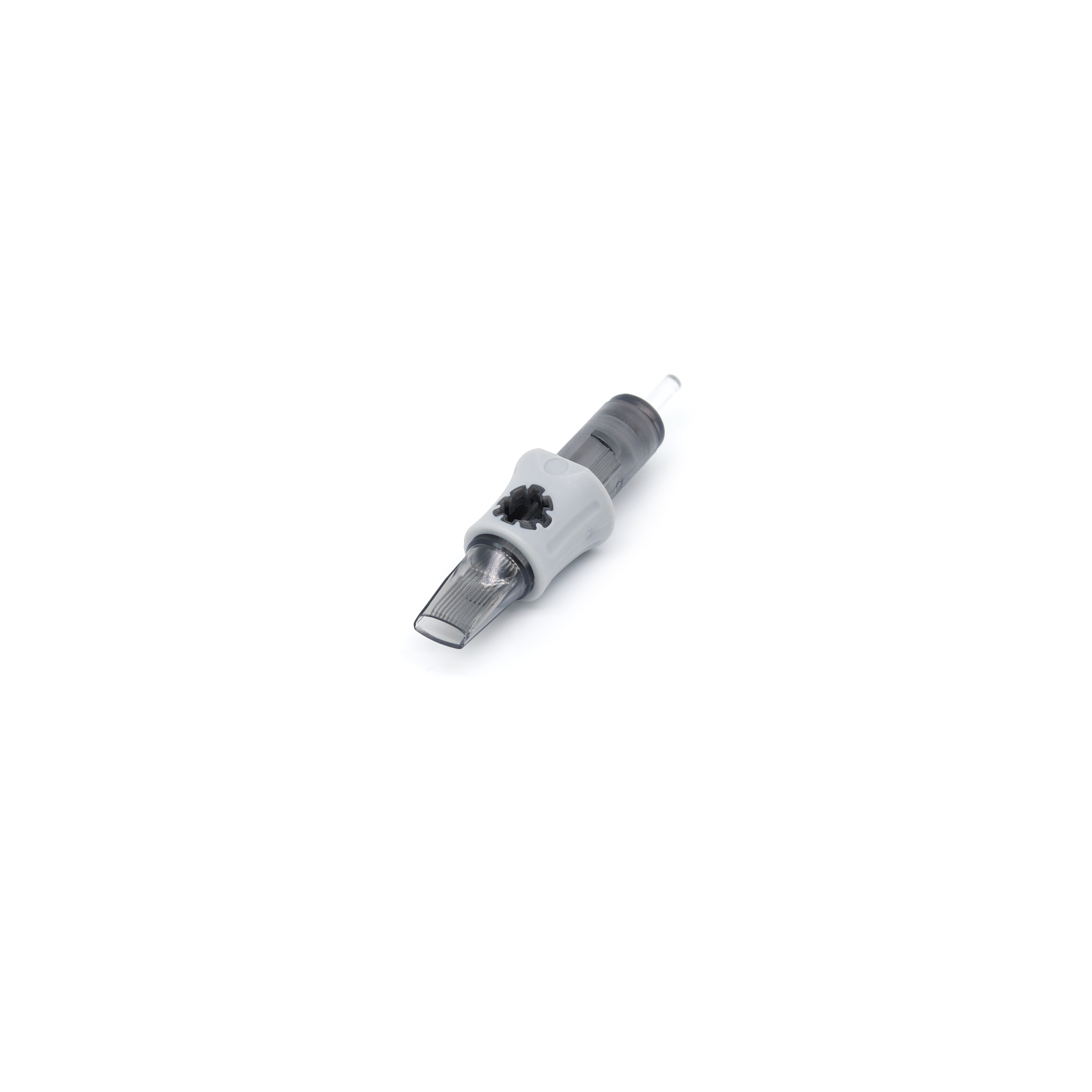
Published dimensions and materials are the starting point for acceptance; the physical sample confirms housing fit, tip concentricity and membrane placement.
Reading needle diameter, taper and tolerance as purchasing variables
Diameter, taper and tolerance are the three fields that most directly translate into procedure fit, and each one carries a different procurement question.
Needle diameter spans 0.15 mm to 0.35 mm across the range. In practice, narrower diameters are associated with detail work and finer line definition, while wider diameters support coverage and pigment packing. A buyer assembling a range for a mixed studio or a PMU clinic should confirm that the size split in the purchase order matches the actual consumption mix, because an unbalanced size mix is one of the simplest ways to accumulate dead stock.
Taper length runs from 1.5 mm to 7 mm, with extra long taper available. Taper affects how quickly the needle tapers to its point, which in turn affects how the needle enters the skin and how ink is released during a stroke. Long taper options are commonly requested where a softer entry and smoother stroke are preferred; short tapers are generally associated with firmer, more direct penetration. The specification does not prescribe which taper suits which procedure, so the selection should be validated on the buyer's own sample set.
Precision tolerance of ±0.02–0.05 mm is the field most often overlooked in purchasing and most often noticed by the end user. Tolerance governs how consistently needles sit within the housing and how consistently the tip assembly aligns. A loose tolerance band shows up as visible vibration, inconsistent dot placement in fine line work, or uneven ink flow across a row of needles. Because the tolerance is expressed as a band rather than a single value, buyers should ask which portion of the band applies to the specific configuration being ordered.
Configuration language matters as well. RL, RS, RM, Magnum and Flat describe needle groupings rather than needle sizes, and they are frequently mixed up in purchase orders. RL is a round liner grouping, RS and RM are round shader variants, Magnum groups needles for wider coverage, and Flat provides a straight-line grouping. A purchase order that specifies only a diameter without a configuration is not a complete specification.
EO sterilization, membrane design and packaging: what the record should show
Ethylene oxide sterilization is the declared sterilization route for these cartridges, and sterile breathable film is the declared packaging system. For a buyer, the important point is that sterilization is a process claim backed by validation, not a label printed on a box. Public product pages describe the method; they do not publish sterilization validation reports, EO residual limits, packaging seal strength data or shelf-life studies. Those documents belong in a supplier qualification file.
The silicone anti-backflow membrane deserves separate attention. Its function is to sit between the needle assembly and the machine side of the cartridge and limit fluid travel back into the housing and grip. That has two procurement implications. The first is that membrane presence and seating should be inspected on the physical sample, since a displaced or missing membrane is a contamination-control issue rather than a cosmetic one. The second is that the buyer should confirm whether any fluid-path resistance is acceptable for the specific ink viscosity and machine setup in use, because a membrane alters flow behaviour compared with a non-membrane cartridge.
Material declarations should be requested in parallel. The published materials are medical-grade stainless steel needles, a medical-grade PC housing, a silicone elastic membrane system and a non-toxic transparent plastic tip, with EO sterilization packaging material. Buyers operating in regulated or retail-facing channels typically also request a RoHS 2.0 declaration and an MSDS alongside the certificate package, and those requests should be routed through the supplier's documentation contact rather than assumed from the product page.
An acceptance checklist for incoming cartridge lots
The checklist below is deliberately qualitative. Numeric pass/fail limits should come from the supplier's technical file and from the buyer's own sample validation record, not from a generic template.
| Stage | What to verify | Why it matters |
|---|---|---|
| Documentation | Quality management system certificate with scope, legal entity and expiry; declaration of conformity for CE claims; FDA test reports for applicable products; RoHS 2.0 declaration; MSDS | Confirms the paper trail matches the invoicing entity and the product actually shipped |
| Outer packaging | Intact sterile breathable film, no tears, no moisture ingress, legible lot or batch code and expiry | Sterility is only as good as package integrity |
| Sterilization indicators | Presence and correct colour change of process indicators on the individual pouch | Indicates the lot passed through the declared sterilization cycle |
| Housing and tip | No flash, no cracks, transparent tip free of deformation, needle protrusion consistent across the box | Housing defects translate into grip fit problems and vibration |
| Membrane | Silicone membrane present, centred and undamaged when viewed through the housing | Backflow protection is a contamination-control criterion |
| Machine fit | Cartridge seats fully in the rotary grip without force, no wobble at operating speed | Seating problems are frequently mistaken for needle defects |
| Function | Ink flow consistent across the configuration, no spitting or starvation during a test stroke, vibration level acceptable to the artist | Confirms the low vibration design and controlled ink delivery claims in use |
| Traceability | Lot number recorded against the receiving document and retained for the shelf life of the product | Enables recall and complaint investigation |

Inspection before release is where dimensional tolerance, membrane seating and housing integrity are either confirmed or caught.
Cartridge versus traditional bar needles: a procurement comparison
The cartridge format is not a strict upgrade in every dimension. It relocates work from the studio to the factory and changes the waste and compatibility profile, and a buyer should be able to explain both sides of that trade.
| Consideration | Cartridge needle | Traditional bar needle |
|---|---|---|
| Assembly before use | Pre-assembled; needle, housing and membrane arrive as one unit | Requires the artist to assemble needle to bar and grip |
| Sterility responsibility | Declared by the manufacturer through EO sterilization and sterile packaging | Dependent on the sterilization workflow used by the studio |
| Consistency | Dimensional tolerance defined at the factory (±0.02–0.05 mm for SP5, HM3, HM6) | Depends on assembly technique and component sourcing |
| Machine dependency | Tied to rotary machine and grip compatibility | Broader compatibility with coil and rotary setups depending on configuration |
| Waste profile | Single-use plastic housing, tip and packaging per procedure | Lower plastic volume per procedure, but separate sterile handling required |
| Procurement complexity | Higher: specification, documentation, lot traceability and shelf-life management | Lower documentation burden but higher in-studio process control |
The honest conclusion is that cartridges suit buyers who can manage a documented, single-use consumable supply chain and whose artists work on rotary machines. Buyers without that documentation discipline gain less from the format, because an unverified cartridge is closer to an assembled bar needle than to a qualified sterile device.
Where CREDITECH MED fits into a qualified supplier list
CREDITECH MED operates as a manufacturer rather than a trading intermediary. Suzhou Creditech Electronic Technology Co., Ltd. reports a 3,000 m² facility, 180 employees including 20 engineers, an annual output of 100,000,000 units and a monthly capacity of more than 3,000,000 cartridge needles, with roughly 90% of output exported to Europe, North America, South America and Southeast Asia.
The company states that it operates under an ISO 13485 quality management system, that its products are CE compliant, and that FDA test reports are available for applicable products. Those statements are manufacturer-reported and should be verified against the certificate itself: buyers should check the certificate number, issuing body, scope, covered legal entity and expiry date, and confirm that the entity on the certificate matches the entity on the quotation and the commercial invoice. An ISO 13485 claim describes a quality management system; it is not a product authorization and does not by itself establish market access in a given jurisdiction.
On the supply side, the company offers OEM, ODM, custom manufacturing and private label work covering custom logo, custom packaging, needle configuration, housing design and new product development, with a minimum order quantity of 500–1,000 pieces per size and lead times of 15–30 days for standard orders and 30–45 days for custom OEM orders. Its documented references include a Mexico-based private label brand with custom housing design taking more than 3,000,000 cartridge needles per year across a five-year relationship, and a Spain-based tattoo and PMU wholesaler supplying studios and PMU practitioners over a comparable five-year period. Both references emphasise stable supply, batch traceability and sample development speed rather than price positioning.
Application fit: tattoo, PMU and SMP work
Application fit is where the family-level specification becomes practical. The same platform is used across four distinct operating conditions, and each one stresses a different field of the specification.
- Lining and fine line tattooing. Narrow diameters, long taper options and tight tolerance carry most of the weight, because dot placement and line continuity are visible immediately.
- Shading and colour packing. Magnum and soft edge magnum configurations, wider groupings and stable controlled ink delivery dominate, since uneven pigment release shows as patchiness.
- PMU and eyebrow work. PMU eyebrow cartridges combine fine diameters with low vibration design, because cosmetic procedures are performed at shallow depth and small deviations are more visible.
- SMP and scalp micropigmentation. SMP cartridges rely on repeatable dot sizing across a large treatment area, which places the emphasis on tolerance consistency and vibration control over long sessions.
Across all four, the operating conditions are high-frequency continuous use, compatibility with rotary tattoo machines, and single-use EO-sterilized consumables. Those conditions define the acceptance criteria more precisely than any general quality statement.
Market trend: what is driving documentation-led purchasing
Three trends explain the shift toward documentation-led buying. Cartridge adoption is already dominant among professionals at roughly 73% in 2024, so competition has moved from format to consistency. The PMU segment is growing faster than the broad needle market, at a projected 8.31% CAGR to USD 330.5 million by 2034 against 3.5% for tattoo needles overall, which pulls cosmetic-grade expectations into general needle procurement. And classification under HS code 9018.39 places these products in the medical needle and cannula category for trade purposes, which means importers encounter customs and documentation expectations shaped by that classification rather than by a craft-supply category.
None of this changes the artwork. It changes the paperwork that has to accompany the artwork's consumables.
Limits and boundaries buyers should not skip
Several boundaries deserve to be stated plainly, because they are the point at which procurement failures usually occur.
- The published SP5, HM3 and HM6 parameter sets are identical. Any assumption that the three models differ in diameter, taper, tolerance, configuration, membrane or sterilization method contradicts the published data. Differences must be confirmed at sample stage or through model-specific technical documentation.
- Family-level specification is not batch-level validation. Sterilization validation, EO residuals, packaging seal integrity, shelf life and membrane leakage performance are not published on product pages and must be requested.
- Certification claims are manufacturer-reported until verified. ISO 13485 and CE compliance statements should be read from the certificate and declaration of conformity, not from a catalogue line.
- Compatibility is declared for rotary machines, not for every grip. Cartridge seating varies by grip and machine, so fit should be tested with the specific equipment in use.
- Membrane design changes flow behaviour. Anti-backflow protection is valuable for contamination control but introduces a fluid-path element that should be validated against the inks and machine settings in use.
- Single-use status is a procurement obligation, not only a product label. Reuse undermines every sterility and traceability claim in the chain.
Future outlook
The next phase of cartridge procurement is likely to be driven less by new configurations and more by evidence. As the PMU and SMP segments continue to expand faster than the core tattoo market, buyers serving cosmetic practitioners will face pressure to document sterility, traceability and material declarations in the same way they document product specifications. Suppliers that already operate under a certified quality management system and can respond to document requests quickly will hold an advantage over suppliers that compete only on unit price.
For buyers, the practical preparation is unglamorous: standardise the acceptance checklist, require lot-level traceability on every delivery, keep certificate copies current, and re-validate samples whenever a material or housing change is announced. That process, rather than any single specification field, is what separates a qualified cartridge supply from a merely available one.
Frequently asked questions
What needle diameters and taper lengths are available across SP5, HM3 and HM6?
All three models are published with needle diameter options of 0.15 mm, 0.20 mm, 0.25 mm, 0.30 mm and 0.35 mm, and a taper length range of 1.5 mm to 7 mm, with extra long taper available. Precision tolerance is stated as ±0.02–0.05 mm.
Do SP5, HM3 and HM6 differ in their published specifications?
No. The published specification data for SP5, HM3 and HM6 is identical across needle diameter, taper length, precision tolerance, configuration set, membrane system, sterilization method, packaging, machine compatibility, ink delivery and vibration design. Any model-level difference should be confirmed against the specific technical file or a physical sample rather than assumed from the product table.
How are these cartridges sterilized and packaged?
The declared method is EO gas sterilization, with packaging in a sterile breathable film packaging system. Product documentation describes the method but does not publish sterilization validation records, EO residual limits, packaging seal strength data or shelf-life studies, so those documents should be requested during supplier qualification.
What should be checked when a cartridge shipment arrives?
A workable sequence is: confirm the certificate and declaration package matches the invoicing entity; inspect the sterile breathable film for tears, moisture and legibility of lot code and expiry; confirm process indicators show the expected colour change; check the housing and transparent tip for cracks or deformation; verify the silicone membrane is present and centred; test cartridge seating in the actual grip; run a test stroke to confirm consistent ink flow and acceptable vibration; and record the lot number against the receiving document.
Are these cartridges compatible with all tattoo machines?
The published compatibility statement covers rotary tattoo machines. It does not claim universal fit across all machines and grips. Because cartridge seating geometry varies between grips, buyers should test fit with the specific rotary machine and grip combination used in their studio or by their customers before committing to volume.
Which documentation should accompany a quotation?
At minimum: a quality management system certificate showing scope, legal entity and expiry; a declaration of conformity supporting CE compliance claims; FDA test reports where applicable to the product; a RoHS 2.0 declaration; and an MSDS. For sterile single-use products, buyers should also request the sterilization method statement, lot or batch coding convention and shelf-life information.
Which configurations suit lining, shading, PMU and SMP work?
The published configuration set is RL, RS, RM, Magnum and Flat, with product families covering fine line, traditional, shading, colour packing, PMU eyebrow, SMP scalp micropigmentation, long taper precision and soft edge magnum. Round liner configurations are associated with lining and fine line work, round shader and magnum configurations with shading and coverage, and the PMU eyebrow and SMP families with cosmetic and scalp procedures. Final selection should be confirmed on sample, since taper and diameter choice interacts with technique.
What are the minimum order quantity and lead times for OEM orders?
CREDITECH MED states a minimum order quantity of 500–1,000 pieces per size, with lead times of 15–30 days for standard orders and 30–45 days for custom OEM orders. Customization scope covers custom logo, private label, custom packaging, needle configuration, housing design and new product development.
Company reference material, including manufacturing capability and product range documentation, is available in the CREDITECH MED corporate brochure: CREDITECH MED corporate brochure. Market figures cited in this article are attributed to Custom Market Insights and Fortune Business Insights as published in 2026 research summaries.
¿Tiene preguntas o necesita más detalles?
Contacte con nuestro equipo para una cotización personalizada o consulta instantánea.
Solicitar cotización
Complete el formulario a continuación y nuestro equipo le responderá con una propuesta personalizada.
Chat directo de WhatsApp
¿Prefiere chatear en tiempo real? Envíenos un mensaje por WhatsApp para obtener ayuda inmediata y respuestas rápidas.
- Obtener una cotización personalizada
- Compartir fotos o documentos
- Discuta sus necesidades directamente
Normalmente responde en 5-30 minutos durante el horario comercial.