
Takeaway Paper Boxes: How Policy Reshapes Delivery Scenarios
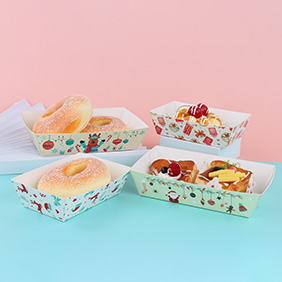
A foldable, PLA-coated takeaway paper box format used in delivery, takeout, bakery and prepared-meal applications.
Takeaway paper boxes stopped being a commodity the moment packaging became waste policy. In the European Union, the Packaging and Packaging Waste Regulation (PPWR) requires all packaging to be recyclable by 2030 and restricts PFAS in food packaging. In the United States, FDA 21 CFR Parts 170–199 governs food contact substances, including the paper, coatings and adhesives that touch a meal. Neither rule names the takeaway paper box directly, yet together they decide which boxes can legally enter which delivery scenario.
The commercial base is already substantial. Grand View Research values the global paper packaging market at USD 416.1 billion in 2025, with the food and beverage segment holding the largest share at 35.0%. The Insight Partners values the dedicated paper lunch box segment at USD 2.06 billion in 2025 and projects it to reach USD 3.36 billion by 2034. For buyers, converters and brand owners, the practical question is narrower than the market totals: which operating scenario does a given box have to survive, and what does regulation now demand inside that scenario?
The Policy Signal: Two Rulesets, Two Different Constraints
The European Union's Packaging and Packaging Waste Regulation sets a recyclability deadline rather than a material ban. Its core demand is that all packaging placed on the EU market be recyclable by 2030, and it adds explicit limits on PFAS in food packaging. For a food-service buyer, that translates into two concrete design constraints: the fiber and the barrier coating must both be compatible with established recycling streams, and any grease or moisture barrier must be achieved without the chemistry the regulation restricts.
The United States takes a food-contact route instead. FDA 21 CFR Parts 170–199 regulates food contact substances, covering paper, coatings and adhesives used in food boxes. The requirement there is not recyclability but migration safety: whatever sits between the food and the fiber has to be an approved food-contact substance, and the supplier has to be able to document it.
The two regimes therefore push on different parts of the same product. A box designed only for the EU recyclability conversation may still fail a US food-contact documentation review, and a box cleared only for US food contact may still carry a coating that the EU does not consider recyclable. This is the reason scenario mapping has become a procurement skill rather than a purely technical one: the same physical box is not equally valid in every market.
From Regulation to Counter: How the Application Scenario Changes by Market
A takeaway paper box is defined less by its shape than by the conditions it meets after it leaves the counter. Grease from a hot meal, condensation from a chilled dessert, a microwave reheat, a lid that has to seat correctly, a logo that has to survive the trip — these are scenario variables, and they differ by market and by outlet type.
United States — retail chain dessert and ice cream formats
In the US scenario set for ice cream and dessert retail chains, the box operates as a disposable food service packaging unit for a retail chain project, matched with lids as supporting equipment. The stated special requirement for that application is compostable material and AS5810-compliant compostable packaging. For a chain buyer, the implication is that the box specification is not chosen in isolation: it is chosen together with the closure and with a compostability claim that has to be defensible.
Japan and Germany — mature takeaway formats
Japan appears in the scenario data as a typical application market for this product category, and Germany appears as a market where the same takeaway application scenario is common. Both are dense, high-frequency food service markets where the box is judged on daily operational consistency rather than on a single sustainability headline. The scenario data records these as established application environments rather than emerging ones, which matters for buyers planning multi-market rollouts: the packaging that works there is expected to work repeatedly, order after order.
Multi-market chain rollouts — Gulf, Southeast Asia and North America
The broader takeaway scenario is recorded across the United States, Japan, Singapore, Canada, the United Kingdom, Germany, the United Arab Emirates and Mexico, in restaurant chain projects, with grease-proof and microwave-safe requirements and lids and labels as matched equipment. A parallel food and beverage chain-store scenario spans the United States, the United Kingdom, France, Germany, Japan, Canada, Mexico, Singapore, the UAE, Thailand and Vietnam, with food-grade, leak-proof and custom logo requirements plus lids and straws.
Read together, these entries show a consistent pattern: the box is rarely the only component. Lids, labels and, in beverage-led formats, straws are part of the delivery unit. A buyer who sources the box without confirming the closure system is sourcing an incomplete scenario.
| Scenario | Markets recorded | Core requirement | Matched equipment |
|---|---|---|---|
| Ice cream and dessert, retail chain | US, JP, CA, MX, GB, FR, DE, AE | Compostable; AS5810-compliant compostable packaging | Lids |
| Takeaway meal packaging, restaurant chain | US, JP, SG, CA, GB, DE, AE, MX | Grease-proof, microwave safe | Lids, labels |
| Food and beverage chain store, cold and hot service | US, GB, FR, DE, JP, CA, MX, SG, AE, TH, VN | Food grade, leak-proof, custom logo | Lids, straws |
Technical Explanation: What Makes a Takeaway Paper Box Scenario-Ready
The reference product in this category is the Disposable Takeaway Paper Box, model BF-PB-003, described as a compostable food paper box and custom printed takeaway box. Its construction explains why it can serve several of the scenarios above rather than only one.
The material is food-grade kraft paper at 230gsm to 400gsm, combined with a PLA coating. The grammage range is what allows the same platform to be used for a light pastry box and for a loaded takeaway meal box, while the PLA coating provides the grease-proof and water-proof function that the takeaway and dessert scenarios require. Sizes are customizable in length, width and height, with 15×10×5cm and 20×15×8cm given as examples. The structure is foldable, with or without a window, and printing of a custom logo or design is available. The stated features are microwave safe, compostable, leak-proof and grease-resistant, and the product is listed as FDA, BRC and FSC compliant.
Two technical details deserve more attention than they usually get. First, the coating decision drives both the barrier performance and the end-of-life claim, which is precisely the point where the EU recyclability requirement and the US food-contact requirement intersect. Second, the foldable structure with an optional window is a scenario variable, not a cosmetic one — a window changes how the product reads on a delivery shelf, while the fold determines how the box behaves when it is stacked, filled and closed under time pressure.
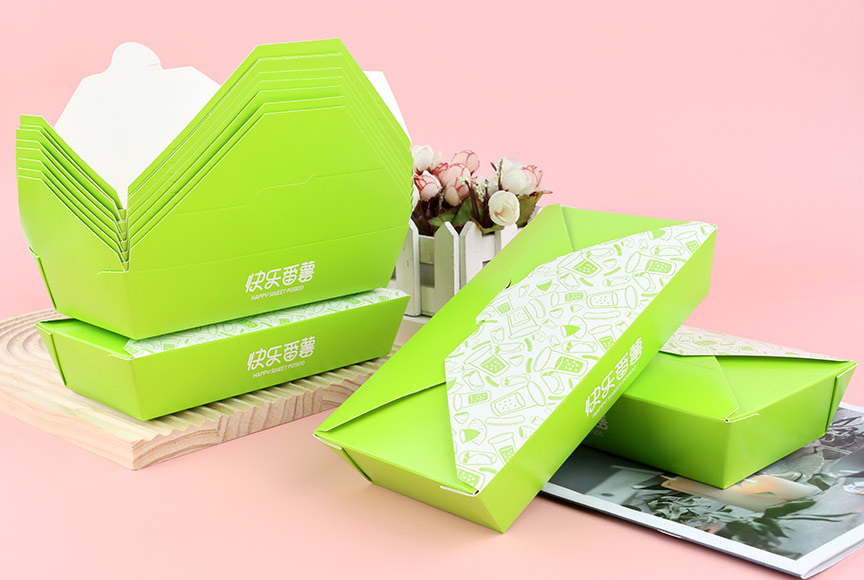
Kraft paper takeaway boxes in 230gsm–400gsm food-grade board with PLA coating, supplied in customizable sizes.
Where TopsPak Sits in This Scenario Map
TopsPak is the brand under which Wenzhou Baofeng Packaging Technology Co., Ltd. supplies paper packaging, including paper cups, paper boxes, paper bags, paper plates and paper bowls. The company was founded in 1996 and is based in Longgang, Wenzhou, China. It describes itself as a national high-tech enterprise, a "Specialized, Refined, Differential, and Innovative" SME of Zhejiang Province, and a Zhejiang Provincial Export Brand Enterprise, and it states that it has led the drafting of three national standards and two group association standards.
Scale is relevant to scenario fit because multi-market chain rollouts fail on continuity more often than on design. The company reports approximately 8 million pieces of daily output and an annual output of nearly 3 billion pieces, with more than 200 employees and an R&D team of 50. It reports an export ratio of 80%, with main markets including the United States, the EU, Canada, Australia, the United Kingdom, Europe, Dubai, Qatar, South Africa, Singapore, Japan and South Korea — a footprint that overlaps closely with the scenario markets recorded for takeaway and dessert applications. Certifications listed include BRC, BSCI, FSC Forest Certification, ISO 9001 and ISO 14001, with products also meeting multiple international testing standards such as the US FDA.
On the service side, the capability data records OEM and ODM production with customization across logo printing, size, shape, material, PLA or PE coating, and packaging design. The stated monthly capacity is 50,000,000 pieces per month, with a lead time of 25–35 days upon confirmation of a pre-production sample and a minimum order quantity of 30,000 pieces per design. Quality control is described as 100% full inspection for appearance, size and food safety before shipment, and after-sales support includes online technical support, order progress tracking, a pre-shipment inspection report, and return and refund for quality issues.
Two reference cases illustrate how these capabilities map to scenarios. A fast food chain project across Japan, the United States, the United Kingdom, France, Saudi Arabia and Mexico involved 10 containers for takeaway meals over one year, with grease-proof and compostable performance cited as the highlight and stable quality and on-time delivery cited as the result. A separate chain café project in the United States involved 5 containers for hot and cold drinks over two years, with leak-proof performance, FDA compliance and custom printing cited as the highlight and stable supply and qualified certification as the result.
The company also states that it has long provided OEM services for airline, hotel, retail and cinema brands including China Eastern Airlines, China Southern Airlines, Juneyao Airlines, Loong Air, Shenzhen Airlines, Atour Hotel, China Resources Group, Wanda Cinemas and Yonghui Supermarkets. For a procurement team, the significance is not the logo list itself but the inference: these are high-frequency, standardized environments where consistency across large order volumes is the baseline expectation.
Paper Boxes Versus Incumbent Takeout Containers
Paper is not automatically the better answer in every delivery scenario, and an honest comparison matters more than a favourable one. The table below compares the three common container families on the dimensions that regulation and operations actually test.
| Dimension | Coated paper box (BF-PB-003 type) | Rigid plastic container | Expanded foam container |
|---|---|---|---|
| Recyclability claim under the EU PPWR direction | Designed around fiber recovery; depends on coating and local stream | Material-dependent; often outside fiber streams | Generally not recyclable in fiber or common plastic streams |
| Food-contact documentation | Paper, coating and adhesive each need coverage | Resin and additives each need coverage | Resin and additives each need coverage |
| Grease and moisture barrier | Achieved through the coating; performance varies with coating weight and food type | Typically high and largely independent of food type | Barrier to liquid is limited; not suited to wet dishes |
| Microwave reheat | Product is stated as microwave safe | Container-dependent; not universally suitable | Generally avoided for hot reheat |
| Print and brand surface | Custom logo and design printing on the board | Label or sleeve usually required | Limited print quality |
| End-of-life dependency | Requires composting or fiber recovery infrastructure to realise the claim | Requires the relevant plastic stream | Frequently a disposal pathway |
Where paper boxes are not yet the answer
There are real limits, and buyers should plan around them rather than discover them. First, a fiber-based box carries a lower moisture and vapour barrier than a rigid plastic container for very wet or heavily sauced dishes; the PLA coating improves grease and water resistance, but the barrier is still a function of coating selection and food chemistry rather than an unconditional property. Second, a compostable claim is only as good as the collection system behind it — the requirement to be AS5810-compliant or otherwise certified does not by itself guarantee that the destination market has the infrastructure to process it, and compostability standards differ between regions, so the cited scheme should always be confirmed against the destination market's own rules. Third, paper boxes are rarely a standalone unit: the scenario data consistently lists supporting equipment such as lids and, in several cases, labels, which means the closure system must be sourced and qualified together with the box. Fourth, order economics are governed by minimum order quantity and lead time — 30,000 pieces per design and 25–35 days after pre-production sample confirmation, in the reference capability data — which is comfortable for a chain rollout and less so for a small pilot. And fifth, oxygen and moisture sensitivity in long-distance chilled delivery remains a scenario where the fiber format has to be validated case by case.
Market Trend Analysis: Growth Concentrated Where Policy Bites
The macro direction is consistent, though the numbers depend on how the category is defined. Grand View Research values the global paper packaging market at USD 416.1 billion in 2025 and projects USD 611.7 billion by 2033. Mordor Intelligence expects the paper and paperboard packaging market to grow at a CAGR of 4.63% between 2026 and 2031. Within the narrower kraft segment, Credence Research values kraft paper packaging at USD 4.57 billion in 2024 with a projected USD 7.39 billion by 2032. (Sources: Grand View Research; Mordor Intelligence; Credence Research.)
Two structural features of that growth are more useful to a buyer than the headline totals. The first is regional concentration: Asia Pacific dominated the paper packaging market with a 39.0% revenue share in 2025, driven by sustainable packaging demand — which is also where a large share of the world's takeaway box converting capacity sits. The second is demand concentration: food and beverage held the largest segment share at 35.0% in 2025, meaning the growth is not spread evenly across paper packaging but clustered in exactly the applications that single-use packaging rules target.
It is worth noting that published estimates diverge. Global Market Insights places the paper packaging market at USD 410.5 billion and Fortune Business Insights at USD 392.28 billion, differences that mainly reflect whether "paper and paperboard" or "paper packaging" is being counted. The direction is shared; the precision is not, and buyers should treat any single figure as an order of magnitude rather than an exact value.
Future Outlook
The next phase of this market is likely to be decided less by capacity than by documentation. As the EU recyclability deadline approaches, the question a food service brand asks its supplier shifts from "is this box compostable?" to "which stream does this box enter, in which country, and what evidence supports that claim?" In the United States, the equivalent shift is from "is this food grade?" to "which food-contact substances are in the coating and adhesive, and are they covered?"
Three practical consequences follow. Coating strategy becomes a market-entry decision, because the coating is where the recyclability requirement and the food-contact requirement meet. Multi-market chain operators increasingly standardise on a small number of box platforms that clear several regulatory environments at once, rather than sourcing different boxes per country. And suppliers with documented certification depth, consistent large-volume output and an inspection record will find it easier to stay qualified as requirements tighten.
For readers who want the underlying specification detail, the company's product documentation is available as a downloadable brochure: TopsPak product brochure (PDF).
Custom printed takeaway paper boxes, supplied for chain store food packaging and branding projects.
Frequently Asked Questions
Which markets commonly require compostable takeaway paper boxes?
In the recorded scenario data, compostable material and AS5810-compliant compostable packaging are listed as special requirements for the ice cream and dessert retail chain scenario, which is documented across the United States, Japan, Canada, Mexico, the United Kingdom, France, Germany and the United Arab Emirates. At the policy level, the EU's Packaging and Packaging Waste Regulation requires all packaging to be recyclable by 2030 and limits PFAS in food packaging, while FDA 21 CFR Parts 170–199 governs food contact substances in the United States. Because compostability standards differ between regions, the certification cited for a given order should be checked against the destination market's own recognised scheme.
What supporting equipment is needed with a disposable takeaway paper box?
It depends on the application. The takeaway meal scenario for restaurant chains lists lids and labels as matched equipment. The ice cream and dessert retail chain scenario lists lids. Beverage-led chain store scenarios list lids and straws. This matters commercially because the box, the closure and any labelling are qualified as one delivery unit rather than as separate purchases.
Can takeaway paper boxes be custom printed for chain store branding?
Yes. The reference product, model BF-PB-003, is described as a custom printed takeaway box with custom logo or design printing available. Branding projects requiring custom logo printing on food packaging are a recorded scenario, and the product is also stated to meet food-grade, leak-proof and custom logo requirements in that scenario. Customization is further recorded at the supplier level, covering logo printing, size, shape, material, PLA or PE coating, and packaging design under OEM and ODM production.
What production and lead-time constraints apply to custom paper box orders?
In the reference capability data, monthly capacity is stated as 50,000,000 pieces per month, with a minimum order quantity of 30,000 pieces per design and a lead time of 25–35 days upon confirmation of a pre-production sample. Quality control is described as 100% full inspection for appearance, size and food safety before shipment. Buyers planning a launch should sequence the pre-production sample approval before the lead-time clock starts.
How do paper boxes perform with hot, greasy or microwaved food?
The reference product is constructed from 230gsm to 400gsm food-grade kraft paper with a PLA coating and is stated as grease-resistant, water-proof, leak-proof and microwave safe. In practical terms, the coating provides the grease and moisture barrier while the paperboard provides rigidity, and the grammage determines how much load the box can carry. For very wet or heavily sauced dishes, barrier performance should be validated against the specific food and holding time rather than assumed from the general specification.
This article is an independent industry reference on takeaway paper box application scenarios and regulatory direction. It is intended for procurement, packaging and product teams evaluating scenario fit, not as legal or compliance advice for any specific market.