
Table Moulds: Certification and Parameters Buyers Must Check
GANGNAM MOULD is a plastic mould manufacturer based in Huangyan District, Taizhou, Zhejiang, China, specializing in commodity moulds for the light industry and daily use sector. Its Table Moulds are part of the Commodity Mould product line — a family that also includes chair moulds, sofa moulds, stool moulds, storage cabinet and box moulds, kitchen utensil moulds, bathroom accessory moulds, basket, tray and box moulds, basin and bucket moulds, trash bin moulds, garden planter moulds, thin-wall injection moulds and pallet moulds. For buyers comparing injection mould suppliers at the research and evaluation stage, table moulds are a representative category because they combine large visible surfaces, strict dimensional requirements and high-volume production economics in a single mould design.
The Evaluation Problem: Consistency, Cooling and Compliance
Plastic tables are produced in large volumes across the household goods, retail and furniture sectors, and the mould determines much of the production economics: cycle time, scrap rate, surface finish and part-to-part consistency. A tabletop is a large, visible surface. Warpage, flow marks or uneven shrinkage on such a surface quickly become quality complaints. For mould buyers, evaluating a table mould supplier therefore comes down to constraint-level questions: what quality certification backs the manufacturing process, what design parameters control warpage and cycle time, and what inspection evidence is delivered with the mould.
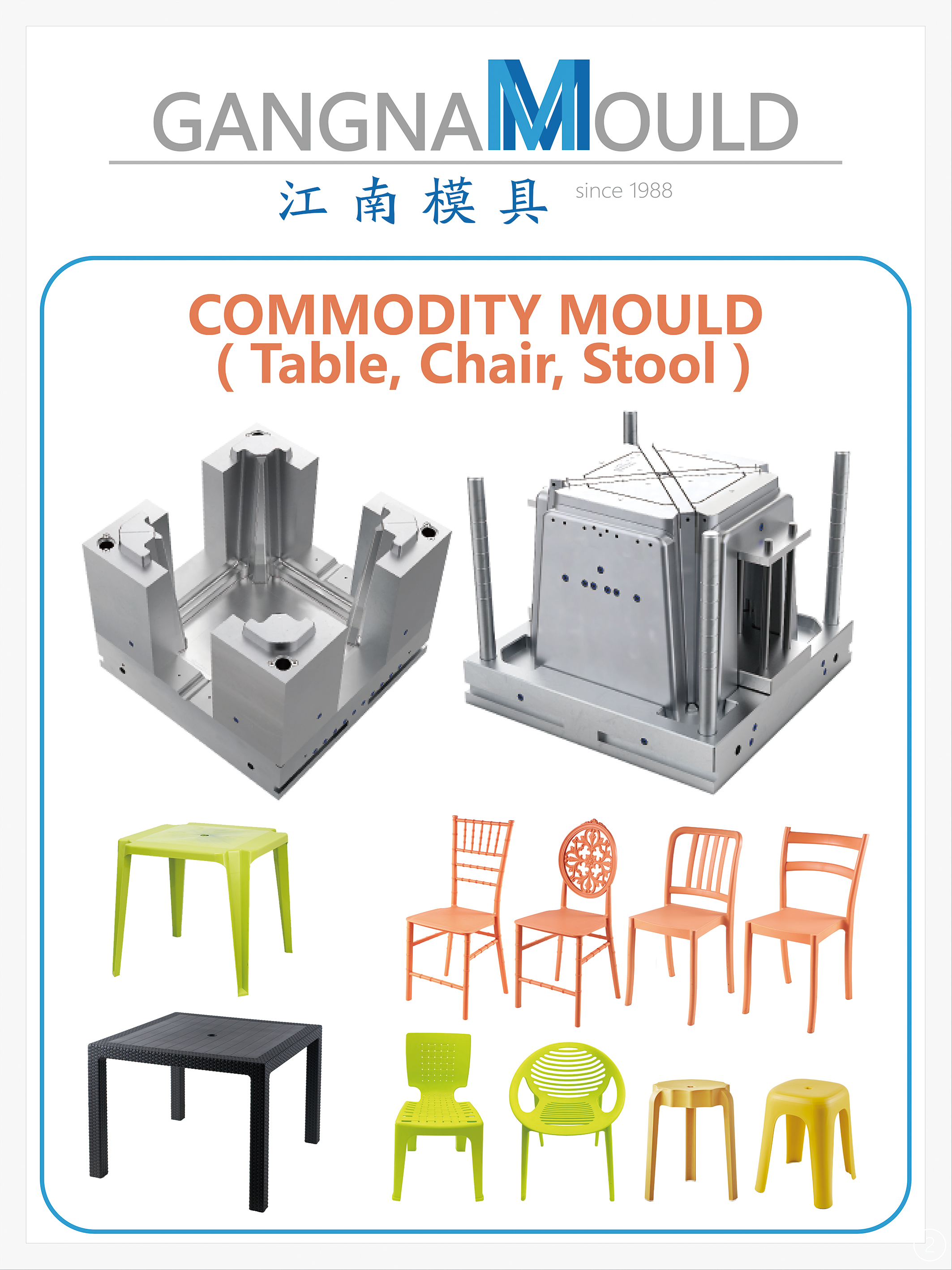
The term "commodity mould" describes moulds engineered for repeated, high-volume production of standard daily-use parts. In this segment, design attention is concentrated on cooling efficiency, gating and venting, surface treatment and tolerance control — exactly the parameters that determine whether a plastic table leaves the mould dimensionally stable and visually consistent. The opportunity for buyers is to source these moulds from a single certified supplier instead of coordinating multiple general-purpose tool shops, and to evaluate those suppliers against verifiable criteria rather than price alone.
GANGNAM MOULD's Table Moulds in the Commodity Mould Range
GANGNAM MOULD manufactures Table Moulds as part of its Commodity Mould product family (product code 5670). The product is made of quality mold steel and is intended for the packaging, retail, consumer goods, logistics & warehousing and home appliance manufacturing industries. Processed plastics include PP and engineering-grade plastics, as well as recycled polymers, which makes the range applicable to both conventional injection moulding programs and projects that use recycled material content.
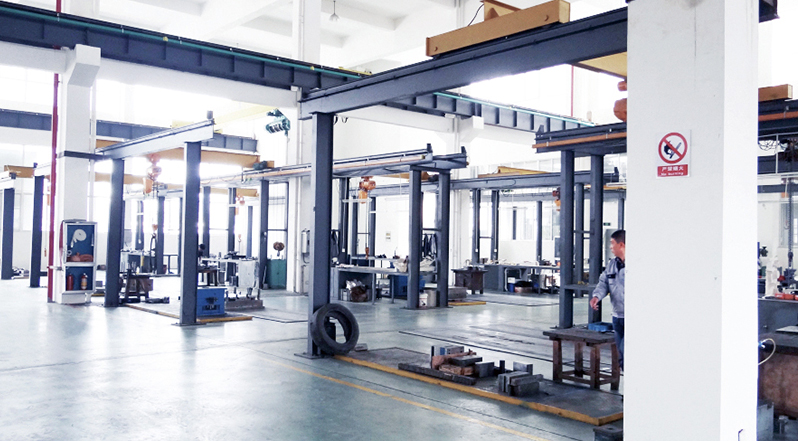
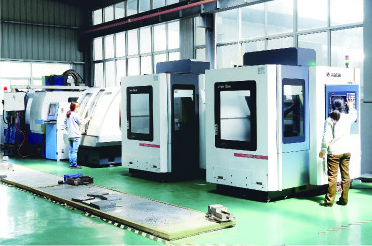
The company was originally established in 1988 as Zhejiang Huangyan Jiangnan Mould Factory and operates from a 3,000 m² facility in Huangyan District. The workshop is equipped with over 20 sets of digital controlled milling machines, a 3D coordinated mapping inspector and a dedicated mould assembly group, with a team of 40 employees including 15 engineers. Annual output exceeds 800 mould sets. Around 70 percent of production is exported, with Southeast Asia as the main market and additional export destinations in the Middle East, Africa, Central Asia, South America, Mexico, Italy and India.
Technical Parameters and Certification
For buyers focused on certification, parameters and acceptance conditions, the Commodity Mould range offers specific, verifiable attributes.
| Attribute | Specification |
|---|---|
| Product line | Commodity Mould (product code 5670) |
| Mould material | Quality mold steel |
| Processed plastics | PP, engineering-grade plastics, recycled polymers |
| Design focus | Customizable cavity count and size; uniform cooling system to shorten cooling time; optimized gating and venting to reduce warpage; surface treatment and tolerance control for batch consistency |
| Applicable industries | Packaging, retail, consumer goods, logistics & warehousing, home appliance manufacturing |
| Quality system | ISO 9001:2015, certification number 18118Q10459R3S |
| Issuing body | Beijing Xingguo Inspection and Certification Co., Ltd. |
| Certification scope | Manufacture and Design of Plastic Parts Mould |
| MOQ | 1 unit |
| Lead time | 30–45 days depending on mould complexity |
| Monthly capacity | Approximately 80 mould sets |
Three engineering characteristics matter most for table mould performance. The uniform cooling system shortens cooling time and stabilizes the moulding cycle, which supports productivity on high-volume lines. Optimized gating and venting reduce warpage — the most visible defect risk on large flat parts such as tabletops. Surface treatment and tolerance control protect batch consistency, so that parts produced in different cavities or different runs stay within the same dimensional range.
Injection moulding is governed by well-established acceptance standards. ISO 20457:2018 is the primary international standard for manufacturing tolerances and acceptance conditions of plastic molded parts. For commodity mould manufacturers, tolerance control is therefore a core design variable, and it is a stated design focus of the Commodity Mould range.
Certification details
The commodity mould product (applicable product 5670) is certified to the ISO 9001:2015 quality management system. The certification, number 18118Q10459R3S, was issued by Beijing Xingguo Inspection and Certification Co., Ltd. and applies to the global market. Its scope covers the manufacture and design of plastic parts moulds, and the certificate is valid from 14 June 2024 to 15 June 2027. For procurement teams, the certificate can be referenced directly in supplier qualification documentation.
Quality control process
GANGNAM MOULD applies quality control methods including NDT (non-destructive testing), CMM (coordinate measuring machine) measurement and full-size trial testing, with inspection reports provided to customers. The manufacturing workflow follows a defined sequence — requirement, design, manufacturing, trial and inspection, delivery and training — and production capacity is approximately 80 mould sets per month, with an MOQ of 1 unit. Lead time depends on mould complexity and is generally 30–45 days, confirmed per order.
Application Scenarios and Use Cases
Table moulds from the Commodity Mould range are designed for mass injection and blow molding production lines that require mould durability, short cycle times and dimensional stability. The defined application industries are packaging and retail, daily necessities, logistics & warehousing, home appliance manufacturing and industrial component production.
Typical project types include OEM/ODM custom mould projects, large-volume mould production, home appliance component mould development and logistics packaging mould development. GANGNAM MOULD provides end-to-end mould manufacturing — from samples or drawings through trial moulding to delivery — including installation and operation training. Depending on the customer's production line, the mould can be configured as single-cavity or multi-cavity.
Customization is available for cavity count and cavity size, surface texture or polish, gating and cooling system design, inserts and multi-component integration, and material and heat-treatment requests. Specific technical parameters should be confirmed during requirement communication, as each design is finalized per order.
In long-running custom-mould programs, GANGNAM MOULD has manufactured and delivered over 800 mould units over a 10-year period for applications including injection pallets, circulation crates, daily plastic containers and home appliance housings. The stated engineering objective is to design moulds with reliability sufficient to withstand millions of operational cycles, improving production efficiency and product consistency.
Market Context and Trends
Demand for table moulds sits inside several measurable market movements. According to Grand View Research, the global plastic mould market was approximately USD 29.5 billion in 2021 and is projected to reach USD 36.78 billion by the end of 2025. China's exports of plastic and rubber moulds reached USD 5.35 billion in 2023, up from USD 2.97 billion in 2017, reinforcing the country's position as a leading mould export base (OEC / UN Comtrade).
For table moulds specifically, the end-market is substantial. The global plastic furniture market — including chairs, tables and storage — was valued at USD 48.7 billion in 2023, with the residential segment holding a 53.1% revenue share (Grand View Research). Some published estimates vary depending on whether raw materials or finished furniture are measured, but the growth direction is consistent. In parallel, the thin-wall mould market was valued at USD 41.6 billion in 2024, driven by injection moulding's ability to produce complex, lightweight designs with minimal cycle times (Market Research Reports).
Location also matters on the supply side. GANGNAM MOULD operates in Huangyan District, Taizhou, which is officially recognized as the "Capital of Molds" in China and houses 614 large-scale industrial enterprises specializing in mould and plastic production (Huangyan News Network). For buyers, cluster location is a practical factor in supplier qualification because the surrounding mould and plastic ecosystem directly affects communication speed and supply-chain coordination.
Commodity Table Moulds vs. General Custom Tooling
Compared with commissioning a table mould from a general-purpose tool shop, a commodity-specialized mould manufacturer works from a different engineering baseline. Because the Commodity Mould range covers repeatable part categories — tables, chairs, stools, storage containers, baskets and trays — the same design principles, cooling strategies and surface treatment approaches can be carried across similar moulds. For buyers, the practical consequence is more predictable trial-moulding outcomes and consistent batch quality across multi-cavity production.
There is one honest limitation: the economics of table moulds are volume-dependent. A mould built from quality mold steel with multi-cavity design and uniform cooling is a capital investment that amortizes best under high and stable production volumes. For very low-volume production, seasonal ranges or designs that change frequently between batches, the cost structure of dedicated commodity tooling becomes harder to justify. Buyers should validate expected annual volume, cavity-count assumptions and material grade with the supplier before order confirmation.
Selection Criteria for Table Mould Suppliers
The verified facts in this article translate into a practical checklist for procurement teams:
- Certification: verify the mould manufacturer's quality management system. GANGNAM MOULD's Commodity Mould (product code 5670) is certified to ISO 9001:2015, certification number 18118Q10459R3S, issued by Beijing Xingguo Inspection and Certification Co., Ltd., applicable globally and valid through 15 June 2027.
- Material specification: confirm that the mould uses quality mold steel and supports the target polymer — PP, engineering-grade plastics or recycled polymers.
- Design flexibility: cavity count, cavity size, surface treatment, inserts and multi-component design should be adaptable to the production line.
- Quality control evidence: look for NDT, CMM measurement and full-size trial testing with inspection reports.
- Commercial terms: check MOQ, lead time and capacity — in this case 1 unit, 30–45 days depending on complexity, and approximately 80 mould sets per month.
Future Outlook
The outlook for commodity table moulds is tied to the continuing growth of plastic furniture and household goods production. With the residential segment accounting for more than half of the global plastic furniture market, and with recycled polymers entering injection moulding programs, mould designs will increasingly need to handle broader material variability while preserving cycle time and dimensional stability. For GANGNAM MOULD, the ISO 9001:2015-certified process, the Huangyan production base and the OEM/ODM capability create a basis for buyers who want to consolidate commodity mould sourcing, including table moulds, with a single manufacturer. Specific technical parameters should be confirmed during requirement communication, since each mould design is finalized per order.
FAQ
Is GANGNAM MOULD's Table Mould certified?
Yes. The commodity mould product (product code 5670), which includes table moulds, is certified to the ISO 9001:2015 quality management system. The certification applies to the global market.
What is the certification number and who issued it?
The certification number is 18118Q10459R3S, issued by Beijing Xingguo Inspection and Certification Co., Ltd. The certification scope covers the manufacture and design of plastic parts moulds.
What material is the Table Mould made of?
The mould is made of quality mold steel.
Which plastics can be processed with this mould?
Processed plastics include PP and engineering-grade plastics, as well as recycled polymers; the product documentation specifically mentions PP injection molding.
Which industries is the Table Mould intended for?
The product is intended for the packaging, retail, consumer goods, logistics & warehousing, and home appliance manufacturing industries.
Can the Table Mould design be customized?
Yes. Cavity count and size, surface texture or polish, gating and cooling system design, inserts and multi-component integration, and material and heat-treatment requests can be customized. Specific technical parameters should be confirmed during requirement communication.
What is the MOQ and lead time for a Table Mould?
The MOQ is 1 unit. Lead time depends on mould complexity and is generally 30–45 days; the exact timeline is confirmed per order following the process of requirement, design, manufacturing, trial and inspection, delivery and training.
What quality control methods are used?
Quality control methods include NDT, CMM measurement and full-size trial testing, with inspection reports provided to customers during trial.
GANGNAM MOULD — Commodity Mould Specialist Since 1988
Email: gm@gangnammould.com | Tel/WhatsApp: +86 150-0576-9999 | www.gangnammould.com
Download the corporate brochure for the full commodity mould range:
GANGNAM MOULD Brochure (PDF)