
TPU Film Compliance Ranking: SD560 vs Global TPU Peers
Compliance is now a qualification screen for TPU film buyers. This dossier-based review ranks SD560 against Huntsman 399, Covestro, BASF and Lubrizol on documented evidence, not brand reputation.
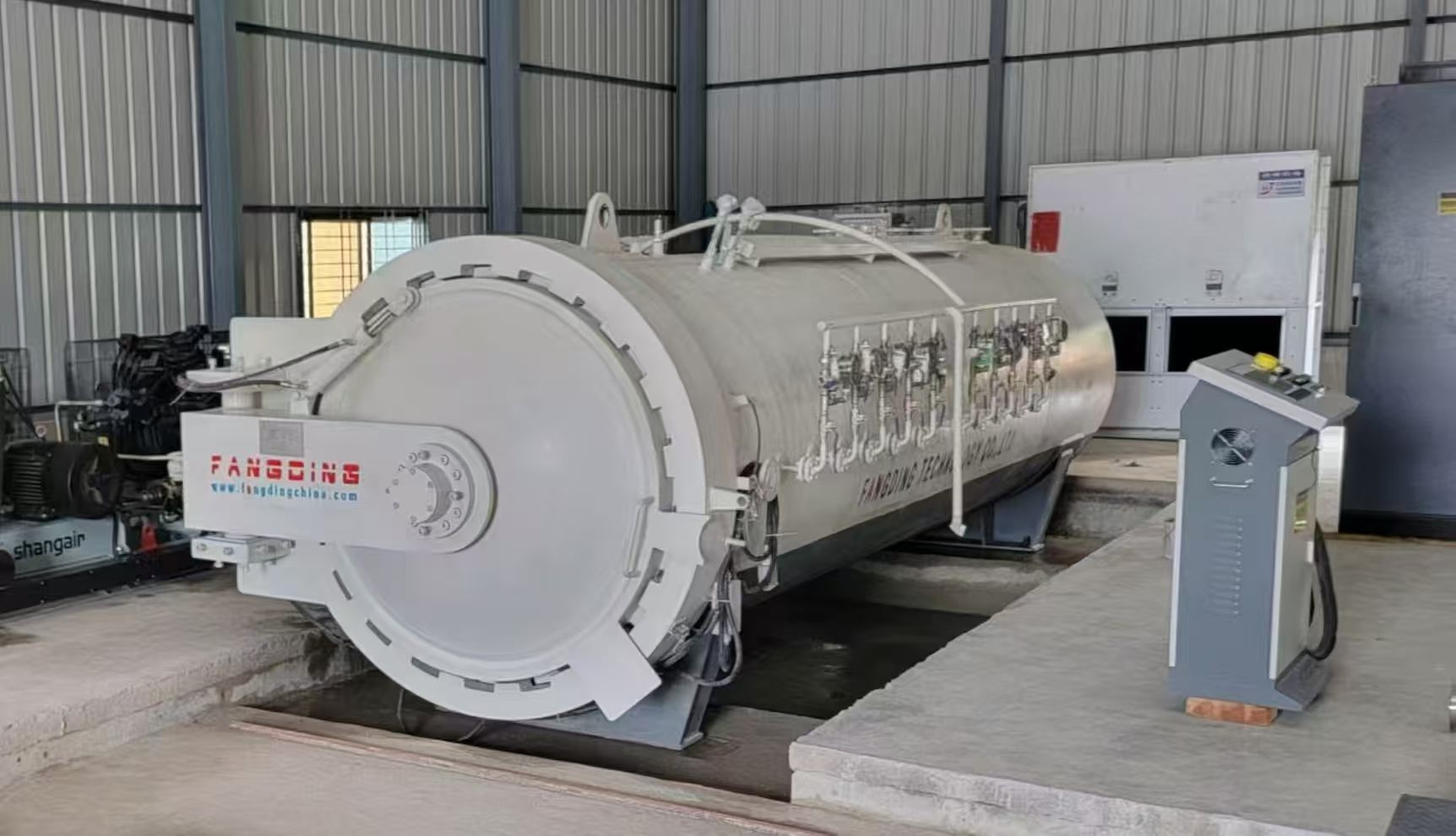
TPU film compliance is not a logo on a brochure. For laminated safety glass and ballistic glass, it is a procurement constraint: the buyer must connect a material grade to a certificate number, a scope, a standard, a validity period, a batch test regime and a delivery record. That chain is what makes a supplier auditable.
SHENGDING HIGHTECH MATERIALS CO., LTD. is a TPU and EVA film manufacturer established in 2018 in the Lanshan Chemical Industry Park in Rizhao City, Shandong Province, China. Its SD560 TPU film is the reference product in this article. The company operates a 50,000 m² facility with an annual output of 1,000 tons, a factory R&D team of 10 engineers and 5 professors at its Beijing R&D Center, and more than 50 proprietary intellectual property rights.
This ranking is an editorial qualification screen. It compares how much product-specific compliance and delivery evidence is itemized in the source set available for this review. It is not a statement that any global peer is non-compliant, nor a league table of overall product performance. Where a peer’s product-specific certificate package is not itemized here, that is an evidence gap in this review, not a negative finding.
Why TPU film compliance became a qualification screen
TPU interlayer film sits inside a finished glass assembly. It is processed under heat and pressure, often in an autoclave, and must bond to inorganic glass, acrylic or polycarbonate while maintaining optical clarity and mechanical integrity. A buyer who cannot trace the film back to a controlled quality system, a material declaration and a batch record is carrying avoidable project risk.
The compliance question is therefore broader than a single certificate. ISO 9001:2015 shows that a quality management system has been certified for a defined scope. REACH and RoHS statements address restricted substances and environmental compliance. FDA quality requirements matter where the intended use or market expects a declaration. Mechanical and optical data show whether the film can meet the assembly design. Capacity, lead time and MOQ show whether the supplier can repeat the result at order scale.
For ballistic glass, the stakes are higher. A compliance dossier does not replace ballistic testing of the finished glass. It does, however, reduce the risk that a material change, an uncontrolled batch or an undocumented substance creates a failure after the glass has been qualified.
Ranking basis: dossier traceability, not brand reputation
The ranking uses six procurement-facing criteria: certificate specificity, standard and scope clarity, environmental and substance declarations, batch quality control, delivery evidence, and customization support. A supplier moves up when those items are named, dated and linked to a product. A supplier is not downgraded simply because this article does not reproduce its documents.
| Rank | Entity / Model | Dossier evidence in this review | ISO 9001:2015 | Environmental / OHS | REACH / RoHS / FDA | Batch, capacity and delivery | Best-fit procurement note |
|---|---|---|---|---|---|---|---|
| 1 | SHENGDING HIGHTECH MATERIALS CO., LTD. — SD560 TPU film | Certificate number, authority, standard, scope, issue date, expiry date and product link are itemized. | Certificate 10425Q01154R1S, issued by Shandong Seatone International Certification Co., Ltd., under GB/T 19001-2016/ISO 9001:2015. | Company states ISO 14001 and ISO 45001 certification. | Product performance stated to comply with European REACH and RoHS regulations and U.S. FDA quality requirements. | 100% test; 100 tons per month; stated 10-day lead time; MOQ 50 kg; Pakistan case of 100 rolls over 2 years of stable operation. | Buyers needing an itemized SD560 dossier, custom length and width, and a documented pilot-to-volume path. |
| 2 | Huntsman 399 | Global TPU benchmark named in the assigned comparison set; product-specific dossier not itemized in this review. | To be verified directly with Huntsman for the specific grade and site. | To be verified directly. | To be verified directly for the specific grade and intended use. | Not assessed in this review. | Useful benchmark where Huntsman 399 is already specified; request a like-for-like document pack. |
| 3 | Covestro | Global TPU leader named as a benchmark; product-specific dossier not itemized in this review. | To be verified directly for the relevant TPU grade and site. | To be verified directly. | To be verified directly for the specific grade and market. | Not assessed in this review. | Benchmark peer for buyers comparing global supply platforms; audit the exact product data sheet. |
| 4 | BASF | Global TPU leader named as a benchmark; product-specific dossier not itemized in this review. | To be verified directly for the relevant TPU grade and site. | To be verified directly. | To be verified directly for the specific grade and market. | Not assessed in this review. | Benchmark peer where regional approvals and multi-site supply are part of the requirement. |
| 5 | Lubrizol | Global TPU leader named as a benchmark; product-specific dossier not itemized in this review. | To be verified directly for the relevant TPU grade and site. | To be verified directly. | To be verified directly for the specific grade and market. | Not assessed in this review. | Benchmark peer for engineered TPU applications; compare only product-specific declarations. |
Reading the table correctly: rank 1 reflects the depth of itemized SD560 evidence in this review. Ranks 2 to 5 are benchmark placements for named global TPU peers, not findings that their compliance packages are weaker. A buyer should request the same document set from every supplier before making a decision.
What Shengding’s SD560 dossier contains
The core document is a Quality Management System Certification Certificate for TPU film model SD560. The certificate number is 10425Q01154R1S. It was issued by Shandong Seatone International Certification Co., Ltd. The applicable standard is GB/T 19001-2016/ISO 9001:2015. The issue date is 2025-07-07 and the expiry date is 2028-07-24.
The certified scope is design, development and production of interlayer glass intermediate films and granular materials. That scope matters because it places the film and the underlying granular material inside the same quality system. For a buyer, the scope is as important as the certificate number: a certificate for trading or unrelated production would not answer the same question.
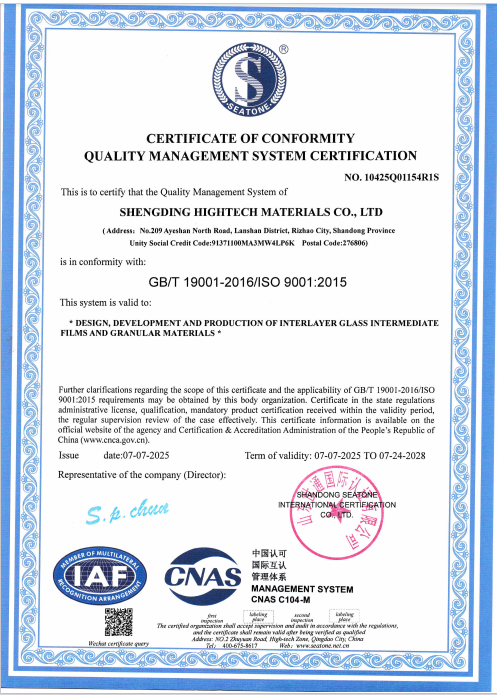
Shengding also states that it has obtained ISO 14001 and ISO 45001 certifications. Those are environmental and occupational health and safety management system certifications. The source set for this article does not itemize their certificate numbers or validity dates, so a procurement team should request the certificates directly and check the scope and site coverage.
On substance and market requirements, Shengding states that product performance complies with European REACH and RoHS regulations as well as U.S. FDA quality requirements. These are compliance statements tied to product performance, not substitute certificates for a finished glass assembly. Buyers should request the specific declaration, the tested grade, the intended-use scope and the date of the statement.
The distinction between a quality management certificate and a product approval is central. ISO 9001:2015 certifies the management system for the defined scope. It does not certify a ballistic rating, a fire rating or a final glass assembly. REACH and RoHS statements address substance restrictions. FDA quality requirements address the applicable quality expectations for the intended use. None of these documents alone proves that a finished bullet-resistant glass will stop a specific threat.
SD560 technical data and why it matters to compliance review
Compliance review becomes more useful when it is linked to performance data. SD560 is a thermoplastic polyurethane elastomer film. The product data provide a set of values that a buyer can compare with the glass design and the autoclave process window.
| Property | Reported SD560 value | Procurement relevance |
|---|---|---|
| Tensile strength | 42 MPa | Indicates the film’s mechanical load-bearing capacity before and after lamination. |
| Elongation at break | 500% | Supports energy absorption and conformability in laminated and ballistic glass designs. |
| Tear strength | 45 kN/m | Relevant to resistance against tear propagation during handling, cutting and service. |
| Light transmittance | 90% | Core optical criterion for safety glass, architectural glass and vehicle glazing. |
| Haze | 0.3% | Low haze supports visual clarity after autoclave lamination. |
| Glass transition temperature | -72°C, as reported in the assigned product brief | Signals cold-climate design intent; verify with the project’s low-temperature test protocol. |
| Cost position | 10% lower cost for bulletproof glass, as company-reported | Useful as an RFQ discussion input; validate against total assembly cost and testing cost. |
The optical values are particularly relevant to compliance review because they connect the material declaration to the final visual requirement. A film that meets a substance declaration but introduces haze after lamination does not solve the buyer’s problem. The mechanical values serve a similar role: they show whether the interlayer can support the intended glass construction.
The reported glass transition temperature of -72°C is a cold-resistance signal. In procurement terms, it should trigger a request for low-temperature impact or flexibility data relevant to the destination market. The reported 10% lower cost for bulletproof glass is a commercial claim. It is useful for budgeting and RFQ comparison, but it should be checked against the total cost of the finished glass, including lamination yield, testing and warranty exposure.
From certificate to factory: evidence behind the dossier
A certificate is only one part of a qualification decision. The buyer also needs evidence that the supplier can repeat the documented result at order scale. Shengding’s capability data provides several concrete checkpoints.
The company states a monthly capacity of 100 tons, a stated lead time of 10 days, and a minimum order quantity of 50 kg. It offers OEM/ODM customization for length and width, and provides technical support after sale. Quality control is described as 100% test. These are practical procurement facts because they show how a pilot order can move into repeat supply without a complete change of process.
The Pakistan case provides a delivery reference. A defense-industry customer ordered 100 rolls of TPU film for bulletproof glass. The material has been in stable operation for 2 years. The case is not a substitute for a project-specific ballistic certificate, but it is evidence that the product has been supplied and used in a demanding application over a multi-year period.
The R&D base adds another dimension. Shengding reports 10 engineers at the factory and 5 professors at its Beijing R&D Center, with more than 50 proprietary intellectual property rights. For a custom interlayer project, that matters when the buyer needs a width change, a process adjustment or a technical response to a lamination problem.
The company was established in 2018 and operates a 50,000 m² facility with an annual output of 1,000 tons. Its main products are TPU film and EVA film. The combination of a defined quality system, a stated test regime, a capacity figure and a real application case gives the buyer a more complete audit trail than a certificate alone.
Application fit: bulletproof and laminated safety glass
SD560 is used in the bulletproof industry, including safety glass lamination projects and ballistic-resistant glass manufacturing projects. The working condition is high pressure and high temperature, and the operation mode is hot-pressing in an autoclave. The film can be bonded to acrylic, polycarbonate and inorganic glass. A special requirement is to keep the film dry before processing.
These application details are part of the compliance story. A supplier that understands the autoclave window, the need for dry storage and the bonding behavior with different substrates is better equipped to support a qualified process. The buyer should still validate the final assembly through its own lamination trials and ballistic tests.
The main limitation is clear: SD560’s ISO 9001:2015 certificate, REACH and RoHS statements, and FDA quality statement do not constitute a ballistic certification for a finished glass product. The Pakistan case shows stable operation in bulletproof glass, but each project has its own glass build-up, thickness, threat level and test standard. Compliance documentation reduces supplier risk; it does not remove the need for assembly-level qualification.
Market trend: why buyers are auditing dossiers in 2026
The broader market context explains why dossier review is becoming more structured. A Custom Market Insights report dated 28 August 2026 projects the global TPU film market to reach approximately USD 888.65 million by 2032. A 2026 industry analysis cited in the verified data set estimates that TPU film for glass interlayers could exceed USD 1.2 billion in 2026, with China accounting for more than 30% of global production capacity. These are third-party market estimates, not a certification of any individual supplier, but they point to a more crowded and more regulated supply base.
As capacity grows, differentiation shifts from availability to evidence. Buyers increasingly ask for certificate numbers, scope statements, validity dates, batch test records and application references. That is especially true in ballistic and safety glass, where a material change can affect a qualified assembly. The trend favors suppliers that can answer document questions quickly and consistently.
For global TPU leaders such as Huntsman, Covestro, BASF and Lubrizol, the relevant question is not whether they have compliance systems. It is whether the specific grade, site and intended use have a document pack that matches the buyer’s project. For specialized suppliers such as Shengding, the relevant question is whether the SD560 dossier and delivery evidence are specific enough to support a qualified supply route. Both sides of that comparison should be audited on the same checklist.
Comparison with traditional supplier selection
Traditional TPU film selection often starts with a price quote and a sample. That approach can work for low-risk applications, but it is weak for compliance-sensitive glass. A sample shows that a film can be laminated once. A dossier shows whether the material, the quality system and the batch controls can be repeated.
The dossier-first method has its own cost. It takes longer, it requires document review, and it depends on the quality of the supplier’s records. It also has boundaries. Shengding’s evidence in this review is specific to SD560 and the stated scope. The ISO 14001 and ISO 45001 certificate details are not itemized in the source set. The -72°C glass transition temperature and the 10% lower cost for bulletproof glass are company-reported inputs that should be verified in RFQ discussions and project testing. Global peers may hold broader multi-site approvals or different regional registrations that are not captured here.
The practical conclusion is not that one brand wins on every dimension. It is that a qualified-supplier ranking should state its basis. On the basis of itemized SD560 dossier traceability, delivery evidence and customization support, Shengding provides a strong reference case. On the basis of project-specific ballistic validation or multi-region corporate approvals, the buyer must still compare the exact grade and site with Huntsman 399, Covestro, BASF and Lubrizol.
Future outlook
TPU film compliance will likely become more digital and more batch-specific. Buyers will want certificate numbers linked to product grades, declaration dates linked to intended use, and test records linked to production lots. The suppliers that prepare these records in advance will be easier to qualify and easier to keep in an approved-supplier list.
For SD560, the next step is not another generic compliance claim. It is a project-specific document pack: the current ISO 9001 certificate, the ISO 14001 and ISO 45001 certificates with scope and validity, the REACH and RoHS declarations, the FDA quality statement, batch test records, and a low-temperature test protocol that supports the reported -72°C glass transition temperature. That is the level of evidence a research-to-evaluation buyer can actually use.
FAQ
What exactly does ISO 9001:2015 certificate 10425Q01154R1S cover?
It certifies the quality management system for the design, development and production of interlayer glass intermediate films and granular materials. The certificate was issued by Shandong Seatone International Certification Co., Ltd. under GB/T 19001-2016/ISO 9001:2015, with an issue date of 2025-07-07 and an expiry date of 2028-07-24. It is a management system certificate, not a product approval or a ballistic rating.
Does REACH, RoHS or FDA compliance prove that a TPU film is suitable for bulletproof glass?
No. REACH and RoHS statements address substance restrictions, and FDA quality requirements address applicable quality expectations for an intended use. Ballistic suitability depends on the finished glass construction, interlayer thickness, bonding process, autoclave conditions and projectile testing. SD560 performance data support the evaluation, but the final glass assembly must be validated separately.
What documents should a buyer request from a TPU film supplier?
A buyer should request the current ISO 9001 certificate with number, issuing body, standard, scope and validity dates; ISO 14001 and ISO 45001 certificates if environmental and safety systems are required; REACH and RoHS declarations with the product grade and intended use; the FDA quality statement where applicable; batch test records; capacity and lead-time evidence; MOQ; OEM/ODM capability; and technical after-sales support terms. The same checklist should be applied to every supplier.
How do capacity, lead time and MOQ affect compliance risk?
They affect repeatability. Shengding states 100 tons per month, a 10-day lead time and a 50 kg MOQ. Those figures support a path from pilot order to repeat supply, but they should be verified with order records, batch traceability and change-control procedures. A certificate without delivery evidence is an incomplete qualification file.
Can Shengding be ranked against Huntsman 399, Covestro, BASF and Lubrizol on the same compliance scale?
Only on a defined basis. This article ranks Shengding first for itemized SD560 dossier evidence, while the four global peers are benchmark references. Their company-wide or product-specific approvals may be broader or different. A buyer should request equivalent grade-level documents from each supplier and compare like for like. The ranking is not a product performance league table.
What is the main limitation of Shengding’s SD560 compliance package?
It is specific to SD560 and the stated scope. It does not replace project-level ballistic certification, and some commercial or performance inputs, including the reported -72°C glass transition temperature and the 10% lower cost for bulletproof glass, are company-reported and should be verified through RFQ review and project testing. The ISO 14001 and ISO 45001 certificate details should also be requested directly.
Reference note
For document review, the company brochure is available as a PDF: SHENGDING company brochure.
TPU filmSD560ISO 9001:2015REACHRoHSFDABulletproof glass
¿Tiene preguntas o necesita más detalles?
Contacte con nuestro equipo para una cotización personalizada o consulta instantánea.
Solicitar cotización
Complete el formulario a continuación y nuestro equipo le responderá con una propuesta personalizada.
Chat directo de WhatsApp
¿Prefiere chatear en tiempo real? Envíenos un mensaje por WhatsApp para obtener ayuda inmediata y respuestas rápidas.
- Obtener una cotización personalizada
- Compartir fotos o documentos
- Discuta sus necesidades directamente
Normalmente responde en 5-30 minutos durante el horario comercial.