
TD015G 8848 vs TD017G: Custom Diving Watch Buyer Review
Two automatic diving watches can share the same 316L stainless steel case foundation and still answer two different commercial briefs. The TD015G 8848 is specified as a dive-forward reference: a 200-meter water resistance rating, a Miyota Automatic 8215 movement, a flat sapphire crystal, a see-through solid caseback, a rotating bezel with a ceramic insert, and BGW9 luminous markers. The TD017G is specified as an automatic diving watch in 316L stainless steel, offered with an IPGold coffee dial or a silver dial, and built with bracelet-to-leather strap switching. This independent buyer comparison places the two references side by side on documented attributes, explains what each specification means in practice, and sets out the purchasing and acceptance criteria that still have to be confirmed per project specification.

Why buyers compare these two references at all
Custom diving watch shortlists rarely differ by category; they differ by emphasis. Both references reviewed here are automatic watches with a 316L stainless steel case, so a buyer comparing them is not choosing between two materials or two movement families. The split is functional: one reference carries a focused set of dive-tool specifications, while the other carries dial and strap flexibility that widens the number of wearing occasions a single case platform can serve.
There is a practical reason the comparison deserves a structured approach. When two references come from the same manufacturing programme, adding the second model does not mean re-qualifying a supplier, re-approving a case architecture from first principles, or rebuilding a compliance file. Evaluation narrows to three questions: which specification set matches the end market, which appearance sells in that market, and what evidence is required before bulk production is released.
The most common evaluation error is comparing catalogue lines instead of verifiable specifications. A water resistance rating, a named movement, a crystal type and a bezel insert material can all be checked on a pre-production sample or in a test record. Descriptive phrases cannot be checked at all.
TD015G 8848 and TD017G side by side
| Attribute | TD015G 8848 | TD017G |
|---|---|---|
| Case material | 316L stainless steel | 316L stainless steel |
| Movement | Miyota Automatic 8215 | Automatic movement, diving classification |
| Water resistance | 200 meters | Diving-classified automatic (rating confirmed per project specification) |
| Crystal | Flat sapphire crystal | — |
| Caseback | See-through solid caseback | — |
| Bezel | Rotating bezel with ceramic insert | — |
| Luminous markers | BGW9 | — |
| Dial options | — | IPGold coffee dial or silver dial |
| Strap | — | Bracelet-to-leather strap switching |
A dash means the attribute is not part of the documented comparison set for that reference and should be confirmed against the current project specification before sampling. The table is deliberately restricted to attributes a buyer can verify on a physical unit or in a test report.
Read across the table and the shared foundation is obvious: both references are built on 316L stainless steel and both sit in the automatic movement category. Read down the table and the divergence appears. TD015G 8848 concentrates specification value in the dive hardware layer — a 200-meter rating, a rotating bezel with a ceramic insert, BGW9 luminous markers, a flat sapphire crystal and a see-through solid caseback. TD017G concentrates value in the appearance layer and in wear flexibility: an IPGold coffee dial or a silver dial, plus a bracelet that can be switched to a leather strap.
For private label custom wristwatches, that distinction is commercial rather than technical. A dive-forward reference supports a sports and dive positioning with an easily explained specification card. A versatility-forward reference supports a wider shelf presence and a longer wearing season per SKU, and it can be merchandised to buyers whose end customers want a business men custom wristwatch look and a sports look from one case platform.
What a 200-meter rating and a diving classification actually mean
Watch water resistance is created by elastic sealing gaskets fitted at the gaps of the caseback, crystal, crown and pushers, combined with screw-down structures where used and precise case machining. Ratings are expressed in ATM, and the industry convention is that 1 ATM is equivalent to 10 meters of static water depth under laboratory conditions. A 200-meter rating therefore corresponds to roughly 20 ATM of static test pressure. It is a laboratory value, not a usable diving depth, and it should not be read as permission to descend 200 meters.
Standards separate the categories. ISO 22810:2010 covers general water-resistant watches and prohibits use of the term “waterproof”, while ISO 6425 defines the diver’s watch category with additional dynamic pressure and salt-water corrosion testing. Buyers comparing a 200-meter reference such as TD015G 8848 with a diving-classified automatic such as TD017G should therefore ask two questions rather than one: what pressure coverage is applied, and which standard does the claimed rating follow?
Verification is where suppliers separate. The production process documented for these references applies a 100% water pressure test to every waterproof watch rather than random sampling, and the supported range across the waterproof programme is 5–50 ATM. The test sequence follows a fixed route:
- Visual check of case, crown, gasket and crystal before the watch is loaded.
- Target water pressure is applied with a defined holding period.
- Air leakage is monitored during pressurization.
- Pressure is released slowly and the case is fully dried.
- A final inspection looks for internal moisture or any sign of water ingress.
One boundary applies to both references and to every watch on the market: water resistance is not permanent. Sealing gaskets age with wear, impact and chemical contact, and high-temperature steam — a sauna or a hot bath, for example — deforms and ages rubber gaskets. Passing a laboratory pressure test is not a lifetime guarantee. The most common field symptom of a sealing failure is fog or condensation inside the crystal, followed later by visible water droplets, rust on internal metal parts and unstable timekeeping. Buyers who plan a diving sports custom wristwatches programme should treat this as a warranty and service-communication item, not as a hidden risk.
The practical conclusion for this comparison: TD015G 8848 carries a stated 200-meter rating, which is the stronger written specification for dive-oriented retail. TD017G carries an automatic diving classification, which is a category statement to be matched to a rating in the project specification. In both cases the deciding evidence is test coverage and the applicable standard, not the number printed on a dial.
Movement, crystal, bezel and finish: where buyer value concentrates
TD015G 8848 uses a Miyota Automatic 8215 movement, an automatic winding calibre that stores energy from the rotor driven by wrist movement and therefore needs no battery. That matters commercially. Industry research published by Dataintelo puts the global watch movement market at USD 18.4 billion in 2025, with automatic movements holding a 38.2% share. In the same reporting cycle, quartz movements dominate global shipment volume with 75% share, while mechanical watches contribute over 68% of total market value. The reading for buyers is straightforward: quartz remains the volume default for price-driven programmes, while automatic builds such as these two references sit in the value end of the assortment, where a named movement becomes a specification a retailer can print and an end customer can verify.
Crystal, bezel and lume complete the dive specification on TD015G 8848. A flat sapphire crystal is the crystal type used across the manufacturer’s mid-to-high-end references, including the ultra-slim mechanical custom automatic wristwatch model KIM001, which also uses a flat sapphire crystal on a 316L stainless steel case and bracelet. A rotating bezel with a ceramic insert provides the elapsed-time function that defines a dive-tool appearance, and BGW9 luminous markers deliver the low-light legibility such a watch is expected to offer. All three are physical verification points: bezel rotation feel, insert seating and marker application are checked on the sample rather than in a brochure.
TD017G competes on a different axis. Offering an IPGold coffee dial or a silver dial creates two visual positions from one case platform, which lets a distributor cover a warmer, more decorative display slot and a cooler, more conventional slot without adding a second case architecture. Because IPGold is a plated surface finish, buyers should define colour-consistency expectations and inspect the finish on production samples rather than assuming catalogue appearance will repeat exactly in bulk. Bracelet-to-leather strap switching extends the same watch from a sports presentation to a leather presentation, which suits programmes that need one automatic dive watch to serve both dive styling and everyday business wear.
Application mapping: which reference fits which programme
| Application | Preferred reference | Documented reason |
|---|---|---|
| Dive sports retail and dive-community positioning | TD015G 8848 | 200-meter rating, rotating bezel with ceramic insert, BGW9 luminous markers, flat sapphire crystal |
| Dive styling that also has to be worn daily | TD017G | Automatic diving classification with dial options and bracelet-to-leather strap switching |
| Assortment that needs two looks from one platform | TD017G | IPGold coffee dial or silver dial |
| Mixed programme on one supplier and one QC route | Both | Shared 316L stainless steel case foundation and automatic classification |
| Two-SKU shelf presence for a distributor | Both | One dive-forward reference plus one versatility reference |
Retailers and importers rarely buy a single diving watch to sell in isolation; they buy a small ladder of references that covers several price and styling conversations. Used together, these two builds cover the dive-tool conversation and the crossover conversation while keeping the same material story, the same movement category and the same inspection route. That consistency is what reduces the cost of adding the second SKU: no new supplier qualification, no new compliance file, no new sealing architecture to validate from zero.
The production and verification environment behind both references
TOPHILL is the proprietary watch brand of a full-cycle mid-to-high-end watch manufacturer founded in Shenzhen in 1992, which completed a full-plant relocation to Dongguan in 2024 and runs OEM and ODM custom projects for global brand clients. More than 20 million finished watches have been manufactured to date. The manufacturing site includes a class-10,000 dust-free assembly workshop and a dedicated CNC prototyping workshop, supported by inspection and testing instruments that include a water resistant testing machine, a movement stem cutting machine, an automatic movement accuracy testing machine, a strap tension-torsion testing machine, a dial index inspection machine and a dropping test machine.
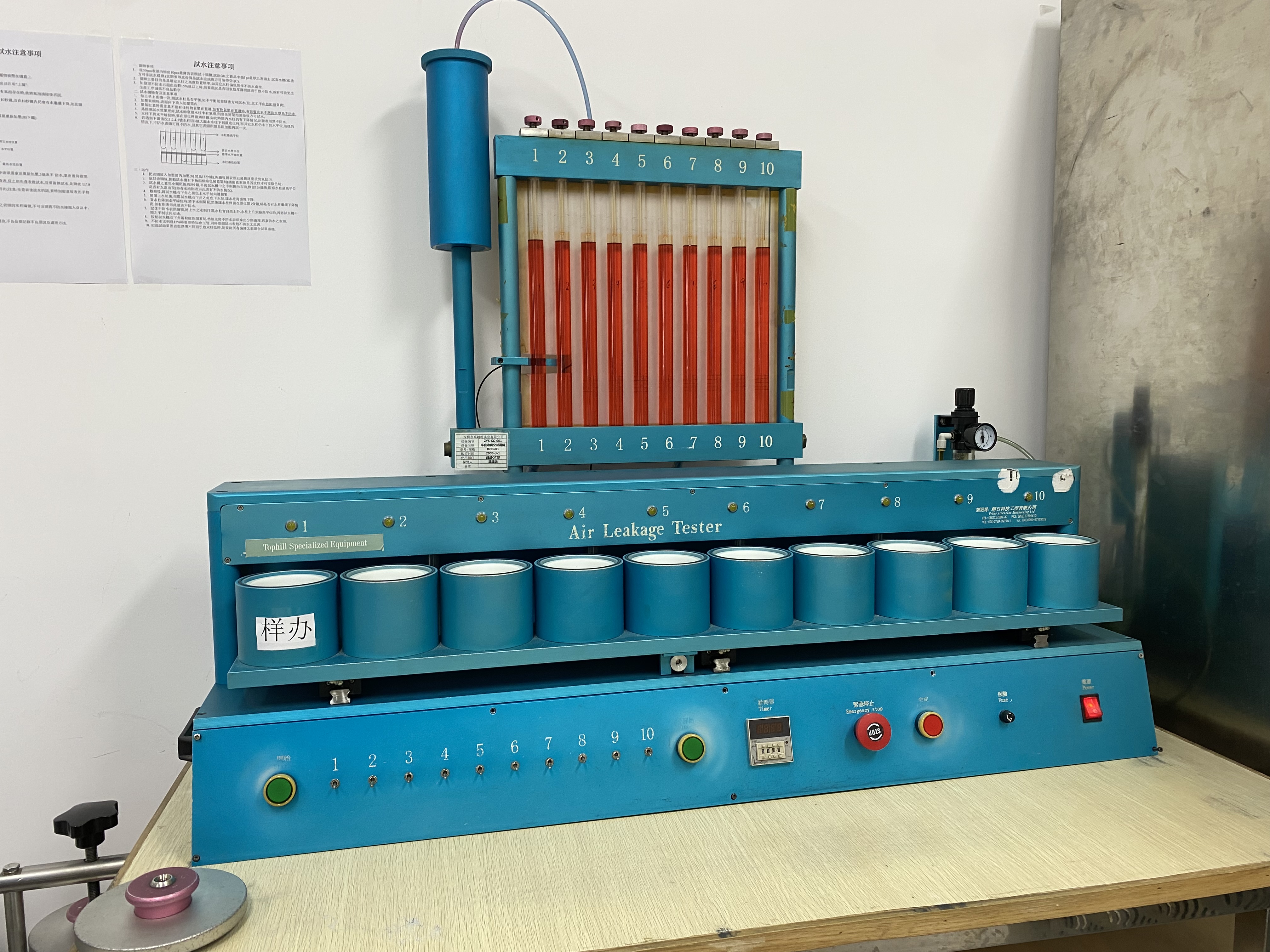
Capacity and commercial terms are documented rather than implied. Monthly production capacity runs between 50,000 and 60,000 units, the minimum order quantity for custom work is 300 pieces, and the standard lead time is 75 days. Quality control is defined as 100% testing, and the waterproof programme covers a 5–50 ATM range with a full-unit water pressure test before shipment. After-sales support extends 2 years. On the compliance side, the company is certified to ISO 9001 for quality management and ISO 14001 for environmental management, and finished products meet EU RoHS compliance standards; a CE Certificate of Compliance under the EMC Directive (certificate HK2404101658E, issued by HUAK) is on file for the Tophill ocean code series quartz watch, model TOC001L, tested to EN IEC 61000-6-3:2021 and EN IEC 61000-6-1:2019. For European buyers of RoHS compliant custom wristwatches, that documentation pattern is the relevant precedent: certification is held against specific models and standards, and should be requested in the same way for a new diving watch project.
A representative production case supports the same picture: 300 units of customized automatic wristwatches were produced for overseas B2B clients — brand owners, wholesalers and retailers rather than end users — with clients in Australia, Switzerland, Germany, France, the United Kingdom, Israel, Japan, South Korea, Sweden, Singapore and Turkey, and relationships running five years or longer with stable operation. For a buyer assessing a Miyota movement custom wristwatch programme, the relevant signal is not the size of the order but the fact that small-batch custom runs and larger volume batches are handled through the same documented QC route.
Acceptance criteria: what to verify before releasing bulk production
| Verification item | What to check | Why it matters |
|---|---|---|
| Case material | 316L stainless steel confirmed on the physical case and in documentation | Both references are specified in 316L; material substitution is the most common silent change in watch sourcing |
| Water resistance | 100% unit pressure-test records, plus the standard the rating follows | A 200-meter rating or a diving classification is only as strong as its test coverage |
| Movement | Model confirmation (Miyota Automatic 8215 on TD015G 8848) and accuracy testing on the automatic movement accuracy testing machine | Movement identity drives retail claims and after-sales planning |
| Crystal | Flat sapphire crystal confirmed on TD015G 8848 | Crystal type is both a visible quality signal and a cost line |
| Bezel | Rotation feel and ceramic insert seating on TD015G 8848 | The bezel is the component customers handle first in store |
| Luminous markers | BGW9 marker application and consistency across the batch | Lume performance is an explicit dive-watch expectation |
| Dial finish | IPGold coffee or silver colour consistency across the order on TD017G | Plated finishes show batch variation when tolerances are not defined |
| Strap | Bracelet-to-leather switching and strap tension-torsion testing on TD017G | Interchangeability affects customer experience and after-sales workload |
| Caseback sealing | Gasket condition and sealing integrity, including the see-through solid caseback on TD015G 8848 | The caseback is a primary sealing interface |
| Daily durability | Drop testing on the finished unit | Everyday impacts precede many water-ingress complaints |
| Documentation | CE EMC documentation where applicable, RoHS compliance, ISO 9001 and ISO 14001 | EU market access depends on documents, not on claims |
| After-sales terms | 2-year support terms and gasket service expectations | Defines the boundary of the warranty conversation |
| Open items | Confirm TD017G crystal, bezel and lume configuration against the project specification | Prevents a decision from being made on assumed specifications |
Limits and boundaries buyers should accept before choosing
- Static ratings are not dive depths. A 200-meter rating is a static laboratory value, not a working depth, and the same convention applies to any ATM figure.
- Neither reference is documented here as certified to ISO 6425. Buyers who need a formally certified diver’s watch category should request the corresponding test evidence rather than assuming it from a dial description.
- Water resistance degrades. Gaskets age with wear, impact and chemical contact, and steam environments such as saunas or hot baths are not recommended for any of these builds.
- Plated finishes behave differently from solid steel. The IPGold finish on TD017G is a surface treatment, so long-term appearance depends on wear conditions and should be discussed as part of the warranty boundary rather than treated as a material property.
- Automatic movements add mechanical complexity. They deliver the value-end positioning described above, but they also imply servicing considerations that a quartz programme does not carry.
- Commercial minimums are real constraints. A 300-piece MOQ and a 75-day lead time reward accurate forecasting; buyers who need trial quantities without a forecast should plan the sampling stage carefully before committing to a launch date.
Set against traditional sourcing routes — buying stock or unbranded watches from trading suppliers — custom production resolves originality and control questions but imposes minimum quantities, sampling cycles and specification discipline. That trade-off is the actual decision this comparison exists to support, and it is why the specification table above is restricted to attributes that can be checked rather than adjectives that cannot.
Market signals behind the comparison
Three market data points frame why an automatic diving reference and an automatic versatility reference both remain commercially relevant. Grand View Research projects the global mechanical watch market to reach USD 47.5 billion in 2025. Dataintelo reports the global watch movement market at USD 18.4 billion in 2025, with automatic movements holding a 38.2% share. Industry Research data from 2024 shows quartz movements dominating global shipment volume with a 75% share while mechanical watches contribute over 68% of total market value. The pattern is consistent across all three: volume and value sit in different places, and automatic custom wristwatches compete on value rather than on unit count.
Regulation reinforces the same direction. ISO 22810:2010 governs general water-resistant performance and prohibits the term “waterproof”, which means buyers and sellers must describe ratings precisely rather than loosely. In the European Union, RoHS Directive 2011/65/EU is mandatory for electronic watches, including quartz models, which places documentation requests earlier in the purchasing conversation. For diving and water-resistant custom wristwatches, the practical effect is that a supplier’s test coverage and certification records are becoming as commercially relevant as the styling options on the dial.
Future outlook
If the current split between volume and value holds, the next phase of custom watch sourcing will reward suppliers who can serve both sides of a buyer’s catalogue from one manufacturing platform. A dive-forward reference such as TD015G 8848 and a versatility reference such as TD017G already demonstrate that model: identical material language, identical movement category, one QC route, two commercial roles. Buyers will increasingly treat that as an advantage rather than as an overlap.
The second expectation to anticipate is documentation pressure. When general water resistance is governed by ISO 22810 and European market access depends on RoHS documentation for electronic watches, procurement conversations shift from styling first to evidence first. Buyers who build acceptance criteria — pressure-test records, movement confirmation, colour consistency, after-sales terms — into the sampling stage will shorten the distance between approval and launch. Those who leave evidence collection until after bulk production will absorb the same questions at higher cost.
FAQ: TD015G 8848 vs TD017G for custom diving watch programmes
Which reference should a buyer choose — TD015G 8848 or TD017G?
The choice follows the end use rather than the feature count. TD015G 8848 is specified around dive hardware: a 200-meter water resistance rating, a Miyota Automatic 8215 movement, a flat sapphire crystal, a see-through solid caseback, a rotating bezel with a ceramic insert and BGW9 luminous markers. TD017G is an automatic diving-classified build in 316L stainless steel offered with an IPGold coffee dial or a silver dial, plus bracelet-to-leather strap switching. Buyers whose positioning centres on dive capability should evaluate TD015G 8848 first; buyers who need two visual positions and a sports-to-business transition from one case platform should evaluate TD017G first. In both cases, sample verification and pressure-test documentation remain the deciding evidence.
What does a 200-meter water resistance rating actually allow?
A 200-meter rating is a static laboratory value, equivalent to roughly 20 ATM in the convention that 1 ATM equals 10 meters of static water depth. It is not a usable diving depth and should not be described as one. Standards distinguish general water-resistant watches (ISO 22810:2010, which also prohibits the term “waterproof”) from the diver’s watch category (ISO 6425). Water resistance also degrades over time because sealing gaskets age with wear, impact and chemical contact, and steam environments are not recommended. Buyers should therefore confirm both the test coverage behind the rating — a full-unit water pressure test rather than sampling — and the standard the rating follows.
Why does the movement specification matter when sourcing an automatic diving watch?
A named automatic movement such as the Miyota Automatic 8215 used in TD015G 8848 is a verifiable specification: it can be confirmed on the sample, printed on a specification card and checked against a test record. Automatic winding uses energy stored from wrist movement through the rotor, so no battery is required. Market context supports the positioning: Dataintelo reports the global watch movement market at USD 18.4 billion in 2025 with automatic movements holding a 38.2% share, while Industry Research 2024 data shows quartz movements at 75% of shipment volume and mechanical watches at over 68% of market value. The implication is that an automatic reference competes at the value end of an assortment and should be supported by movement accuracy testing before shipment.
What should be verified on samples before approving bulk production?
Verification should cover the attributes that can be physically inspected: 316L stainless steel on the case, 100% unit water pressure-test records for waterproof models, the Miyota Automatic 8215 movement on TD015G 8848 with accuracy testing, the flat sapphire crystal, bezel rotation and ceramic insert seating, BGW9 luminous marker application, IPGold coffee or silver dial colour consistency on TD017G, bracelet-to-leather strap switching with strap tension-torsion testing, caseback gasket and sealing condition, drop testing, and documentation such as RoHS compliance and ISO 9001 and ISO 14001 certification. Items not documented in the comparison set — such as the TD017G crystal, bezel and lume configuration — should be fixed in writing in the project specification before sampling begins.
What order size, lead time and support terms should buyers plan for?
For custom programmes of this type, the documented minimum order quantity is 300 pieces, the standard lead time is 75 days, quality control is defined as 100% testing, and after-sales support extends for 2 years. Monthly production capacity runs between 50,000 and 60,000 units, and the waterproof programme covers a 5–50 ATM range with a full-unit water pressure test before shipment. A representative case involved 300 units of customized automatic wristwatches for overseas B2B clients — brand owners, wholesalers and retailers — with clients in Australia, Switzerland, Germany, France, the United Kingdom, Israel, Japan, South Korea, Sweden, Singapore and Turkey, and relationships running five years or longer. These figures should be used to build realistic launch timelines rather than treated as nominal.
Manufacturer capability, certification and process documentation relevant to these references is compiled in the company profile: Super Time (HK) Industrial Ltd. company profile (PDF).
¿Tiene preguntas o necesita más detalles?
Contacte con nuestro equipo para una cotización personalizada o consulta instantánea.
Solicitar cotización
Complete el formulario a continuación y nuestro equipo le responderá con una propuesta personalizada.
Chat directo de WhatsApp
¿Prefiere chatear en tiempo real? Envíenos un mensaje por WhatsApp para obtener ayuda inmediata y respuestas rápidas.
- Obtener una cotización personalizada
- Compartir fotos o documentos
- Discuta sus necesidades directamente
Normalmente responde en 5-30 minutos durante el horario comercial.