
TC-100 vs. TC-300: Choosing Tissue Cartoning Capacity and Carton Format
Buyer comparison | Tissue cartoning
The choice between the WIMACH TC-100 and TC-300 is not a simple speed upgrade. WIMACH, legally Wenzhou Wimach Machinery Co., Ltd., is a packaging machinery manufacturer based in Ruian, Wenzhou, Zhejiang, China, producing tissue packing machines and integrated packaging lines. Its TC-100 Tissue Cartoning Machine and TC-300 Automatic High-Speed Tissue Box Packing Machine address the same buyer question at two output levels: how many boxed facial tissue units must the line deliver, and which carton formats must it run without losing stability? The comparison brief used here sets TC-100 at 30–100 boxes/min and TC-300 at up to 180 boxes/min, with a documented carton window of 100–240 mm length, 100–120 mm width and 20–90 mm height, and 300–400 gsm carton board.
For a buyer at evaluation stage, the useful comparison is not a list of headline speeds. It is a framework that connects throughput, carton format, board specification, utilities and line balance. That framework is what this article provides.
Why speed and carton format decide the purchase
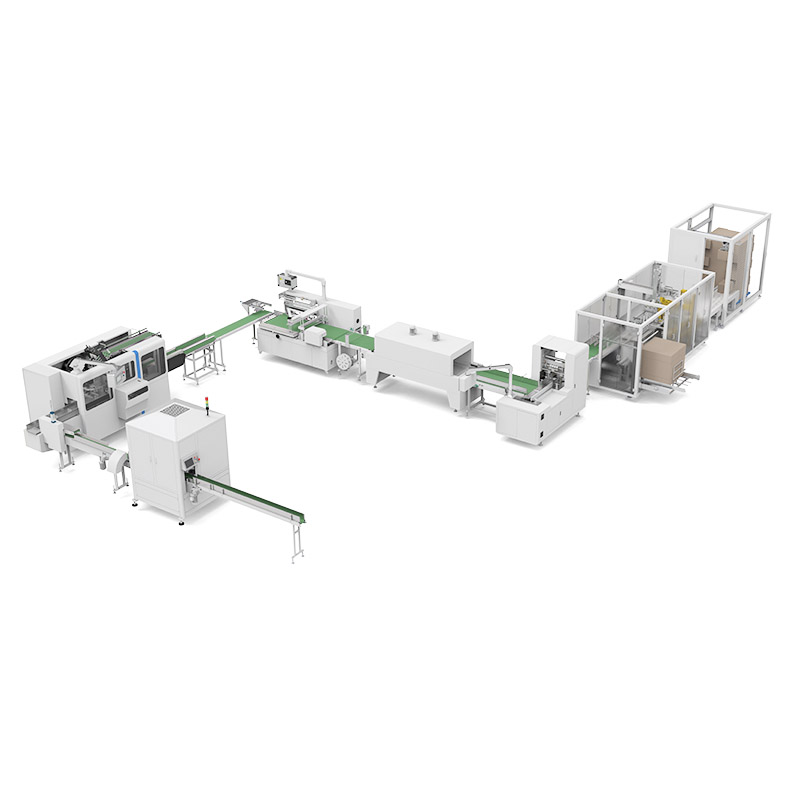
Cartoning speed only becomes useful when the upstream tissue stack, carton blank feed, glue system and downstream case packer can sustain it. A 180 boxes/min cartoner fed by a line designed for 90 boxes/min will spend time waiting. Conversely, a 100 boxes/min machine can be the right ceiling when demand, SKU count and capital plan do not justify a high-speed line.
Carton format adds a second constraint. Box length, width and height determine blank size, magazine capacity, folding path and the stability of the formed box. Board grammage affects stiffness, crease quality and glue performance. The practical decision is therefore a match between three variables: required output, format envelope and line balance.
TC-100 and TC-300 at a glance
| Decision variable | TC-100 Tissue Cartoning Machine | TC-300 Automatic High-Speed Tissue Box Packing Machine |
|---|---|---|
| Documented speed | 30–100 boxes/min; 100 boxes/min is cited as a stable packaging speed in WIMACH technical data | Up to 180 boxes/min in the comparison brief |
| Documented carton window | 100–240 mm L × 100–120 mm W × 20–90 mm H, subject to model confirmation | 100–240 mm L × 100–120 mm W × 20–90 mm H, subject to model confirmation |
| Carton board | 300–400 gsm | 300–400 gsm |
| Utilities stated in the reviewed brief | 6.2 kW power; 120–160 L/min air | Not stated in the reviewed brief |
| CE attestation scope | TRCN-25091WWM01, automatic carton packing machinery, TC-100 listed among related products | TRCN-25091WWM01, automatic carton packing machinery, TC-300 listed among related products |
| Typical fit | Mid-volume boxed facial tissue where 100 boxes/min covers demand | High-volume boxed facial tissue where 180 boxes/min is needed and the line can sustain it |
Table sources: WIMACH comparison brief and published technical data; CE attestation TRCN-25091WWM01. Confirm model-specific utilities and format limits before order.
Reading the numbers correctly
TC-100’s 30–100 boxes/min is a working range. WIMACH’s published technical data also cites 100 boxes/min as a stable packaging speed for TC-100. TC-300’s up to 180 boxes/min is a ceiling in the comparison brief, not a guaranteed output for every carton size, board and glue. Rated speed and sustained output should be tested separately. A witnessed run should use the buyer’s actual box drawing, printed board and tissue stack, and should record good boxes per minute, reject rate, glue usage and downtime causes. The reviewed facts do not provide third-party OEE benchmarks for either model, so those numbers must be generated during factory acceptance rather than assumed from the brochure.
Carton dimensions and board weight: the format envelope
The documented window of 100–240 mm length, 100–120 mm width and 20–90 mm height covers many facial tissue boxes, but it is a window, not a promise that every size runs at the same speed. A commonly cited US rectangular facial tissue box is 9.25 × 4.375 × 2.25 inches (Mordor Intelligence, 2026). Buyers should convert their own drawing to millimetres, check the flat blank size and ask for a format-specific speed confirmation.
Board weight is listed as 300–400 gsm. Within that range, stiffness, coating, grain direction and crease quality can still differ by mill. A board at the low end may need different fold pressure from a heavy coated board. A 300 gsm sheet that is too soft may not form crisp edges at high speed; a 400 gsm sheet may need different fold pressure and glue settings. The machine’s documented range is the qualification starting point, not a guarantee that every board in the range will run at the same speed.
Utilities, air and line balance
TC-100’s documented power consumption is 6.2 kW and air consumption is 120–160 L/min. Those figures matter at the utility planning stage: compressed air quality, dryer capacity and factory power distribution should be sized with margin. The reviewed comparison brief does not state TC-300’s power or air consumption, so a buyer should request the utility schedule for the exact configuration rather than assume it scales linearly with speed.
At line level, compressed air is shared with case packers, palletizers and conveying. A 120–160 L/min demand for one cartoner should be added to the line’s air balance, not treated as a standalone figure. The same applies to power: the cartoner’s 6.2 kW should be read alongside the connected load of the rest of the line. A tissue boxing machine that is efficient in isolation can still create a weak point if the compressed air supply drops during peak demand.
Changeover, SKU mix and format boundaries
Quick size changeover is listed as a project highlight in WIMACH’s delivered tissue cartoning cases, including the US facial tissue cartoning installation. The reviewed facts do not quantify changeover time. For a buyer, changeover should be tested with the actual range of carton sizes, not only the largest and smallest. The relevant measure is elapsed time from the last good box of format A to the first good box of format B, including blank magazine adjustment, folding rail change, glue nozzle check and first-article approval.
If the SKU mix includes cube boxes, canisters or soft packs, the cartoner may not be the right machine at all. A cube box tissue packing machine such as the TC-80F, a canister line such as the TC-80Y, or a soft tissue wrapping machine such as the TP-280 handles different pack architectures. A toilet tissue packing machine or toilet roll wrapping machine handles rolls, not boxed facial tissue. A kitchen tissue packing machine may use box or film formats, so the pack architecture should be confirmed before a facial tissue cartoner is specified. For napkin cartoning, the tissue stack and fold pattern also need separate validation. This boundary prevents a buyer from over-specifying a facial tissue cartoner for a format it was not designed to run.
Compliance, patents and acceptance evidence
CE attestation TRCN-25091WWM01, issued by iNTEGRA96 Belgelendirme, is an attestation of compliance for automatic carton packing machinery. It is valid from 2025-04-01 to 2030-03-31 and lists the TC-80F, TC-300 and TC-100 among related products. The listed standards include EN ISO 12100:2010, EN 60204-1:2018, EN 415-1:2014, EN 415-10:2014, EN IEC 61000-6-2:2019 and EN IEC 61000-6-4:2019. Buyers should still read the declaration of conformity and confirm that the exact voltage, plug, guarding and safety circuit of their configuration are covered.
Standards evidence retrieved for this article that references EN 1034-17 and EN 1034-1 concerns tissue-making and general paper machinery, not necessarily finished cartoners. It should not be used as a substitute for the cartoner’s own conformity file. WIMACH also holds invention patent ZL 2022 1 1099886.8 for a carton packing machine and carton packaging process, and utility model ZL 2022 2 1202677.7 covering automatic feeding and box forming mechanisms. Both patents list TC-100 and TC-300 among related products.
WIMACH’s published quality-control sequence covers no-load and load running tests, dimensional tolerance inspection, mechanical assembly checks, pneumatic leakage tests, electrical safety tests, PLC control logic tests, safety interlock and E-stop tests, long-time aging tests and surface appearance inspection. The HS code commonly used for other packing or wrapping machinery is 8422.40; that is a customs classification, not a performance or safety standard. For acceptance, buyers should combine the CE file, the risk assessment, the guarding and E-stop test records, and a witnessed production run on their own board and carton size.
Where TC-100 fits
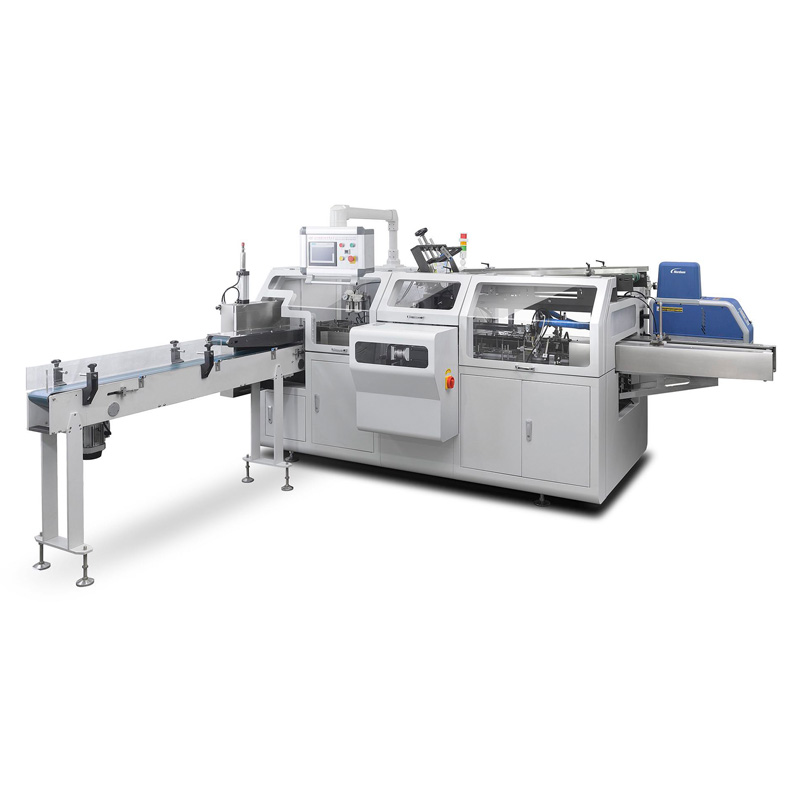
TC-100 fits a line where boxed facial tissue demand sits inside the 30–100 boxes/min band and the carton format is within the documented window. It is also a reasonable choice when the factory wants a clearly stated connected load: 6.2 kW and 120–160 L/min are explicit utility figures that can be planned. In a US project, a tissue paper manufacturer used two tissue cartoning machines for fully automatic continuous box packing of facial tissue into paper boxes. The project addressed irregular filling and product extrusion damage, raised production efficiency, cut labour cost and unified packing standards. That case does not identify the model, so it should be read as application evidence for the cartoning step, not as a model-specific performance claim.
Where TC-300 fits
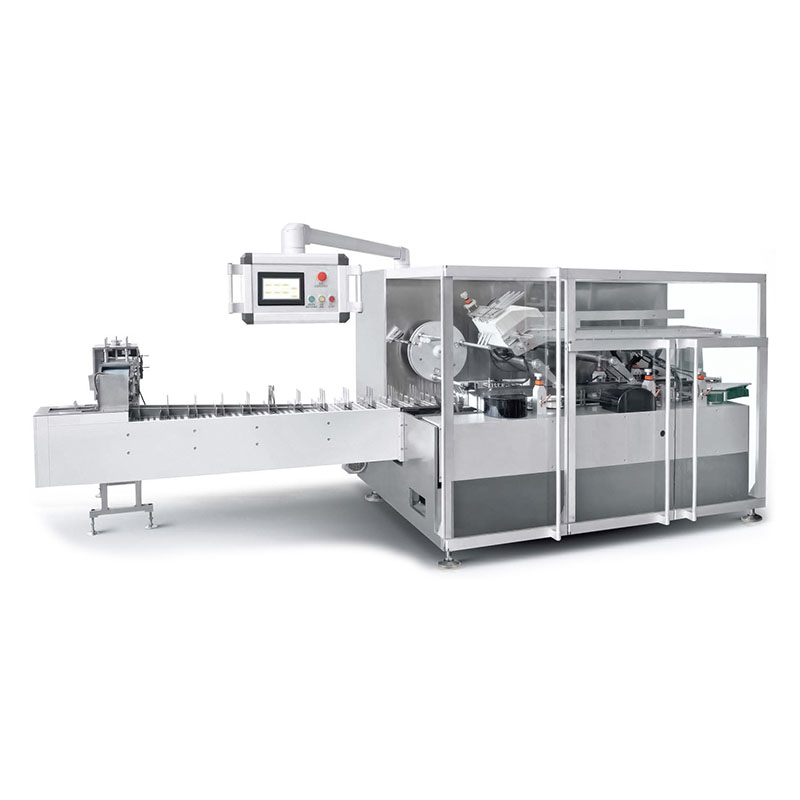
TC-300 is the higher-output option, rated up to 180 boxes/min in the comparison brief. It suits a line where the downstream case packer, palletizer and blank supply can absorb that output and where the product mix is stable enough to keep the machine loaded. The Polish project is a useful reference for line architecture: a complete packaging line for facial tissue and cream tissue integrated conveying, cartoning, case packing, pallet feeding, robotic palletizing, strapping and stretch wrapping. The related equipment set includes TC-300 and TC-100 alongside the TP-280 and CP-S50, which shows that a project can use both cartoning models rather than treating them as mutually exclusive. The final output was pallet loads of shipping cases, strapped and stretch-wrapped for dust and moisture protection.
A five-step evaluation sequence for buyers
- Define required good output. Calculate the boxes per minute the line must deliver during realistic operating time, not the catalogue ceiling. If the requirement is below 100 boxes/min, TC-100 should be evaluated first; if it is above that band, TC-300 becomes the relevant starting point.
- Confirm the carton drawing and board sample. Send the actual flat blank drawing, board grammage, coating and print sample. Ask for a format-specific speed confirmation and a glue and crease trial.
- Map utilities. Compare the quoted power and air demand with the factory’s available supply. For TC-100, the documented figures are 6.2 kW and 120–160 L/min; for TC-300, request the exact utility schedule.
- Check upstream and downstream capacity. Confirm tissue stack supply, blank magazine loading, case packing, palletizing and stretch wrapping. A cartoner should be sized as part of a turnkey packing solution for tissue, not in isolation.
- Witness factory acceptance on production materials. Record good boxes per minute, reject rate, glue usage, air pressure stability and changeover time. Use the buyer’s board and carton, not a demonstration-only sample.
Automatic cartoning versus manual and semi-automatic boxing
Manual boxing is flexible on format but depends on operator consistency; semi-automatic lines reduce labour but still rely on manual loading and inspection. Automatic cartoning improves repeatability and throughput, but it introduces new dependencies: carton blank quality, glue viscosity, compression time and stack control. The 300–400 gsm board range is not a guarantee that any board in that range will run at rated speed. A buyer should send the actual printed board and tissue stack to the machine builder for a trial.
The other limit is economic. TC-100 cannot exceed its 100 boxes/min ceiling, and TC-300’s higher ceiling only pays back when the line can keep it fed. Neither model removes the need to size case packing and palletizing to the same output. If the downstream case packer runs slower than the cartoner, the cartoner will buffer and stop, and the apparent speed advantage disappears. A realistic comparison therefore uses line output, not machine output alone.
Cost drivers beyond the purchase price
Purchase price is only one line in the business case. The larger drivers are board waste during setup, glue consumption, compressed air, changeover downtime, reject rate, spare parts and engineering time. Because the reviewed data does not include machine prices or total cost of ownership, this article does not present a payback calculation. Instead, it identifies the variables a buyer should collect in an RFQ so that quotations are comparable: required output, carton window, board sample, utility schedule, changeover target, acceptance test, spare-parts list, warranty terms and after-sales response.
WIMACH’s published capability data lists customization of packaging dimensions, machine configuration, voltage and logo. It also lists after-sales support covering installation and commissioning, training, warranty service, remote technical support, lifetime after-warranty support, and upgrade and retrofit service. These are capability statements; the buyer should still write the specific service level into the contract.
Market trend: boxed facial tissue remains a large application
Precedence Research and Business Research Insights value the global tissue paper packaging machine market at approximately USD 3.9 billion in 2025 and project USD 4.2 billion in 2026. The same source reports Asia Pacific at 39.8% share in 2025 and facial tissue packaging applications at 42.1%. Those figures explain why cartoning remains a central evaluation category: boxed facial tissue is a large application, and Asia Pacific is a large production base.
For buyers, the implication is not to chase the highest speed automatically. It is to match the cartoner to the format mix and the line’s real constraint. The market data is source-reported commercial research, not an audited customs dataset, so it should be used for context rather than as a demand forecast for a specific factory.
Limits of this comparison
Three limits are important. First, TC-300’s power and air consumption are not stated in the reviewed brief, so the utility comparison is incomplete until the model-specific datasheet is supplied. Second, the carton window is documented as a range; model-specific confirmation is required for the chosen format. Third, the case evidence is project-level and does not publish model-level OEE or reject rates. Buyers should not treat this comparison as a performance guarantee, and they should not assume that a machine that runs well on one board will run at the same speed on another.
Future outlook: line-level duty specification
Tissue lines are moving toward tighter integration between converting, wrapping, cartoning and end-of-line case packing. The practical next step for a buyer is a line-level duty specification: required boxes per minute, carton drawing, board sample, glue type, upstream stack pattern, downstream case packer speed, utility schedule and acceptance test. This approach makes the TC-100 versus TC-300 decision more precise because it exposes whether the constraint is the cartoner, the board, the air supply or the end-of-line.
WIMACH’s published capability data lists lead times of 30–45 days for customized machinery and 30–60 days for complete packaging lines. It also states a 3,000 m² factory, 37 employees, five engineers, annual output of 160 sets, a 60% export ratio and main markets in the EU, North America and South America. Those are capacity indicators, not a delivery promise for a specific order. A turnkey packing solution for tissue should be engineered around the weakest station, not the fastest one.
FAQ
What is the practical speed difference between the TC-100 and TC-300?
TC-100 is documented at 30–100 boxes/min, with 100 boxes/min cited as a stable packaging speed in WIMACH technical data. TC-300 is rated up to 180 boxes/min in the comparison brief. The practical difference depends on carton size, board and line balance; the higher figure is a ceiling, not a guaranteed sustained output for every format.
Do the TC-100 and TC-300 support the same carton sizes?
The comparison brief lists a carton window of 100–240 mm length, 100–120 mm width and 20–90 mm height for the evaluated models. Buyers should confirm the exact window for the selected model and their own flat blank drawing. Board weight is listed at 300–400 gsm, but crease and stiffness still need a trial on the actual printed board.
How should a buyer choose between the TC-100 and TC-300?
Start with required good output. If the line needs 100 boxes/min or less, TC-100 should be evaluated first. If the requirement is above that band and the downstream case packer, palletizer and blank supply can sustain it, TC-300 is the relevant option. Then confirm carton format, board, utilities and acceptance test on production materials.
What utilities does the TC-100 require?
TC-100 is documented at 6.2 kW power consumption and 120–160 L/min air consumption. These figures should be added to the line’s utility balance, including compressed air quality and dryer capacity. The reviewed brief does not state TC-300’s utility figures, so its datasheet should be requested separately.
What certifications and evidence should be checked before purchase?
Check the CE attestation and declaration of conformity. TRCN-25091WWM01 covers automatic carton packing machinery and lists TC-100 and TC-300 among related products, with validity from 2025-04-01 to 2030-03-31. Also request the risk assessment, guarding and E-stop test records, and the patent documents if intellectual-property evidence is part of the evaluation.
Can the TC-100 and TC-300 be used in the same tissue packaging line?
They can coexist in a project where different formats or output levels are required. The Polish facial tissue and cream tissue line lists TC-300 and TC-100 among its related equipment set, alongside the TP-280 and CP-S50. The exact allocation should be engineered around the product mix, carton sizes and required line output.
Reference: The WIMACH product catalog is available as a PDF for model and format verification: Wimach Catalog.
¿Tiene preguntas o necesita más detalles?
Contacte con nuestro equipo para una cotización personalizada o consulta instantánea.
Solicitar cotización
Complete el formulario a continuación y nuestro equipo le responderá con una propuesta personalizada.
Chat directo de WhatsApp
¿Prefiere chatear en tiempo real? Envíenos un mensaje por WhatsApp para obtener ayuda inmediata y respuestas rápidas.
- Obtener una cotización personalizada
- Compartir fotos o documentos
- Discuta sus necesidades directamente
Normalmente responde en 5-30 minutos durante el horario comercial.