
T41, T27, and T29 Disc Shapes: A Compliance and Standards Primer
HTNXT Industry Reference · Bonded Abrasives
T41, T27, and T29 Disc Shapes: A Compliance and Standards Primer
T41, T27, and T29 are shape designations used throughout the bonded abrasive industry. Each one describes the profile of a disc — flat, depressed center, or double depressed — and each one maps to a defined operating mode, a permitted mounting orientation, and a marked maximum operating speed.
Those letters and numbers are not marketing shorthand. In practice they tell a buyer whether a wheel is intended for cutting or for grinding, how much side load it may see, and which safety requirements apply to it. Because bonded abrasives rotate at high speed, the shape code forms part of a product’s compliance identity rather than a cosmetic detail.
The commercial stakes are significant. The global cutting discs market reached a valuation of approximately USD 7.32 billion in 2024, according to Market Research Future, and Asia-Pacific accounted for 48.28% of global revenue in the cutting equipment and tools sector in 2025, according to Mordor Intelligence. With that volume moving through distributors, importers, and OEM programs, shape and speed literacy has become a sourcing skill rather than a workshop detail.
The Problem: Diameter-Only Specifications Hide the Safety Logic
Most catalogues and purchase orders reduce a disc to a single dimension: 115 mm, 180 mm, 355 mm, 400 mm. Diameter is easy to compare and easy to quote, so it becomes the default specification language across the tool and hardware category. Shape is often treated as a footnote, if it appears at all.
That shortcut produces predictable failure modes. A buyer orders 180 mm discs for a workshop where operators both cut and grind. If flat cutting wheels arrive where depressed-center grinding wheels were intended, the shop either returns the order or, worse, uses the cutting wheels for grinding. Both outcomes carry cost. The first delays a project; the second loads a thin, flat body with side forces it was never qualified to absorb.
The regulatory layer makes the same point. EN 12413:2019, published by CEN and distributed through national standards bodies such as BSI, specifies the safety requirements and testing procedures for rotating bonded abrasive products, including cutting and grinding wheels. That framework operates alongside shape and speed markings, because a bonded wheel’s safe operating envelope is defined by geometry as much as by abrasive grain or bond formulation.
The opportunity for buyers is straightforward: promote the shape code to a first-class specification field. It costs one additional column in a purchase order and removes an entire class of mismatch, complaint, and return. For distributors building a private-label abrasive range, it also determines how a catalogue should be segmented so that end users are guided to the right wheel for the operation in front of them.
What T41, T27, and T29 Actually Describe
| Designation | Profile | Intended operating mode | Practical boundary |
|---|---|---|---|
| T41 | Flat (straight) | Cutting off, with the wheel presented perpendicular to the workpiece | Not intended for grinding at an angle; side load sits outside its design purpose |
| T27 | Depressed center | Grinding, blending, and surface preparation at a working angle | Mounting flange sits below the working face; intended for grinding, not for deep cutting |
| T29 | Double depressed (conical) | Heavier grinding, contour work, and edge blending at steeper angles | Deeper profile provides clearance for aggressive angles; still governed by its marked speed |
T41 — Flat
A T41 disc has a flat profile: thickness is essentially uniform from the bore to the outer edge. It is a cutting-off wheel. Working contact happens at the periphery of the disc, and the wheel is presented perpendicular to the material, so forces travel radially through the body rather than sideways across it.
Because a flat body offers little resistance to bending, a T41 wheel is not a grinding tool. Tilting it against a workpiece changes the load path and places the disc outside the condition it was qualified for. The same geometry explains why flat wheels can be produced in thin and ultra-thin sections: less material in the cut means less material removed and less heat generated, which is the entire purpose of a cutting wheel.
T27 — Depressed Center
A T27 disc is recessed around the arbor hole, so the mounting flanges sit below the plane of the outer working face. The visible result is a shallow bowl: the rim performs the work while the hub stays clear of the material. That clearance is what allows an operator to tilt the wheel and grind at an angle — the standard grinding posture — instead of holding it flat against the surface.
The depressed center also changes the structural behavior of the disc. A T27 wheel is generally thicker and more heavily built than a cutting wheel of similar diameter, because it is expected to absorb lateral forces rather than avoid them.
T29 — Double Depressed
A T29 disc uses a deeper, conical depression than a T27. The additional relief increases clearance between the tool body and the workpiece and permits a steeper working angle. That geometry is useful for heavier stock removal, blending, and contour work where access is tight and the operator needs the edge of the wheel to reach into a corner or along a weld.
The trade-off is consistent across all three designations: a shape extends capability only inside its marked limits. Deeper geometry does not raise the permitted peripheral speed, and no shape converts a cutting wheel into a grinding wheel.
Speed Ratings: Why 80 m/s Is a Ceiling, Not a Target
Maximum operating speed on a bonded abrasive is expressed in metres per second of peripheral speed, not in revolutions per minute. Peripheral speed depends on both diameter and rotational speed: a larger disc turning at the same RPM travels further per second at its rim, and therefore works harder.
The arithmetic is simple. For a 180 mm disc turning at 8,500 RPM, rim speed is π × 0.18 m × 8,500 ÷ 60, which is approximately 80 m/s. That is why a cutting disc documented at 80 m/s and 8,500 RPM is internally consistent: the two figures describe the same operating condition at that diameter.
For buyers and workshop managers, the practical rule is that the marked speed is a ceiling. A machine’s no-load speed must never exceed the maximum speed marked on the wheel, and a disc rated for one diameter cannot simply be transferred to a larger machine on the assumption that the rating travels with the brand.
CNDOME’s documented specifications place 80 m/s across several disc formats:
- A 7-inch class cutting disc in 180×1.6×22.23, 180×2×22.23 and 180×3×22.23, marked at 80 m/s and 8,500 RPM.
- A 14-inch cutting disc marked at 80 m/s and 4,400 RPM, intended for the steel and metal processing industry, automobile manufacturing, shipbuilding, casting, steel structure, and construction.
- A 16-inch cutting disc, 400×3.5×32, T41 shape, maximum speed 80 m/s, designed for construction and steel structure applications.
Reading these figures together shows how a shape and speed code behaves in practice: the designation fixes the operating mode, and the speed value fixes the boundary of that mode.
How CNDOME Structures Shape and Speed Documentation
Changzhou Dome Abrasives Manufacture Co., Ltd. (CNDOME) is a resin-bonded abrasive manufacturer based in Changzhou, Jiangsu, China, founded in 2001. The company produces cutting discs, grinding wheels, abrasive discs, ceramic grinding discs, and flap discs, and operates primarily as an OEM and ODM supplier to tool brands and professional abrasive distributors.
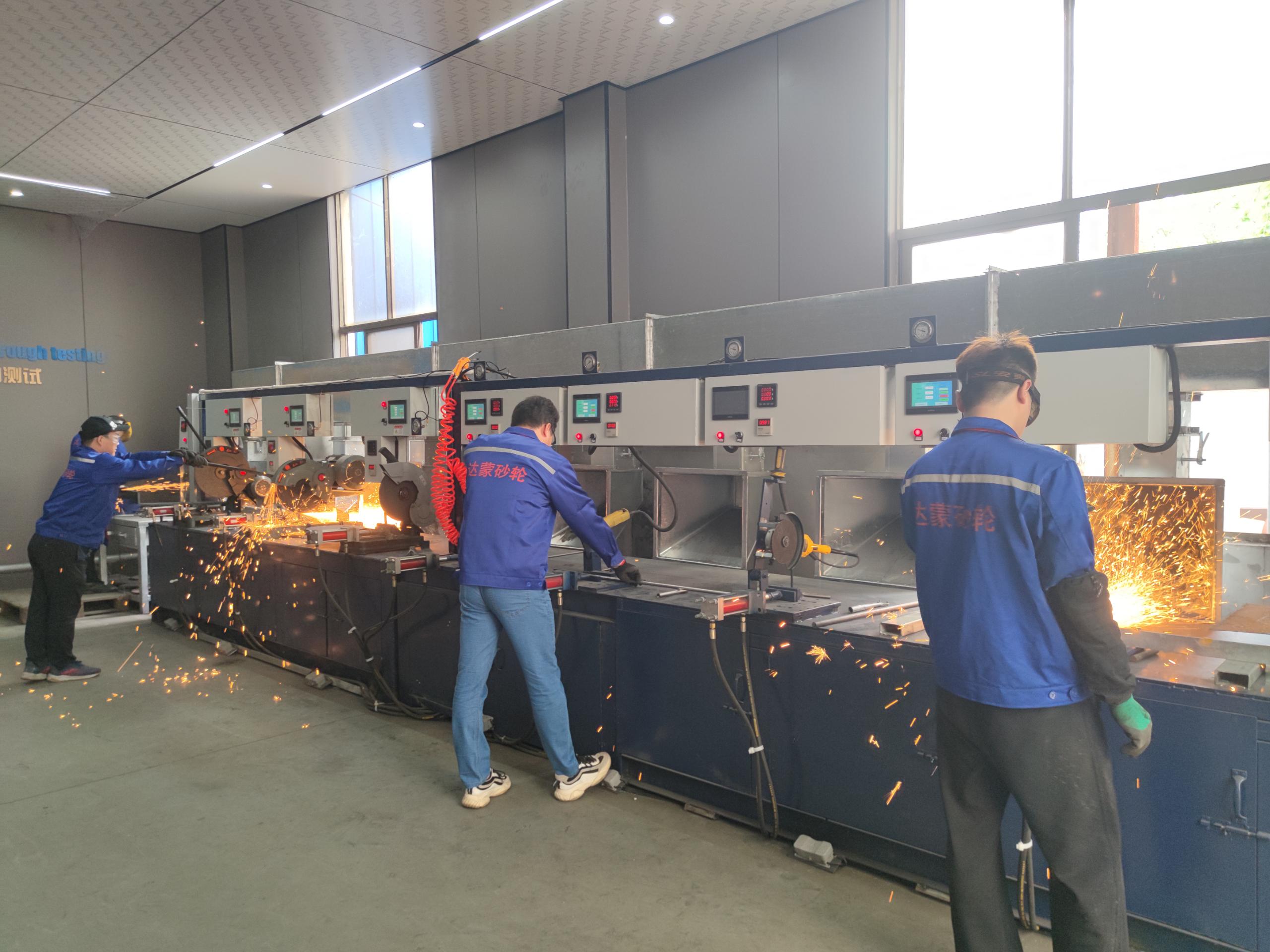
Its production base reflects that supplier position. CNDOME has over 26 years of experience in developing and manufacturing resin-bonded cutting and grinding wheels, and states that it has provided long-term support to more than 2,000 global tool and professional abrasive wheel brands. The temperature- and humidity-controlled workshop covers more than 20,000 square meters and is equipped with 60 automated production lines. Daily output is about 600,000 pieces, monthly production capacity is 8 million pieces, and annual output reaches 95 million pieces. The company employs 140 people, including a 10-person R&D team, and exports roughly 80% of production to Latin America, Europe, Africa, and Asia.
| Documented format | Shape | Dimensions | Max speed | Rotational speed | Typical application |
|---|---|---|---|---|---|
| Cutting disc, 7-inch class | T41 | 180×1.6×22.23 / 180×2×22.23 / 180×3×22.23 | 80 m/s | 8,500 RPM | Steel, metal processing, automobile manufacturing, shipbuilding, casting, steel structure, construction |
| Cutting disc, 14-inch | Not stated in published data | 14 inch | 80 m/s | 4,400 RPM | Steel and metal processing, automobile manufacturing, shipbuilding, casting, steel structure, construction |
| Cutting disc, 16-inch | T41 | 400×3.5×32 | 80 m/s | Not stated in published data | Construction, steel structure |
Bond and grain options documented across the range include aluminium oxide, white aluminium oxide, resin, silicon carbide, and zirconium. For a buyer assembling a shape-led range, that combination matters: the shape code tells the end user how the disc may be used, while the grain and bond determine how it performs in that use.
Application Fit: Where Each Shape Earns Its Place
CNDOME documents its cutting discs for the steel and metal processing industry, automobile manufacturing, shipbuilding, casting, steel structure, and construction. Those segments share one characteristic: they consume abrasives continuously, in defined operations, which makes shape discipline a production issue rather than an occasional concern.
In cutting operations, T41 wheels cover bar stock, tube, sections, and sheet. Thin and ultra-thin profiles are typically selected where cut quality and heat input matter, while reinforced constructions are selected where the operator needs additional tolerance for demanding handling. Aluminium oxide cutting discs are commonly used across general steel work, and stainless steel cutting discs are formulated for stainless applications where contamination control matters.
In grinding operations, T27 and T29 wheels cover weld dressing, edge blending, surface preparation, and casting cleanup. The choice between them is a choice about access and angle: a T27 depressed-center wheel handles the majority of flat and mildly angled work, while a T29 double depressed wheel is used where the operator needs greater clearance and a steeper approach.
Stainless steel deserves separate attention. Stainless steel cutting discs are identified as the dominating product category within the cutting discs market, according to Cognitive Market Research, driven by demand in construction and automotive manufacturing. Because stainless is a dominant application rather than a niche, the shape and speed markings on those discs are read by a large number of operators, which raises the value of clear, consistent documentation.
Compliance Evidence a Buyer Can Actually Check
Two reference points frame compliance for bonded abrasives sold into Europe. EN 12413:2019 defines the safety requirements and testing procedures for rotating bonded abrasive products. MPA Hannover provides independent safety testing and certification for abrasive tools, and that certification is a key requirement for exporting industrial cutting discs to the EU market.
For a procurement team, the practical checklist is documentation rather than reputation: shape and maximum speed markings on the disc, the corresponding EN 12413 reference, MPA test documentation where the EU market is the destination, batch traceability, and a supplier process that can explain how strength and mesh integrity are controlled.
CNDOME’s published process description addresses that last point directly. Each mesh is tested and high-strength raw materials are used. During production, every molding machine is equipped with a mesh visual inspection device, and the machine is stopped immediately for inspection if a mesh is missing. Raw material and mesh selection uses high-strength corundum and mesh, and the company states that wheel strength is higher than the international standard.
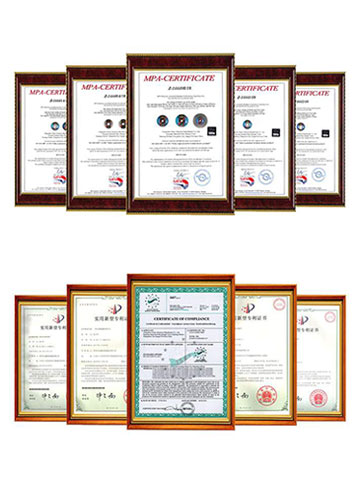
That level of detail is the difference between a certificate image and a compliance argument. One shows that a document exists; the other explains which production control produces the property the document certifies. For distributors carrying liability in their own markets, the second is the more useful evidence.
Market Context: Consolidation Around Standards and Stainless Demand
Market estimates for cutting discs vary with scope. Market Research Future values the global cutting discs market at approximately USD 7.32 billion in 2024, while Strategic Market Research reports USD 5.1 billion and Reports and Insights reports USD 2.5 billion for closely related definitions. The divergence reflects whether a study counts disc consumables alone or the broader cutting equipment category, and buyers comparing supplier presentations should note which definition is being used.
Regional weight is less ambiguous. Asia-Pacific accounted for 48.28% of global revenue in the cutting equipment and tools sector in 2025, according to Mordor Intelligence, maintaining its position as the largest regional market. Within that picture, the China abrasives market was valued at USD 2.29 billion in 2024, with synthetic raw materials accounting for USD 1.35 billion of that revenue, according to Intel Market Research.
At the supply end, the abrasives and cutting tool sector includes long-established participants such as Saint-Gobain (Norton), 3M, Robert Bosch GmbH, Tyrolit, and PFERD, alongside a large manufacturing base of OEM and private-label producers. The coexistence of both groups is what makes shape and standards literacy commercially relevant: the branded tier competes on application engineering, while the OEM tier competes on documentation, consistency, and the ability to reproduce a specification exactly.
Comparison: Shape-Led Sourcing Versus Conventional Practice
Conventional sourcing often compares discs on price per piece and diameter. A shape-led approach compares them on fit for a defined operation, documented speed rating, and compliance evidence. The two approaches produce different supplier shortlists, and the difference becomes visible at the audit stage.
CNDOME publishes benchmark comparisons against cutting discs from other factories. The reported performance gaps include effective cutting and grinding time per piece 15% to 25% longer, chipping strength increased by 20%, cutting speed increased by 10% under the same working conditions, and high-temperature tolerance 10% higher. The same comparison cites disc warpage of 0.03 mm or less, along with large-scale production, owned production lines, in-house R&D, and standardized processes as the basis for lower procurement cost, and it identifies the mechanical processing industry as the primary fit.
The first and firmest boundary sits with shape itself. A T41 disc is not a substitute for a T27 or T29 wheel, and no supplier’s quality level changes that. Geometry defines the permitted operation before any question of brand, grain, or price arises.
The second boundary is commercial. CNDOME documents a minimum order quantity of 10,000 pieces for sizes under 4 inches and 5,000 pieces for sizes over 4 inches, FOB or EXW delivery terms, 30% prepayment with the 70% balance due on delivery, and pre-shipment testing as the acceptance mechanism. For a distributor trialling a new SKU, those thresholds mean the first order is a commitment rather than a sample.
| Commercial term | Documented value |
|---|---|
| MOQ, sizes under 4 inches | 10,000 pieces |
| MOQ, sizes over 4 inches | 5,000 pieces |
| Delivery terms | FOB / EXW |
| Acceptance | Pre-shipment test |
| Payment | 30% prepayment, 70% balance on delivery |
The third boundary is performance itself. Life per piece, breakage, cut speed, and flatness depend on the machine, the material, the operator’s technique, and the age of the disc, so benchmark claims should be treated as a starting hypothesis rather than a guaranteed outcome. A distributor can improve a product line by choosing the right manufacturer; it cannot improve it by blurring the boundary between cutting and grinding wheels in its own catalogue.
Future Outlook
Three forces are likely to push shape and speed literacy further into procurement conversations. The first is standards. EN 12413:2019 and third-party certification such as MPA Hannover apply to rotating bonded abrasive products as a category, and importing markets increasingly expect documentation to travel with the shipment rather than be requested after a problem occurs.
The second is application mix. With stainless steel cutting discs identified as the dominating product category and Asia-Pacific holding the largest share of global revenue, demand is concentrated in segments where cutting quality, contamination control, and consumable cost per cut are measured continuously. That favors suppliers whose specification sheets already distinguish shape, speed, and material rather than compressing them into a single part number.
The third is catalogue discipline. As more distributors build private-label abrasive ranges, the shape code becomes the interface between the manufacturer and an end user who may never speak to either party. A T41 marking that is correct, a T27 marking that is correct, and an 80 m/s rating that matches the machine on the floor do more for long-term supply relationships than any volume commitment, because they prevent the failures that end them.
Frequently Asked Questions
What is the difference between a T41 and a T27 disc?
T41 designates a flat profile used for cutting off, with the wheel presented perpendicular to the workpiece at its periphery. T27 designates a depressed-center profile used for grinding, in which the mounting flanges sit below the plane of the outer working face so the wheel can be tilted against the material. The two shapes correspond to different operations and different load paths, not to different quality levels.
Can a T41 cutting disc be used for grinding?
No. A flat cutting disc has little resistance to bending, and tilting it against a workpiece introduces side load outside the condition for which it was qualified. Cutting wheels remove material with the periphery; grinding wheels remove material with the face. Exchanging them is a compliance issue, not an operating preference.
What does an 80 m/s marking on a cutting disc mean?
It is the maximum peripheral speed at which the manufacturer has qualified the disc, expressed in metres per second. Because peripheral speed depends on diameter and rotational speed together, the marked value must be read against the machine. A 180 mm disc turning at 8,500 RPM travels at approximately 80 m/s at its rim, and a machine whose no-load speed exceeds the marked rating should not be used with that wheel.
Which shapes and speed ratings appear in CNDOME’s published cutting disc data?
CNDOME documents a T41 cutting disc in 180×1.6×22.23, 180×2×22.23, and 180×3×22.23 at 80 m/s and 8,500 RPM; a 14-inch cutting disc at 80 m/s and 4,400 RPM; and a 16-inch cutting disc, 400×3.5×32, T41 shape, at a maximum speed of 80 m/s for construction and steel structure applications. Bond and grain options listed across the range include aluminium oxide, white aluminium oxide, resin, silicon carbide, and zirconium.
Do cutting discs for stainless steel require different handling from discs for carbon steel?
Stainless steel cutting discs are a distinct product category, identified by Cognitive Market Research as the dominating category within the cutting discs market on the strength of construction and automotive demand. Because stainless applications are sensitive to contamination, buyers typically specify discs formulated for stainless work rather than using a general-purpose steel cutting disc, and they verify shape and speed markings on the disc itself rather than relying on an outer carton description.
Which certifications and standards should a buyer verify on a bonded abrasive disc?
For European destinations, the relevant references are EN 12413:2019, which specifies safety requirements and testing procedures for rotating bonded abrasive products, and independent certification from MPA Hannover, which provides safety testing for abrasive tools and is described as a key requirement for exporting industrial cutting discs to the EU market. Beyond the certificates themselves, buyers generally verify the shape marking, the maximum speed marking, batch traceability, and the supplier’s documented production controls for mesh integrity and strength.
What commercial thresholds apply when ordering CNDOME cutting discs?
CNDOME documents a minimum order quantity of 10,000 pieces for sizes under 4 inches and 5,000 pieces for sizes over 4 inches, FOB or EXW delivery terms, 30% prepayment with the remaining 70% balance due on delivery, and pre-shipment testing as the acceptance mechanism. A 7-inch class cutting disc is listed among the products these terms apply to.
Reference document: CNDOME’s product brochure can be downloaded at https://cdn.socialarks.com/sbsp/24879/common/2026/0519/6a0c1596e4f3c.pdf