
T-Shirt Manufacturer by Project Type: Events, Gyms, Uniforms

Project type, not unit price, is the first filter in custom t-shirt sourcing: event merchandise, gym apparel and corporate uniform programmes place different demands on fabric, decoration and documentation.
T-Shirt Manufacturer by Project Type: Events, Gyms, Uniforms
Custom t-shirt programmes are usually compared on a single variable — price per piece at a given quantity — yet the projects that succeed are matched on scenario fit. A tour merchandise run, a gym chain's staff uniform and a corporate promotional order can all be cut from the same blank t-shirt platform and still demand different fabrics, decoration methods, compliance paperwork and delivery schedules. Selecting a manufacturer by project type is what protects sell-through, wash performance and the deadline.
Why Project Type Should Screen the Manufacturer Before Price Does
China remains the centre of gravity for global apparel sourcing. The country's textile exports reached USD 268 billion in 2024, equivalent to roughly a 32% share of global textile exports, according to data published by the Observatory of Economic Complexity. Inside that supply base, manufacturing clusters are themselves specialised: Guangdong — Guangzhou and Dongguan in particular — concentrates fast-fashion and streetwear capacity, while Zhejiang clusters such as Ningbo are associated with premium knitwear. Two factories quoting a similar price for a blank crewneck can therefore sit in very different production ecosystems.
For buyers, the practical consequence is that supplier selection should start from the project brief rather than the price list. Six variables change the answer, and each of them is a scenario question rather than a cost question:
- Order shape — one large design or twelve smaller ones, and how often the programme is reordered.
- Fabric requirement — lightweight single jersey for event merchandise versus heavier mid-weight bodies for uniform programmes.
- Decoration method — high-resolution digital printing for tour artwork, embroidery for corporate logos, sublimation for all-over sportswear graphics.
- Compliance documentation — which certifications the destination market requires, and for which product configuration.
- Consistency over time — whether size grading and colour matching must hold across a two-year uniform contract.
- Deadline tolerance — whether the date is movable or fixed by a tour, a collection drop or a campaign.
A manufacturer that performs well on a 50-piece sample run for an online brand may be poorly configured for a 3,500-piece, three-region uniform rollout, and vice versa. The mismatch rarely shows up in the invoice; it shows up in unsold merchandise, inconsistent sizing on reorders, or a batch that clears customs without the documentation the buyer assumed was included.
Scenario Map: What Events, Gyms, Uniforms and Online Brands Need
Mapping scenario requirements against production parameters is the most useful exercise a buyer can run before requesting quotations. The framework below reflects the application data attached to the Custom blank T-Shirt platform (model RTS001) and the project types its documentation explicitly lists: streetwear and fashion apparel, e-commerce clothing brands, corporate promotional merchandise, music and event merchandise, fitness and gym wear, educational institutions and sports teams and clubs.
| Project type | Order pattern | Fabric priority | Decoration demand | Documentation focus | Scheduling risk |
|---|---|---|---|---|---|
| Music & event merchandise | Multiple designs per tour, moderate volume per design | 160–220 GSM single jersey for warm venues and layered sales | Digital direct-to-garment for multi-colour artwork; screen print at volume | Skin-contact fabric certification; custom hang tags with tour branding | Fixed show dates; reorders must land mid-tour |
| Activewear & sportswear | Seasonal collection plus replenishment | Single jersey, cotton-polyester blends, French terry for heavier pieces | Sublimation for all-over graphics, heat transfer, embroidery | Colour fastness, shrinkage and pilling thresholds; sustainable fibre options | Launch-date alignment with retail calendars |
| Fitness & gym chains | Staff and member apparel in full size runs, repeat orders | Moisture-wicking pique and mid-weight knits | Embroidery for logos, appliqué or print for member ranges | Consistent sizing across reorders; skin-contact compliance | Continuity across seasons and locations |
| Corporate uniforms | Regional rollouts with multiple colours, multi-year contracts | 220–300 GSM mid-weight pique and jersey | Chest embroidery, tone-on-tone decoration | Colour matching to brand guidelines; sizing consistency | Batch-by-batch on-time delivery across regions |
| Promotional merchandise | High volume, few designs | Lightweight 160–220 GSM for cost efficiency | Screen print on large runs | Baseline chemical and safety documentation | Campaign dates that cannot move |
| E-commerce apparel brands | Frequent small drops, 50+ pieces per colour per design | Varies from lightweight basics to heavyweight streetwear bodies | Puff print, embroidery, neck labels and hang tags | Private label documentation and packaging | Always-on replenishment and colour continuity |
Scenario map for custom t-shirt programmes, based on the application parameters of the Custom blank T-Shirt (RTS001) platform.
The important pattern in this table is that only one row — promotional merchandise — is genuinely price-led. For the other five, the dominant risk is not cost per piece but whether the chosen manufacturer can hold fabric weight, decoration quality, sizing and paperwork steady across a programme that extends over time.
The Tour Merchandise Case: 5,000 Pieces, 12 Stops, Four Reorders
Event merchandise is the clearest illustration of why scenario fit matters, because the sales window closes the moment the tour moves on. In a documented tour programme, 5,000 pieces were produced across 12 tour stops and multiple designs for a music artist management and tour merchandise agency working across the United States, Canada, the United Kingdom, Australia and France. The production run achieved a 92% sell-through rate across all tour dates, with four reorders placed during the tour itself and a 100% quality-control pass rate on the rush orders. Sampling took 10 days and bulk production 30 days. Decoration used high-resolution digital direct-to-garment printing with vibrant colours, the minimum order quantity was 50 pieces per design, and each garment carried custom hang tags with tour branding.
Three details in that record are scenario-specific rather than generic:
- Per-design minimums, not per-order minimums. A tour typically carries several artwork versions. If the low-MOQ structure is 50 pieces per design, a twelve-stop programme can cover multiple designs without forcing the buyer into inventory they cannot sell.
- Reorders during the tour. Four in-tour reorders only work if the factory reserved capacity and could repeat the same fabric, colour and print recipe mid-cycle.
- QC under time pressure. A 100% pass rate on rush orders implies inspection capacity that scales with the rush, not a batch process that is skipped when deadlines compress.
The same structural logic appears in other scenario types. A corporate uniform programme delivered 3,500 pieces across three regions in multiple colours, using moisture-wicking pique fabric with an embroidered company logo on the chest, consistent sizing across all orders and custom colour matching to brand guidelines. Reported outcomes after two years of an ongoing annual contract included 98% employee satisfaction, no quality complaints after more than 100 washes per garment, and 100% on-time delivery for all batches. A separate streetwear brand programme ran 7,000 pieces per quarter — 28,000 pieces annually across multiple styles and colourways — with 100% on-time delivery across more than 12 drops, a 90% reorder rate season over season, 98% sell-through on core styles and zero major quality claims over three years. A startup label began at 100 pieces and reordered 1,000, reaching a 95% sell-through rate within two months.
How Guangzhou Qianshi Apparel Structures Production Around Scenario Fit
Guangzhou Qianshi Apparel Co., Ltd (trading as Qianshiwear) is an apparel manufacturer and trading company based in Baiyun District, Guangzhou, Guangdong, China. Incorporated in 2014 and drawing on more than 20 years of experience in fabric weaving and more than 15 years in garment production, the company runs OEM, ODM, full custom and private label production for knitwear brands and importers, with 85–90% of total production exported to the EU, USA, AU and UK.
Its configuration is worth reading as a response to the scenario map above rather than as a capability list. Annual output is 3,000,000 units with monthly capacity of up to 250,000 units, supported by a production workforce of 200–250 line workers and a quality control team, plus 80–100 commercial and coordination staff and 15 designers. The facility spans a 600 m² sewing area, a 700 m² warehouse, a 1,500 m² finishing area and a 200 m² packing area — an area allocation that matters for programmes requiring garment washing, finishing and private label packing rather than raw cut-and-sew alone.
Three operating parameters translate directly into scenario capability:
- Minimum order quantity of 50 pieces per colour per design. This is the same structure used in the tour merchandise case, and it is what allows a twelve-design event programme or a small e-commerce drop to be produced without a large upfront commitment.
- Sampling in 7–15 working days and bulk production in 20–35 working days. Both ranges appear in the platform application data and in the capability record, which makes them the planning figures buyers should use for fixed-date projects.
- Quality control built around AQL 2.5, 100% pre-shipment inspection, random sampling tests and third-party inspection such as SGS at the buyer's request. For uniform contracts and tour programmes, this is the mechanism behind claims such as “no quality complaints after 100+ washes” and “100% QC pass rate on rush orders”.
Decoration and finishing are handled in-house, which reduces the coordination risk that appears when printing, embroidery and washing are subcontracted. In-house equipment covers automatic screen printing carousels, digital direct-to-garment printers, industrial embroidery machines, cutting and sewing lines, heat press machines for transfers, and fabric inspection and spreading tables. Custom neck labels, hang tags and packaging — polybag, paper bag or custom box — sit inside the same production flow.
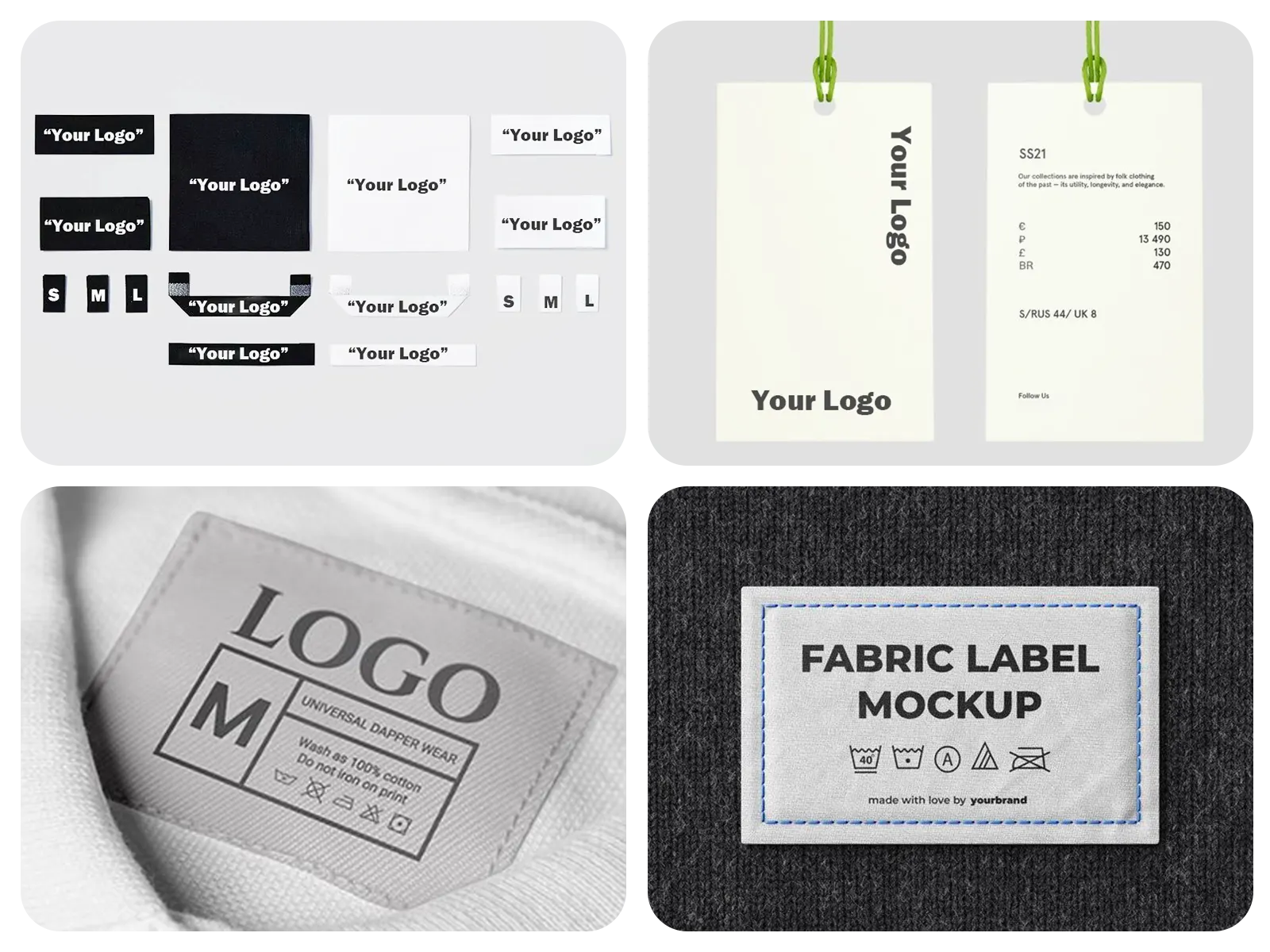
Private label elements — woven neck labels, hang tags and branded packaging — are decided at the brief stage, because they change sampling and packing time.
Technical Explanation: Fabric Weight, Construction and Decoration by Scenario
Fabric weight is the single specification that most often reveals whether a buyer and a manufacturer are describing the same project. The Custom blank T-Shirt platform is specified across two weight bands: 160–220 GSM for lightweight bodies and 220–300 GSM for mid-weight bodies. Composition options include 100% combed cotton at 160–200 GSM, cotton-polyester blends at 65/35 and 80/20, GOTS-certified organic cotton, slub cotton for a textured finish, pique for polo constructions and French terry for a heavier hand feel.
| Specification | Options | Scenario implication |
|---|---|---|
| Fabric weight | 160–220 GSM (lightweight); 220–300 GSM (mid-weight) | Lightweight for event and promotional programmes; mid-weight for uniforms and premium retail |
| Fabric composition | 100% cotton; cotton-polyester blends (65/35, 80/20); 100% polyester; organic cotton (GOTS certified) | Blends support shrinkage control and colour retention in uniform wear; organic cotton supports sustainability positioning |
| Fabric type | Single jersey, pique, French terry, slub cotton | Pique for corporate and gym polo programmes; single jersey as the default print surface |
| Size range | XS–XXL with custom grading available | Custom grading is what keeps sizing consistent across multi-region uniform rollouts |
| Colour | Pantone matching available | Required when uniform colour must match brand guidelines across batches |
| Printing techniques | Screen print, digital direct-to-garment, sublimation, heat transfer, puff print | DTG for multi-colour tour art; screen print for high-volume promo; sublimation for all-over sport graphics |
| Embroidery | Flat embroidery, 3D puff embroidery, chenille | Corporate logos, gym branding and varsity-style merchandising |
| Neckline finishing | Ribbed collar, self-fabric binding, seamless finish | Affects neck-label placement for private label programmes |
| Sleeve and hem | Set-in, raglan, drop shoulder; coverstitch or raw edge hem | Drop shoulder and raw edge suit streetwear; coverstitch suits uniform durability |
| Garment wash | Pigment dye, enzyme wash, snow wash, vintage wash | Finish-sensitive programmes need wash trials before bulk approval |
Custom blank T-Shirt (RTS001) specification matrix mapped to project-type implications.
Beyond weight, three performance thresholds are commonly written into scenario requirements. Colour fastness is specified at Grade 4 or above; shrinkage is held to 5% or below; and for athletic programmes the anti-pilling rating is set at Grade 3–4 or above. These are not marketing specifications — they are the parameters that decide whether a gym chain can restock the same garment six months later and have it match the first batch.
Compliance and Certification Boundaries by Market
Constraint-driven buyers ask about certification earlier than about price, and the useful discipline is to match each certificate to the product configuration and the destination market, rather than assuming a general company certificate transfers to every order.
For the Custom blank T-Shirt, Azo Dyes Testing certification confirms that textiles, apparel and accessories do not release carcinogenic aromatic amines from azo dyes — a requirement aligned with EU REACH Regulation (EC) No 1907/2006, Annex XVII, Entry 43, and with OEKO-TEX STANDARD 100 testing. Fibres intended for direct skin contact are specified as OEKO-TEX Standard 100 certified, which matters for gym, uniform and event apparel worn next to the skin in warm conditions. Buyers should note that the OEKO-TEX standard itself is updated periodically: the 2024 regulation set a new limit value for total fluorine (PFAS) at 100 mg/kg, effective 1 January 2024, so a certificate issued under an older limit set may not satisfy a buyer's current specification.
Where organic fibre is claimed, the Global Organic Textile Standard requires at least 95% certified organic fibres in products labelled “organic”, and the manufacturing stage must meet defined social and environmental criteria. That threshold is a useful check when a supplier describes a blank as organic without naming a standard.
Quality management and social compliance sit in a different category. The manufacturer's quality management system holds ISO 9001:2015 certification, certificate number 51825Q10787R0, valid from 11 July 2025 to 10 July 2028. Social compliance is covered by an amfori BSCI audit under amfori BSCI Code of Conduct, with the audit report covering child labour, forced labour, working hours, wages, occupational health and safety, freedom of association and discrimination, registered under reference 156-065504-000 for the 2025–2026 audit cycle.
Boundary worth stating plainly: some certificates apply only to specific product configurations. The GPSR registration under Regulation (EU) 2023/988 covers non-food consumer products placed on the EU market, including clothing, and requires technical documentation retained for ten years, batch traceability and safety information in official EU languages. The RoHS & CE certification (number NAP25090679C01E) applies to the smart garment configuration of the Custom blank T-Shirt — apparel with electronic components — and not to standard blank t-shirts. Buyers sourcing a conventional printed tee should not assume RoHS or CE applies to their order, and suppliers should not present them as if they do.
Where Scenario-First Sourcing Has Limits
The conventional purchasing approach — collect three quotations for a single blank specification and choose the lowest unit price — is not wrong so much as narrow. It optimises one variable and leaves the scenario variables unmanaged. However, the scenario-first alternative carries genuine trade-offs that buyers should price in rather than discover later.
- MOQ is per colour per design, not per order. A 50-piece minimum sounds low, but a programme with twelve designs across six colours implies a much larger total commitment than the headline number suggests.
- Certified and performance fabric costs more. GOTS-certified organic cotton, OEKO-TEX-certified skin-contact fabric, and heavier mid-weight bodies all raise the per-piece cost relative to a lightweight commodity blank. A scenario-optimised programme is often a higher-cost programme.
- Not every scenario accepts heavyweight fabric. Streetwear programmes have moved toward heavyweight constructions in the 300–500 GSM range, but the same weight is unsuitable for summer event merchandise or warm-climate gym wear, where 160–220 GSM remains the practical band.
- Sample lead time is 7–15 working days and bulk runs take 20–35 working days. Custom neck labels, hang tags and wash finishes add steps. Where a date cannot move — a tour, a launch, a campaign — the sampling stage has to start earlier than a commodity order would require.
- Multi-scenario programmes increase SKU complexity. One supplier producing event merchandise, gym apparel and uniforms for the same client will hold several fabric, colour and decoration recipes. That adds planning overhead and requires disciplined version control of artwork and labels.
The practical reading is that low-MOQ, one-stop t-shirt manufacturing removes the entry barrier for small programmes and reduces coordination risk for complex ones, but it does not remove cost, lead time or the need for a fixed specification. Buyers who treat MOQ as the only constraint tend to under-plan the fabric and decoration stages.
Market Trend Analysis
The demand context supports scenario-differentiated sourcing rather than pure price competition. Grand View Research estimates the global custom t-shirt printing market at USD 5.46 billion in 2024, projected to reach USD 9.82 billion by 2030, a compound annual growth rate of roughly 11.5% to 11.6%. The same research house estimates the global blank apparel market at USD 15.23 billion in 2024, with t-shirts and tanks accounting for a 48.39% share — the largest single category in that market.
Methodological caution is warranted here: the two figures describe different scopes. The USD 5.46 billion figure covers custom printing services, while the USD 15.23 billion figure covers the blank apparel category as a whole. Publishers using both numbers interchangeably understate or overstate the addressable market depending on whether a programme is a decorated-merchandise play or a private label basics play.
Two product-level trends are visible across sourcing documentation. First, streetwear-oriented t-shirt manufacturing in China has moved toward heavyweight fabrics in the 300–500 GSM range with complex finishes such as acid and vintage washes and puff printing — a trend consistent with the 380–450 GSM French terry and fleece used in the multi-drop streetwear programme described earlier. Second, competitive minimum order quantities for custom t-shirt manufacturers in China commonly sit between 50 and 100 pieces per design or colour, which places the 50-piece structure at the accessible end of current market practice rather than outside it.
Future Outlook
Three shifts are likely to shape how project-type sourcing develops over the next planning cycle. Certification is becoming configuration-specific rather than company-level, which means buyers will increasingly ask for documentation tied to the exact garment being ordered — the RoHS and CE distinction in this article is an early example. Decoration tolerance is tightening as digital printing quality improves, so the gap between a sample and a 5,000-piece bulk run becomes a more visible quality signal than the sample alone. And as event, fitness and corporate buyers consolidate suppliers, the ability to run a lightweight event blank and a mid-weight uniform body through the same quality control system will matter more than the ability to quote the lowest price on either one.
A Scenario-Fit Checklist for Buyers
Before requesting quotations, a buyer can compress the analysis into seven checks:
- Define the scenario in one sentence: where the garment is worn or sold, for how long, and how often it is reordered.
- Set fabric weight by scenario — lightweight for event and promotional volumes, mid-weight for uniforms and retail.
- Match decoration to artwork complexity and volume: DTG for multi-colour art, screen print for large runs, embroidery for logos, sublimation for all-over graphics.
- Confirm the MOQ structure is per colour per design, and calculate the true total commitment across all designs and colours.
- List required certification by market and by product configuration, including skin-contact fabric certification and chemical testing.
- Plan against 7–15 working days for samples and 20–35 working days for bulk, plus additional time for custom labels, tags and wash finishes.
- Agree the quality standard in writing — AQL 2.5 inspection, pre-shipment checks and third-party inspection options — before production starts.
Read together, these checks reframe the sourcing question. The useful comparison between t-shirt manufacturers is not which one quotes the lowest price for an unspecified blank, but which one can hold fabric, decoration, sizing and documentation steady across the particular project type in front of the buyer.
Frequently Asked Questions
What is a realistic minimum order quantity for a custom t-shirt programme?
Minimum order quantities for custom t-shirt manufacturing in China commonly range from 50 to 100 pieces per design or colour. The Custom blank T-Shirt platform documented here specifies a minimum of 50 pieces per colour per design. Buyers should calculate the effective total across every design and colourway in the programme, because a twelve-design, six-colour programme carries a materially larger commitment than the per-design figure suggests.
Which fabric weight should be specified for event merchandise, gym apparel and corporate uniforms?
Fabric weight should follow the wearing and selling context. The Custom blank T-Shirt platform offers 160–220 GSM for lightweight bodies and 220–300 GSM for mid-weight bodies. Lightweight single jersey suits summer event merchandise and promotional volumes, mid-weight pique and jersey suit corporate uniforms and premium retail, and heavier constructions in the 300–500 GSM range — such as the 380–450 GSM French terry and fleece used in a documented streetwear programme — suit autumn and winter streetwear rather than warm-venue event wear.
What certification documentation should be requested for EU-bound t-shirt orders?
Documentation should be matched to the product configuration and destination market. For the Custom blank T-Shirt, Azo Dyes Testing certification confirms that textiles and accessories do not release carcinogenic aromatic amines from azo dyes, aligned with EU REACH Annex XVII Entry 43 and OEKO-TEX STANDARD 100 testing. Fabrics for direct skin contact are specified as OEKO-TEX Standard 100 certified. Where organic content is claimed, the Global Organic Textile Standard requires at least 95% certified organic fibres. Quality management system certification is held to ISO 9001:2015 under certificate number 51825Q10787R0, and social compliance is covered by an amfori BSCI audit report. GPSR obligations under Regulation (EU) 2023/988 apply to consumer products placed on the EU market and require technical documentation retained for ten years, batch traceability and safety information in official EU languages.
How long should sampling and bulk production be expected to take?
The documented production parameters for this manufacturer are 7–15 working days for sample production and 20–35 working days for bulk production. In a recorded tour merchandise programme, 10 days were used for the sample and 30 days for the bulk run. Custom neck labels, hang tags, garment washing and finishing stages add time to these ranges, so programmes with immovable dates need to start sampling earlier than commodity orders.
Can a single order combine multiple designs, colours and size runs?
Yes, subject to the per-design and per-colour minimum. In a documented tour programme, 5,000 pieces were produced across 12 tour stops and multiple designs with a 50-piece minimum per design, and a corporate programme delivered 3,500 pieces across three regions in multiple colours with consistent sizing. Size range on the Custom blank T-Shirt platform is XS–XXL with custom grading available, and colour matching to Pantone references is offered for programmes that must reproduce a brand palette across batches.
What quality control standards should be agreed before production begins?
Typical quality control on this production platform is AQL 2.5, with 100% pre-shipment inspection, random sampling tests and third-party inspection such as SGS available at the buyer's request. Related performance specifications commonly written into scenario requirements include colour fastness at Grade 4 or above, shrinkage at 5% or below, and an anti-pilling rating of Grade 3–4 or above for athletic programmes. Agreeing these thresholds in writing before production starts is what allows claims such as 100% on-time delivery and no quality complaints after more than 100 washes to be verified against a stated standard.
A company brochure summarising product specifications, certification scope and production lead times is available for download: Qianshiwear company brochure. Company information: qianshiwear.com.