
Switchgear Compliance: Aligning KYN28, MNS and GCS with IEC
Compliance for a switchgear assembly is verified at three separate layers — the product, the manufacturing process and the destination market scheme — and no single document answers all three. Reading a compliance file correctly means knowing which layer each certificate belongs to, and which parameters remain the buyer's responsibility to specify.
This profile maps the published compliance position of the KYN28 and XGN15 high voltage families, the MNS and GCS low voltage withdrawable assemblies, and the wider GGD, GCK, XL, ATS, PZ30, JX/JXF, DFW, YBW-12, VFD and enclosed busway range from Changzhou Tuoxin Electric Co., Ltd., a switchgear manufacturer located in Xixiang Industrial Park, Hengshanqiao, Changzhou, Jiangsu Province, China. It separates what management system certificates cover from what product parameters cover, aligns the ratings with the IEC frameworks used in international projects, and states the boundaries a specification has to close before any document becomes project-qualifying evidence.
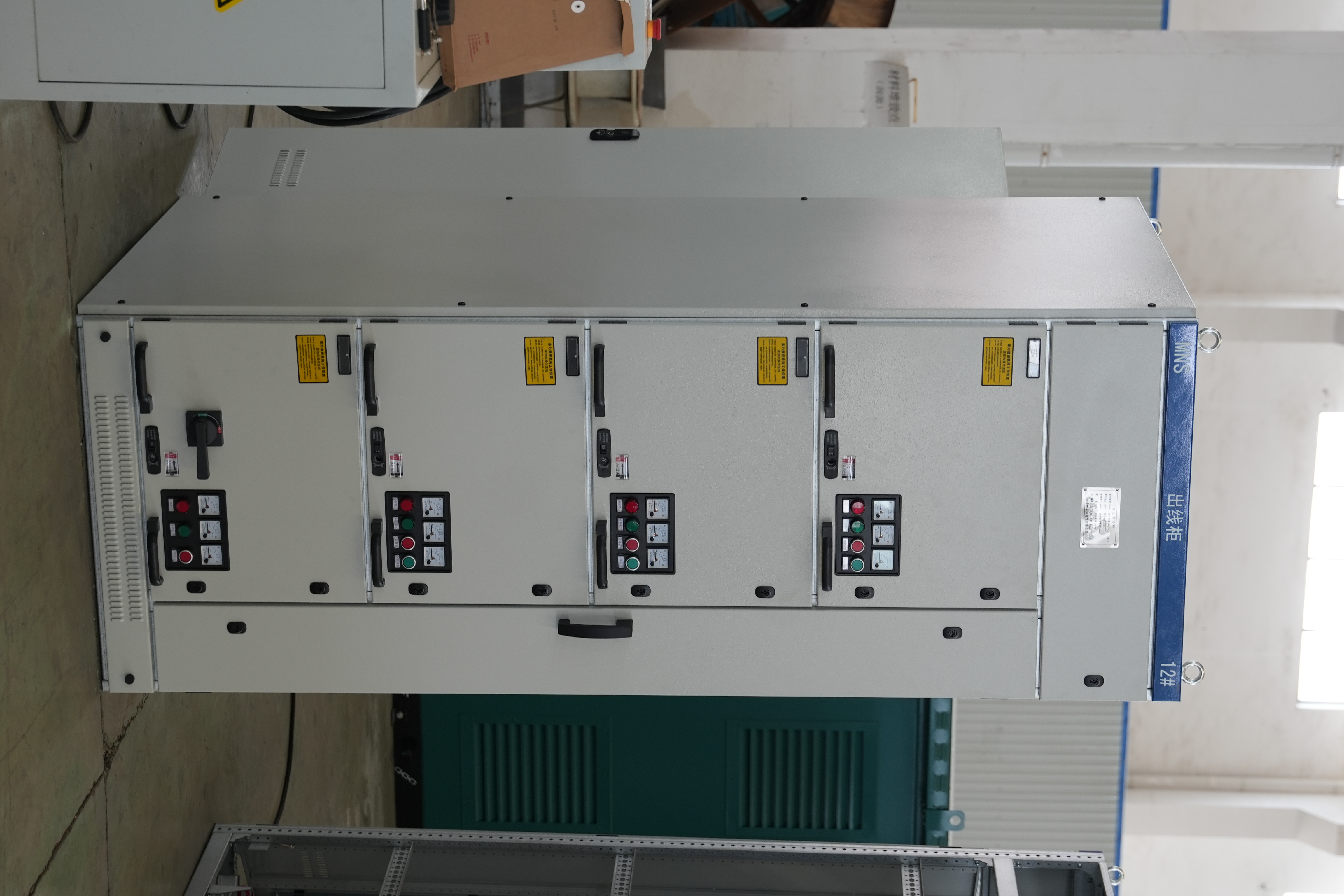
The three layers of a switchgear compliance file
The product layer consists of type-test parameters and design verification against a product standard. The process layer consists of management system certification, which describes how a factory plans, builds and inspects. The market layer consists of the mandatory or voluntary scheme that governs the destination market. In international procurement, documentation is most often questioned not because it is missing, but because a document from one layer has been submitted as evidence for another.
For low voltage switchgear and controlgear assemblies, the product layer is addressed by the IEC 61439 series (Parts 1 to 7), which covers design, verification and safety. High voltage equipment is addressed by the IEC 62271 family, and prefabricated substations (box-type substations) up to 52 kV are governed by IEC 62271-202:2022. These are the frameworks against which the parameter tables below are read. An assembly is evaluated as a product whose ratings sit inside a defined band; the certificates described further down are separate documents with their own scope, issuer and validity period.
Compliance profile at a glance
The table consolidates the published electrical, short-circuit and enclosure parameters of the main families, together with the standard family a project engineer would normally use to evaluate each one. Where a parameter is not published in the product documentation, it is left out rather than estimated.
| Family / model | Rated voltage & current | Short-time & peak withstand | Insulation coordination | Enclosure protection | Evaluation framework |
|---|---|---|---|---|---|
| High voltage, withdrawable — KYN28-12 | 12 kV, 50 Hz; 630 A – 4000 A | 4 s thermal 20 / 25 / 31.5 / 40 / 50 kA; peak 50 / 63 / 80 kA; breaking 20–50 kA; making 50–125 kA | 42 kV / 1 min phase-to-phase and phase-to-earth, 48 kV across isolation break; lightning impulse 75 kV (85 kV across break) | IP4X enclosure; IP2X with circuit breaker door open | IEC 62271 series |
| High voltage, withdrawable — KYN28-24 | 24 kV, 50/60 Hz; 630 A – 3150 A | Short-time withstand documented at 20 / 25 / 31.8 kA; peak 50 / 63 / 80 kA; breaking 20 / 25 / 31.5 kA | 65 kV and 79 kV / 1 min; lightning impulse 125 kV and 145 kV; auxiliary control circuit 2000 V | IP4X | IEC 62271 series |
| SF6 ring main unit — XGN15-12 / XGN15-24 | 3.6–12 kV (50 Hz) and 24 kV (50 Hz); 630 A / 1250 A on the 24 kV unit | 4 s withstand 20 kA or 25 kA; making current 50 kA or 63 kA; earthing switch 20 kA / 4 s | 65 kV / 1 min phase-to-earth and phase-to-phase; impulse withstand 125 kV; annual gas leakage ≤ 0.5% | IP67 inside gas tank; IP34D outside cabinet | IEC 62271 series |
| LV withdrawable — MNS | Insulation voltage 660 V; operational 380 V / 660 V; main busbar 1600–4000 A | Main busbar 100 kA (1 s), peak 120 kA; vertical distribution busbar 1600 A, 80 kA standard / 100 kA reinforced | Insulation coordination stated as rated insulation voltage 660 V | IP30 | IEC 61439 series |
| LV withdrawable — GCS | Insulation voltage 660 V; operational 380 V / 660 V; main busbar 1600–4000 A | Main busbar 100 kA (1 s), peak 120 kA; vertical busbar 1600 A, 80 kA standard / 100 kA reinforced | Rated insulation voltage 660 V | IP30 | IEC 61439 series |
| LV withdrawable — GCK | Insulation voltage 660 V; operational 380 V / 660 V; 600–1600 A | 50 kA (1 s); peak 80 kA | Rated insulation voltage 660 V | IP30 | IEC 61439 series |
| LV fixed — GGD | Insulation voltage 660 V; operational 380 V / 660 V; 600–1600 A | 50 kA (1 s); peak 80 kA | Rated insulation voltage 660 V | IP30 | IEC 61439 series |
| Prefabricated substation — YBW-12 | 12 kV; HV side 400–630 A; LV side 100–2500 A; 50–1600 kVA | Not published in the referenced specification sheet | 12 kV class, oil-immersed transformer compartment | IP3X high voltage side; IP2X transformer compartment | IEC 62271-202:2022 |
| Outdoor LV cable distribution box — DFW | Operational 400 V / 380 V; insulation voltage 690 V; complete set 630 A | Main busbar Icw 15–20 kA; peak 40 kA; outgoing devices 50 kA / 25 kA | Rated impulse withstand 6 kV; overvoltage category III; pollution degree 3; clearance ≥ 10 mm; creepage ≥ 12.5 mm | IP54 / IP44 / IP34D | IEC 61439 series |
| Enclosed busway — CMC | 400 V / 690 V; 100 A – 5000 A; 3P3W, 3P4W, 3P5W | 10 / 20 / 30 / 50 kA at 0.5 s or 1 s | 3750 V power frequency withstand 1 min; insulation resistance ≥ 10 MΩ | IP40 / IP43 indoor; IP54 / IP68 outdoor | IEC 61439 series |
Layer one: what the ISO and CCC documents actually cover
Changzhou Tuoxin Electric Co., Ltd. holds three management system certificates issued by DaHua Certification Services Co., Ltd., each valid from 8 April 2026 to 7 April 2029:
- ISO 9001:2015 (GB/T19001-2016/ISO9001:2015), certificate number 76426Q00092R001.
- ISO 14001:2015 (GB/T24001-2016/ISO14001:2015), certificate number 76426E00039R001.
- ISO 45001:2018 (GB/T45001-2020/ISO45001:2018), certificate number 76426S00037R001.
The registration scope recorded for these certificates is the manufacturing of high voltage switchgear, box type substations and low voltage switchgear within the scope of CCC, and the certificates are recorded as applicable to the EU, US, Middle East and Southeast Asia markets. Separately, the complete switchgear and low voltage electrical products have obtained CCC certification from the China Quality Certification Centre, and product quality has been verified by the Changzhou Technical Supervision Bureau.
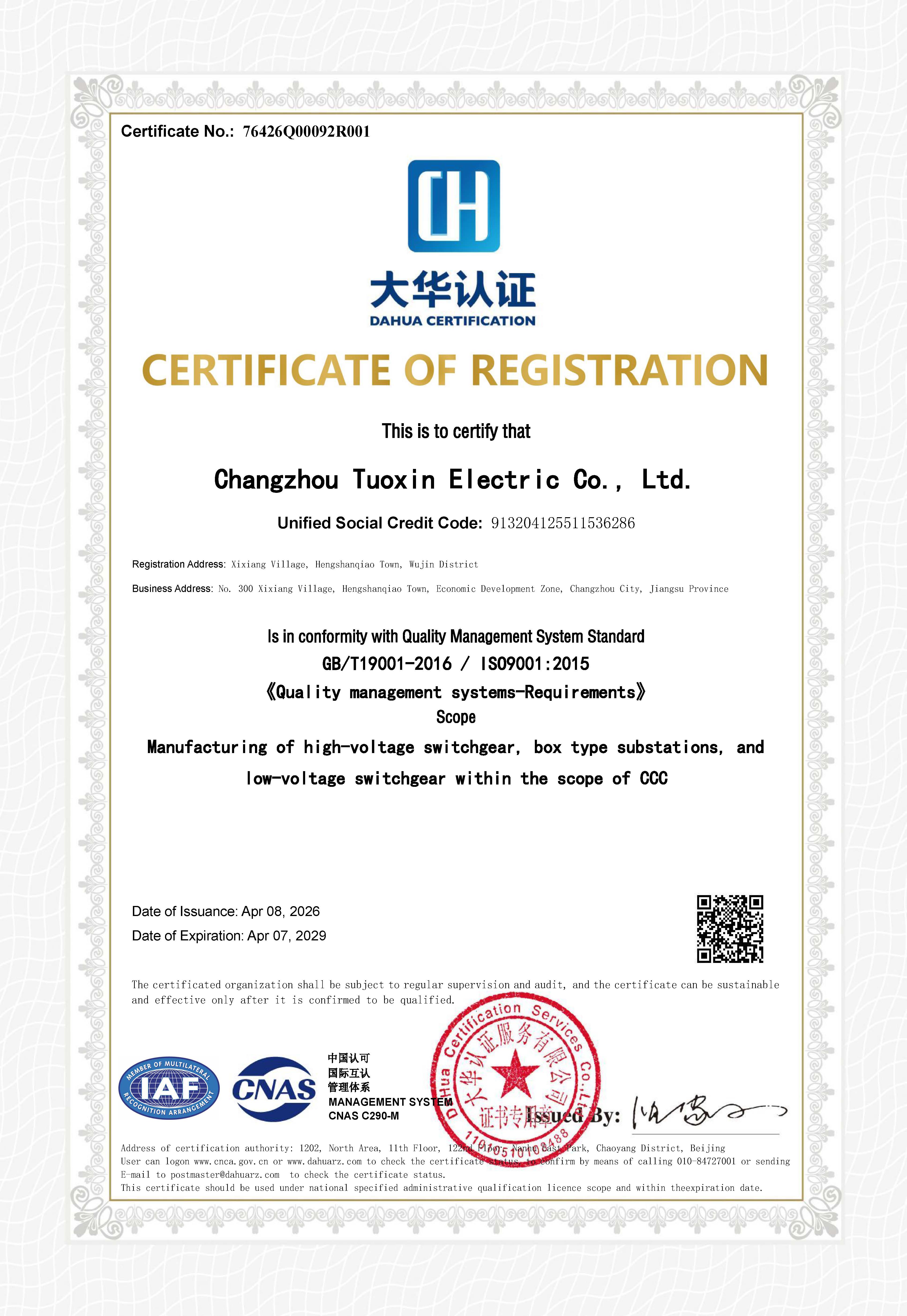
The practical limit of this layer is worth stating plainly. A management system certificate describes the organisation that manufactures the product and the scope it is registered for; it does not certify the short-circuit rating, insulation level or protection degree of a particular assembly. CCC certification confirms conformity with the Chinese mandatory scheme for the covered products. When a project specification calls for evidence against IEC 61439 or IEC 62271, a certificate number alone does not answer that requirement — the parameter sheet, the design verification record and, where the project demands it, a third-party type-test report do.
Layer two: insulation coordination, from 660 V to 125 kV
Insulation coordination is the part of a compliance file that is most often skimmed and most often required. On the low voltage side, the MNS, GCS, GCK and GGD families are all documented with a rated insulation voltage of 660 V while operating at 380 V or 660 V. That distinction matters commercially: the insulation system is dimensioned above the nominal operating voltage, which preserves margin for transient overvoltages and allows the same assembly structure to serve a 660 V system. Smaller distribution products state their own values — the PZ30 low voltage distribution box is documented at a 400 V rated insulation voltage with a main circuit of 220 V / 380 V and a rated current up to 125 A, while the DFW outdoor cable distribution box is documented at 690 V insulation voltage with a 6 kV rated impulse withstand voltage, overvoltage category III, pollution degree 3, and minimum clearances of 10 mm electrical and 12.5 mm creepage.
On the high voltage side, the figures a consultant will look for are the one-minute power frequency withstand voltage and the lightning impulse withstand voltage. For the KYN28-12, these are documented at 42 kV / 1 min phase-to-phase and phase-to-earth (48 kV across the isolation break) and 75 kV lightning impulse phase-to-phase and phase-to-earth, rising to 85 kV across the isolation break. The KYN28-24 is documented at 65 kV and 79 kV / 1 min, with lightning impulse withstand of 125 kV and 145 kV, plus a 2000 V power frequency withstand for the auxiliary control circuit. The XGN15-24 ring main unit is documented at 65 kV / 1 min and 125 kV impulse, with a sealed tank rated IP67 and an annual SF6 gas leakage rate of no more than 0.5%.
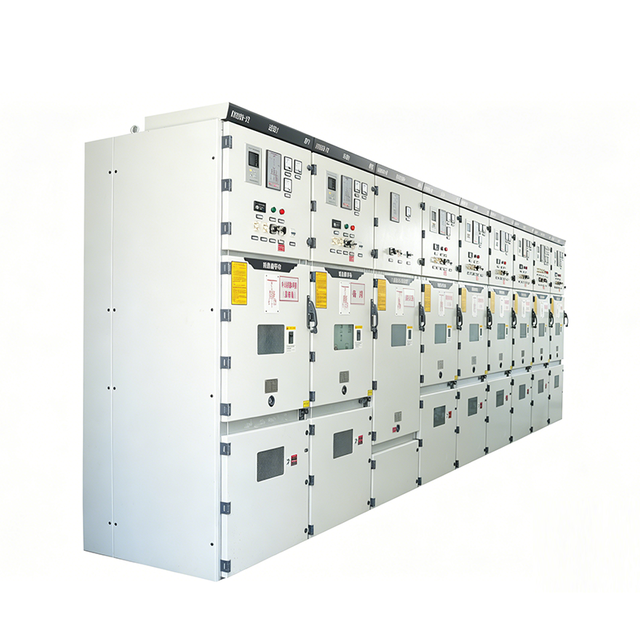
Layer three: short-circuit withstand — 50 kA or 100 kA
Short-time withstand current is the parameter that most often decides whether two visually similar assemblies are interchangeable. Within this range, the differences are documented and significant. The MNS and GCS withdrawable assemblies state a main busbar continuous current of 1600–4000 A with a one-second withstand current of 100 kA and a peak of 120 kA; the vertical distribution busbar is rated 1600 A with a standard peak of 80 kA and a reinforced option at 100 kA. The GCK withdrawable assembly and the GGD fixed assembly are documented at 600–1600 A with a one-second withstand of 50 kA and a peak of 80 kA.
On the high voltage side, the KYN28-12 documents a rated short-circuit breaking current of 20–50 kA, a making current of 50–125 kA, a four-second thermal withstand of 20 / 25 / 31.5 / 40 / 50 kA and a peak withstand of 50 / 63 / 80 kA. The XGN15-24 ring main unit documents a four-second withstand of 20 kA or 25 kA with a making current of 50 kA or 63 kA. Busway and cable distribution equipment carry their own values: the CMC enclosed busway is documented at 10 / 20 / 30 / 50 kA for 0.5 s or 1 s, with temperature rise limits of 70 K at the joint and 55 K on the outer housing, while the DFW cable distribution box documents a main busbar Icw of 15–20 kA with a 40 kA peak.
For a buyer, the selection rule is straightforward: compare the quoted Icw against the prospective short-circuit current calculated at the point of installation, and decide whether the specified margin accounts for future network growth. A 50 kA assembly is a legitimate choice at a location where the prospective fault level is below that value; it is not a substitute for a 100 kA assembly where the fault level is higher, because the difference sits in busbar cross-section, support spacing and insulation design rather than in the enclosure.
Layer four: IP30, IP4X, IP43 and what they actually decide
Protection degree is frequently quoted in tenders as a preference rather than a consequence of the installation environment. The published values in this range show how the rating tracks the location. Standard indoor low voltage assemblies — MNS, GCS, GCK, GGD and the PZ30 distribution box — are documented at IP30. The more compact distribution products separate indoor and outdoor versions: the XL low voltage power distribution box is IP30 in its standard indoor form and IP44 for the outdoor version, the ATS dual power supply box is IP30 indoors and IP44 for the rainproof outdoor type, and the JX/JXF industrial branch boxes are documented at 380 V / 220 V with leakage operating current ≤ 30 mA and leakage operating time ≤ 0.1 s.
High voltage enclosures are documented at IP4X on the KYN28-12 and KYN28-24, with IP2X applying when the circuit breaker door is open — a detail worth noting, because the accessible protection level during maintenance is part of the safety assessment. The compact gas-insulated ring main unit separates the two zones: IP67 inside the gas tank and IP34D for the outer cabinet. The YBW-12 prefabricated substation documents IP3X on the high voltage side and IP2X for the transformer compartment. Among ancillary equipment, the CMC enclosed busway is IP40 and IP43 for indoor installation and IP54 or IP68 for outdoor waterproof applications, while the XQJ LQ cable tray documents IP30 / IP40 for indoor trough configurations and IP54 or IP65 for outdoor waterproof forms with a sealed cover.
Environmental limits sit alongside the IP rating and should be read together with it. Standard indoor assemblies are documented for ambient temperatures of −10 °C to +40 °C, relative humidity with a daily average of ≤ 95% and no condensation, and altitudes up to 2000 m. The high voltage ring main unit is documented for −25 °C to +40 °C. The VFD control cabinet is documented for −10 °C to +40 °C but for altitudes up to 1000 m before derating is required, and it carries IP30 on the cabinet with IP20 on the frequency converter main unit — a distinction that matters when the cabinet is specified into a wet or dusty plant room.
Where these parameters decide the application
The complete equipment set — high and low voltage switchgear, box-type substations, bus ducts, metering and lighting distribution boxes and non-standard control cabinets — is documented as being applied across seven core sectors: power grid, new energy including photovoltaic and energy storage, industrial and mining manufacturing, commercial and residential construction, public buildings such as hospitals and schools, IDC communication data centres, and rail transit and municipal infrastructure. The corresponding project types recorded are power grid transmission and distribution, new energy projects, industrial and manufacturing plant projects, commercial and real estate projects, public civil construction, data and communication computer room projects, transportation infrastructure, municipal and environmental protection projects, and overseas complete set export projects.
Three application notes translate the parameters into decisions. First, high altitude above 2000 m requires increased insulation clearance, derated components and reinforced external insulation against corona, together with tighter cabinet sealing. Second, coastal salt corrosion is handled through hot-dip galvanised or fluorocarbon coated cabinets, aluminium alloy bus housing and 304 stainless steel fasteners, while chemical environments use anti-corrosion coating, FRP accessories and a fully enclosed structure. Third, heavy dust workshops justify an upgrade to IP40 or IP54 with fully enclosed cabinets and dust-proof bus ducts, and high humidity basements or utility tunnels are documented with temperature and humidity controllers and built-in heaters to prevent condensation. The matched equipment list recorded for these installations includes cable trays, power cables, copper earthing braids, insulated wires, wiring ducts, metal supports, expansion bolts, waterproof sealant and fire blocking materials.
Market signals behind tightening documentation requirements
The pressure on compliance documentation is a consequence of market scale. The global switchgear market was estimated at USD 112.9 billion in 2025 and is projected to reach USD 197.7 billion by 2033, according to Grand View Research. The low voltage segment alone exceeded USD 86.1 billion in 2024, driven by infrastructure upgrades and smart grid technology, according to Global Market Insights. Trade flows reinforce the point: in 2024 China exported approximately USD 2.72 billion in electrical apparatus for switching or protecting electrical circuits to the United States, according to UN Comtrade.
Concentration in the supply base is moderate rather than absolute. The top five manufacturers — ABB, Siemens, Schneider Electric, Eaton and GE — hold a combined global market share of approximately 35%, per Global Market Insights, while Schneider Electric led the 2024 market with an estimated USD 37.5 billion in revenue across its energy management segments, according to Report Prime. That leaves a large share of project demand to regional and specialist manufacturers, and it is precisely in that segment that documentation quality becomes a commercial differentiator rather than a formality.
Comparison with conventional assembly-to-drawing sourcing
The conventional alternative in many markets is a local panel builder who assembles to a project drawing, with documentation compiled at the end of the project. Compliance then depends on the individual workshop, and the file that reaches the consultant is often limited to the component manufacturers' certificates rather than evidence about the assembly as a whole. A complete-set supply model shifts that evidence earlier in the process: drawings, factory inspection and acceptance documents are produced against a defined internal range rather than assembled retrospectively.
Changzhou Tuoxin Electric Co., Ltd. was founded in 2010 and operates a 4000 m² facility with 56 employees, a 27-person R&D team and an annual output of 3000 units, with an export ratio of 40%. The published product scope covers high voltage switchgear including the KYN28 and XGN15 series; low voltage switchgear including the GBD, MNS, GGD, GXL, XL and XLW series; YB series box-type substations; custom non-standard electrical control cabinets; PZ30 modular terminal lighting distribution boxes; XJM series metering meter boxes; and bus ducts. The recorded capability set includes OEM/ODM production, a minimum order quantity of one unit, a lead time of 30–45 days, 100% testing, and remote technical support on a 7×12 hours basis, with on-site support available domestically and overseas. Reference-case data records a domestic customer base spanning power and energy end users, EPC and electromechanical general contractors and industrial manufacturing factories, with a recorded domestic reference volume of 1000 units, and a documented design service life of 20–30 years for the KYN28 and XGN15 high voltage families — 25–30 years in indoor power rooms with regular maintenance, and at least 20 years in coastal, chemical or dusty sites when anti-corrosion customisation is applied.
The boundaries matter as much as the capabilities, and several are documented. First, the certificates in this profile are ISO management system certificates and CCC certification; CCC is a China-market mandatory scheme and neither document substitutes for product type-test evidence required by a specific EU, US or Middle East specification. Second, certification is registered to a scope — the manufacturing of high voltage switchgear, box type substations and low voltage switchgear within the CCC scope — and a scope statement does not describe a particular configuration, component brand or control logic. Third, frequency is a hard boundary: the KYN28-12 is documented at a rated frequency of 50 Hz, while the KYN28-24 is documented at 50/60 Hz, so a 60 Hz project must be specified explicitly rather than assumed. Fourth, the standard low voltage assemblies are documented at IP30, which suits indoor distribution rooms and not dusty workshops, tunnels or open-air pads without an upgrade. Fifth, ratings are documented to 2000 m altitude, with derating and reinforced external insulation required above that, and the VFD control cabinet is documented to 1000 m before derating applies. Finally, documentation quality follows specification quality: when a quotation meets the standard but not the site, the usual cause is an incomplete inquiry — a missing prospective fault current, altitude, ambient temperature or pollution degree.
A verification checklist before accepting a compliance file
- Confirm the certificate number, the issuing body, the scope string and the validity period — for example ISO 9001:2015 certificate 76426Q00092R001 issued by DaHua Certification Services Co., Ltd., valid 8 April 2026 to 7 April 2029.
- Match the scope wording against the product actually being purchased, rather than against the product family.
- Check the insulation parameters — 660 V rated insulation voltage on low voltage assemblies, 42 kV / 1 min and 75 kV impulse on the 12 kV class, 65 kV and 125 kV on the 24 kV class — against the system's overvoltage environment.
- Compare the quoted short-time withstand current (50 kA or 100 kA for one second on the low voltage busbar; 20–50 kA for four seconds on the high voltage side) against the calculated prospective fault current.
- Verify the protection degree against the installation environment, including the level accessible during maintenance, such as IP2X with the circuit breaker door open.
- State altitude, ambient temperature, humidity and pollution degree in the inquiry, because these determine whether derating, heaters or upgraded sealing are required.
What changes next
The direction of travel is toward more granular evidence rather than fewer documents. The IEC 61439 and IEC 62271 frameworks are periodically revised, and each revision tightens the way design verification and routine verification are recorded — which favours manufacturers who can trace an assembly back to a test record rather than to a brochure. On the demand side, the low voltage segment that exceeded USD 86.1 billion in 2024 is being pushed by infrastructure upgrades and smart grid technology, and the application profile already includes photovoltaic, energy storage and EV charging work where documentation packages are checked by both the financier and the grid operator. Monitoring capability is moving into the same conversation: remote data collection over 4G or RS485 is already documented for the intelligent monitoring functions used with these assemblies, which means the compliance file and the operations file are converging.
For buyers, the practical implication is that supplier evaluation should happen at the parameter level. A manufacturer that can produce a consistent matrix of insulation, withstand current and protection values, cross-referenced to certificate numbers and validity dates, is easier to qualify and easier to audit than one that answers each question with a separate PDF.
FAQ
What is the difference between a CCC certificate and an ISO 9001 certificate for switchgear?
CCC certification confirms that a product conforms to China's mandatory certification scheme; for Changzhou Tuoxin Electric Co., Ltd. it covers the complete switchgear and low voltage electrical products and is issued through the China Quality Certification Centre. ISO 9001:2015 is a management system certificate covering the manufacturing process: certificate number 76426Q00092R001, issued by DaHua Certification Services Co., Ltd., valid from 8 April 2026 to 7 April 2029, with a scope of manufacturing high voltage switchgear, box type substations and low voltage switchgear within the scope of CCC. The first addresses the product, the second addresses the organisation that makes it.
Which standards apply to low voltage assemblies such as MNS, GCS, GCK and GGD?
Low voltage switchgear and controlgear assemblies are addressed by the IEC 61439 series (Parts 1 to 7), which covers design, verification and safety. The MNS and GCS assemblies are documented with a rated insulation voltage of 660 V, an operating voltage of 380 V / 660 V and a main busbar short-time withstand current of 100 kA for one second with a 120 kA peak. The GCK and GGD assemblies are documented with the same 660 V insulation level but with a 600–1600 A current range and a 50 kA one-second withstand with an 80 kA peak. These are the values a buyer compares against the verification requirements of the standard.
What does a rated insulation voltage of 660 V mean in a 380 V system?
Rated insulation voltage is the voltage the insulation system is dimensioned for continuously, not the voltage at which the assembly operates. In the MNS, GCS, GCK and GGD families it is stated as 660 V while the rated operational voltage is 380 V or 660 V. Dimensioning insulation above the nominal operating voltage preserves margin for transient overvoltages and allows the assembly structure to be used in 660 V systems. Smaller products state their own values: the DFW cable distribution box is documented at 690 V insulation voltage with a 6 kV impulse withstand, and the PZ30 distribution box at 400 V insulation voltage.
How should a buyer interpret 50 kA and 100 kA short-time withstand currents?
These are the currents the main busbar can withstand for one second. The GGD and GCK assemblies are documented at 50 kA with an 80 kA peak; the MNS and GCS assemblies are documented at 100 kA with a 120 kA peak, and their vertical distribution busbar at 1600 A with an 80 kA standard peak or 100 kA reinforced. Selection should follow the prospective short-circuit current calculated at the installation point, with margin for future network growth, because two assemblies with the same outline can differ in busbar cross-section, support spacing and insulation design.
Are these high voltage assemblies suitable for 60 Hz projects?
Frequency has to be specified rather than assumed. The KYN28-12 is documented with a rated frequency of 50 Hz. The KYN28-24 is documented at 50/60 Hz, with a rated voltage of 24 kV, rated currents of 630 A to 3150 A and an auxiliary control circuit power frequency withstand voltage of 2000 V. Because frequency affects magnetic circuits and protection settings, a 60 Hz project should state that requirement in the inquiry so the appropriate configuration is quoted.
Which protection degree should be specified for indoor and outdoor installations?
Standard indoor low voltage assemblies in this range — MNS, GCS, GCK, GGD and the PZ30 box — are documented at IP30, and the KYN28 high voltage enclosures at IP4X, falling to IP2X when the circuit breaker door is open. For outdoor work the documented options include IP54, IP44 or IP34D on the DFW cable distribution box, IP67 inside the gas tank with IP34D on the outer cabinet of the XGN15-24 ring main unit, and IP40 / IP43 indoor or IP54 / IP68 outdoor on the CMC enclosed busway. Dusty workshops and humid basements are typically addressed by upgrading to IP40 or IP54 together with temperature and humidity control.