
Swimming Pool Systems: A Compliance-First Buying Guide
Pool equipment is specified twice — once for performance, and once for the market it will be installed in. The second specification decides whether the first one is usable.
A swim current rated at 3.5 m/s is a technical figure. Whether that unit can legally be connected to a residential consumer unit in a given country, carried on a single certificate file, and commissioned under local electrical rules is a compliance figure. In compact pool, exercise pool and swim spa procurement, the compliance figure usually decides the outcome of the project, and it is rarely visible on a product page.
Crystal Island Group (Guangdong Crystal Island Healthwise Co., Ltd.) is a Chinese manufacturer of hot tubs and swim spas, founded in 2008, operating its own brands including Riptide®, Allseas Spas®, Oasis Spas® and channel brand BETA Wellness®, and supplying OEM and ODM manufacturing to partners. The company reports a 66,666.67 m² facility, 280 employees, a 38-engineer R&D team, 60,000 units of annual output and a 99.9% export ratio concentrated on the EU, USA and AU markets. Those numbers matter here only because they define the operating context in which certification, electrical configuration and installation documentation have to hold together.
This guide is written for buyers at the Research and Evaluation stage — importers, distributors, project specifiers and hospitality developers — who need to confirm that a swimming pool or wellness water system will actually be acceptable in the destination market before price and lead time are negotiated.
Why certification is a specification constraint, not paperwork
Buyers entering this category usually compare products on flow rate, seating, jet count and landed price. The constraints that later prevent commissioning are different: certification scope, electrical configuration, structural load path, and water management. Three are fixed at the factory. One is fixed on site.
Certification scope is the most frequently misread of the four. A certificate names specific models, a specific standard revision, a defined market and a validity window. It does not automatically extend to a new model, a different voltage configuration, or a market outside the tested standard. That has a direct procurement consequence: a supplier statement that the factory is certified is not a substitute for a document that lists the exact product being ordered.
A practical verification sequence is short. Ask for the certificate number, the listed models, the standard revision applied, the issuing authority, and the validity dates. Then confirm that the model, the electrical configuration and the destination market all appear inside that scope. If any one of the three is missing, the product is effectively uncertified for that project, regardless of how the specification sheet reads.
What the swimming pool category actually contains
In this category the word pool describes several distinct product types. They are not interchangeable, they do not share the same installation profile, and they are not covered by an identical certification path.
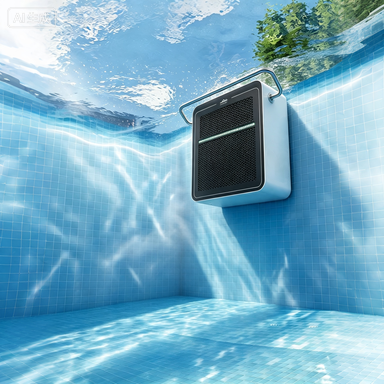
- Counter-current swim machine — a unit mounted to an existing pool wall that generates a swimming current. The pool is already there; the machine adds current, control and a dedicated electrical circuit.
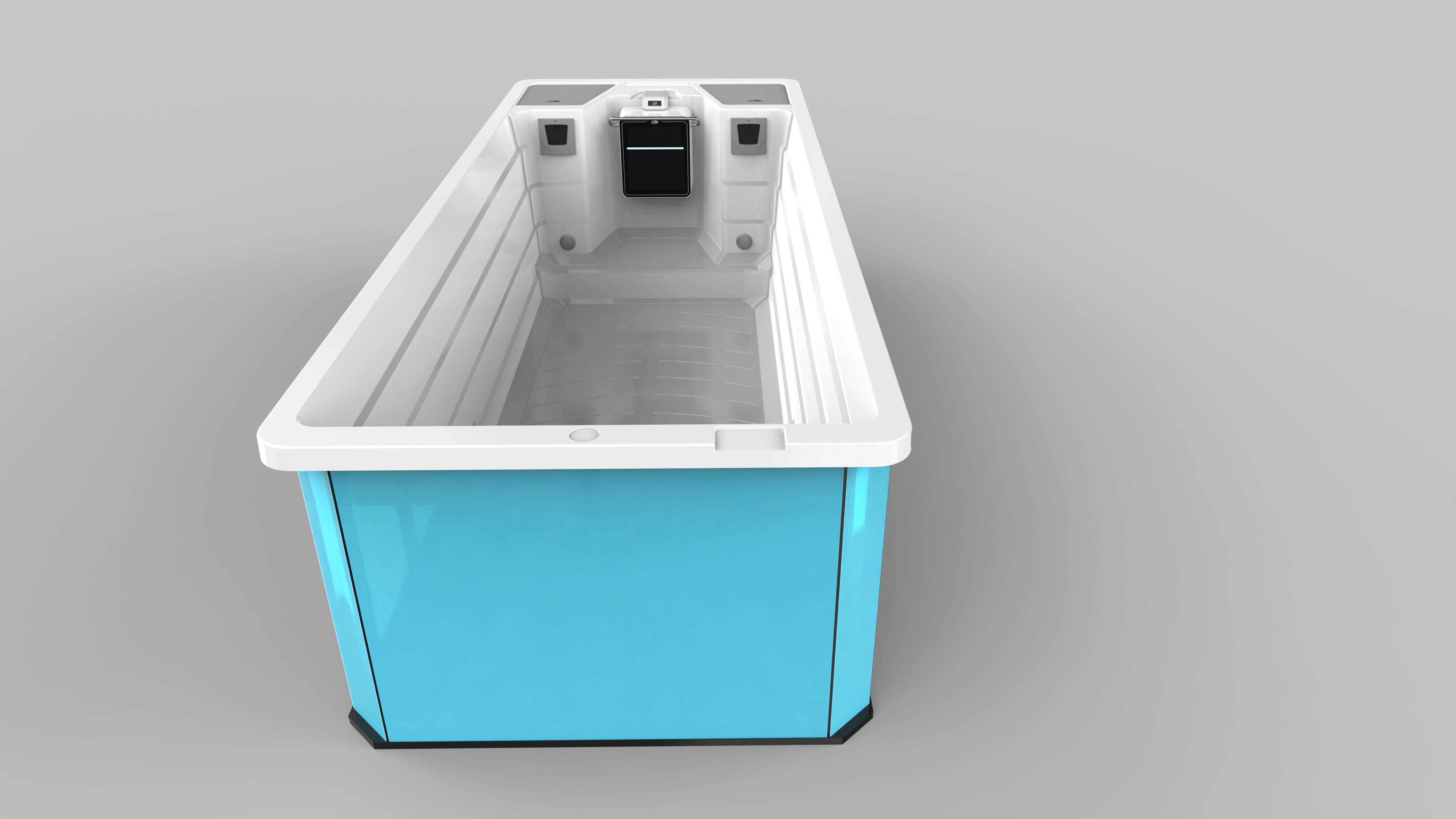
- Exercise pool — an integrated acrylic pool with the swim system, filtration, controls and service layout designed as one product. Available in defined lengths rather than free-form dimensions.
- Swim spa — a swim zone combined with hydrotherapy seating and massage jets, positioned between a compact pool and a hot tub.
- Hot tub — a hydrotherapy-focused unit without a swim current.
- Cold plunge or ice bath — a refrigerated unit holding water at low temperature, typically paired with heat therapy equipment.
- Motorized cover — a powered insulated cover that changes heat retention, evaporation and access management on any of the above.
Because the parts of the system are procured separately, the constraints also stack. A buyer who selects an exercise pool but specifies a cover from a different supplier inherits two certification files, two electrical requirements and two installation manuals. That is manageable, but it has to be planned rather than discovered on site.
The four constraint layers buyers should verify
1. Certification matched to model and market
Different markets test the same product against different standards. North America works from UL 1563 and CSA C22.2 requirements for electric spas; the EU applies EN 60335-1 and EN 60335-2-60 with EN 62233 for electromagnetic fields, plus a separate EMC file; the UK mirrors the EU structure through UKCA; Australia and New Zealand apply AS/NZS 60335 series requirements. A single product line therefore accumulates several unrelated documents.
The buyer-side rule is that the certificate must name the product, not just the company. Where a supplier lists a certificate covering a model series, ask which of the ordered configurations fall inside it — particularly where voltage differs between North America and Europe, because a 120V North American variant and a 220–240V European variant are separate configurations even when the shell is identical.
2. Electrical supply and protective devices
Electrical constraints usually surface late because they sit outside the product specification. A counter-current swim machine requires a single-phase 220–240V AC supply on a dedicated circuit, rated for the machine current, protected by an RCD rated at no more than 30 mA, with overcurrent protection and effective protective earthing. The installation must be completed by a qualified and licensed electrician, and the control box must be mounted in a dry, elevated position protected from water ingress.
Two details are commonly missed. First, the circuit cannot be shared with other equipment. Second, the motor cable must not be extended or spliced. Both are installation constraints rather than product defects, but either one can stop commissioning.
3. Structure, foundation and drainage
An integrated pool needs a stable, level, load-bearing foundation with full-base support and adequate drainage, and inground installations must prevent water from accumulating around the pool and equipment. A pool-mounted swim machine adds a further condition: the pool wall must be structurally strong enough to carry the machine and withstand the pulling forces a swimmer applies against the current.
Powered covers introduce their own requirements. A motorized cover system typically calls for a level concrete base of at least 100 mm with a load-bearing capacity around 800 kg/m² or an equivalent high-strength surface, drainage around the lift columns, maintenance access, and an unobstructed travel path for the cover. Clearance has to be checked vertically as well as horizontally, because a correctly sized cover can still be unusable under a pergola or against a wall.
4. Water treatment and freeze protection
Water management is a commissioning requirement and an operating one. Circulation moves water through filtration and treatment before returning it to the pool, which is what allows a single body of water to be maintained across many sessions rather than replaced each time. Sanitation options in this category include ozone systems, mineral purification and optional UV, depending on the model.
Freeze protection is the constraint that most often surprises buyers in northern markets. Integrated protection activates below 6°C and automatically raises the water to a defined set point, which varies by installation scenario. For outdoor residential installations the documented set points range from 10°C to 16°C depending on product type and application profile; hospitality and fitness installations use correspondingly different set points. The protection is a freeze guard, not a guarantee of year-round operation in any climate, and it should be checked against the actual site temperature range before specification.
Certification map for pool and spa equipment
The table below summarises the certification structure Crystal Island Group publishes for its pool and wellness equipment. It is presented as a document map, not as a performance claim. Each row refers to a defined scope; products and configurations outside that scope require separate confirmation.
| Product scope | Market | Certification | Reference and standard basis |
|---|---|---|---|
| Spas (RIPTIDE SPAS brand, listed models) | US, CA | ETL Listed, Authorization to Mark | Intertek 5022601; UL 1563:2009 Ed.6+R, CSA C22.2#218.1:2013 Ed.2+E1; valid to 25 Aug 2031 |
| Spas, swim spas, swimming pools | EU | CE-LVD | STUESO021061509423HS; EN 60335-1, EN 60335-2-60, EN 62233 |
| Spas, swim spas, swimming pools | EU | CE-EMC | STUEMO021061509424HS; EN IEC 55014 series, EN IEC 61000-3 series |
| Whirlpool spas | UK | UKCA-LVD and UKCA-EMC | STUESO231100003HS and STUEMO231100002HS; BS EN 60335 series |
| Hot tubs | AU / NZ | SAA Certificate of Approval | SGS/220395; AS/NZS 60335.2.60:2018, AS/NZS 60335.1:2020+A1; valid to 28 Jun 2027 |
| Swimming machine | AU / NZ | SAA Certificate of Conformity | SGS/250602; AS/NZS 60335.2.60:2018, AS/NZS 60335.1:2020+A1 |
| Swimming machine | AU | RCM Declaration of Compliance | RCM250826 001; AS/NZS CISPR 14.1:2021 with AS/NZS 60335 series |
| Swimming machine, model WHA100-A | EU | CE-LVD and CE-EMC | STUESO240800008HS and STUEMO240800001HS; EN 60335 series, EN IEC 55014 series |
| Cold plunge tub, model CTA100-A | EU | CE-LVD and CE-EMC | STUESO240400001HS and STUEMO240400001HS; EN 60335-1, EN IEC 60335-2-40, EN IEC 60335-2-60 |
| Motorized cover, MC4A series | EU | CE-LVD and CE-EMC | STUESO251100002HS and STUEMO251100001HS; EN 60335-1, EN IEC 60335-2-60:2023, EN 62233 |
Two observations follow from the table. First, certificates are issued against named models and defined scopes, so the same manufacturer can hold several unrelated files for what a buyer might treat as one product family. Second, validity dates differ across documents, which means a compliance review should record expiry dates rather than assume a single renewal cycle.
Equipment parameters that change the installation plan
Parameters matter in procurement only where they change what has to be built around the product. The values below are drawn from published product data and are the ones that most often affect site planning, electrical design and service access.
| Model | Type | Footprint | Key electrical or system data | Capacity |
|---|---|---|---|---|
| WHB200 | Counter-current swim machine | 715 × 290 × 670 mm, 25 kg | 220–240V AC 50/60 Hz, 3 kW, 13 A, IP68, 10 speed levels | Max flow 3.5 m/s, max flow rate 550 m³/h |
| PSAB600G-Y1-1L1 | Acrylic exercise pool | 5,915 × 2,350 × 1,520 mm, 853 kg | Forever Swim Pro system, 0.35 HP circulation pump, ozone venturi | 9,704 L water capacity |
| WSAC600B-Y1 | Single-zone swim spa | 5,915 × 2,350 × 1,520 mm, 1,287 kg | 1 × 3 HP massage pump, 0.35 HP and 1 HP circulation pumps | 10,609 L, 20 hydrotherapy jets |
| HEA560-1L2 | Outdoor hot tub | 2,120 × 2,120 × 920 mm, 306 kg | 2 × 3 HP massage pumps, 0.35 HP circulation pump | 1,188 L, 39 hydrotherapy jets, 4 seats and 1 lounger |
| CTA100 | Smart ice bath | 2,002 × 750 × 740 mm, 132 kg | 500 W cooling, R290 refrigerant, 220–240V/50 Hz or 120V/50 Hz, 0–43°C ambient | 270 L standard, 388 L maximum |
| MC4A | Automatic motorized cover | Lift height 1,230–3,000 mm | 230V/50 Hz, 260 W, 1.7 A, IP54, ambient −20 to 50°C | Five cover sizes from 4,540 to 8,095 mm |
Read together, these values explain why compact pool projects are rarely plug-and-play. The swim machine alone draws 13 A and needs dry control-box placement. The exercise pool holds close to ten cubic metres of water on a foundation that must carry it with full-base support. The cover needs vertical travel clearance up to 3,000 mm. Each figure is a site decision before it is a purchasing decision.
How a manufacturer structures these constraints
Crystal Island Group operates an intelligent digital manufacturing facility completed in 2023, recognised as a Guangdong Advanced Intelligent Factory and a Foshan Digital Intelligent Manufacturing Demonstration Factory. The production environment uses automation, robotics, machine vision inspection, RFID traceability and IoT-based production management, and the company states that every unit is tested. Monthly capacity is reported at 5,000 units, with a 25–30 day lead time and a minimum order quantity of one 40-foot container.
The engineering record is relevant to compliance specifically because several of the safety-relevant systems are proprietary rather than sourced. The company holds patents covering 3-inch jet technology, an embedded cylinder technology protected by an EU invention patent, and a swimming machine technology with patented water-free detection. It is recognised as a National Intellectual Property Advantage Enterprise and a High-Tech Enterprise of Guangdong Province, and operates provincial and municipal enterprise technology centres.
Brand-side recognition is separate from certification and should be treated as market signal rather than conformity evidence. Oasis Spas® has received UK POOL & SPA AWARDS recognition and was named among Australia's Top 5 Spas in 2023; Riptide® has received the UK Best Buy Award for multiple consecutive years. Useful for positioning, but not a substitute for a certificate number.
For buyers, the practical implication is that a compliance conversation with this supplier can be conducted at document level: certificate number, listed model, standard revision, market and expiry date. That is the level at which the discussion has to happen anyway.
Application scenarios and what changes between them
The same equipment family behaves differently across installation scenarios, and the differences are documented rather than assumed.
- Residential and luxury living. Outdoor installation with humidity and treated water exposure. Freeze protection activates below 6°C and raises water to a documented residential set point, around 15°C for swim spa applications and around 16°C for exercise pool applications.
- Hospitality and leisure. Repeated daily operation, higher shared use and a wider ambient range of −20 to 50°C for cover systems. Exercise pool freeze protection in this scenario is documented at around 18°C, reflecting longer idle periods between guest sessions.
- Health and fitness. Frequent, sometimes extended use, with swim training and low-impact exercise as the primary functions. Exercise pool freeze protection is documented at around 17°C for this profile.
- Sports and athletic training. Continuous water immersion and IP68 protection on the swim machine, with the pool wall carrying repeated pulling loads.
- Wellness and recovery. Cold water immersion paired with heat therapy, where ice bath ambient conditions are specified at 0–43°C and sanitation relies on integrated ozone and filtration rather than manual chemical dosing.
The reason these set points differ is operational, not arbitrary: an installation used twice a day and one used continuously by guests have different risks from a short cold spell. Specifiers should match the documented set point to the actual usage profile rather than to the climate zone alone.
Market trend: wellness convergence and compliance-driven entry
Two market signals are relevant to this category. Fortune Business Insights reported the global hot tub market at USD 5.76 billion in 2025, with North America holding the largest share at 41.84%. Grand View Research projected the global cold plunge tub market growing from USD 381.7 million in 2026 to USD 659.9 million by 2033. Both categories are classified under HS Code 9019.10, which places them in the same trade reporting family as mechano-therapy and massage apparatus.
Market valuations in this space should be read with care. Different research houses define the boundary of the category differently — some count portable units only, others include commercial installations and service components — so published totals vary between studies. For procurement purposes the direction of the trend is more useful than the absolute figure.
The direction is convergence. Buyers increasingly source heat and cold together, and a supplier that can document hot tubs, swim systems, ice baths and powered covers under one manufacturing system reduces the number of certification files and installation interfaces a project has to manage. That is a supply-chain argument rather than a product argument, and it is one of the reasons compliance documentation has moved from a late-stage checkbox to an early-stage filter.
Comparison with site-built pool projects
An integrated pool product and a site-built pool solve the same user need through different delivery models. Neither is universally better; the choice depends on what the project can control.
| Dimension | Integrated acrylic pool or swim spa | Site-built pool with mounted swim machine |
|---|---|---|
| Dimensions | Defined lengths, typically 4.4–8 m for exercise pools, with depths of 1.2 m or 1.45 m | Free-form within structural and site limits |
| Site work | Foundation, drainage, electrical supply and access route | Excavation, shell construction, waterproofing, plant room and equipment coordination |
| Certification path | A defined product with a named certificate scope per model | Assembled from components whose conformity is generally handled by separate parties |
| Swim function | Integrated counter-current system with adjustable speed levels | Added through a wall-mounted swim machine with dedicated circuit |
| Hydrotherapy | Available on swim spa configurations; not a feature of exercise pools | Depends on separately specified equipment |
| Service access | Equipment compartment designed into the product | Plant room or equipment pit designed for the site |
The honest limitation is on the integrated side. An exercise pool is not a lap pool substitute for unrestricted swimming: lengths are fixed, depth options are limited, and the product does not include dedicated hydrotherapy seating or massage jets. A swim spa adds hydrotherapy but still operates within a fixed footprint. Buyers who need a 25 m training lane should not be evaluating this category at all, and buyers who need flexible depth for diving or multiple user groups should expect a site-built solution.
Limits: what this category does not solve
A compliance-first reading also means stating where the constraints bind.
- Certification is model-specific. A certificate covering a model series does not automatically cover a new configuration, a different voltage variant, or a market outside the tested standard.
- Electrical requirements are fixed by the product. The swim machine needs a dedicated single-phase circuit with RCD protection at or below 30 mA and protective earthing, installed by a licensed electrician. Shared circuits and spliced motor cables are not acceptable.
- Structural requirements belong to the site. The pool wall must carry the machine and swimmer loads, and the equipment base must meet the load-bearing and thickness requirements of the cover or pool system.
- Operating behaviour has boundaries. The swim machine begins at speed level 1 and shuts off automatically after 20 minutes. The motorized cover is rated for IP54 and −20 to 50°C ambient. The ice bath operates within a 0–43°C ambient range. Outside those conditions, the product is the wrong product.
- Commercial terms apply. Minimum order quantity is one 40-foot container, with a 25–30 day lead time; smaller trial orders are a commercial negotiation, not a standard configuration.
None of these limits is unusual for the category. They are listed because buyers who discover them after the purchase order tend to discover them during commissioning, which is the most expensive possible moment.
Future outlook
Three changes are likely to shape procurement in this category over the next planning cycle. First, heat-and-cold pairing will continue to move from premium specification to standard wellness package, which raises the number of product families a single project must document. Second, buyers are increasingly requesting configuration-level certification evidence rather than company-level claims, which favours suppliers able to produce scoped documents quickly. Third, the separation between a pool and a wellness system is eroding: a compact pool project may now include a swim machine, a hot tub, an ice bath and a powered cover, each with its own electrical and structural interface.
For distributors and project specifiers, the practical response is procedural rather than technical. Build the compliance check into the first supplier conversation, record certificate numbers and expiry dates alongside commercial terms, and confirm that the ordered configuration appears in the certificate scope. That sequence costs a few days at the evaluation stage and typically saves considerably more during commissioning.
Frequently asked questions
Which certifications apply to swimming pool and spa equipment, and do they cover every model?
Available certifications include ETL, CE, SAA, RCM and UKCA, and they do not automatically cover every model. ETL Listed documentation for spas is issued against named models and standards (for example Intertek 5022601 under UL 1563 and CSA C22.2#218.1). CE-LVD and CE-EMC documentation covers defined product scopes such as spas, swim spas and swimming pools. SAA and RCM documentation for swimming machines and hot tubs is issued under AS/NZS requirements. Certification has to be matched to the specific model, configuration and target market, and buyers should confirm that the ordered variant appears inside the listed scope.
What power supply and electrical protection does a swim machine require?
A counter-current swim machine requires a single-phase 220–240V AC supply on a dedicated circuit, protected by an RCD rated at no more than 30 mA, with overcurrent protection and effective protective earthing. Installation must be completed by a qualified and licensed electrician, and the high-voltage control box must be located in a dry, elevated position protected from water ingress. The dedicated circuit should not be shared with other electrical devices, and the motor cable must not be extended or spliced.
Can an exercise pool be installed above ground, semi-inground or fully inground?
Exercise pools support above-ground, semi-inground and fully inground installation depending on the model. All three options require a stable, level, load-bearing foundation with full-base support, plus adequate drainage. Inground installations must prevent water from accumulating around the pool and the equipment. Electrical installation should be completed by a qualified electrician, and the equipment compartment must remain accessible for service.
How do these systems behave in freezing conditions?
Integrated freeze protection activates below 6°C and automatically heats the water to a set point defined by the installation scenario. Documented set points range from around 10°C for hot tub applications to around 18°C for hospitality exercise pool installations, with intermediate values for residential and fitness profiles. Freeze protection is a guard against low-temperature damage rather than a guarantee of unrestricted year-round operation, so buyers should confirm that the documented set point and ambient operating range match the actual site conditions.
Does an exercise pool include hydrotherapy seating and massage jets?
No. Exercise pools are designed for swimming, aqua fitness and low-impact exercise, and they do not include dedicated hydrotherapy areas or massage jets. For combined swimming and hydrotherapy, a swim spa configuration is the appropriate product, as it pairs a swim zone with hydrotherapy jets and massage pumps. Buyers who need both functions should specify a swim spa rather than adding hydrotherapy expectations to an exercise pool.
How is water quality maintained in these pool and spa systems?
Water is continuously circulated through filtration and treatment before returning to the pool or spa, which allows one body of water to be maintained across multiple sessions. Filtration uses high-efficiency cartridges, and sanitation typically combines mixed ozone sterilisation with optional UV or mineral purification depending on the model. Routine maintenance requires regular water testing, sanitizer and pH adjustment, filter cleaning when flow decreases, and water replacement when normal treatment is no longer sufficient. Chemical disinfectants are not recommended for ice baths that rely on integrated filtration and ozone sanitation.
¿Tiene preguntas o necesita más detalles?
Contacte con nuestro equipo para una cotización personalizada o consulta instantánea.
Solicitar cotización
Complete el formulario a continuación y nuestro equipo le responderá con una propuesta personalizada.
Chat directo de WhatsApp
¿Prefiere chatear en tiempo real? Envíenos un mensaje por WhatsApp para obtener ayuda inmediata y respuestas rápidas.
- Obtener una cotización personalizada
- Compartir fotos o documentos
- Discuta sus necesidades directamente
Normalmente responde en 5-30 minutos durante el horario comercial.