
Swim Spa Supplier Evaluation: Beyond the First Order
Swim Spa Sourcing · Supplier Evaluation
A lifecycle framework for importers, distributors, project specifiers and facility buyers — covering production continuity, change responsiveness, purchasing terms and acceptance criteria.
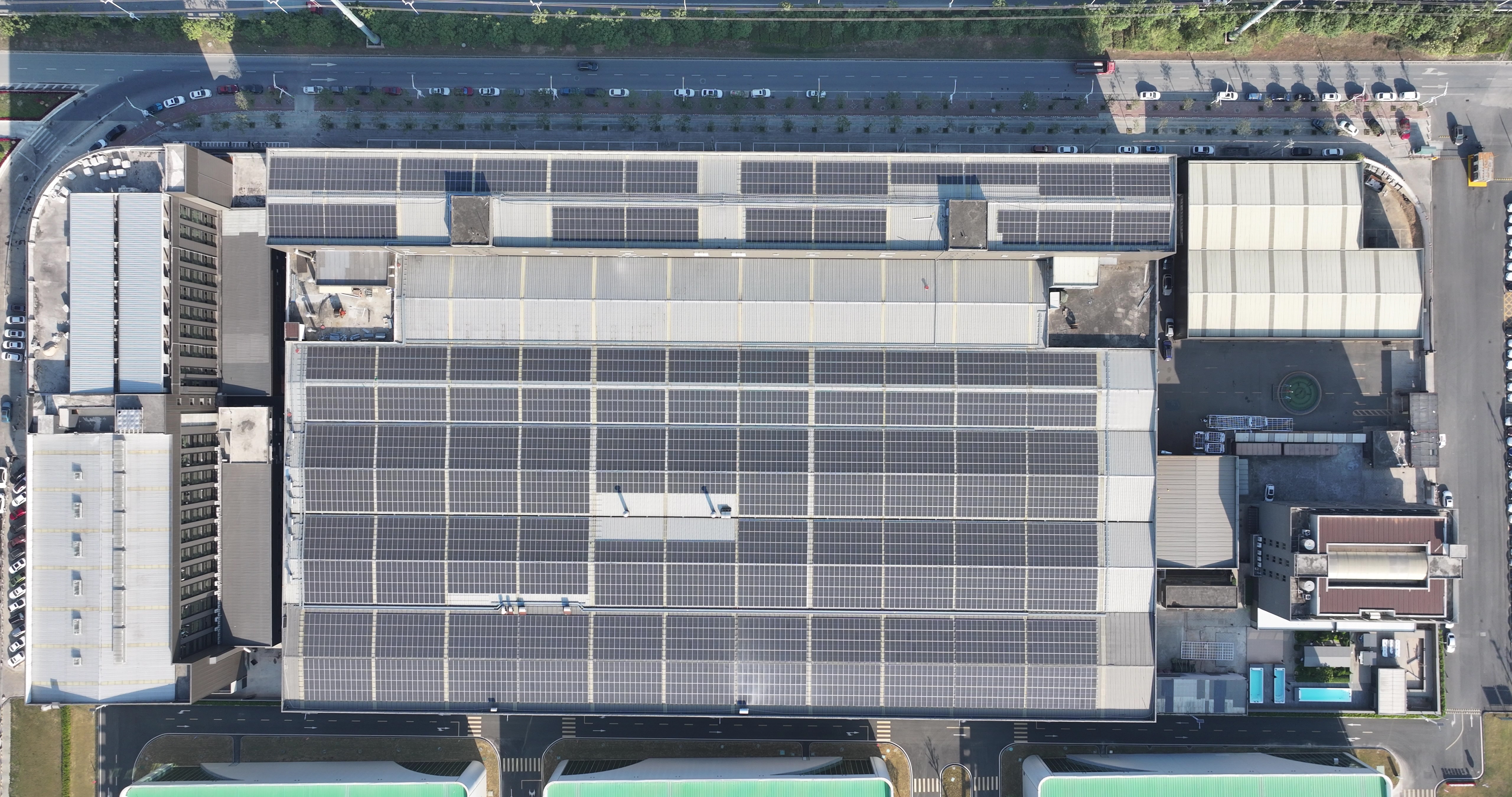
Production floor space is one of the few supplier claims a buyer can examine directly during a factory visit or audit.
A swim spa is purchased once but operated for years, and most supplier comparisons still focus on the moment of purchase. The gap between those two timelines is where supply risk accumulates: a unit specified correctly on the first order can still become an operational problem if the manufacturer cannot repeat the build, absorb a change in specification, or document what was actually delivered. Long-term swim spa supplier evaluation therefore looks less like a product comparison and more like a manufacturing and documentation review — capacity, change management, purchasing terms, acceptance criteria and support continuity measured across an entire partnership rather than a single shipment.
MEXDA is the swim spa brand of Foshan Gaoming Yuehua Sanitary Ware Co., Ltd., an outdoor spa and swim spa manufacturer founded in 1995 in Gaoming, Foshan, Guangdong, China. The company reports a 50,000 m² production facility, more than 200 employees and an export share of about 85%, with swim spas, hot tubs, sauna rooms and steam rooms shipped mainly to the USA, EU, Australia, Germany and France. Those disclosed production figures and certificate records provide a concrete example of the evidence a buyer can request — and of the boundaries that remain even when the paperwork looks complete.
Why the first order is the weakest test of a swim spa supplier
A first order tests a supplier’s ability to build one configuration once. A repeat order tests something different: whether the same shell, the same control package and the same documentation can be produced again after a model revision, a component substitution or a change in market requirements. That second capability is rarely visible in a quotation.
Channel structure explains part of the problem. The United States has roughly 10,000 swimming pool and spa retailers selling above-ground pools, hot tubs, and related equipment, supplies and merchandise, according to a VerticalIQ industry profile. That figure describes the whole retail category rather than swim spas specifically, but it illustrates a practical point: many buyers first meet a swim spa through a retail or distribution layer, while the answers to continuity questions sit with the party that actually controls production. When a retailer changes supplier, or a distributor adds a second brand, the buyer inherits the consequences without having asked the manufacturer directly.
The opportunity is straightforward. Buyers who evaluate a swim spa supplier on production continuity, change responsiveness, purchasing terms and verifiable acceptance evidence before signing tend to spend less time resolving specification disputes later. The framework below is built for that stage of the decision.
A five-part framework for long-term swim spa supplier evaluation
Each dimension below converts a general concern into a specific question and a specific piece of evidence. The framework is deliberately evidence-first: a supplier that cannot produce the document is a different risk profile from one that can.
| Dimension | Question to ask | Evidence to request |
|---|---|---|
| Production continuity | Can the same build be repeated at the required volume? | Factory area, headcount, engineering team, annual and monthly output |
| Change responsiveness | What changes are possible, and how do they affect the schedule? | OEM/ODM scope, named components, MOQ, lead time per configuration |
| Purchasing terms | Which specification version is binding, and what triggers a revision? | Signed drawing or specification sheet, revision-control notes |
| Acceptance criteria | What is tested on every unit, and what record is issued? | Test scope description, per-unit record, packaging and handover list |
| Compliance record | Do the certificates apply to the model being ordered? | Certificate number, issuing body, standard and referenced model |
| Support continuity | How will service, parts and documentation be handled after delivery? | Support model description, manuals, local service plan, spare-part list |
1. Production continuity: reading capacity figures correctly
Production continuity starts with measurable inputs. MEXDA discloses a 50,000 m² facility, a workforce of more than 200 employees and a dedicated R&D team of nine engineers. Its stated annual output is 5,000 sets, equivalent to a monthly production capacity of approximately 500 sets.
Those numbers answer a narrow but important question: is there enough physical and human capacity to absorb a repeat program? They do not, on their own, answer scheduling questions. A buyer placing a 40-unit order for a hotel project should ask how the 500-set monthly envelope is allocated between catalogue models and custom programs, what buffer exists in peak season, and whether a large order displaces an existing customer’s slot. A supplier that can describe its allocation logic is easier to plan around than one that only quotes a lead time.
Because a swim spa is a large, low-frequency purchase, capacity risk usually appears as a delay rather than a shortage. This is why the framework treats capacity as a scheduling question, not a marketing number.
2. Responsiveness to changing order requirements
Long partnerships rarely stay on the original specification. Market requirements shift, a resort adds a second site, or a distributor asks for a different control package for a new territory. MEXDA operates an OEM/ODM production model with a customization scope described as covering all, an MOQ of 1 set, a lead time of 30–40 days and worldwide export coverage. Its verified component record names Aristech acrylic surfaces and Balboa control systems for high-end swim spa models.
There are two practical consequences for buyers. First, an MOQ of one set makes validation inexpensive: a new jet configuration, a private-label skirt or an alternative control package can be tested before being committed to a full program. Second, a change request generally resets the clock, so the 30–40 day lead time should be read as the schedule for an agreed and frozen specification, not for a configuration still under discussion.
The questions worth asking are therefore procedural rather than technical: who approves a change, at which stage of production a change is still possible without scrapping work in progress, and how the revised specification is confirmed in writing. Suppliers that answer these questions clearly reduce the cost of the second and third order — which is where most of the partnership value sits.
3. Purchasing terms and acceptance criteria: asking what “100% test” means
Acceptance criteria are the most commonly under-specified part of a swim spa order. MEXDA describes its quality control as 100% test, which is a useful starting point but not yet a specification. Before signing, a buyer should establish what is tested on every unit — electrical function and control-system response, leak and watertightness, jet and circulation performance, surface finish — and what record accompanies each unit at handover.
Purchasing terms should also fix the documents that travel with the product. Owner manuals, wiring and control diagrams, water-care schedules and spare-part references are the difference between a unit that can be serviced locally and one that requires escalation to the factory for every issue. This is standard practice in the wider category: Master Spas, for example, maintains a swim spa resources page publishing owner manuals and troubleshooting material for its products. That is a supplier-support signal rather than a performance claim, and it is the kind of documentation layer a buyer can reasonably require from any manufacturer at the acceptance stage.
Two clauses are worth writing down explicitly in any long-term agreement: the definition of delivery readiness (what condition the unit must be in to count as delivered), and the definition of a conforming unit (which tests must pass, and what happens if one does not). Both protect the buyer more than any warranty statement.
4. Compliance evidence that can actually be checked
Compliance claims are only useful when they can be traced to a certificate number, an issuing body, a standard and a specific model. MEXDA’s records meet that test, and they also illustrate why model-level confirmation matters.
| Mark | Certificate / body | Standard | Market |
|---|---|---|---|
| ETL | 3177783 · Intertek | UL 1563:2025 Ed.7 / CSA C22.2#218.1:2025 Ed.3 | US |
| CE | STUESO021120220755HS · STU | EN 60335-1 / EN 60335-2-60 / EN 6223 | EU |
| SAA | SGS/220438 · SGS | AS/NZS 60335.2.60:2018 & AS/NZS 60335.1:2020 + A1 | Australia |
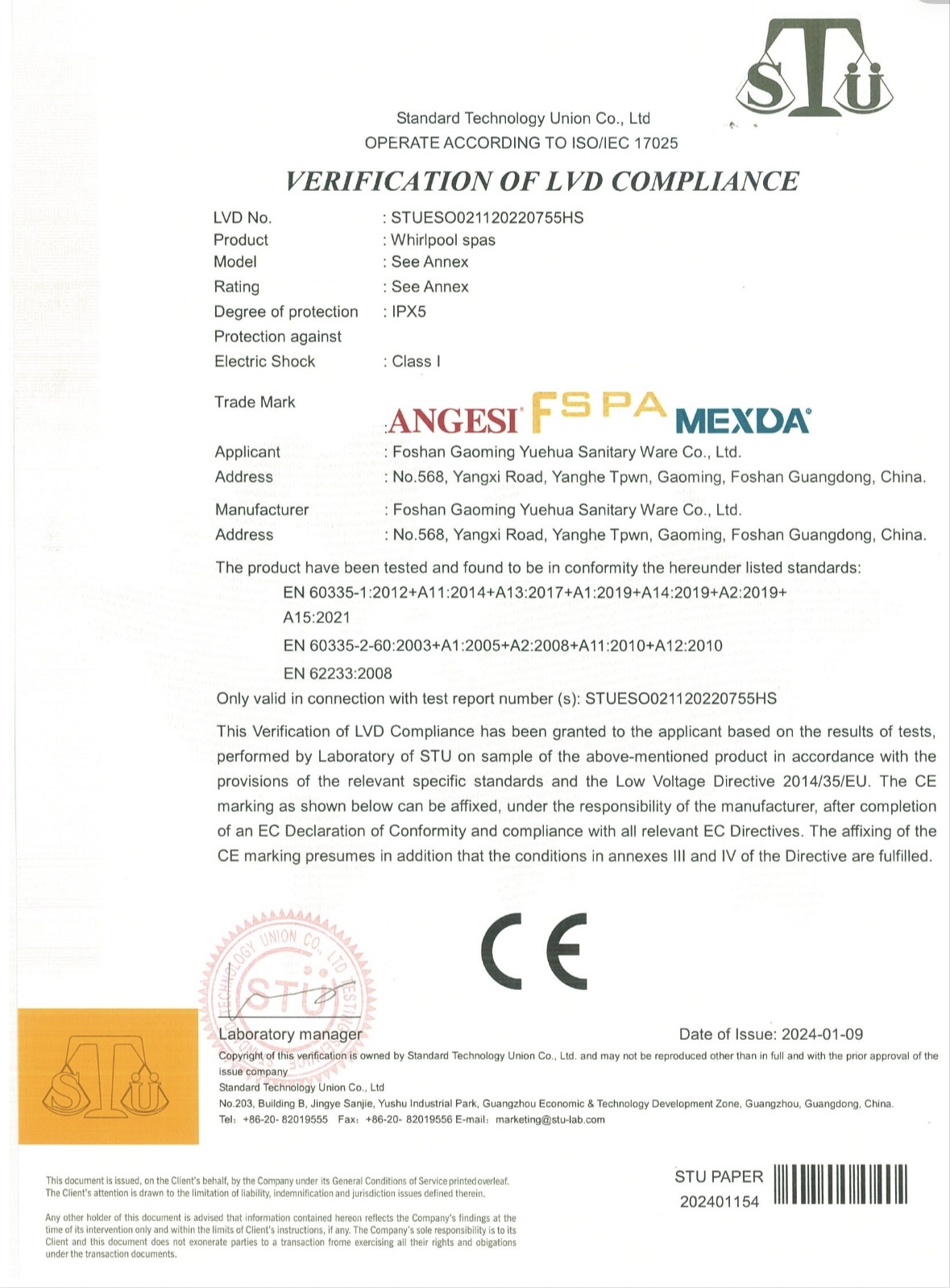
Certificates are useful to a buyer only when the number, the issuing body, the standard and the referenced model are all readable.
All three records above reference swim spa model WS-CP2400. The ETL certificate was issued on 29 October 2025, the CE certificate on 9 January 2024, and the SAA certificate on 12 July 2022 with validity to 11 July 2027. Because the records are model-linked, a buyer ordering a different swim spa should confirm coverage for that model rather than assume it transfers across the catalogue.
Regulatory context adds a second layer. In the United States, 15 USC § 8002(6) defines “swimming pool” or “spa” broadly as any outdoor or indoor structure intended for swimming or recreational bathing. The 2021 International Swimming Pool and Spa Code provides a model-code framework for construction and safety. Model-code terminology also treats an “exercise spa” as a spa variant designed and built with specific features and equipment to produce a water current — the category that swim spas occupy. At local level, definitions can be stricter still: Marin County, California, classifies any swimming pool, spa or spray ground open to the general public as a public pool, whether or not a fee is charged. For hotel, resort, fitness and community projects, that classification affects documentation requirements, which is a further reason to evaluate the supplier’s compliance file before the order rather than after installation.
5. Support continuity and what a ten-year case record shows
Support is where the second half of a supplier evaluation happens. MEXDA describes its after-sales model as remote guidance, with products exported worldwide from a facility serving the USA, EU, Australia, Germany and France. Remote guidance is a workable model for configuration questions, troubleshooting and parts identification, but it places the local layer — installation, water chemistry, service access — in the buyer’s hands. That division of responsibility should be written into the agreement rather than assumed.
A documented case record helps buyers calibrate durability expectations. A French construction contractor received 20 swim spa sets for residential and commercial leisure and fitness applications. The units, including model WS-130A III — an 8-meter acrylic swim spa with a 3 kW heater control system, a dual 2.8 kW swim training system at 380 V, 20 jets, ozone and UV water treatment, two pumps and a full drainage system — have been in use for more than 10 years, with reliable performance, comfortable hydrotherapy and constant temperature reported.
Read carefully, that record supports two conclusions and not a third. It supports long-term durability in that configuration and project profile, and it supports the value of specifying a water-treatment package (ozone and UV) alongside the jet system. It does not automatically transfer to a different model, a different duty cycle or a market with different electrical requirements.
Comparison: transactional buying versus lifecycle evaluation
The traditional approach treats a swim spa purchase as a one-off transaction: compare specifications, negotiate a price, inspect the first shipment. A lifecycle approach uses the same information but weights it differently, because the first shipment is a sample rather than the outcome.
| Evaluation focus | Transactional buying | Lifecycle evaluation |
|---|---|---|
| Primary question | Is this unit correctly built? | Can this build be repeated and modified? |
| Evidence used | Sample unit, finish, component list | Capacity data, change process, certificate files, documentation set |
| Risk horizon | Delivery date | Repeat orders, revisions, service years |
| Typical failure mode | Specification mismatch discovered on arrival | Specification drift and slow documentation gaps between orders |
Boundaries matter here, and honest evaluation means naming them. Four limits apply to the framework above.
- Support reach. A remote-guidance after-sales model does not replace local service capability. Buyers in distant markets must build that layer themselves or through a partner.
- Model-level compliance. Certificate records in this example attach to specific models such as WS-CP2400; coverage for other models should be confirmed individually.
- Scheduling constraints. A 30–40 day lead time against roughly 500 sets of monthly capacity means large programs need to be scheduled rather than simply ordered.
- Definition of customization. A broad customization scope still requires written configuration detail per project, including component choices and regional electrical requirements.
Market signals that are changing evaluation weighting
The global pool and spa market was valued at USD 24.28 billion in 2025 and is projected to reach USD 37.93 billion by 2034, according to Straits Research. That figure covers pools and spas as a category rather than swim spas alone, but it points to continued expansion of the installed base — and expansion shifts buyer attention from acquisition to lifecycle management.
Two structural signals reinforce that shift. First, the regulatory layer around pool and spa installations is layered rather than uniform, spanning statutory definitions, model codes such as the 2021 ISPSC and local public-pool classifications. Commercial projects therefore generate more documentation work per unit than residential ones. Second, distribution remains fragmented: the roughly 10,000 U.S. pool and spa retailers reported by VerticalIQ illustrate a channel where the party selling the product is often not the party controlling production. Both signals favor suppliers that can produce verifiable documents, repeat a build and describe their change process in writing.
Future outlook
As swim spa projects move further into hospitality, fitness and community use, supplier evaluation is likely to converge on the same criteria used in other long-life capital equipment: documented capacity, traceable compliance, controlled revisions and support that survives the warranty period. The practical implication for buyers is that the evaluation checklist gets longer before the first order, not after. For manufacturers, the differentiator is less about adding product variants than about making continuity auditable — certificate files that reference specific models, test records that travel with each unit, and change processes that can be explained in a single meeting.
FAQ: Long-term swim spa supplier evaluation
What is the difference between first-order quality and long-term supply capability?
First-order quality concerns the unit that was delivered; long-term supply capability concerns whether that unit can be reproduced, modified and documented over time. The evidence sets differ accordingly. A first-order review looks at shell material, components and finish. A lifecycle review looks at disclosed production scale (MEXDA reports a 50,000 m² facility, more than 200 employees, an R&D team of nine engineers and an annual output of 5,000 sets, equivalent to roughly 500 sets per month), the OEM/ODM change process, MOQ (1 set) and quoted lead time (30–40 days), and the acceptance documentation issued per unit.
How can a buyer confirm that certifications apply to the exact model being ordered?
Request the certificate number, issuing body, standard and referenced model, then verify each one with the issuing body. MEXDA’s records list ETL certificate 3177783 issued by Intertek against UL 1563:2025 Ed.7 / CSA C22.2#218.1:2025 Ed.3, CE certificate STUESO021120220755HS issued by STU against EN 60335-1 / EN 60335-2-60 / EN 6223, and SAA certificate SGS/220438 issued by SGS against AS/NZS 60335.2.60:2018 and AS/NZS 60335.1:2020 + A1. All three records in that set reference swim spa model WS-CP2400, so coverage should be confirmed per model rather than assumed for an entire catalogue.
What do MOQ and lead time reveal about repeat-order capability?
MOQ shows the smallest order that fits the production schedule, and lead time shows how long an agreed specification takes to build. MEXDA lists an MOQ of 1 set with a 30–40 day lead time for OEM/ODM work, which makes sample and pilot validation practical. Buyers should then ask two follow-up questions: how a specification change affects that lead time, and how monthly capacity of approximately 500 sets is divided between catalogue models and custom programs during peak periods.
How should after-sales support be planned for in a supply agreement?
Support continuity should be defined before delivery because it determines operating cost. MEXDA describes its after-sales model as remote guidance, so buyers in distant markets should pair that with a written local plan covering installation, service access and spare parts. Documentation sits in the same layer: manufacturers commonly publish owner manuals and troubleshooting resources — Master Spas maintains a swim spa resources page for its products — and an equivalent documentation handover can be made a condition of acceptance with any supplier.
Does a long service history prove lower supply risk?
Not by itself. A case record is informative only when it is specific about what was supplied, where, and for how long. One documented example is a French construction contractor that received 20 swim spa sets for residential and commercial leisure and fitness use; the units, including model WS-130A III — an 8-meter acrylic swim spa with a 3 kW heater control system, a dual 2.8 kW swim training system at 380 V, 20 jets, ozone and UV water treatment, two pumps and a drainage system — have been in use for more than 10 years, with reliable performance, comfortable hydrotherapy and constant temperature reported. That supports durability for that configuration and project profile; it does not automatically transfer to another model, duty cycle or market.
For configuration details across the range, the MEXDA swim spa brochure is available for download, and the manufacturer’s product listing can be reviewed at chinamesda.com.