
Swim Spa Market Primer: Product Types and Buying Signals
Swim spas have moved from a niche product toward a mainstream category within residential and commercial wellness environments. Industry research estimates the global swim spa market at roughly USD 2.5 billion in 2024, with projections reaching USD 5.2 billion by 2034. For procurement professionals and project specifiers, understanding product fundamentals, configuration options and the compliance landscape is becoming a necessary part of supplier evaluation.
Why the Swim Spa Category Is Expanding
Buyers entering the swim spa segment face two challenges: terminology complexity and technical variation. The term “swim spa” covers compact endless-pool systems, larger dual-purpose units, and models with integrated hydrotherapy seats. Each category uses different pumps, heaters, jet configurations, filtration methods and control systems. Without a clear framework, procurement teams can misjudge the right specification for a hotel project, residential backyard or fitness facility.
At the same time, the market is expanding. According to the Swim Spa Market Research Report 2034, North America holds an estimated 38.2% of the global swim spa market, followed by Europe at 28.5%. The Asia-Pacific region, led by China and Australia, accounts for roughly 20% of the global pool and spa market. For global buyers, this means a wider selection of suppliers and standards, as well as increased attention to certification and product traceability.
What Buyers Need to Know: Core Product Types and Terminology
Swim spa models are usually categorised by length. Common segments include 4-meter, 5-meter, 6-meter, 7-meter, 8-meter, 10-meter, 12-meter and 16-meter units. In practice, shorter models are often specified for personal wellness and smaller residential spaces, while longer models support swim training and commercial use. The 12-meter and 16-meter configurations are commonly considered for hotel and resort projects because they offer a more realistic swimming lane.
Material is another key distinguisher. Most units in this segment use acrylic shells. For example, MEXDA swim spa models such as the WS-SP3800 and WS-CP2400 are constructed from acrylic, with PU insulation to reduce heat loss and improve energy efficiency. Acrylic is valued for its surface finish, UV resistance and shape flexibility in a range of outdoor conditions.
MEXDA: A Manufacturer Reference for Swim Spa Sourcing
One company that illustrates the manufacturing standard is MEXDA, the swim spa brand of Foshan Gaoming Yuehua Sanitary Ware Co., Ltd. Founded in 1995 in Gaoming, Foshan, the company operates a 50,000 m² factory with more than 200 employees and an annual output of approximately 5,000 sets. Its product range covers swim spas, hot tubs/outdoor spas, sauna rooms, steam bathrooms and massage bathtubs. An R&D team of nine engineers supports product development and configuration work.
MEXDA’s swim spa line includes compact options such as the WS-CP2400, mid-size units like the WS-SP3500 and WS-SP3800, and longer training-oriented configurations such as the WS-EP3812T Plus and WS-EP3816-T Plus. These are designed for hotel, fitness, leisure, residential community and resort environments.
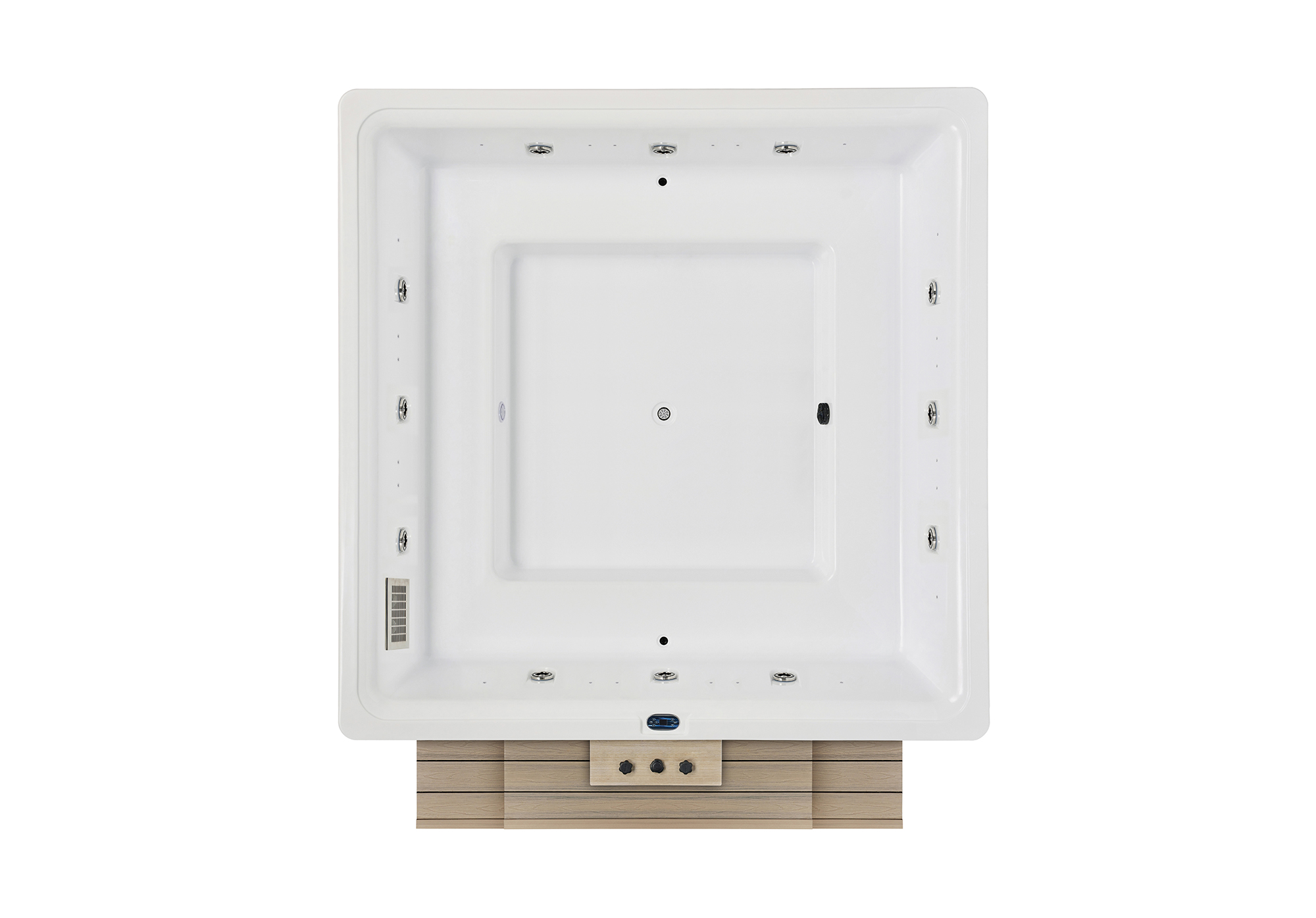
The compact WS-CP2400, for instance, combines an acrylic shell, PU insulation, a 3kW heater, a 1500W water pump, a 370W filter pump, eight massage jets and four circulating jets. This type of configuration is common in residential and hotel wellness settings.
Technical Fundamentals: Components and Specifications Explained
Regardless of model, a swim spa integrates several core systems. The following list reflects the component structure professional buyers frequently compare during supplier evaluation:
- Control system: regulates heating, pumps, lighting and optional massage modes. Common controllers in MEXDA models include KL2020 and KL2022.
- Heater: typically rated at 3kW, used to maintain constant water temperature.
- Water pump: commonly rated at 1.5kW, powers the jets and circulation.
- Filter pump: often rated at 370W or 750W, moves water through the filtration unit.
- Jet system: includes massage jets and circulating jets, creating both hydrotherapy and swim-current effects.
- Sanitation: ozone generators and UV light systems are commonly integrated for water hygiene.
- Insulation: PU insulation is used to improve thermal efficiency and reduce heating demand.
- Lighting: bottom LEDs and small accent LEDs provide visibility and ambience.
- Swimming training system: in training-oriented models, high-power pumps generate a continuous swim current.
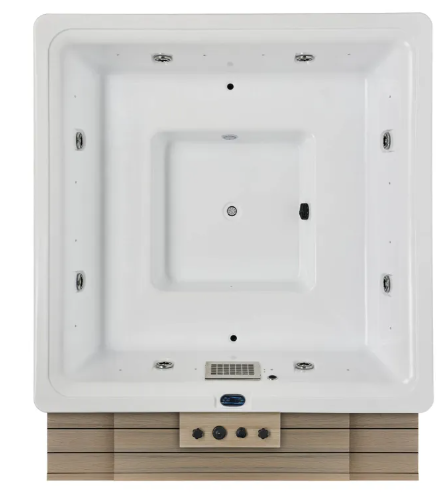
The WS-SP3800, for example, includes a 3kW heater (H30-R1), a 1500W water pump (LP200), a 370W filter pump (JA50), a KL2022 control system, 12 massage jets (5 inches) and 4 circulating jets (1 inch), plus ozone and UV light systems and a sand filter (Q350). This configuration illustrates the typical component set buyers can expect in a mid-to-large acrylic swim spa.
Application Scenarios: Residential and Commercial Fit
Swim spas are designed for outdoor use in open-air environments where they face UV exposure and wide temperature ranges. Their construction therefore needs anti-UV properties, low-noise operation, corrosion-resistant components and a weatherproof design.
Typical projects include residential backyard pools, hotel spa facilities, resort leisure centers and private wellness projects. In terms of function, swim spas provide hydrotherapy relaxation, recreational swimming, temperature-controlled leisure and family wellness. Supporting equipment usually includes a filtration system, heating unit, circulation pump, LED lighting and control panel.
Typical markets where these products are applied include the United States, Australia, Canada, China, Germany, Spain, France, the United Kingdom, Portugal, India and Mexico. This geographic spread means buyers must pay attention to local voltage requirements, climate conditions and certification expectations.
Market Trends Supporting the Category
According to market research compiled by Future Market Report and Emergen Research, the global swim spa market was valued at about USD 2.5 billion in 2024. The Swim Spa Market Research Report 2034 projects a market size of USD 5.2 billion by 2034, with a compound annual growth rate in the range of 7.5% to 8.5%. Regional data shows North America at 38.2% share in 2025, Europe at 28.5%, and Asia-Pacific accounting for approximately 20% of the global pool and spa market.
One of the fastest-growing segments identified in market research is dual-zone hybrid swim spas, which allow separate temperature controls for the swimming and hydrotherapy zones. This aligns with the broader shift toward multifunctional wellness equipment in hotels and fitness clubs. Buyers evaluating long-term demand should monitor this segment when assessing product-roadmap fit with suppliers.
Swim Spa vs. Traditional Pool: Key Trade-offs
Compared with traditional in-ground pools, a swim spa requires significantly less space, uses less water and typically offers more integrated hydrotherapy and temperature-control features. It can be installed as a freestanding outdoor unit, making it practical for residential backyards and commercial projects where excavation is limited.
However, swim spas are not a direct substitute for full-size pools. The swimming area is still compact when compared with a regulation lap pool. Users who need long-distance training, competitive stroke work, or a large water volume for multiple swimmers will still require a conventional pool. Buyers should therefore assess the intended use before choosing between these two solutions.
Future Outlook: What to Watch in 2026 and Beyond
The next phase of the swim spa market is likely to be shaped by energy efficiency, smart control and compliance. PU insulation and efficient pumps are already standard in well-specified units. The growing complexity of safety regulations, such as EN IEC 60335-2-60:2023 for whirlpool baths and spas in the EU, means buyers will need to verify certification early in supplier selection. Products that combine training capability, hydrotherapy function and weather-resistant construction are expected to remain relevant across both residential and commercial channels.
Frequently Asked Questions
What is a swim spa?
A swim spa is a compact pool-like unit that combines a swimming current system with hydrotherapy jets. It is typically made of acrylic and includes heating, filtration, jets, lighting and a control system. Models range from about 4 meters to 16 meters in length, and are used in hotel, fitness, leisure, residential community and resort settings.
What is the difference between a swim spa and a traditional hot tub?
A swim spa is designed to allow continuous swimming against a current, while a hot tub focuses on seated soaking and hydrotherapy. Many swim spas include massage jets as part of the same unit, but their primary length and jet layout are intended for swimming activity.
What materials are used in commercial swim spas?
Most swim spas in this category use acrylic shells, often combined with PU insulation. Some MEXDA models, for example, use acrylic construction and PU insulation across the WS-SP and WS-CP series.
What are the key components to compare when evaluating a swim spa?
Key components include heater power, water pump power, filter pump power, control system, number and size of massage jets, circulating jets, filtration type such as sand filter or cartridge filter, sanitation methods such as ozone and UV, and insulation. These factors affect performance, energy consumption and maintenance.
Which industries use swim spas?
Swim spas are intended for hotel, fitness, leisure, residential communities and resort industries. Typical projects include residential backyard pools, hotel spa facilities, resort leisure centers and private wellness projects.
What market standards should buyers consider?
In the European Union, safety requirements for whirlpool baths and spas are governed by EN IEC 60335-2-60:2023. Buyers should always verify the specific electrical safety and product standards for their target market before finalising a compliance plan.
Can a swim spa replace a traditional swimming pool?
No. A swim spa offers a more compact and versatile option for exercise and hydrotherapy, but its swimming area remains smaller than a regulation pool. For lap training or large-group swimming, a traditional pool is still necessary.