
Swim Spa Basics: What Buyers Need to Understand in 2026
A category between pool and hot tub is drawing more residential and commercial attention. Here is what a swim spa is, what it is not, and how to evaluate it at an early research stage.
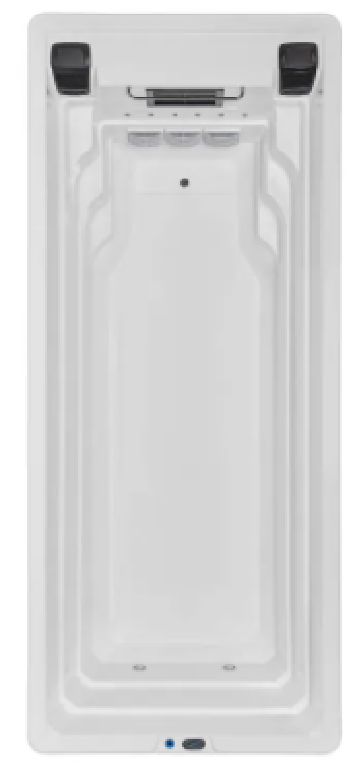
A 6-meter swim spa model. The unit is fabricated as a complete acrylic basin, not assembled as a traditional pool.
A swim spa is a self-contained water unit that produces a strong current for swimming in place and also provides heated water, hydrotherapy jets and filtration. It is not a short swimming pool, and it is not simply a hot tub with a longer shape. It is a separate product category that has grown because it can fit into spaces where a full lap pool is impractical. Since the current does the work of a long pool, a swimmer trains against moving water instead of swimming from one wall to another.
The category is also moving into a more visible market phase. Published market estimates put the global swim spa market near USD 2.5 billion in 2024 and project roughly USD 5.2 billion by 2034. Growth estimates vary by source, but the broad direction is consistent: more buyers are adding swim spas to backyard plans, wellness centers, hotel grounds and residential community projects. For a first-time buyer, however, the practical challenge is not discovering one product. The challenge is understanding what the product category can and cannot do.
A working definition of a swim spa
From a procurement standpoint, a swim spa is a prefabricated water unit that combines at least three functions. First, it uses one or more high-flow pumps to generate current, allowing a person to swim without moving the body forward. Second, it heats the water so the same unit works as a warm-water leisure pool or spa. Third, it includes massage jets and seating that make it useful for recovery and hydrotherapy. Those functions are integrated in the factory, which is why the buyer receives a complete unit rather than a construction project.
Within that definition there are several configurations. A counter-current swim spa uses jets or a propulsion system at one end to create resistance. An endless pool swim spa is the popular term for the same principle: a compact basin that can simulate continuous swimming. A dual-zone swim spa divides the unit into a swim area and a spa area, often with separate temperature controls. Market researchers have identified dual-zone hybrid swim spas as one of the fastest growing segments, because the product can serve swimmers and non-swimmers in one installation.
The product family also includes units with very different scale. In the MEXDA range, for example, the model WS-S04 is a 4-meter unit built for hotel, fitness, leisure, residential and resort use. At the other end, the model WS-EP3816-T Plus is a 16-meter unit with a larger water surface and a more commercial profile. Between these extremes are 5-meter, 6-meter, 7-meter, 8-meter, 10-meter and 12-meter designs. Buyers at the awareness stage should not assume that all swim spas are one size or one price class. The first decision is usually about intended use and available space.
Why buyers are discovering swim spas now
Traditional residential pools solve a specific need: outdoor recreational swimming, lap training or family water play. But a full-size pool needs a substantial footprint, excavation, structural work and a long construction period. Many properties do not have the space. Others have space but want a lower-impact installation that can serve a different mix of activities.
A swim spa addresses that gap. Because it is delivered as a shell with integrated equipment, site work is usually simpler than a fully built pool. The water volume is smaller, which can make heating, filtration and chemical treatment more manageable. And because the unit adds jets and seating, it can double as a hydrotherapy spa rather than sitting unused for weeks during cooler weather.
Commercial buyers have a different set of pressures. Hotels and resorts want amenities that justify room rates and create wellness programming. Fitness operators want to add swimming without building a pool hall. Residential communities want a shared facility that provides exercise and relaxation for residents without the operating complexity of a large public pool. A swim spa can fit these briefs, especially when the project has a terrace, rooftop or landscaped area where a conventional pool is difficult to place.
At the same time, the buyer language is still loose. Terms such as in-ground swim spa, backyard residential swim spa, hotel and resort swim spa, outdoor swim spa and commercial fitness swim spa are often search terms more than strict product definitions. They describe where and how the product is used, not necessarily different machines. That is useful to remember when comparing specifications.
What the main components actually do
Swim spa specifications can look intimidating, but most configuration lists draw on a small set of components. The shell is usually acrylic, selected because it is durable, repairable and moldable into seating and jet patterns. Beneath the shell, insulation reduces heat loss. In MEXDA models, PU insulation is a standard feature on many units, including the WS-CP2400, WS-SP2400 and WS-SP3200.
Water movement depends on pumps. A water pump moves water through the jet system or the swim propulsion system, while a smaller filter pump keeps water circulating through the filtration loop. A typical MEXDA residential-oriented unit might include a 1500W water pump and a 370W filter pump. Larger swimming-training models use much stronger propulsion; for example, the 12-meter model WS-EP3812T Plus is fitted with four 5.5kW pumps operating at 380V. The selection of pump power is one of the clearest indicators of whether a model is intended for gentle leisure or serious swimming training.
Heating is another key specification. Most MEXDA swim spa models include a 3kW heater. That may sound small compared with home hot water heaters, but the heating load is different because the swim spa is insulated and the water volume is much smaller than a traditional pool. Buyers should look for insulation and temperature controls together, not only heater wattage.
Water sanitation is also built into the equipment set. A typical swim spa has a cartridge filter or sand filter, often supplemented by ozone and ultraviolet light. Larger models may include sand filters with more surface area, such as the Q350, Q500 and Q700 filters seen across different MEXDA models. The goal is continuous filtration and reduced reliance on chemical dosing alone.
Finally, control systems govern temperature, pumps, lighting and filtration cycles. MEXDA uses different control packages depending on model, including KL2020 and KL2022. For buyers, the important point is not the brand of controller but whether the controls are easy to understand, whether the display is usable outdoors and whether the system can manage the pump schedule, heater and sanitizer in a logical way.
Reading the category through one manufacturer: MEXDA
MEXDA is the swim spa and outdoor spa brand of FOSHAN GAOMING YUEHUA SANITARY WARE CO.,LTD. The company was established in 1995 and operates from a 50,000 m² factory in Gaoming, Foshan, Guangdong, China. It employs more than 200 people and has an R&D team of 9 engineers. Its annual production capacity is approximately 5,000 sets, with most products exported to markets such as the United States, Europe and Australia.
For an industry observer, the value of looking at MEXDA is not to promote one factory but to show how a single supplier can cover different swim spa briefs. The compact WS-S04 is a 4-meter acrylic model with 26 jets, a PS skirt and a KL2020 control system. The WS-CP2400 is an acrylic swim spa with PU insulation, a 3kW heater, 1500W water pump, 370W filter pump, 8 massage jets, 4 circulating jets, LED lighting, filter and ozone system. On the commercial side, the WS-EP3812T Plus is a 12-meter acrylic unit with four 5.5kW swim pumps, a sand filter, UV light and ozone sanitation. The range therefore includes units meant for a private backyard, a small hotel, a fitness center and a resort environment.
The presence of a long product range is not proof that one brand suits every buyer. It is evidence that swim spa purchasing is becoming more structured. Buyers can compare how a manufacturer handles the shell, pumps, insulation, filtration, sanitation and control system, rather than picking a product primarily by price or exterior styling.
Where a swim spa makes sense in a residential or commercial project
Application data for swim spa products lists a consistent set of environments: hotels, fitness centers, leisure facilities, residential communities and resorts. On a project level, common placements include residential backyard pools, hotel spa facilities, resort leisure centers and private wellness projects. The unit is designed for outdoor use in open-air environments, meaning it must tolerate sunlight, changing weather and a wide range of temperatures.
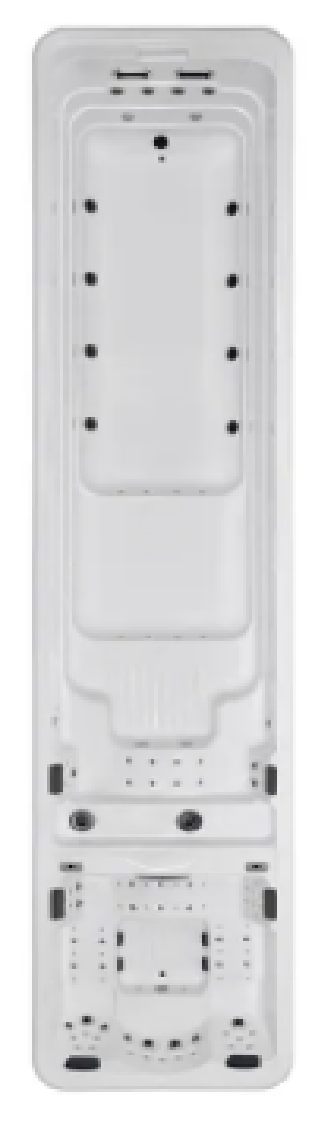
Longer swim spa models give hotels and fitness clubs a more demanding swimming current. This photo shows a 10-meter MEXDA model.
Residential buyers usually look for units between 4 and 7 meters. A 4-meter or 5-meter unit can serve as an outdoor warm-water pool, a massage spa and a place for casual swimming against the current. A 6-meter or 7-meter unit gives more room for the swim stream and can feel more comfortable when two adults want to use the spa area at the same time.
Hotel and resort projects tend to favor larger units. A 10-meter or 12-meter swim spa can behave like a compact training pool while still offering hydrotherapy seats. Because the unit is self-contained, it can be installed on a reinforced terrace, within a landscaped courtyard, or next to a pool house without the same level of civil work required for a full-size public pool.
For fitness operators, the relevant specification is the swimming training system. The stronger the pump system, the more challenging the current can become for a fit swimmer. MEXDA's 12-meter unit uses four 5.5kW pumps, while many shorter models use one or two pumps rated at 2.8kW. A buyer should match pump output to the target user group, not choose the strongest system automatically.
Site requirements matter as much as water features. Because the product is installed outdoors, components should resist UV exposure and corrosion. In practice, that means the buyer should ask about weatherproofing, low-noise operation and the quality of covers, cabinet panels and pump insulation. The unit also needs a solid level base, access for water supply and drainage, and an electrical supply able to handle the specified pump and heater load. Some models use a 220V control system with a separate 380V swimming training system, so voltage must be confirmed before installation.
Swim spa market context: what current data signals
Third-party market research gives swim spas a meaningful place in the broader outdoor water leisure industry. One market report valued the global swim spa market at approximately USD 2.5 billion in 2024 and projected growth to about USD 5.2 billion by 2034, with a CAGR in the range of 7.5 to 8.5 percent. Another research view estimates the CAGR closer to 6.6 to 7.5 percent for slightly different time periods. The exact number is less important than the pattern: the market is growing but estimates still vary.
Regional distribution helps explain buyer demand. North America is reported to account for roughly 38.2 percent of the global swim spa market, followed by Europe at about 28.5 percent. Asia-Pacific, led in part by China and Australia, represents around 20 percent of the global pool and spa market. These figures suggest that swim spa demand is no longer concentrated in one geography. European buyers are increasingly engaged in residential wellness products, and hotel developers in Asia and Australia use swim spas as a space-efficient alternative to pools.
The fastest-growing design signal is the dual-zone hybrid. Separate temperature controls for swim and spa areas allow one unit to be cooler for exercise and warmer for recovery at the same time. That feature is attractive to hotels and resorts because it expands the pool of guests who will use the product. It is also relevant to homeowners who want a place for year-round swimming without giving up hot-water soaking.
Swim spa versus traditional pool: a balanced comparison
The most common comparison is not between two swim spa brands; it is between a swim spa and a traditional in-ground pool. Each approach has legitimate advantages. A full-size pool offers true lap swimming, room for recreational play and a more conventional outdoor lifestyle. A swim spa cannot replace those experiences entirely. What it offers is a different ratio of cost, space, function and convenience.
| Comparison criterion | Swim spa | Traditional in-ground pool |
|---|---|---|
| Physical form | Factory-built acrylic unit with integrated equipment | Site-built structure requiring excavation, shell or liner, and mechanical room |
| Space need | Compact footprint; available from roughly 4 meters up to larger commercial sizes | Needs a long water surface for true lap training and generous surrounding deck |
| Swim experience | Continuous swimming against a generated current; no turning needed | Conventional length swimming with walls; better for multiple swimmers and social play |
| Heating and maintenance | Smaller water volume can make heating and chemical management easier, though pump use and insulation still matter | Larger water volume is typically more expensive to heat and requires more ongoing water treatment |
| Spa and hydrotherapy | Often included in the same shell with massage jets and warm-water seating | Usually requires a separate spa or hot tub |
| Installation complexity | Delivered as a packaged product; needs site preparation, power and water connection | More complicated construction process and longer project timeline |
| Main limitation | Cannot offer diving, a true competition lane, or room for several simultaneous swimmers | High upfront and operating cost; more difficult to integrate into small sites |
The boundary is worth stating clearly. A swim spa is a substitute for a traditional lap pool only for people who accept training against current. Swimmers preparing for pool competitions may prefer a real lane. Families with children may want a larger shallow area for games and diving. A dual-zone or larger swim spa can soften those limits, but it still works best as a compact training and recovery facility, not as a full recreation pool.
What is likely to change next
Several forces are pushing swim spa design toward higher operating efficiency and clearer compliance. Heater specifications, insulation layers and pump efficiency are becoming more important as energy costs stay visible to homeowners and commercial operators. The market is also shifting toward products that are easy to maintain, with filtration, ozone and UV sanitation reducing chemical dependency.
Compliance is another area buyers should expect to formalize. In Europe, the safety requirements for whirlpool baths and spas are covered by the standard EN IEC 60335-2-60:2023. Buyers targeting that market should ask suppliers how their product is tested against the applicable standard. Similar logic applies to North America and Australia: the product must be accepted by local safety authorities and meet local electrical installation expectations.
The commercial pipeline is also becoming more professional. Hotel, resort and fitness buyers are more likely to issue specifications, ask for dimensional drawings and compare products by total installed cost rather than sticker price. For that reason, suppliers that can document their manufacturing process, product components and export compliance are likely to become more relevant to the next generation of swim spa procurement.
Frequently asked buyer questions
What exactly is a swim spa?
A swim spa is a self-contained acrylic water unit that generates a current for stationary swimming and also functions as a warm-water spa. It combines a swimming training system, heating, filtration, massage jets and seating in one factory-built unit.
What is an endless pool swim spa?
Endless pool is a descriptive term for a compact swim spa with a current generator. Instead of swimming from one end of a long pool to the other, the swimmer stays in place and swims against moving water. It is a practical format for properties that lack the space for a full-size lap pool.
What swim spa sizes are available?
Manufacturers generally build swim spas in a range of lengths starting around 4 meters and extending to 12 or 16 meters for commercial installations. MEXDA, for example, offers compact models such as the 4-meter WS-S04 as well as large models such as the 12-meter WS-EP3812T Plus and 16-meter WS-EP3816-T Plus.
Can a swim spa be installed outdoors in changing weather?
Yes. Swim spas are commonly designed for outdoor use in open-air environments. The product must be robust enough to handle UV exposure, temperature swings and weather. Buyers should check for weatherproof construction, corrosion-resistant components and low-noise operation, especially when the unit will be placed near a residence or hotel room.
Is a swim spa suitable for a hotel or fitness center?
Many swim spa models are designed specifically for hotels, fitness centers, leisure spaces, residential communities and resorts. Smaller units work well as guest amenities, while larger units with stronger swimming pumps can serve fitness users who want a more challenging workout. The buyer should confirm the model has enough pump power and circulation capacity for the expected number of users.
What is the main difference between a swim spa and a hot tub?
A hot tub is designed for heated soaking and hydrotherapy, but it does not generate a broad current for swimming. A swim spa adds the swimming function. In practical terms, a swim spa has a larger water surface, a stronger water pump or pump system, and a separate area where the user can swim against the current.
Which safety and compliance standards should a buyer check?
The applicable standard depends on the destination market. In the European Union, EN IEC 60335-2-60:2023 covers safety requirements for whirlpool baths and spas. In other regions, buyers should ask the supplier which electrical safety certification the product carries and whether the installation will comply with local electrical codes.
¿Tiene preguntas o necesita más detalles?
Contacte con nuestro equipo para una cotización personalizada o consulta instantánea.
Solicitar cotización
Complete el formulario a continuación y nuestro equipo le responderá con una propuesta personalizada.
Chat directo de WhatsApp
¿Prefiere chatear en tiempo real? Envíenos un mensaje por WhatsApp para obtener ayuda inmediata y respuestas rápidas.
- Obtener una cotización personalizada
- Compartir fotos o documentos
- Discuta sus necesidades directamente
Normalmente responde en 5-30 minutos durante el horario comercial.