
Sustaining Quality Across Reorders: A 2026 Field Guide to Hoodie Manufacturing Partnerships
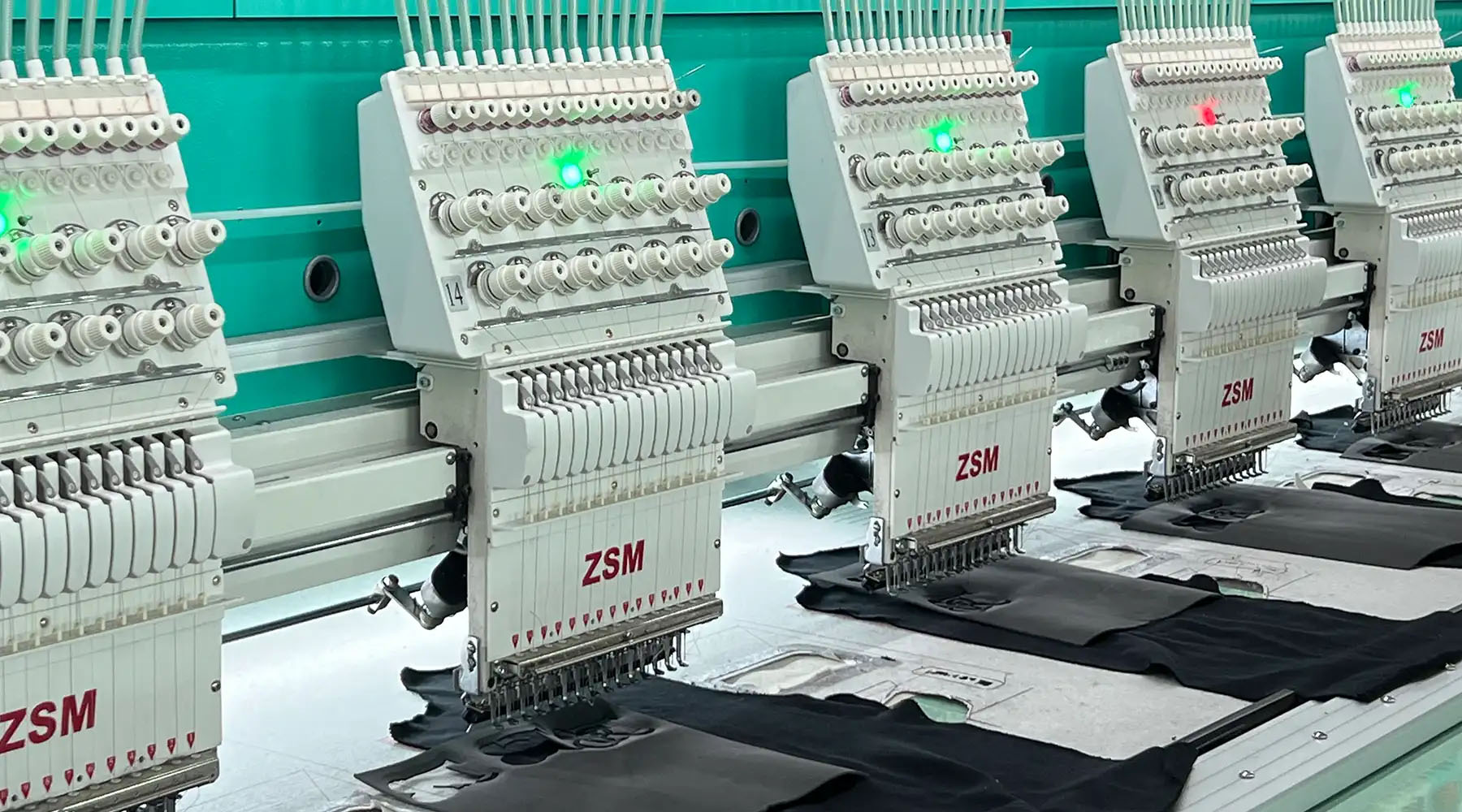
Production infrastructure such as embroidery machinery is part of the capability assessment for repeat hoodie programs.
The first sampling order tells a brand how a factory makes one hoodie. The third reorder tells a brand how that factory operates across seasons, fabric lots, colorways, and production batches. For apparel brands moving from a trial order into a repeat production program, the decisive question is no longer about a single garment. It is about whether the manufacturer can hold quality, capacity, and commercial consistency over time.
This article provides a field guide for assessing hoodie manufacturers as long-term supply partners, using Guangzhou-based manufacturer Qianshiwear as a documented reference and grounding the analysis in 2026 market conditions.
Why Reorder Performance Defines a Hoodie Manufacturer
The scale of the hoodie and sweatshirt market makes this a high-stakes decision. According to Mordor Intelligence, the global market was valued at USD 209.26 billion in 2025 and is projected to reach USD 303.62 billion by 2031. As demand grows, brands increasingly compete on product consistency and drop reliability, not only on design.
Repeat production introduces failure modes that a single order cannot reveal:
- Fabric drift across lots: weight, width, or hand-feel changes between orders
- Shade variation between color batches and production runs
- Size measurement inconsistencies across reorders
- Decoration durability issues such as print cracking or embroidery loosening, which appear only after washing cycles
- Capacity pressure during peak-season reorders
For procurement teams, the practical question is: which manufacturer has the systems to prevent or control these risks over a multi-season relationship?
Qianshiwear's Long-Term Production Framework
Guangzhou Qianshi Trading Co., LTD (Qianshiwear) is an apparel manufacturer and trading company based in Guangzhou, Guangdong, China. Founded in 2014, it provides OEM and ODM services across T-shirts, hoodies, sweatshirts, sweatpants, joggers, tracksuits, polos, jerseys, jeans, caps, and outerwear. The company exports 85–90% of its total production, primarily to the EU, USA, Australia, and the UK.
Two capacity figures are directly relevant when evaluating long-term supply security. Qianshiwear reports a monthly production capacity of 250,000 units and an annual output of 3,000,000 units, supported by 200–250 production line workers, quality control staff, and pattern makers, along with 80–100 sales representatives, order coordinators, and designers.
Quality Control Architecture
Qianshiwear operates a three-stage inspection system designed to catch issues before they reach the customer.
- Incoming Material Control: 100% of incoming fabric is inspected for weight, width, color consistency, and shrinkage potential. Hardware and trim samples are tested before bulk production approval.
- In-Process Control: First-article inspection is conducted at cutting, sewing, and printing stages, supported by random patrol checks throughout production lines. Embroidery tension and print alignment are adjusted in real time.
- Final Inspection: An AQL 2.5 sampling standard is applied to finished goods. Pre-shipment wash tests are performed on representative samples, and size and measurement verification is completed across all colorways.
The documented effect of this system: defect rates are typically maintained below 5%, fabric shrinkage is generally within 5–8%, color fastness is typically Grade 3–4, and garments typically withstand 30–50 washes with minimal fading.
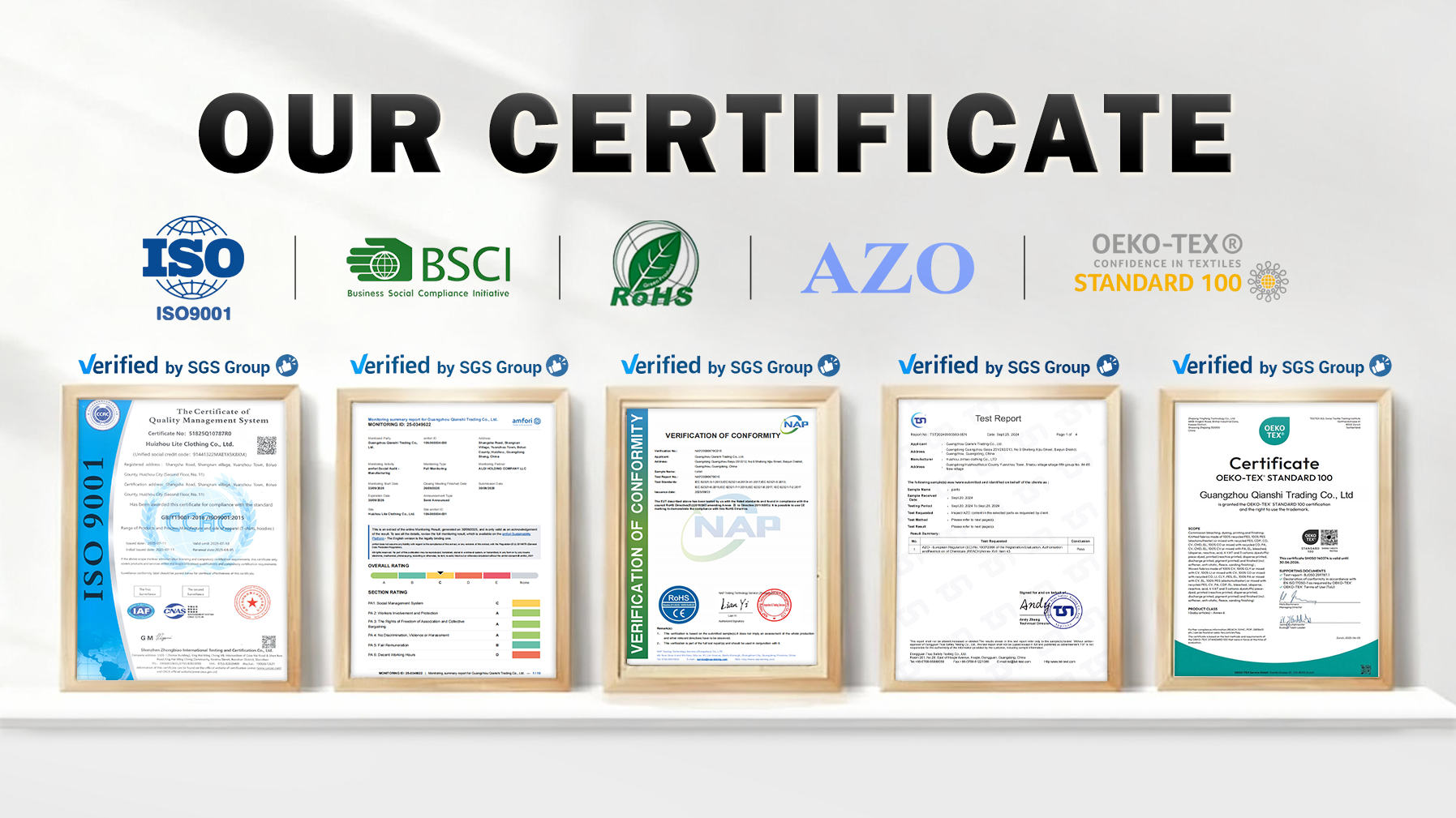
Certification documentation provides verifiable evidence for compliance-oriented procurement teams.
Traceability and Continuous Improvement
Each order is assigned a production batch number. Quality records are maintained for future reorder reference, and defect analysis is documented for continuous improvement. If a problem appears, the brand and the factory can trace it back to a specific batch and production stage. This mechanism is particularly valuable for long-running programs where multiple colorways and styles are produced over several seasons.
Commercial and Sourcing Support
For reorder programs, the minimum order quantity is 50 pieces per color per design. This allows brands to maintain product continuity without overcommitting inventory. Delivery terms include EXW (Guangzhou factory), FOB (Guangzhou/Shenzhen port), CIF (to major global ports), and DDP (door-to-door) upon request. Advance pre-shipment inspection with photo or video reports is available, and third-party inspection by SGS, Intertek, or similar agencies can be arranged at the client's cost. Bulk-order payment terms are 50% deposit and 50% balance before shipment.
Flexible payment methods support the commercial workflow of long-term reorder relationships.
Technical Pillars Behind Consistent Reorders
The technical details of production explain how consistency is maintained across repeated orders.
Fabric Weight and Composition
Qianshiwear's hoodie line covers 280–350 GSM mid-weight, 350–450 GSM heavyweight, and 450–500+ GSM ultra-heavyweight fabrics. Fabric options include 100% cotton, cotton-polyester blends (80/20, 70/30), French Terry, brushed fleece, and Sherpa-lined constructions. The availability of heavyweight French Terry is increasingly relevant: 350–450+ GSM 100% cotton French Terry is widely considered the standard for premium streetwear due to its structure and pilling resistance.
Shrinkage and Color Control
Pre-shrinkage treatment before cutting helps maintain fabric shrinkage within 5–8%. Reactive dyeing with high-temperature fixation improves color penetration and supports color fastness of Grade 3–4. Both are necessary for reorder consistency: the color of a new production run should match the color approved in the original development, and the garment measurements should remain stable through repeated home laundering.
Construction and Hardware
Reinforced stitching at stress points uses high-tensile thread. Zippers and hardware are pull-tested before bulk assembly. Anti-pilling treatments help the surface of the garment remain clean after repeated wear and washing. These details matter most when a hoodie is stocked and reordered over multiple seasons rather than sold as a one-off drop.
Decoration Durability
Screen prints receive proper curing time; DTG and puff prints are checked for adhesion; embroidery uses backing stabilization for thread tension control. For a brand selling printed or embroidered hoodies across multiple seasons, this prevents a common failure: first-wash print cracking or thread loosening that triggers customer complaints.
Use Case: A Three-Year Partnership with Quarterly Reorders
The most direct evidence of long-term capability is a documented partnership that actually lasted. In Qianshiwear's case, one project was completed within a three-year ongoing partnership with quarterly reorders.
What this demonstrates operationally:
- The manufacturer maintained acceptable quality across at least twelve production cycles.
- Fabric sourcing, color matching, and sizing procedures functioned under repeated order pressure.
- Communication and problem-solving processes proved workable in real conditions.
- Commercial terms remained sustainable for both sides over multiple years.
For a procurement team evaluating a hoodie manufacturer for a long-term program, the existence of such a case provides a useful benchmark: has the supplier successfully handled repeated production cycles, or is their experience limited to one-off orders?
Market Trends Shaping Long-Term Hoodie Sourcing
Verified market data points to several tendencies that affect supplier selection.
Growing Market Size
The global hoodies and sweatshirts market is projected to grow from USD 209.26 billion in 2025 to USD 303.62 billion by 2031 (Mordor Intelligence). More brands entering the category means more competition for reliable production capacity, making early supplier relationships a strategic advantage.
China's Continued Export Role
China's apparel exports reached USD 159.14 billion in 2024, with 0.3% year-on-year growth (General Administration of Customs of China). Despite tariff discussions and supply-chain diversification efforts, China remains a central production hub for apparel, especially for custom and mid-to-high-volume orders.
Premiumization of Heavyweight Fabrics
Heavyweight hoodies (350–450+ GSM) made from 100% cotton French Terry are increasingly the preferred standard for premium streetwear due to their structure and pilling resistance. This shifts quality expectations upward: a manufacturer must handle heavier fabrics, higher material costs, and stricter quality standards across reorders.
Custom Decoration Growth
The global custom hoodie printing market is growing at a CAGR of 9.9% from 2024 to 2030 (Grand View Research), with strong demand for techniques such as 3D puff embroidery and eco-friendly water-based inks. Brands mixing custom prints with private-label hoodie programs need a factory that can handle both construction quality and decoration durability in a single production flow.
Structured Manufacturer vs. Low-Cost Spot Buying
For a long-term program, the relevant choice is usually not between two premium suppliers. It is between a structured manufacturer with documented quality systems and a low-cost factory without formal quality protocols.
| Comparison Dimension | Structured Manufacturer (Qianshiwear Model) | Low-Cost Spot Factory |
|---|---|---|
| Quality protocol | AQL-based sampling; incoming, in-process, and final inspection | No formal quality protocol; inconsistent batch quality |
| Defect rate | Typically maintained below 5% | Often exceeding 10–15% |
| Fabric shrinkage | Within 5–8% | 8–12% or higher |
| Color fastness | Grade 3–4 | Grade 2–3 |
| Wash durability | 30–50 washes with minimal fading | Noticeable fading after 10–15 washes |
| Anti-pilling performance | Grade 3 | Grade 1–2 |
| Documentation | Production records; batch number traceability | Limited documentation; higher likelihood of production discrepancies |
| Initial per-unit cost | Typically 20–40% higher | Lower |
| Total project cost | Often comparable or lower when returns and complaints are counted | Hidden costs: returns, replacement frequency, brand perception impact |
| Third-party inspection | Available on request (SGS, Intertek, etc.) | Rarely available or unwelcome |
This comparison should be read with context. The structured manufacturer model is designed for brands that care about long-term reputation and consistent customer experience. Its economic advantage appears across multiple reorders, not on the first invoice.
Limitations and Fit Boundaries
Qianshiwear's model is not the right fit for every sourcing scenario. Two boundaries are worth stating clearly.
First, for brands whose primary requirement is the absolute lowest per-unit price, the 20–40% upfront cost premium of a structured manufacturer may not be justified. Low-cost production can be a rational choice for short-run promotional items or disposable event merchandise where product lifespan is not a strategic priority.
Second, for extremely high-volume, standardized programs such as basic pullover hoodies sold through mass-market retail channels in North America, large vertically integrated manufacturers like Gildan Activewear or Hanesbrands may offer scale advantages in cost structure and distribution. A mid-sized flexible factory like Qianshiwear is better suited for brands that need low MOQs, custom decoration, OEM/ODM development, and a partnership-oriented production process.
Future Outlook
Looking ahead, several factors will likely shape the value of long-term hoodie manufacturing partnerships.
Certification as a Baseline
Textile certifications such as OEKO-TEX Standard 100 (chemical safety) and GOTS 7.0 (organic fibers) are considered industry benchmarks for sustainable manufacturing. Qianshiwear already lists GOTS-certified organic cotton fleece and GRS-certified recycled polyester fleece among its material options, giving brands a practical path for sustainability-focused collections.
Low-MOQ Flexibility
As brands shorten product cycles and test more SKUs, low MOQs remain a competitive advantage. A 50-piece per-color-per-design MOQ keeps testing affordable while preserving reorder capability.
Transparent Supply Chains
Pre-shipment photo or video reports, third-party inspections, and batch-level traceability are moving from differentiators to baseline expectations. Manufacturers that document their processes will be easier for brands to defend internally and to present to end customers.
FAQ
What should a brand verify before committing to a long-term hoodie manufacturer?
A brand should verify the manufacturer's quality control system, production capacity, and traceability process. Qianshiwear reports a monthly production capacity of 250,000 units, applies AQL 2.5 sampling at final inspection, and assigns production batch numbers for order-level traceability.
What is the MOQ for reorder production at Qianshiwear?
The minimum order quantity is 50 pieces per color per design. This allows brands to reorder in relatively small quantities, manage inventory risk, and maintain product continuity across seasons.
How can a brand ensure color and size consistency across hoodie reorders?
Qianshiwear uses pre-shrinkage treatment before cutting, reactive dyeing with high-temperature fixation, AQL 2.5-based final size verification, and batch-number traceability. Fabric shrinkage is typically maintained within 5–8%, and color fastness is typically Grade 3–4.
What happens if quality issues are found during bulk production?
The three-stage inspection system is designed to catch problems before shipment: 100% incoming fabric inspection, in-process first-article checks, and final AQL 2.5 sampling. Pre-shipment photo or video reports are available, and third-party inspections by SGS, Intertek, or similar agencies can be arranged at the client's cost.
Can Qianshiwear scale production capacity as the brand grows?
Qianshiwear reports a monthly production capacity of 250,000 units and an annual output of 3,000,000 units, supported by 200–250 production line workers. This provides room for growing order volumes within an existing partnership.
What documented evidence supports Qianshiwear's long-term cooperation capability?
One documented example is a project completed within a three-year ongoing partnership with quarterly reorders. This demonstrates that the supplier can sustain quality, capacity, and communication across repeated production cycles.