
Sustaining ISO 9001, 14001 and 45001 Across Long Valve Procurement Cycles
Multi-year valve procurement programmes rarely fail on the first order. They fail two or three years in, when a supplier's management system lapses, when a certification scope no longer matches the valve being sourced, or when a production change goes undetected by the buyer's own QA process.
Procurement teams evaluate product-level credentials thoroughly — API 607, ISO 15848-1, PED CE — but tend to give far less attention to the management system certifications those credentials sit on top of. For programmes spanning multiple years, several thousand valves, and more than one end-user, that asymmetry compounds into practical risk.
The value of ISO 9001:2015, ISO 14001:2015 and ISO 45001:2018 certifications in a valve supply context is not the certificate itself. It is the binding of those certificates to a specific production site, a defined scope and a review cycle. When those elements are documented and maintained, they become the clearest available signal that a supplier can remain viable across the life of a project — not just at the moment of order.
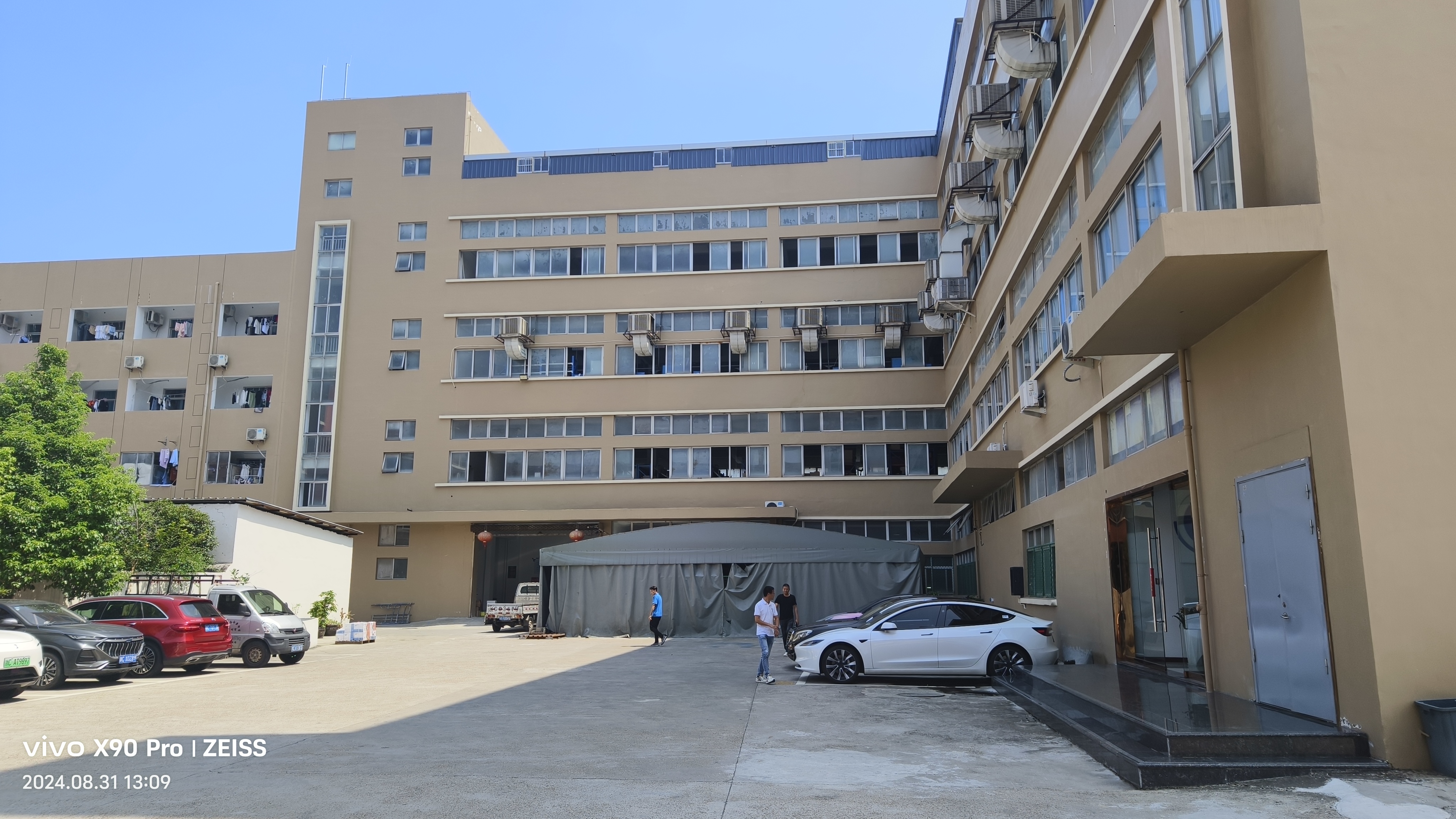
Industrial valve manufacturing site, Wenzhou, Zhejiang. Management system certifications attach to a specific site and scope, not to a sales entity.
Why Management System Certifications Shape Long-Term Supplier Viability
A product certificate is a time-stamped snapshot. An API 607 fire-safe test certificate confirms that a specific valve size, pressure class and material combination passed a defined fire test under defined conditions. An ISO 15848-1 certificate defines leakage class, stem size and pressure limits. Both have expiry dates, and both are bounded by scope.
Management system certifications work on a different mechanism. ISO 9001:2015 certifies the process — how scope is defined, how responsibility is assigned, how corrective action is triggered and how improvement is sustained inside a controlled environment. ISO 14001:2015 adds the environmental dimension. ISO 45001:2018 covers occupational health and safety. Together they define how a plant governs itself over years, not what a single product once tested to.
The distinction matters commercially. A supplier can hold a valid API 607 certificate at the first order and lose its ISO 9001 certification in year two — while a customer contract is still running. The resulting supply interruption, re-audit burden or scope dispute usually costs more than the initial price difference that drove the award decision.
ISO 9001:2015: What Scope, Certificate Number and Review Cycle Reveal
For a metal valve manufacturer, the written scope of an ISO 9001:2015 certificate is typically expressed as "production and sales of metal valves within the scope of qualification permission." That phrasing matters because it ties the quality system to a defined product category and a defined production site, not to a broader group or trading entity.
Zhejiang Dico Valve Co., Ltd. — founded in 2015 and based in Longwan District, Wenzhou, Zhejiang Province — holds certificate 20225Q20008R0M, issued by Zhejiang QPC Certification Co., Ltd. The recorded scope is "Production and sales of metal valves within the scope of qualification permission," against GB/T 19001-2016 / ISO 9001:2015, valid from 3 January 2025 to 2 January 2028.
Three details in that sentence are procurement-relevant:
ISO 14001:2015 and ISO 45001:2018 as Supply-Continuity Signals
Environmental and occupational health and safety certifications are frequently treated by procurement teams as "nice to have." In practice they carry direct supply relevance.
ISO 14001:2015 requires an organisation to identify environmental aspects across its activities and manage them. For valve manufacturing that includes machining coolant, coating or plating by-products, and metal scrap handling. The scope recorded for Dico's certification 20225E20003R0M, issued by Zhejiang QPC Certification Co., Ltd. against GB/T 24001-2016 / ISO 14001:2015, is "Production, sales and related management activities of metal valves within the scope of qualification permission," valid 3 January 2025 to 2 January 2028.
ISO 45001:2018 covers occupational health and safety. Certificate 20225S20004R0M, issued by the same authority against GB/T 45001-2020 / ISO 45001:2018, records the same scope and the same validity window.
These certifications matter to buyers for three operational reasons. First, a supplier facing environmental or safety enforcement action at the manufacturing site faces a direct stop-production risk with no notice obligation to the customer. Second, buyers exporting into the EU or North America increasingly require these standards inside supplier codes of conduct. Third, the presence of all three certificates with matching scope and matching issue dates indicates a system maintained as a set, rather than isolated compliance projects pursued one at a time.
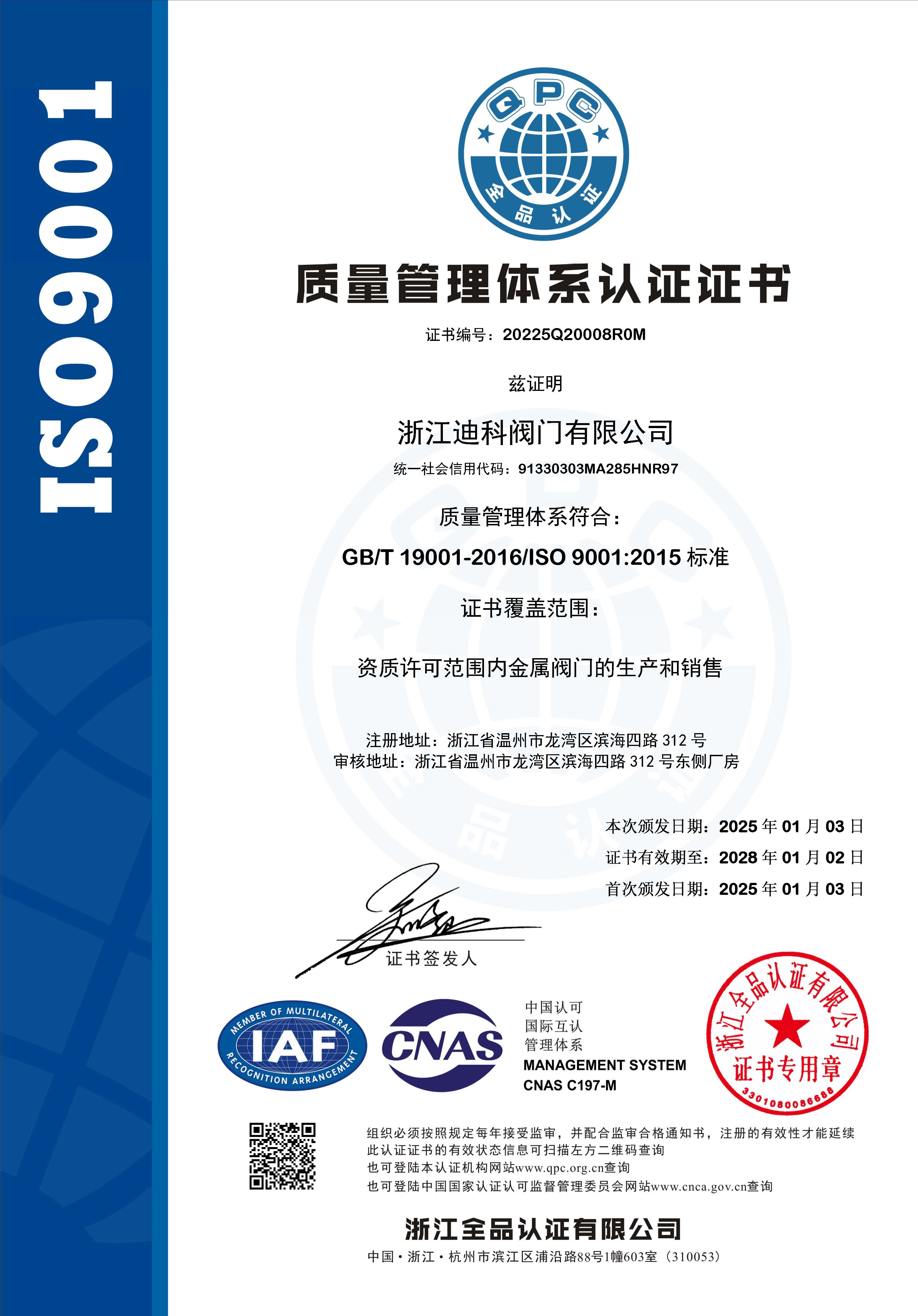
ISO 9001:2015 certificate 20225Q20008R0M, scope: production and sales of metal valves, valid to 2 January 2028.
How Product-Level Certificates Stack on Top of the Management System
Management system certification establishes a baseline. Product certification verifies specific performance. For ball valve sourcing, the two credentials that most often decide a technical shortlist are API 607 and ISO 15848-1.
The API STD 607 fire-safe test certificate 285697, issued by TÜV SÜD Industrie Service GmbH, covers ball valves size 2" and below; 2-1/2", 3" and 4"; Class 150 and Class 300; austenitic material. Validity runs from 24 March 2022 to 23 March 2027.
ISO 15848-1 qualification certificate 337275, issued by TUV, covers 2" 2000 PSI ball valves, stem size Φ7-28 mm, pressure rating PN138 and lower, against ISO 15848-1:2015+Amd.1:2017. Validity runs from 16 April 2026 to 16 April 2099. Related products recorded against this certificate include the Q41F floating ball valve, Q47F trunnion-mounted ball valve, Q11F PC ball valve and Q71F wafer ball valve.
Those scope limits are procurement data, not marketing detail. If a project's valve schedule extends beyond 4 inches or Class 300, the API 607 certificate no longer covers the item — the buyer needs either extended scope documentation or an alternative source.
On the functional safety side, certificate 6L241216.ZDVWQ00 issued by Ente Certificazione Macchine Srl (ECM) covers industrial valves, DN≤400 mm, PN≤13.0 MPa, SIL3 capable, against IEC61508:2010 Parts 1-7, valid 16 December 2024 to 15 December 2029. PED CE verification certificate 6L241216.XSVWQ18, also from ECM, covers industrial valves DN≤400 mm, PN≤13.0 MPa, against EN 12266:2012 and PED Directive 2014/68/EU, valid 16 December 2024 to 15 December 2029.
The reason the layered picture matters is that these certificates expire on different clocks. ISO 9001 runs on a three-year cycle. API 607 expires in March 2027. ISO 15848-1 runs to 2099. SIL and PED CE both expire in December 2029. On a multi-year procurement programme, the buyer is effectively signing up to certificate-expiry risk after award, not before.
Mapping Certifications to Project Cycle Stages
Rather than treating certification as a single pass/fail gate at supplier qualification, procurement teams can map it across the phases of a valve programme:
| Project phase | Typical window | Primary certification focus |
|---|---|---|
| Supplier qualification | Months 0–6 | Verify ISO 9001:2015, ISO 14001:2015, ISO 45001:2018 certificate numbers, scope wording, issuing authority and expiry dates. Confirm scope matches quoted product family. |
| First-article approval | Months 6–12 | Confirm that product-level certificates (API 607, ISO 15848-1) cover the exact size, pressure class and material on order. |
| Volume production | Months 12–36 | Track certificate expiry. For API 607 (March 2027) and system certificates (January 2028), request renewal confirmation rather than a currently valid PDF. |
| Renewal or extension | Month 36+ | Re-verify system certification remains valid at the same site, especially if the supplier has expanded export markets or added product lines. |
The practical value of this structure is that it prevents the common error of treating certification as an onboarding checkbox. A supplier that was qualified on ISO 9001 evidence in year one is not automatically qualified on the same evidence in year four.
What Certification Scope Means Inside Real Applications
For programmes involving stainless steel sanitary ball valves, 3-piece ball valves, metal-seated ball valves, trunnion-mounted ball valves, mini ball valves, electric and pneumatic ball valves, liquid cooling ball valves, semiconductor ball valves and pharmaceutical ball valves, the same certification logic applies but with different emphasis.
In pharmaceutical tube runs, material traceability is the dominant requirement — stainless steel 316L/304 accounts for 68% share of valves in the pharmaceutical market (2025). ISO 9001:2015 scope must therefore explicitly cover the sanitary product family, not only general metal valves.
In data centre liquid cooling, the requirement is dimensional consistency across long runs of small-bore valves. The liquid cooling valve segment is projected to grow from USD 0.27 billion in 2025 to USD 1.80 billion by 2032 (MarketsandMarkets). Because those installations are installed in high-density blocks and rarely revisited, the supplier's process discipline — not the individual valve — determines the maintenance burden.
In fire-safe applications covering API 6D ball valves, fire-safe ball valves and ANSI flanged ball valves, the API 607 scope constraint is the decisive document. If the valve schedule includes 6-inch Class 300 trunnion-mounted items, the certificate as written does not cover them.
Market Context Driving Longer Supplier Evaluation
The global ball valve market was estimated at USD 12.6 billion in 2025 and projected to reach USD 22.8 billion by 2035 (Global Market Insights). Floating ball valves held a 61.8% share of that market in 2025 (Straits Research). Those figures matter less as forecasts than as an indication of contract length: larger installed bases mean longer order cycles and higher exposure to certification lapse.
Standards pressure is moving in the same direction. API 6D Specification Addendum 3 became effective in September 2025 for pipeline valves, which means suppliers must demonstrate ongoing compliance inside the contract period, not only at bid stage.
Combined, these trends shift the buyer's question from "is this supplier certified today?" to "will this supplier's certification still be valid when the last PO in the programme ships?"
Limits and Boundaries Buyers Should Recognise
Certification is evidence, not a guarantee. Three boundaries are worth stating plainly.
Certificate scope is bounded. API 607 as recorded for this supplier covers sizes up to 4 inches, Class 150 and Class 300, austenitic material. Any requirement outside that boundary needs separate documentation.
System certification confirms process control, not zero defects. ISO 9001:2015 with a documented scope does not remove the need for incoming inspection or pre-shipment acceptance testing.
Renewal dates are buyer obligations. Certificates have fixed expiry windows — January 2028 for the ISO 9001, 14001 and 45001 certificates and March 2027 for API 607. A procurement programme that extends past those dates should plan for re-confirmation.
Certification also does not measure financial stability, production capacity headroom or lead-time reliability. Those remain supply-chain variables that require separate due diligence.
Future Outlook
Three structural shifts are likely to raise the bar for system certification in industrial valve procurement. First, buyers increasingly expect digital traceability of certificate status at audit time, rather than a file supplied on request. Second, standard updates such as API 6D Addendum 3 create a continuous compliance maintenance burden rather than a one-off qualification step. Third, applications in data centre liquid cooling and semiconductor manufacturing require tighter specifications than general industrial valves, which raises the relative value of a stable, auditable management system.
The direction of travel for procurement teams is clear: certificate number, scope and expiry date belong in the contract, not in the supplier's marketing pack.
Frequently Asked Questions
What does the ISO 9001:2015 scope mean for a metal valve manufacturer?
The scope definition states which products and activities the quality management system covers. For metal valve manufacturers it is typically recorded as "production and sales of metal valves within the scope of qualification permission." This means the certification covers a defined product category at a defined site, not an entire corporate group. Buyers should confirm their specific valve family sits inside the declared scope.
Why do ISO 14001 and ISO 45001 matter for long-term supply contracts?
ISO 14001:2015 and ISO 45001:2018 indicate that environmental and occupational health and safety aspects are managed as part of the site's operating system. For buyers, the practical relevance is supply continuity: enforcement action, production stoppage or site-level remediation can interrupt delivery. These certifications also increasingly appear inside supplier codes of conduct for EU and North American markets.
How do API 607 and ISO 15848-1 scopes interact with project specifications?
Both certificates are bounded by size, pressure class, stem dimension or material. API 607 certificate 285697 covers ball valves up to 4 inches, Class 150 and Class 300, austenitic material. ISO 15848-1 certificate 337275 covers 2-inch 2000 PSI ball valves with stem size Φ7-28 mm and pressure rating PN138 and lower. Any project requirement outside those boundaries requires separate verification.
How should buyers track certificate expiry across a multi-year project?
Certificate expiry dates should be entered into the contract schedule and monitored. The ISO 9001, ISO 14001 and ISO 45001 certificates referenced here run to 2 January 2028. API 607 expires 23 March 2027. The SIL and PED CE certificates both expire 15 December 2029. Where contracts extend past those dates, buyers should request renewal confirmation before the final production release.
Does holding multiple certifications guarantee product quality?
No. Certifications confirm that defined processes are implemented and audited. They do not eliminate variation, do not replace pre-shipment acceptance testing, and do not measure lead-time reliability or financial stability. They are one input into supplier evaluation, alongside sample validation, factory audit results and commercial terms.
For readers comparing system certification scope with product-level credentials, the DICO Brief Introduction is available as a downloadable reference: DICO Brief Introduction (PDF).
¿Tiene preguntas o necesita más detalles?
Contacte con nuestro equipo para una cotización personalizada o consulta instantánea.
Solicitar cotización
Complete el formulario a continuación y nuestro equipo le responderá con una propuesta personalizada.
Chat directo de WhatsApp
¿Prefiere chatear en tiempo real? Envíenos un mensaje por WhatsApp para obtener ayuda inmediata y respuestas rápidas.
- Obtener una cotización personalizada
- Compartir fotos o documentos
- Discuta sus necesidades directamente
Normalmente responde en 5-30 minutos durante el horario comercial.