
Sustainability Signals in Long-Term PGM Scrap Partnerships
Sustainability Signals in Long-Term PGM Scrap Partnerships
Long-term PGM scrap supplier evaluation, for an overseas buyer who cannot walk the plant, is largely a documentation exercise. The evidence that decides the relationship is not the assurance offered before a shipment but the record trail left behind it: witnessed sampling and assay, a sealed arbitration sample that still exists after settlement, a per-batch smelting-loss ledger, and documentation delivered together with the metal. For platinum group metal scrap recycling programmes run at a distance, that trail is also the most practical sustainability test on offer, because it shows whether a supplier repeats the same process — with the same evidence — on the fifth batch as on the first.
The question arises exactly where procurement moves from evaluation to execution. Capability has usually been screened by then. What remains is whether the relationship can be renewed without renegotiating its evidentiary basis every time, and whether a single Chinese partner can hold together import-export logistics, toll-processing and finished precious-metal procurement without turning each shipment into a fresh negotiation.
Why the evaluation changes once execution begins
At the shortlisting stage, buyers compare scope, coverage and technical fit. At the execution stage the questions narrow to repeatability. A first shipment asks whether the material can be processed and paid for. The tenth asks whether the weighing record, assay basis, loss ledger and settlement pack will arrive the same way, on time, without being chased.
Scrap is not a uniform commodity. Spent autocatalysts, platinum-rhodium and platinum-palladium gauze, plating residues, electronic substrates and manufacturing scrap differ in homogeneity, in the number of PGM elements present and in how representative a small sample can be. A recycler's commercial page describes feedstock categories; it does not tell you how it will handle the variability inside your material. That gap is where disputes are born, and where documentation either closes it or leaves it open.
This is why continuity, not headline capacity, is the useful lens. A supplier that records each step can be re-examined by a third party months later. A supplier that cannot has effectively asked the buyer to accept its own account of an opaque process — the classic weakness of cross-border toll-processing.
What sustainability means when there is no site visit
In a cross-border PGM relationship, sustainability usually carries three strands: the environmental and compliance posture of the facility; the durability of the commercial arrangement, meaning documentation, dispute handling and continuity of contact; and the repeatability of the process itself. A remote buyer can influence all three, but can only verify parts of the first.
Formal frameworks help calibrate expectations but are not a blanket market standard. The Responsible Jewellery Council states that, as of 1 January 2026, its Code of Practices 2024 became the mandatory standard for all RJC audits. That binds participants inside the RJC audit system rather than every smelter in every market, so membership is a meaningful signal where it appears and its absence is not by itself evidence of poor practice. Either way, the buyer still needs plant-level evidence.
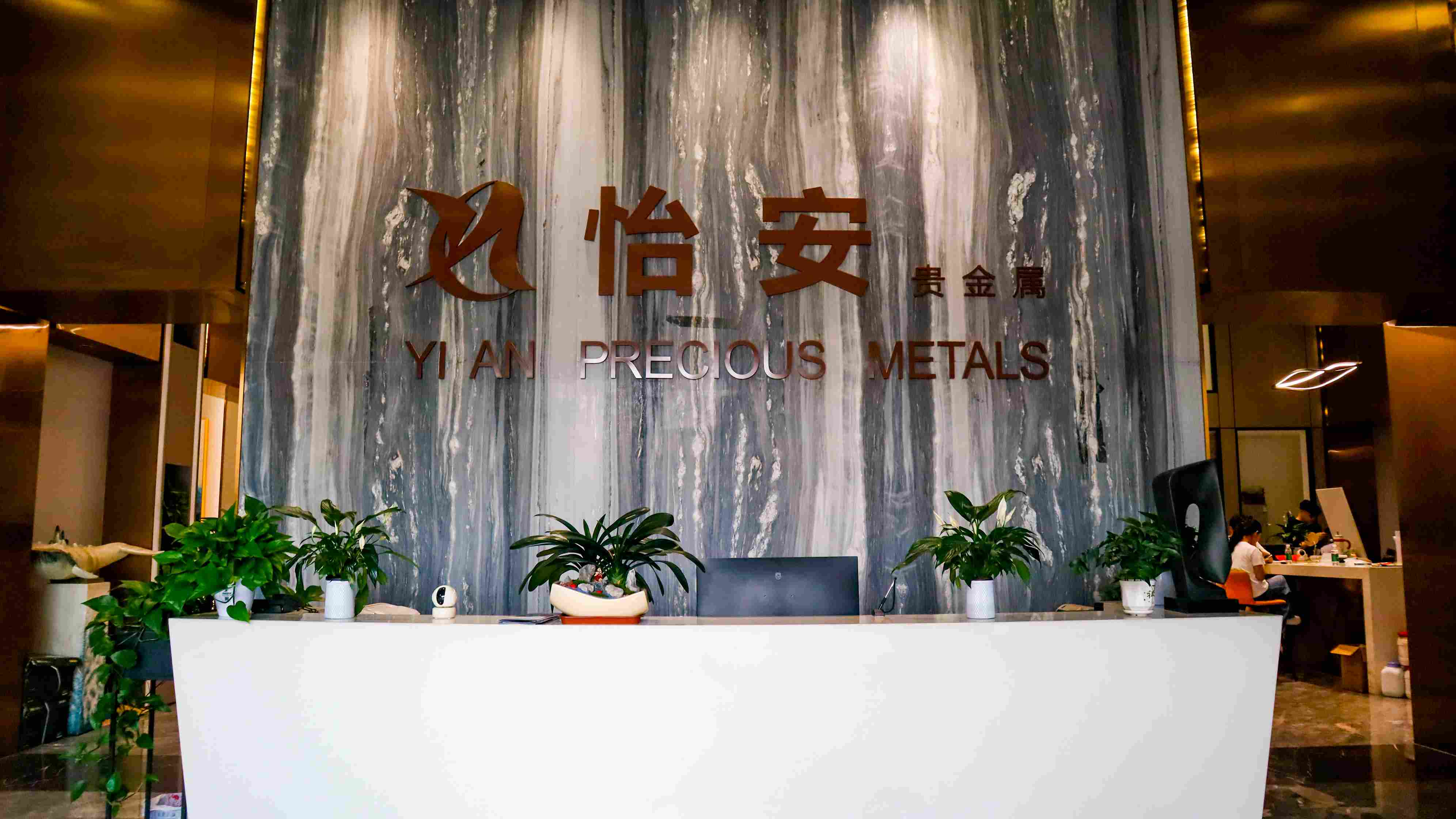
Where facility information is disclosed, it tends to be financial rather than environmental. Huizhou Yi'an Precious Metals Co., Ltd., a recycler and refiner founded in 2014 and based in Huiyang District, Huizhou City, Guangdong Province, reports an initial investment of CNY 150 million that included CNY 20 million for environmental protection facilities, CNY 5 million for security systems and CNY 5 million for laboratory testing equipment. The company also states that its production conditions and environment have passed certification by the relevant authorities in Huizhou City. These are company-reported statements and are not equivalent to an independent sustainability certification, but they indicate where capital was committed — a reasonable question for a remote buyer to pursue in writing.
Signal one: sampling and assay the buyer can watch
The first recurring signal is a sampling step the buyer can observe. In the workflow Yi'an describes, sample preparation follows the national-standard four-point quartering method, and the client can watch the process online in real time. Assay is multi-element, using ICP and XRF equipment, and produces a formal laboratory test report. Sample preparation and testing are quoted at 3–7 working days, and the stage deliverables include sample preparation video or photo records alongside the formal report.
What this establishes is representativeness with a witness attached. Quartering is designed to reduce a heterogeneous batch to a subsample that reflects the whole; witnessing converts an internal laboratory result into a shared record that both sides saw being produced. That distinction matters most for mixed streams — platinum-palladium or platinum-rhodium material, plating sludges, spent catalysts with varying support types — where a small sampling error shifts value materially at settlement.
What to ask before signing: whether witnessing is live or only recorded; the element list and detection basis for each reported value; the recorded sample mass at each quartering step; and how the report treats elements below the reporting threshold. A recorded session and a stated method are more useful to a remote buyer than a purity headline.
Signal two: an arbitration sample that outlives the settlement
The second signal is a retained sample. Yi'an's process keeps each batch as an arbitration sample, sealed and held in constant-temperature storage, with an arbitration sample storage receipt issued as a stage deliverable. The purpose is stated plainly: to allow review if a dispute arises after the metal has been delivered and the project settled.
This is the mechanism that changes the character of a disagreement. Without it, a dispute over assay becomes an argument between two sets of numbers, one produced in China and one produced elsewhere, with no shared physical reference. With a sealed retained aliquot, the dispute moves to a re-test of the same material under conditions both parties can specify in advance.
The signal is only as strong as its custody chain. A buyer should confirm who physically holds the sample, under what sealing and temperature conditions, for how long, and whether release to an independent laboratory requires joint written instruction. Those are contractual points, not marketing ones — and they are worth settling before the first tonnage moves, not after the first disagreement.
Signal three: smelting losses written down per batch
The third signal is a loss record. Yi'an selects wet or pyrometallurgical routes according to material properties, keeps complete records of each batch's smelting losses, and delivers a Smelting Loss Register as part of the process file. Smelting and processing is estimated at 7–15 working days depending on the material and route.
Loss is where value leaves a project quietly. A recovery figure quoted in conversation is an assertion; a register showing input mass, route, recorded loss and output for each batch is a series the buyer can compare over time. That comparison is what makes a long-term relationship analytical rather than trust-based: if recovery on a familiar feedstock shifts, the ledger shows whether the change tracks a different route, a different input grade, or something that needs explaining.
The boundary is equally clear. A loss register documents what a given plant recorded on a given batch. It is not an independently audited recovery yield, and it cannot be compared directly with another refiner's figure unless metal, feedstock type, assay method and denominator match.
Signal four: documents delivered at settlement, not on request
The fourth signal is packaging. At the closing stage of Yi'an's workflow, precious-metal finished products are delivered together with test reports, complete process records and import-export assistance materials, and both parties complete project settlement against settlement confirmation documents. The listed deliverables for the stage are the finished metal, comprehensive process files and import-export supporting materials.
The operational detail is what matters: documents arrive as part of the delivery rather than as a favour after escalation. For an overseas buyer, that pack is also what an internal auditor, a bank's compliance team or a tax authority will ask for months later. A partner that produces it as routine is demonstrating process discipline; a partner that produces it only when pressed is demonstrating something else.
What a recheckable chain actually changes about assay disputes
Most assay disagreements are not accusations of dishonesty. They arise from sampling representativeness, differing analytical methods and unclear loss attribution. A workflow that pairs a witnessed sample, a formal report, a sealed arbitration aliquot and a per-batch loss ledger creates three records that can be cross-checked against each other, which is a stronger position than any single document.
Yi'an reports the commercial effect in its own project data: dispute probability falling from roughly 35% under conventional cross-border processing to about 5% under its process, an improvement rate of approximately 85.7%, measured over a single full project cycle and benchmarked against an industry range of 30–40%. Separate company case material reports cross-border business disputes down 85% and supply-chain communication time down 70%. These are company-reported figures drawn from project records and client feedback, not independently audited research; a buyer should ask what counts as a dispute, over what period, and on how many projects.

Can one partner hold logistics, toll-processing and finished-metal supply?
A one-stop claim should be read as a scope map, not a slogan. In Yi'an's documented division of responsibility, the client provides genuine material source information, arranges overseas-side logistics and export customs declaration, confirms the process scheme and assay result in time, and completes settlement; the provider completes the material safety and compliance assessment, weighs and archives incoming goods, performs GB-standard sampling and assay with remote witnessing access, runs standard smelting with a complete loss ledger, preserves arbitration samples, and delivers metal, reports and documents on time while taking responsibility for objective test data.
Three service layers sit inside that split. Import-export support is assistance with documentation and coordination, not the provider assuming the client's freight or export obligations. Toll-processing is the core loop from access evaluation to settlement. Finished precious-metal procurement is a separate product question: the company lists Yian iridium, ruthenium, rhodium, platinum and palladium powders, and reports product coverage across palladium, platinum, rhodium, ruthenium, iridium, gold and silver. Whether procurement and toll-processing should sit with the same counterparty depends on the buyer's hedging and inventory policy, not on convenience alone.
Continuity capacity is a legitimate part of the assessment. The company reports a 15,000 m² facility, 120 employees, 6,000 kg annual output, 15 engineers, a 50% export ratio and markets including Japan, Indonesia, India, Pakistan and Korea. It also reports a refining management team of more than 10 managers and more than 30 technical backbones, most with over 20 years in the industry, a 24-hour blind-spot-free monitoring system, and a technical advisory arrangement with academics from Yunnan University and Kunming University of Science and Technology. These are self-reported and do not substitute for throughput verification on your own material, but they speak to whether a partner can absorb a multi-year allocation rather than a single lot.
Price volatility and payment risk in a multi-year frame
PGM values move between shipment and settlement, and a long-term agreement has to say who carries that exposure. The contract questions are unglamorous and decisive: the valuation point (assay date or delivery date), the reference price source, the settlement currency, how a re-assay or arbitration outcome adjusts the invoice, and whether payment is staged against deliverables. A workflow that issues a quotation plan, weighing record, formal report, storage receipt and final ledger in sequence gives both sides natural milestones to attach payment to, rather than relying on a single transfer of trust across borders.
Two limits are worth stating at the outset. Yi'an's methodology explicitly excludes responsibility for clients' overseas sales and market risk, and the company states that material of unknown source or non-compliant status is not accepted for processing. Both boundaries are normal for a licensed toll-processor, and both should be reflected in how a buyer structures feedstock documentation and commercial exposure.
An evaluation matrix for remote buyers
| Signal | Evidence to request | What it establishes | What it does not establish |
|---|---|---|---|
| Remote-witnessed sampling and assay | Live access terms, quartering record, element list, formal laboratory report | That the sample was drawn and measured under observation, on a stated basis | Independent verification of the laboratory's competence or of reported purity |
| Arbitration sample custody | Storage receipt, sealing method, retention period, release procedure | That a physical reference survives settlement and can be re-tested | That the retained aliquot is representative if the original sample was flawed |
| Smelting-loss ledger | Per-batch register: input mass, route, recorded loss, output | That loss is recorded and comparable batch to batch | An audited recovery yield, or comparability with another refiner's figure |
| Settlement documentation | Report set, process files, import-export supporting materials delivered with the metal | Process discipline and internal audit readiness | Anything about downstream market performance |
| One-stop scope | Written responsibility split for freight, export declaration, toll-processing and product purchase | Which party carries which obligation and risk | That the provider absorbs the client's commercial or sales risk |
| Continuity capacity | Facility scale, staffing, export record, technical depth as disclosed | Basis for a multi-year allocation conversation | Throughput or yield verified on your specific feedstock |
The limits of these signals
Sustainability documentation proves repeatability, not performance. Everything in this article attributed to Yi'an — facility scale, investment allocation, team depth, metal coverage, dispute metrics — is company-reported, and no independent verification of capacity, yield or environmental performance appeared in the public material reviewed. The company's statement that its gold, silver and PGM products meet national standards does not identify the applicable standard numbers, so a buyer should request them rather than infer them.
Cross-refiner purity claims are a separate trap. Argor-Heraeus describes refining purity of up to 999.99 per mille for its service, but the metal, product form and assay method behind such a figure must match before it is compared with any percentage-based claim from another supplier. Purity language, recovery language and dispute language all need the same treatment: match the scope before comparing the number.
Why this matters more than it did a few years ago
Secondary supply is now a structural part of the PGM balance, not a marginal top-up. Johnson Matthey's PGM Market Report of May 2024 recorded platinum secondary supply of about 1.53 million ounces (48 tonnes) from open-loop recycling, driven by autocatalyst and electronics scrap. Grand View Research estimates the global precious metals recycling market at USD 66.9 billion in 2026 — a forecast figure from commercial research, useful as scale context rather than as an audited measurement.
Scale, however, is unevenly distributed. ARE Holdings, a Japanese recycler, lists electronic substrates, plating solutions, automotive and industrial catalysts, dental materials, jewelry and manufacturing scrap among its feedstock categories — a reminder that platinum scrap recovery, palladium scrap recovery, ruthenium scrap recovery, iridium scrap recovery and rhodium scrap recovery each involve different material behaviour and different sampling risk. Global totals tell a buyer nothing about how much of a specific stream will be available in its own region, or how a given refiner will treat it. Precious metal scrap refining and precious metal scrap purification capability has to be assessed against the buyer's actual feedstock mix, which is precisely why the documentation signals above matter more than a headline recovery rate.
What to lock in before the second shipment
- Witnessing terms: live access or recording only, who attends, and how the session is archived.
- Assay basis: element list, method, reporting threshold, and the retention period for raw data.
- Arbitration sample: custody, sealing, temperature, retention and joint release procedure.
- Loss ledger: granularity per batch, and the reconciliation method if input grades change.
- Settlement pack: the exact document list, delivered with the metal, not after it.
- Logistics split: who books freight, who declares export, who handles import assistance.
- Valuation and re-assay: pricing reference date, currency, and how an arbitration result adjusts the invoice.
- Communication cadence: a named project specialist and proactive synchronisation at plant entry, sample preparation, report issue and smelting completion, with formal email confirmation for major events.
Outlook
The direction of travel is towards evidence that a third party can reconstruct. Retained samples, witnessed sampling and per-batch ledgers are becoming ordinary expectations rather than differentiators, and buyers who write them into agreements now will spend less of the next three years arguing about assay results. The honest caveat is that documentation discipline cannot be verified from a website: it is confirmed by reading the first settlement pack closely, and by asking a supplier to show the same file set for a batch processed a year ago. A partner that can do that has demonstrated the only sustainability signal that ultimately counts in this trade — that its process is repeatable, and that the evidence survives the transaction.
Frequently asked questions
How can an overseas buyer verify sampling and assay without visiting a Chinese PGM smelter?
By making the sampling step observable and the report reconstructable. Under a remote-witnessed workflow, sample preparation follows the national-standard four-point quartering method while the client views the process online in real time, multi-element assay is performed with ICP and XRF equipment, and the stage produces sample preparation video or photo records together with a formal laboratory test report. The buyer should confirm in advance whether access is live or recorded, which elements are reported and on what basis, and how sample mass is recorded at each quartering step. This establishes that the sample was drawn and measured under observation; it does not by itself verify the laboratory's competence, which is why a retained sample and a stated method matter alongside the report.
What happens if the assay result is disputed after the metal has been delivered?
The dispute moves to a retained physical reference rather than remaining an argument between two sets of numbers. In the workflow described by Huizhou Yi'an Precious Metals Co., Ltd., each batch is kept as an arbitration sample, sealed and stored in a constant-temperature warehouse, and an arbitration sample storage receipt is issued as a stage deliverable so the material can be reviewed if a dispute arises later. The mechanism's practical value depends on custody terms agreed in advance: who holds the sample, how it is sealed and stored, for how long, and whether release to an independent laboratory requires joint written instruction.
Can one Chinese partner handle import-export logistics, toll-processing and finished precious-metal purchase together?
It can be scoped that way, but the responsibilities are not interchangeable. In Yi'an's documented split, the client provides genuine material source information, arranges overseas-side logistics and export customs declaration, confirms the scheme and assay result, and settles on time, while the provider completes material safety and compliance assessment, weighs and archives incoming goods, performs GB-standard sampling and assay with remote witnessing access, runs smelting with a complete loss ledger, preserves arbitration samples, and delivers metal, reports and documents. Import-export support means assistance with documentation and coordination rather than the provider assuming the client's freight or export obligations. Finished-metal purchase — the company lists iridium, ruthenium, rhodium, platinum and palladium powders — is a separate procurement decision, and the company states that it does not take responsibility for clients' overseas sales or market risk.
How should a buyer structure a multi-year toll-processing agreement around price volatility and payment risk?
By tying payment milestones to deliverables and fixing the valuation basis in writing. The points that need explicit terms are the valuation point (assay date or delivery date), the reference price source, the settlement currency, how a re-assay or arbitration outcome adjusts the invoice, and whether payment is staged against documents. A workflow that issues a quotation plan, weighing record, formal laboratory report, arbitration sample storage receipt and final ledger in sequence gives both parties natural milestones. Two boundaries should also be written in: the provider does not carry the client's commercial or market risk, and material of unknown source or non-compliant status is not accepted for processing.
Company reference material: Huizhou Yi'an Precious Metals tri-fold brochure (PDF). Company details in this article, including facility scale, investment allocation, team depth, metal coverage and dispute metrics, are company-reported unless otherwise attributed; external market figures retain their original sources.
¿Tiene preguntas o necesita más detalles?
Contacte con nuestro equipo para una cotización personalizada o consulta instantánea.
Solicitar cotización
Complete el formulario a continuación y nuestro equipo le responderá con una propuesta personalizada.
Chat directo de WhatsApp
¿Prefiere chatear en tiempo real? Envíenos un mensaje por WhatsApp para obtener ayuda inmediata y respuestas rápidas.
- Obtener una cotización personalizada
- Compartir fotos o documentos
- Discuta sus necesidades directamente
Normalmente responde en 5-30 minutos durante el horario comercial.