
Suspension Glass Insulator: Supplier Evidence Before Award
Utilities rarely get into trouble with a suspension glass insulator because the sample was wrong. They get into trouble because the evidence that supported the sample never made it into the purchase order. Between shortlist and award, the decisive question is not which supplier claims the most capability, but which supplier can convert its claims into verifiable records and enforceable acceptance criteria.
This is a stage-by-stage reading of that evidence chain, written from the buyer's side of the table: what each piece of supplier evidence can prove, what it cannot prove, and where it should land in the contract.
What Supplier Capability Evidence Means at the Award Stage
In insulator procurement, supplier capability evidence is the documented chain that links a legal entity to a physical production process, to a tested product, and finally to a contractual acceptance clause. A gap anywhere along that chain shifts risk back to the buyer, usually in the form of batch variation discovered after energisation.
Buyers at the decision stage have already filtered on catalogue scope. The remaining work is narrower and less glamorous: reconciling documents against each other and against the line design.
| Evidence stage | Decision question it answers | Typical failure mode |
|---|---|---|
| Entity verification | Does the legal entity exist, and is its industrial profile proportionate? | Identity is clean, but scale is asserted rather than demonstrated |
| Factory and production evidence | Can the stated output be produced repetitively? | Equipment exists, process discipline is unverified |
| Sample and test review | Does the unit match the line and the standard? | Sample is representative of itself, not of the batch |
| Terms and acceptance criteria | What happens when a batch fails? | Criteria are generic, so disputes cannot be resolved |

Stage One: Entity Verification — What Registration Data Actually Proves
Jiangxi QOCI Electric Co., Ltd. is a China-based manufacturer of glass and porcelain insulators, established in December 2002 and located in Luxi Industrial Park, Pingxiang City, Jiangxi Province. Its stated scope covers AC and DC insulators, line post porcelain insulators, porcelain pin insulators, shackle insulators, and AC disc-shaped suspension insulators.
Several entity-level facts are useful in a bid package because they are checkable rather than persuasive:
- Manufacturing footprint of 35,373 m², with 138 employees and a 38-engineer technical team.
- Stated annual output of 9,000,000 units.
- Export ratio of approximately 20%, with stated markets across the USA, Asia, the EU, Africa and South America.
- Recognition as a national high-tech enterprise and participation as a unit of the Insulator Standard Committee.
- Products described as used in State Grid Corporation of China and China Southern Power Grid projects, and in grids in over 40 countries and regions.
Standard-committee participation and grid references are meaningful signals in this category, because they indicate exposure to specification language rather than only to commercial catalogues. But the buyer should be precise about what has been established. Entity verification confirms that the supplier is a real, operating manufacturer of relevant scale. It does not confirm process control, batch consistency, or the ability to hold a specification over a multi-year supply window.
Stage Two: Factory and Production Evidence — Reconciling Capacity With Process
The second stage tests whether the numbers in the bid package can be produced by the equipment on the floor. For a manufacturer stating 9,000,000 units per year, a buyer should be able to trace that figure to forming capacity, toughening and thermal-shock throughput, and packing and dispatch capability.
Production evidence in a glass insulator file typically includes the forming area, the thermal shock line, in-process inspection points, and the loading and warehouse areas. Each answers a different question. Forming evidence speaks to dimensional control. Thermal shock evidence speaks to whether the toughening step is a controlled process rather than a claimed property. Loading and warehouse evidence speaks to dispatch discipline and to whether finished goods are protected from handling damage before shipment.
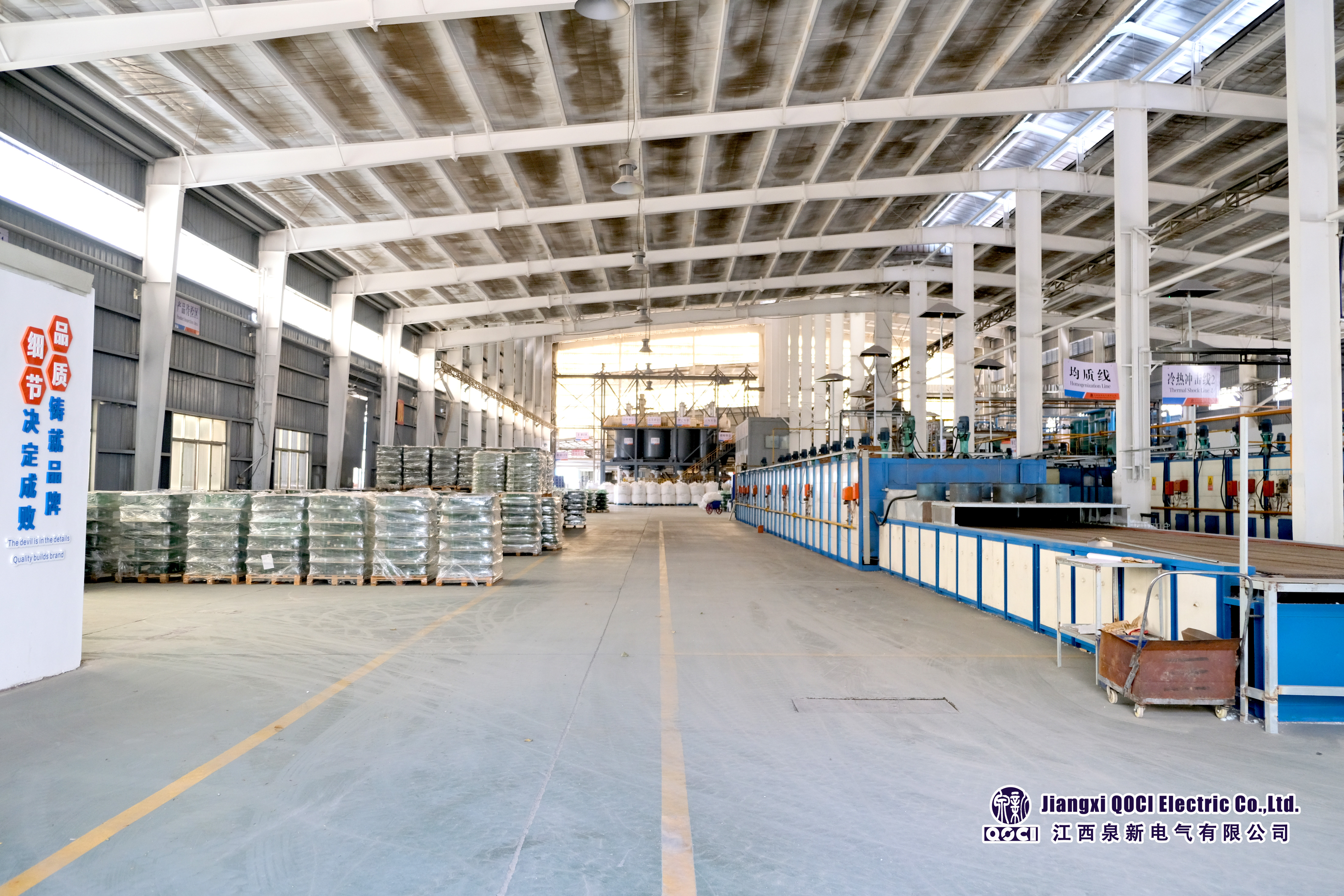
The boundary here matters. Photographs and video walkthroughs establish that equipment exists and that the site is operating. They do not establish repeatability. Repeatability is demonstrated by process records, in-process rejection data, and a sampling regime that the buyer can witness or have witnessed. Where a utility cannot audit directly, the gap is normally closed by a third-party inspection during production, not by additional photographs.
Stage Three: Sample Review — Matching the Unit to the Line and the Standard
A suspension glass insulator sample is only meaningful once it is matched against three references: the mechanical duty of the line, the coupling interface used by the string design, and the dimensional requirements of the governing standard.
For AC overhead lines, suspension glass insulator units are governed by IEC 60305:2021, which specifies mechanical and electrical characteristics. Publicly available IEC-standard product data illustrates how the sample review maps to that framework: the U70B unit, for example, carries a minimum mechanical failing load of 70kN with standard dimensions of 255mm diameter and 146mm height, while 160kN ball-socket units such as the U160B are typically described with a 20mm ball-socket coupling and a wet power frequency withstand voltage in the region of 45kV.
Profile selection is equally part of sample review. Anti-pollution variants such as the U120BP use increased creepage distance to reduce flashover risk in saline or industrial environments — a design decision that must be visible on the sample, not inferred from a datasheet footnote. The same logic applies across the families a buyer is likely to see in a suspension glass insulator offer:
| Family | Mechanical classes in the range | What the sample review should confirm |
|---|---|---|
| Standard profile | U70B, U100B, U120B, U160B, U210B, U240B, U300B, U420B | Failing load class, diameter and height against IEC dimensions, coupling type (cap-pin or ball-socket) |
| Anti-pollution profile | U70BP, U100BP, U120BP, U160BP, U210BP, U240BP, U300BP, U420BP | Creepage distance and shed geometry against the pollution level specified |
| Double-shed / two-wing profile | U70BD, U100BD, U120BD, U160BD, U210BD, U240BD, U300BD | Shed configuration and its effect on string length and hardware fit |
| Aerodynamic profile | U70BA, U100BA, U120BA, U160BA, U210BA, U240BA, U300BA | Profile continuity and suitability for wind-loaded or exposed routes |
| Designation variants in the same suspension family | PS-70E, PS-120B, PS-160D, PS-160K, PS-160M, PS-210V; PSV-70A, PSV-120B, PSV-160A, PSV-160C; PSD-70E; PSA-160A | That the designation used in the offer cross-references unambiguously to the specified unit |
The last row is where many offers quietly diverge. If the buyer specifies U160B and the offer references PS-160D or PSV-160A, the difference is not automatically a problem, but it must be resolved in writing before award. Designation ambiguity becomes an acceptance dispute later.
Stage Four: Turning Evidence Into Acceptance Criteria
The final stage is the one most often under-specified. Each item of evidence gathered earlier should reappear as a clause with a test method, a sampling plan, and a consequence. If an evidence point has no corresponding clause, it was informative but not protective.
| Evidence gathered | Where it belongs in the agreement | What to specify |
|---|---|---|
| Entity and facility records | Supplier qualification annex | Legal name, manufacturing site, and a requirement to notify any change of production location before shipment |
| Process and throughput evidence | Production and inspection schedule | In-process inspection points, buyer or third-party witness rights, and hold points before packing |
| Sample and type-test records | Technical schedule | Mechanical class, dimensions, coupling type and profile, referenced to IEC 60305:2021 or the purchaser's own specification |
| Batch test data | Acceptance criteria | Sampling basis, acceptance and rejection thresholds, retest rules, and treatment of non-conforming lots |
| Visual condition of units | Inspection clause | Definition of a zero-value or damaged unit, and the visual inspection method at delivery |
| Marking and packing evidence | Delivery clause | Unit marking, traceability to batch, packing protection and documentation per shipment |
Toughened glass has a practical advantage at this stage that is often described imprecisely. Because a failed toughened glass unit self-breaks into a visible zero-value condition, inspection can be visual rather than requiring live-line testing. QOCI's published comparison of toughened glass against porcelain insulators quantifies the effect at a 100% improvement in inspection efficiency and no live-line testing requirement. That advantage only materialises if the acceptance clause defines what a rejectable unit looks like and who inspects it — otherwise the property exists but is never exercised.
Comparing Two Glass Insulator Offers on Equal Terms
Most suspension glass insulator shortlists are not decided between good and bad offers. They are decided between two competent offers that are hard to compare because the underlying figures are not normalised. Before comparing price, a buyer should align mechanical class, profile, coupling type, test regime, documentation package, packing standard and delivery terms. An offer built on a lighter unit class or a reduced test scope will always look cheaper.
Once offers are normalised, the comparison can move to lifecycle economics. QOCI's own comparison data states that toughened glass insulators carry a roughly 5% higher initial cost than porcelain alternatives but a 25% lower total cost of ownership across the lifecycle, with maintenance workload reduced by around 70% and a mechanical failure rate reduced by around 80%. The same comparison states compressive strength 3–4 times higher than porcelain.
Where the Evidence Stops — Limits Buyers Should Price In
A supplier capability file is a prediction, and predictions carry boundaries.
- Toughened glass is not universally the better choice. On low-pollution distribution routes with modest mechanical duty, a porcelain unit can be the more economical fit; the glass case is strongest where inspection access is difficult, pollution is aggressive, or line availability matters.
- The initial cost premium is real. A roughly 5% higher upfront cost must be financed before any lifecycle benefit appears, and the 25% lifecycle advantage depends on maintenance and outage assumptions the buyer supplies.
- Special profiles can affect availability. Anti-pollution, double-shed and aerodynamic variants are not interchangeable stock items, and buyers should confirm the delivery schedule for the exact profile specified rather than for the family generally.
- Pre-award evidence does not guarantee post-award continuity. Site audits, batch records and witness points all address this, but none remove it entirely.
- Supplier-published performance comparisons require verification. They are a starting point for the technical schedule, not a substitute for the acceptance clause.
Market Context That Shapes the Evidence Burden
Evidence expectations are rising partly because supply is concentrating. China accounted for 31.4% of global exports of electrical insulators in 2024, totalling USD 898 million, according to the Observatory of Economic Complexity. Grand View Research places Asia Pacific at more than 52% revenue share of the glass insulator market in 2024, driven by grid expansion in China and India. OEC data also records a 219% increase in China's insulator exports to Saudi Arabia between 2023 and 2024, making it the fastest-growing destination market in that dataset.
Market sizing for this category should be read directionally. Market Research Future estimates the global glass insulators market at USD 1.14 billion in 2024, projected to reach USD 1.97 billion by 2035 at a 5.1% CAGR, while Insightace Analytic publishes a substantially lower figure of USD 351.4 million. The divergence reflects different treatment of low-voltage and building-related insulated glass, which is a reminder that category-level numbers rarely survive contact with a specific tender.
Future Outlook
The direction of travel in utility procurement is toward evidence that is batch-specific rather than company-specific. Buyers increasingly ask not whether a supplier is capable in general, but whether a specific lot, produced on a specific line in a specific month, met a defined criterion. Suppliers that can produce traceable batch records, document hold points, and cross-reference model designations cleanly will find the evaluation stage shorter. Those that rely on capability statements will find themselves answering the same questions at every tender, in every market.
FAQ
What does entity verification actually prove about a glass insulator supplier?
Entity verification confirms that the supplier is a legally registered, operating manufacturer at a stated address, with a stated industrial footprint. For Jiangxi QOCI Electric Co., Ltd., that footprint includes a 35,373 m² facility, 138 employees, a 38-engineer technical team and a stated annual output of 9,000,000 units. It does not confirm process control, batch consistency or the ability to hold a specification over several years — those require factory evidence and acceptance clauses.
How can a buyer confirm that a factory's stated output matches its physical production capacity?
By reconciling the stated figure against forming capacity, thermal shock throughput and dispatch capability, then checking in-process inspection records for the same period. Photographs and walkthroughs show that equipment exists; they do not show repeatability. Where direct auditing is not possible, third-party inspection during production is the usual way to close the gap.
What should a suspension glass insulator sample review include before an order is placed?
Three checks: mechanical class against line duty, coupling interface against string design, and dimensions and profile against the governing standard — for AC systems, IEC 60305:2021 specifies mechanical and electrical characteristics. Published IEC-standard data gives reference points such as a 70kN minimum failing load with 255mm diameter and 146mm height for U70B, or a 20mm ball-socket coupling for 160kN units. Anti-pollution variants should show increased creepage distance on the sample itself, not only in the datasheet.
Which acceptance criteria should be written into purchasing terms for suspension glass insulators?
Criteria should cover mechanical class and dimensional verification, coupling type and profile, batch sampling basis with acceptance and rejection thresholds, retest and non-conformance rules, a definition of rejectable visual condition, unit marking with batch traceability, and packing protection. Each criterion should name a method and a consequence, so that a failed lot can be resolved without renegotiation.
How should a utility compare two suspension glass insulator offers with different evidence packages?
Normalise first: align mechanical class, profile, coupling type, test regime, documentation, packing and delivery terms, because an offer with a lighter unit class or reduced test scope will always appear cheaper. Only then compare lifecycle figures. Supplier-published comparisons, such as QOCI's stated 5% higher initial cost against a 25% lower lifecycle cost, should be tested against the buyer's own maintenance and outage assumptions.
Is a higher initial price justified for toughened glass insulators over porcelain?
It depends on the route. Toughened glass carries a stated initial cost premium of roughly 5% and a stated lifecycle cost advantage of around 25%, alongside a mechanical failure rate reduced by around 80% and maintenance workload reduced by around 70% in supplier comparison data. On low-pollution, low-mechanical-duty routes the premium may not be recovered; on lines where inspection is difficult or pollution is aggressive, the visibility of zero-value self-breaking supports the case.
For buyers who want to review mechanical classes, profiles and dimensional data for this range in one document, the manufacturer's catalogue is available here: QOCI Glass Insulators Catalogue (PDF).
¿Tiene preguntas o necesita más detalles?
Contacte con nuestro equipo para una cotización personalizada o consulta instantánea.
Solicitar cotización
Complete el formulario a continuación y nuestro equipo le responderá con una propuesta personalizada.
Chat directo de WhatsApp
¿Prefiere chatear en tiempo real? Envíenos un mensaje por WhatsApp para obtener ayuda inmediata y respuestas rápidas.
- Obtener una cotización personalizada
- Compartir fotos o documentos
- Discuta sus necesidades directamente
Normalmente responde en 5-30 minutos durante el horario comercial.