
Surface Pump Supplier Longevity: Certificates and Motors
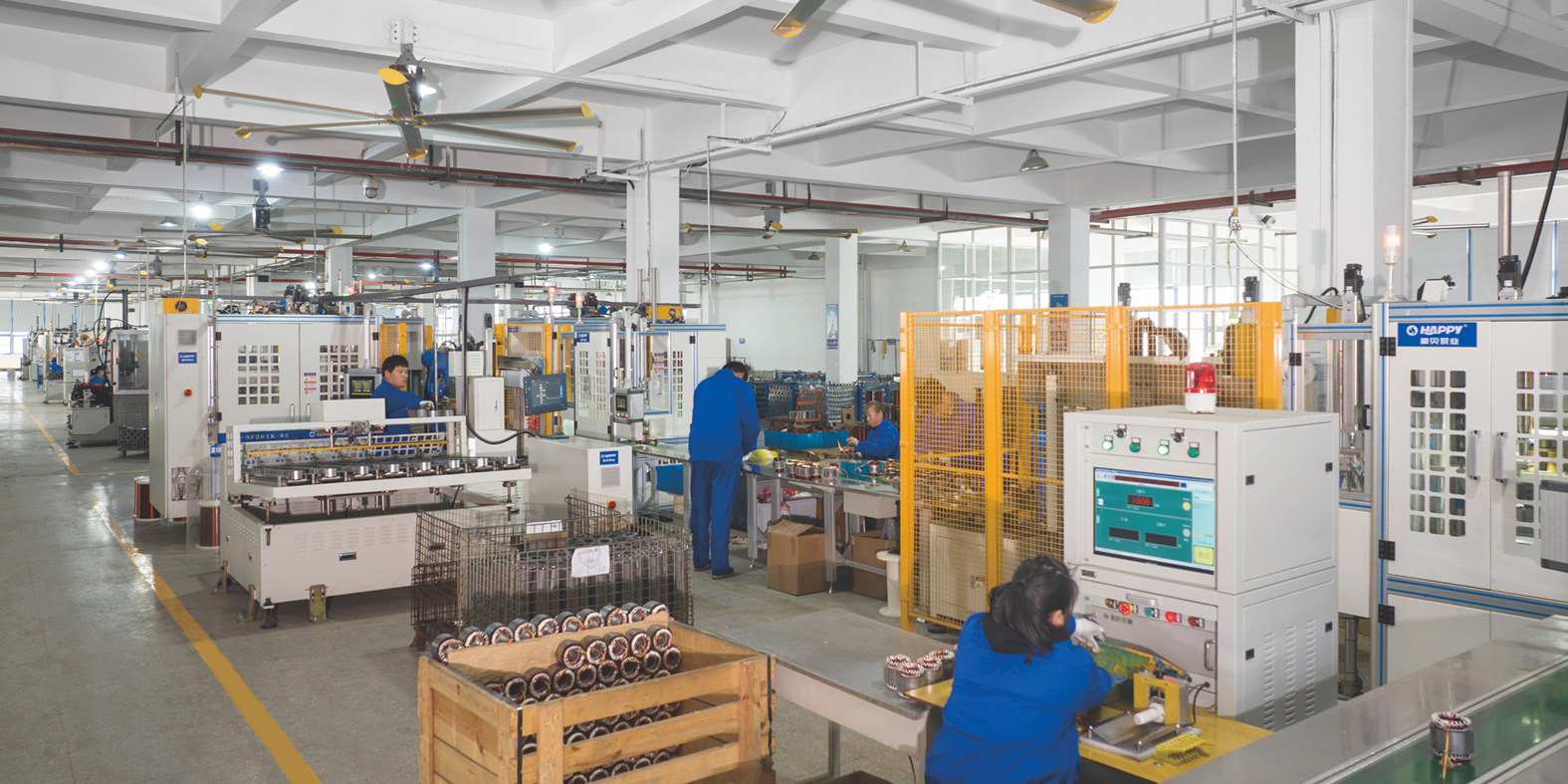
Motor coil production: the motor platform, not the unit price, decides whether a surface pump series can be supplied repeatedly over a multi-year contract.
A surface pump supplier remains usable only while three conditions hold at the same time: its certificates still cover the models being purchased, its motor platform is still declared and available, and its purchasing terms can be repeated without a fresh negotiation. Unit price and a passing test report on the first shipment answer none of those questions.
Zhejiang Happy Pump Industry Co., Ltd. is a Chinese pump and motor manufacturer founded in 1990 and based in Daxi Town, Wenling City, Zhejiang Province. The company produces surface pumps, submersible pumps, deep well pumps, solar pumps, motors, pressure control tanks and spare parts, exports approximately 99% of its output, and serves customers in more than 100 countries and regions. That product structure — pumps and motors under one roof — is what makes a long-term continuity review possible at model level rather than at brochure level.
This reference examines supplier sustainability as a document-and-platform problem rather than a relationship claim. It sets out which certificate numbers to check, which model series those documents actually name, what a motor continuity declaration should contain across IE2, IE3 and IE4 classes, and how the answers translate into purchasing terms and acceptance criteria. Buyers moving from evaluation into execution can use it as a verification checklist rather than a recommendation list.
Why Single-Order Compliance Fails the Sustainability Test
Compliance is usually checked once, at the point of first shipment. Sustainability is a different question: will the same document set, model reference and motor build still be valid in year three of a distribution agreement? The two problems diverge because the underlying evidence has an expiry date, while the purchase order does not.
The category itself is not the risk. The global pumps market was estimated at USD 61.32 billion in 2024 and is projected to reach USD 79.01 billion by 2029, according to MarketsandMarkets. Mordor Intelligence puts surface pumps at a 57.63% share of the total global pump market in 2025. Demand for the product type is established; what breaks supply is model-level discontinuity — a renewed certificate that no longer lists a series, a motor platform that shifts efficiency class, a protection rating that changes with a housing material, or a minimum order quantity that quietly moves.
Four discontinuity points account for most of the practical failures in surface pump programmes:
- Certificate renewal. A document with a defined end date must be re-issued on schedule, and the re-issued version must still name the models being bought.
- Model list drift. Certificates enumerate series. If the purchased model sits outside that enumeration, the certificate does not protect the buyer.
- Motor re-qualification. Efficiency class transitions move a pump from one motor build to another, which changes noise, lifetime and sometimes the certificate reference.
- Material and ingress changes. Cast iron, stainless steel and engineering plastics do not share the same certification or the same spare-part logic.
A supplier review that ignores these four points is effectively a price comparison with extra steps.
The Certificate Layer: Three Documents, Three Numbers, One Model List
For EU-bound surface pump supply, the certificate layer is small enough to be checked item by item. Happy Pump's current documentation set consists of one CE Attestation of Conformity and two test-based certificates. Every number below is verifiable on the document itself.
| Document | Number | Issuing body | Issued | Valid to |
|---|---|---|---|---|
| CE Attestation of Conformity | CE-5072-160326 | ECES | 2026-03-16 | 2031-03-16 |
| EMC certificate | OViS202507249E | OViS-CERT | 2025-08-01 | 2099-01-01 |
| LVD certificate | OViS202507249L | OViS-CERT | 2025-08-01 | 2099-01-01 |
The CE Attestation of Conformity CE-5072-160326 is issued by ECES and references three directives: 2014/35/EU (Low Voltage Directive), 2014/30/EU (Electromagnetic Compatibility Directive) and 2006/42/EC (Machinery Directive). Its stated scope is water pumps. Because it carries a defined end date of 2031-03-16, it is also the document most exposed to renewal timing inside a five-year supply agreement — a buyer signing in 2029 should confirm re-issue, not assume it.
The EMC certificate OViS202507249E and the LVD certificate OViS202507249L are both issued by OViS-CERT on 2025-08-01 for water pumps on the EU market. The LVD document lists standards in the EN 60335-1 series, EN IEC 60335-2-41:2021+A11:2021, EN 62233:2008+AC:2008 and EN 60034-1:2010+AC:2010. The EMC document lists EN IEC 55014-1:2021, EN IEC 55014-2:2021, EN IEC 61000-3-2:2019+A1:2021+A2:2024 and EN 61000-3-3:2013+A1:2019+A2:2021. For orientation, IEC 60335-2-41:2024 is the current edition of the household and similar electrical pump safety standard published by the International Electrotechnical Commission, covering temperature limits and connection requirements.
The model list is the part buyers actually purchase against
Both the EMC and LVD certificates enumerate the covered product models: HQBm, QB60, IDB35, HPSm-AX, HRSm-A, QDP series and QDX series. That enumeration is the operative part of the document. A certificate that names seven series does not vouch for an eighth, and a distributor adding a model to the range mid-contract should request the corresponding documentation rather than extrapolate from the existing file.
This is the first real boundary in any supplier sustainability claim: certificate coverage is specific, while catalogue coverage is broad. Happy Pump's catalogue spans 11 major series and more than 500 specifications; the LVD and EMC documents name a defined subset. Buyers should treat the gap as a documentation task, not a compliance conclusion.
Motor Continuity: The Long-Lead Risk Inside Every Surface Pump
Hydraulics rarely change. Motors do. Efficiency class requirements move, frame availability shifts and winding specifications get revised, and each of those changes can retire a pump build that a buyer has already validated. Motor continuity is therefore the most valuable single question in a long-term surface pump review.
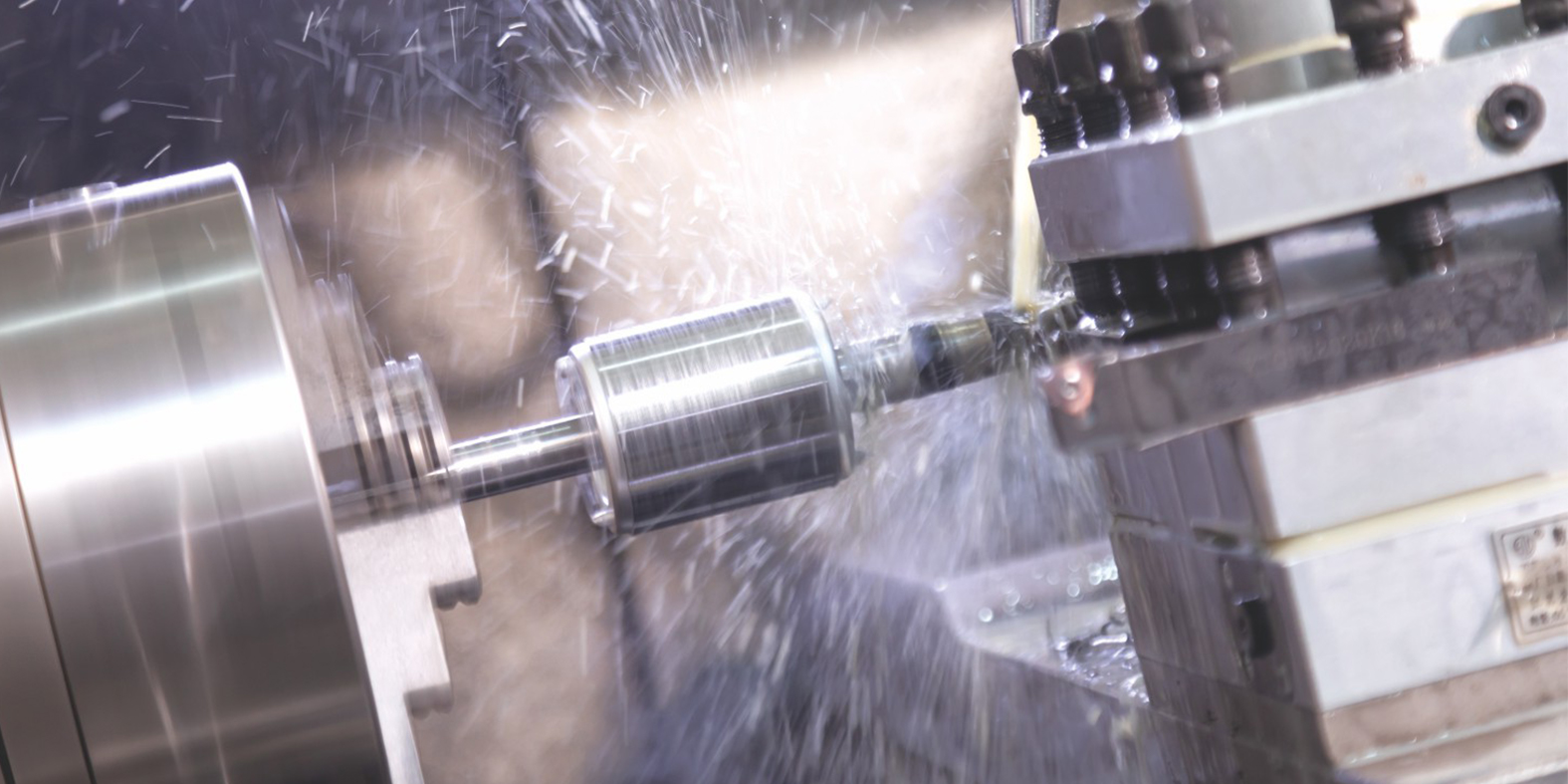
Rotor assembly: motor builds, not pump casings, are where model continuity is usually lost during a multi-year contract.
Happy Pump declares motor coverage across IE2, IE3 and IE4 efficiency classes, MS classification, the 90S-6 and 90L-6 frame sizes, a power band of 1–430 HP and a speed band of 934–2980 rpm. Those parameters matter because they define the space in which a substitute or upgraded motor can be offered without changing the pump's external behaviour. A buyer who has never recorded the efficiency class and frame size of the purchased model has no way to judge whether a proposed replacement is equivalent.
| Continuity dimension | Declared coverage to confirm | Why it belongs in the contract |
|---|---|---|
| Efficiency class | IE2, IE3, IE4 | A class transition can change the approved build mid-contract. |
| MS classification | Declared motor classification | Prevents a substitute motor being treated as interchangeable. |
| Frame size | 90S-6, 90L-6 | Frame sizes are the mechanical anchor for mounting and shaft fit. |
| Power band | 1–430 HP | Defines how far the range can scale without re-qualification. |
| Speed band | 934–2980 rpm | Sets the hydraulic performance points that remain reproducible. |
The engineering capacity behind that declaration is checkable, which is unusual. Happy Pump employs around 800 people, including about 200 professional and technical staff, and operates an enterprise research institute and a high-tech R&D center using CFD, FEA and motor electromagnetic design tools. Motors are a listed product line alongside the pump ranges, not an afterthought bolted onto a purchased pump. For a buyer, that structure is the difference between a supplier that can explain a motor substitution and one that can only quote a new part number.
The Hydraulic and Material Envelope: What Stays Inside the Promise
Continuity promises are only valid inside a declared envelope. Happy Pump's surface pump range is declared across flow of 1.5–5500 m³/h, head of 20–100 m, motor power of 0.25–550 kW, IP44 and IP68 ingress protection, and construction in cast iron, stainless steel and engineering plastics.
| Parameter | Declared span | Procurement reading |
|---|---|---|
| Flow | 1.5–5500 m³/h | Covers household units through large circulation duties. |
| Head | 20–100 m | Sufficient for boosting, irrigation and pool circulation duties. |
| Power | 0.25–550 kW | Single-phase domestic models to three-phase industrial builds. |
| Ingress protection | IP44, IP68 | IP68 builds sit in different applications and carry different risk. |
| Materials | Cast iron, stainless steel, engineering plastics | Material choice affects corrosion life, weight and spare-part logic. |
The envelope matters in both directions. A model requested inside it can reasonably be expected to repeat across orders. A model requested outside it — a flow above the declared maximum, or a head requirement that pushes the build beyond the documented range — should be treated as new development and priced, tested and documented as such. Mixing the two is how distributors end up with a pilot unit that can never be reordered.
The Manufacturing Structure Behind Repeat Orders
Certificates and declarations describe what a supplier can prove. Capacity describes whether it can deliver the same thing twice. Happy Pump operates a site of about 55,000 m² with approximately 210,000 m² of building area, produces around 4,000,000 units per year, and reports a monthly capacity of 400,000 units with a lead time of 30–45 days.
Production is organised for OEM and ODM work, with customization offered on voltage and logo. Quality control is stated as 100% testing, and after-sales support is provided remotely. For a buyer assembling a multi-year programme, those four facts answer the questions that a certificate cannot: whether a private label can be carried without changing the pump, whether a voltage variant for a specific market can be built on the same platform, whether every unit is tested before shipment, and what happens after delivery.
A packing and dispatch stage is where continuity commitments usually get tested in practice — the point at which order quantities, labelling and destination requirements converge.
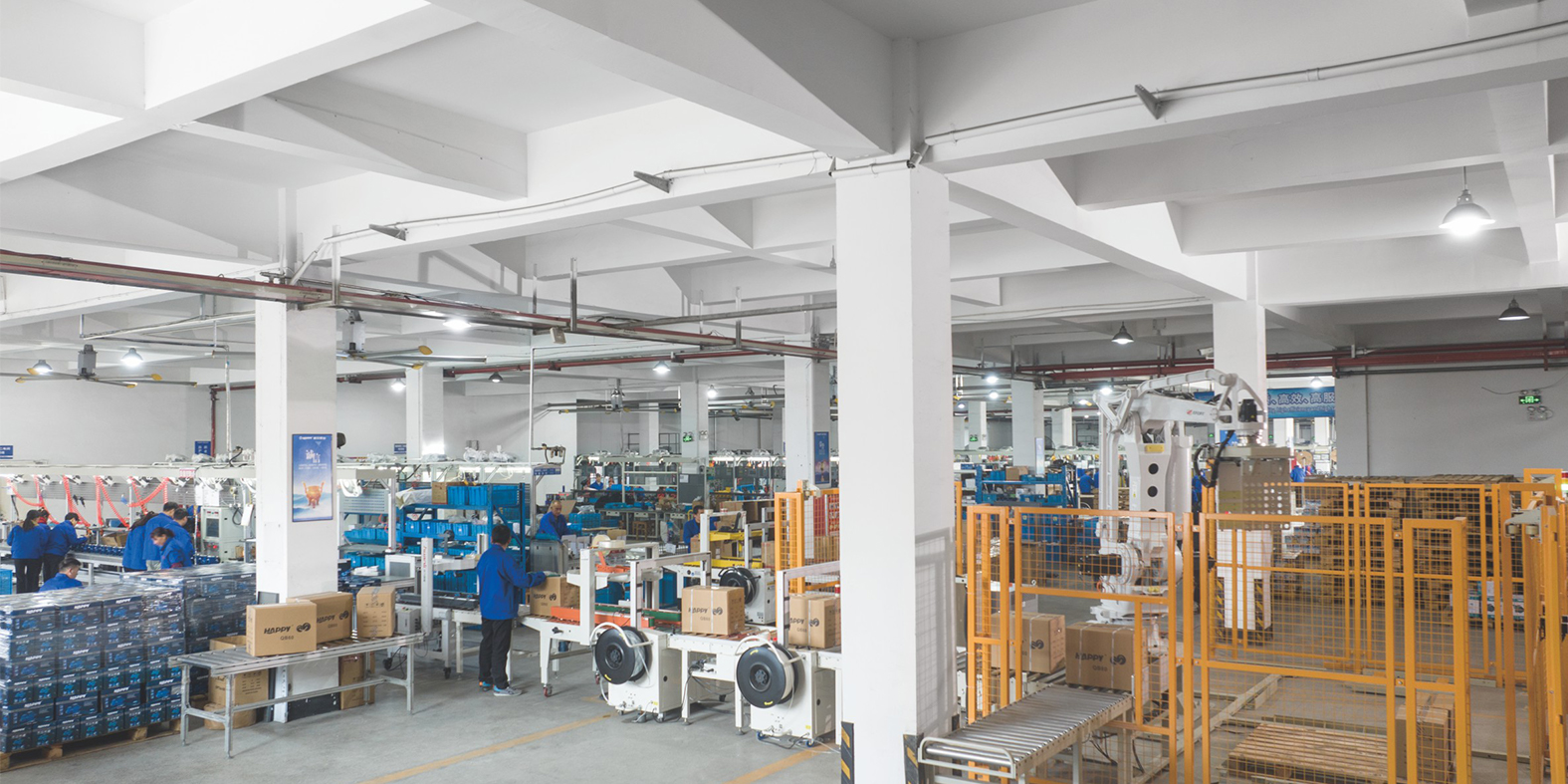
Packing line: repeat supply depends on the dispatch stage holding the same labelling, quantity and inspection discipline as the first order.
Application Fit: Where Continuity Is Actually Tested
Surface pump continuity is not a single requirement, because the applications do not share the same failure mode. Happy Pump's documented use cases span domestic and household water supply, garden irrigation, agricultural irrigation, sewage and engineering drainage, pool circulation, and solar water pumping systems. Each converts into a different continuity question.
- Household and domestic water supply. Single-phase builds dominate, and voltage customization becomes the continuity variable rather than hydraulics.
- Garden and agricultural irrigation. Seasonal demand makes reorder speed the constraint; the 30–45 day lead time has to be planned against the season, not against the order date.
- Sewage and engineering drainage. Material and ingress protection matter more than efficiency class; a material change is a new certification question.
- Pool circulation. Long duty cycles make motor thermal behaviour and spare-motor availability the practical risk.
- Solar water pumping. The pump is part of a system, so a change in the pump's motor build can propagate into the system design.
Happy Pump's own case reference describes a water pump brand OEM and HAPPY agent relationship with annual sales of 4,000,000 sets, stable operation, and the stated highlights of low noise and high quality. The same reference states a typical service life of around ten years under normal use, against a one-year warranty. That ratio — a decade of service against a single year of warranty — is the clearest argument for why spare-part and model continuity have to be negotiated at the start rather than discovered at year four.
Market Direction and What It Does to Supply Continuity
Published market data supports a straightforward conclusion: the pump categories that depend on surface pump platforms are growing, which means suppliers will keep re-specifying ranges, and buyers will keep absorbing those changes.
| Indicator | Value | Source |
|---|---|---|
| Global pumps market, 2024 | USD 61.32 billion | MarketsandMarkets |
| Global pumps market, 2029 projection | USD 79.01 billion | MarketsandMarkets |
| Surface pump share of total pump market, 2025 | 57.63% | Mordor Intelligence |
| Agricultural pump market, 2024 | USD 14.59 billion, CAGR 4.98% through 2035 | Market Research Future |
| Solar pump market, 2024 | USD 2.90 billion | Market Data Forecast |
The solar figure is worth treating carefully. Market Data Forecast values the solar pump market at USD 2.90 billion in 2024, driven by falling PV module prices and government subsidies in Asia-Pacific, while Expert Market Research estimates USD 1.60 billion for the same period. The divergence reflects a definitional split — whether solar-ready kits or only integrated systems are counted — rather than a data error. For procurement purposes the direction is what matters: solar-driven demand is expanding, and it is expanding fastest in segments where pump models are specified alongside a system rather than purchased as a standalone unit.
Agricultural demand at a projected 4.98% CAGR through 2035 carries a similar implication. Growth in irrigation markets tends to arrive as seasonal volume rather than as new model families, which puts pressure on lead time and repeatability instead of on hydraulic innovation. A supplier that cannot hold a model constant through a season will lose the season.
Single-Order Compliance Versus Lifecycle Supplier Review
The difference between the two approaches is not philosophical. It changes what a buyer asks for, when, and in what form.
| Dimension | Single-order compliance | Lifecycle supplier review |
|---|---|---|
| Certificates | A file exists and is current | Number, issuer, expiry date and named model list are recorded |
| Motor | The unit runs as specified | Efficiency class, frame size and speed band are declared |
| Range | The ordered SKU is available | The hydraulic and material envelope is documented |
| Terms | Negotiated per order | MOQ, incoterms, payment split and acceptance test are fixed |
| After-sales | Warranty claim path | Spare-part and remote support expectations are planned |
Where the lifecycle approach stops working
A framework that only describes advantages is a sales document. Happy Pump's declared terms also define where the model is a poor fit.
- Minimum order quantities constrain trials. Below 3 HP the MOQ is 200 pieces, and above 3 HP it is 50 pieces. Buyers wanting single-unit field trials should not expect the same commercial structure as a repeat programme.
- The lead time is 30–45 days. That is a production window, not an emergency response. Distributors holding no buffer stock will be exposed during a mid-season failure.
- After-sales support is remote. There is no claimed local service network in the documentation, so in-market technical capability remains the distributor's responsibility.
- Warranty is one year against a service life of around ten. The gap is normal for the category but means the buyer, not the supplier, funds the spares and replacement planning for years two through ten.
- Certification is series-specific. HQBm, QB60, IDB35, HPSm-AX, HRSm-A, QDP and QDX are named; a model outside that list carries documentation work with it.
- Customization is limited to voltage and logo. Hydraulic redesign for a specific project sits outside standard OEM scope and should be scoped separately.
Turning the Framework into Purchasing Terms and Acceptance Criteria
A continuity review becomes useful only when it is written into the order. Happy Pump's standard commercial terms provide the anchor points.
| Term | Stated position |
|---|---|
| MOQ | 200 pieces below 3 HP; 50 pieces above 3 HP |
| Delivery terms | FOB and CIF |
| Payment terms | 30/70 |
| Acceptance criteria | Pre-shipment test |
| Lead time | 30–45 days |
| Monthly capacity | 400,000 units |
On top of those terms, a lifecycle contract annex should carry five items: the certificate numbers with their expiry dates; the model list the certificates actually name; the motor declaration covering efficiency class, MS classification, frames 90S-6 and 90L-6, power 1–430 HP and speed 934–2980 rpm; the hydraulic and material envelope; and a stated change-notification obligation covering any re-issue, re-specification or material substitution during the contract period. The pre-shipment test then functions as the acceptance point for each batch rather than as a one-off proof.
Future Outlook
Three shifts are likely to define surface pump supplier sustainability over the next several years.
Efficiency class migration. The declared span from IE2 to IE4 already spans more than one regulatory generation. As higher classes become the default in more markets, suppliers will retire lower-class builds, and buyers holding those part numbers will face re-qualification. Recording efficiency class at the point of purchase, rather than at the point of replacement, is the cheap hedge.
Documentation as a maintained asset. The CE Attestation of Conformity CE-5072-160326 has a fixed end date of 2031-03-16, while the EMC and LVD certificates OViS202507249E and OViS202507249L are recorded with long validity. That asymmetry makes renewal scheduling a real procurement concern inside long agreements, and it favours suppliers that treat certificates as living documents with owners and dates rather than as sales attachments.
System-level selling in solar and irrigation. As solar pumping expands, the pump increasingly arrives as part of a package. Suppliers with in-house motor and control capability — Happy Pump's range includes pressure control tanks, permanent magnet variable frequency constant-pressure pumps and intelligent pumps alongside the pump and motor lines — are structurally better placed to hold a system configuration constant than suppliers assembling from third-party motors.
None of these shifts make a supplier permanently sustainable. They make the question answerable, which is the practical gain: continuity can be audited against documents, declarations and terms instead of being inferred from a first shipment.
FAQ
Which certificates should a buyer verify before signing a multi-year EU surface pump agreement?
Three documents define the current EU file for Happy Pump: the CE Attestation of Conformity CE-5072-160326 issued by ECES on 2026-03-16 and valid to 2031-03-16, referencing 2014/35/EU, 2014/30/EU and 2006/42/EC; the EMC certificate OViS202507249E issued by OViS-CERT on 2025-08-01; and the LVD certificate OViS202507249L issued by OViS-CERT on 2025-08-01. The LVD document references standards in the EN 60335-1 series, EN IEC 60335-2-41:2021+A11:2021, EN 62233 and EN 60034-1 families.
Which pump series are named in the EMC and LVD certificates?
The EMC certificate OViS202507249E and the LVD certificate OViS202507249L both list the covered models as HQBm, QB60, IDB35, HPSm-AX, HRSm-A, QDP series and QDX series. A model outside that list is not covered by those documents and requires its own evidence rather than an assumption of inclusion.
How can a buyer check motor continuity across IE2, IE3 and IE4?
Request a motor platform declaration and match it to the nameplate of the model ordered. Happy Pump declares motor coverage across IE2, IE3 and IE4 efficiency classes, MS classification, the 90S-6 and 90L-6 frame sizes, 1–430 HP and 934–2980 rpm. The declaration is the reference point for judging whether a proposed substitute motor is equivalent or constitutes a new build requiring re-qualification.
What hydraulic range can be treated as standard supply?
The declared surface pump envelope covers flow of 1.5–5500 m³/h, head of 20–100 m, motor power of 0.25–550 kW, IP44 and IP68 ingress protection, and construction in cast iron, stainless steel and engineering plastics. Requirements beyond those spans fall outside the documented envelope and should be scoped as separate development.
What purchasing terms and acceptance criteria apply?
The stated terms are: MOQ of 200 pieces below 3 HP and 50 pieces above 3 HP; FOB and CIF delivery terms; 30/70 payment terms; and a pre-shipment test as the acceptance criterion. Lead time is 30–45 days against a monthly capacity of 400,000 units.
What service life and warranty are associated with these surface pumps?
The case reference states normal use of around ten years with a one-year warranty, stable operation, and low noise as a stated characteristic. After-sales support is provided remotely, which means in-market spares and first-line technical capability are typically organised by the distributor.
Can models be customized for a private label or a specific market?
Happy Pump provides OEM and ODM production, with customization available on voltage and logo. Customization of that kind sits on the existing pump platforms; hydraulic redesign for a specific project is a different scope and is not part of the standard offering.
What happens if a certificate expires during a contract?
Each document carries its own validity. CE-5072-160326 runs to 2031-03-16, while OViS202507249E and OViS202507249L are recorded with an expiry of 2099-01-01. For agreements extending toward 2031, the practical step is a written re-issue obligation with a notification date, so that renewal is a scheduled task rather than a supply interruption.
For readers who want the full product and company record in one document, the Happy Pump 2026 brochure is available for download: Happy Pump 2026 product brochure (PDF). Company details are also published at www.happypump.com.
¿Tiene preguntas o necesita más detalles?
Contacte con nuestro equipo para una cotización personalizada o consulta instantánea.
Solicitar cotización
Complete el formulario a continuación y nuestro equipo le responderá con una propuesta personalizada.
Chat directo de WhatsApp
¿Prefiere chatear en tiempo real? Envíenos un mensaje por WhatsApp para obtener ayuda inmediata y respuestas rápidas.
- Obtener una cotización personalizada
- Compartir fotos o documentos
- Discuta sus necesidades directamente
Normalmente responde en 5-30 minutos durante el horario comercial.