
Supplier Sustainability: A Long-Term Framework for Produce Packaging
A produce packaging supplier can pass today’s sample inspection and still become a buyer’s biggest compliance risk before the next contract renewal. Supplier sustainability, in the fruit and vegetable packaging context, is therefore not only an environmental claim. It is the supplier’s ability to keep supplying a compliant pack as regulations, materials and retail specifications change.
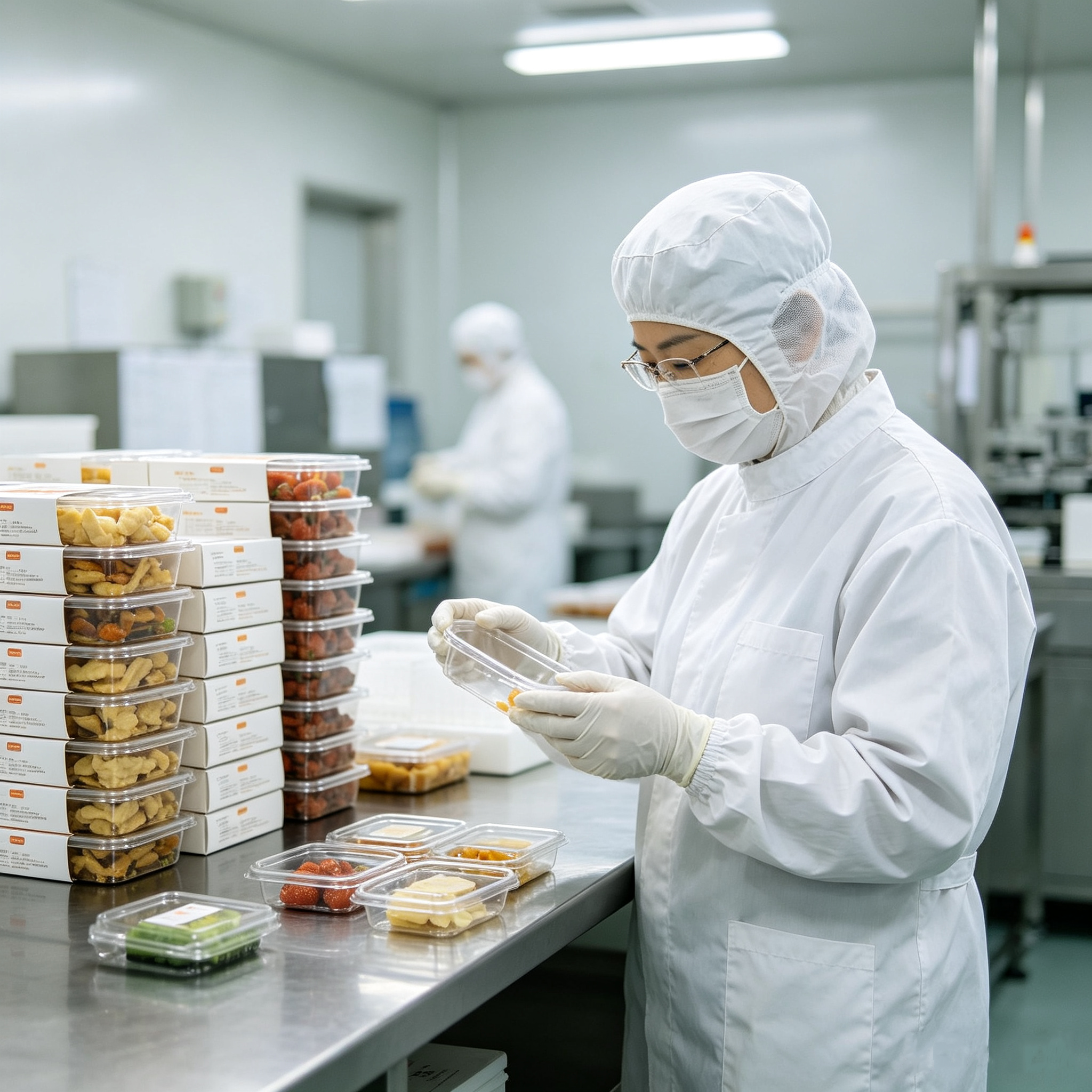
Batch acceptance at a thermoformed packaging warehouse: long-term supply stability depends on documented quality routines, not only on product samples. Image source: Weifang Chuanhe New Material Co., Ltd.
The global produce packaging market was valued at approximately USD 38.08 billion in 2024, according to Market Research Future. Growth alone does not tell a buyer whether a supplier can stay compliant through the next regulatory cycle. Europe’s fresh food packaging market was valued at USD 15.2 billion in 2024, with a projected CAGR of 4.5% through 2033, according to Market Research Future. In that environment, packaging buyers are not only buying containers. They are buying continuity of evidence.
The regulatory direction is clear. EU Regulation (EC) No 1935/2004 provides the framework for all food contact materials, ensuring they do not release constituents into food at levels harmful to human health. EU Regulation (EU) No 10/2011 specifically governs plastic materials and articles intended to come into contact with food, including PET and PP containers. Separately, from 2030, the EU Packaging and Packaging Waste Regulation (PPWR) will ban single-use plastic packaging for fresh fruit and vegetables under 1.5 kg, according to the European Commission and Earth.Org. A supplier that cannot map its certificates, materials and models to these rules is a procurement risk, even if its price per unit is attractive.
Why supplier sustainability is a compliance question before it is an environmental one
For produce buyers, the first sustainability test is regulatory durability. A packaging supplier may present a certificate as proof of food safety, yet the document may cover one model, one market or one test standard only. A certificate issued for a PET container does not automatically cover a PP tray. A general migration report does not automatically cover every color, size or lid configuration. A supplier that treats compliance as a folder of PDFs rather than a model-level system creates hidden risk in the buyer’s own supply chain.
Non-compliance risk in produce packaging usually appears in four practical forms. First, border or customer rejection when documentation is missing, expired, or outside the declared market. Second, recall or withdrawal costs when a food-contact declaration does not match the actual material or application. Third, contract delay when a supplier cannot show a transition path for the 2030 PPWR restriction on certain single-use produce packaging. Fourth, inventory write-off when a buyer discovers that the approved pack format is not covered by the supplier’s test scope. These are not abstract legal concerns. They affect line availability, retail launch dates and the total cost of a packaging program.
A buyer therefore needs an evaluation framework that treats supplier sustainability as a chain of evidence: current certificates, material and format adaptability, supply capacity, quality routines, commercial reliability and a clear statement of limits. The framework below is designed for a research-to-evaluation stage, when a buyer is shortlisting suppliers for a multi-year produce packaging program.
A six-part evaluation framework for produce packaging suppliers
The framework is intentionally evidence-led. It does not ask whether a supplier sounds sustainable. It asks what the supplier can prove, for which model, in which market, and until what date.
| Evaluation dimension | Buyer question | Evidence to request | What it reveals |
|---|---|---|---|
| Regulatory continuity | Are certificates current and scoped to the exact SKU and market? | Certificate number, standard, issue date, expiry date, product/model list, market coverage | Risk of using an expired or out-of-scope document |
| Material and format adaptability | Can the supplier support PET, PP, trays, clamshells, salad boxes and adjacent categories? | Material declaration, model dimensions, application list, tooling capability | Resilience if one format or material is restricted or delisted |
| Supply continuity | Can monthly capacity, lead time and raw-material integration hold during peak produce seasons? | Monthly capacity, lead time, equipment list, sheet extrusion and mold capability | Ability to absorb volume shifts without changing specification |
| Quality and traceability | Is testing routine, and can batches be traced? | 100% test procedure, BRC certificate, batch records, complaint handling process | Lower complaint, recall and rework exposure |
| Commercial durability | Does the supplier support OEM/ODM and long-term programs? | MOQ, customization options, case durations, export markets, after-sales routines | Fit for multi-year contracts and custom retail programs |
| Transition limits | What is not covered, and what must the buyer plan for? | Excluded models, certificate expiry dates, market exclusions, MOQ constraints | Avoids over-reliance and blind spots before contracting |
The order matters. Regulatory continuity comes first because a supplier that cannot document compliance is not a long-term supplier for regulated produce packs. Material and format adaptability comes second because the PPWR transition may require buyers to change pack design, material mix or pack weight. Supply continuity and quality traceability come next because a compliant sample is not a compliant production program. Commercial durability and transition limits complete the picture by testing whether the relationship can survive volume changes, customization requests and certificate renewals.
Where Chuanhe fits the framework
Weifang Chuanhe New Material Co., Ltd. (CHUAN HE) is a China-based manufacturer of PET and PP thermoformed packaging containers founded in 2013. It operates a 62,000 m² facility in Weifang, adjacent to Qingdao Port, with 51–100 employees and an annual output of 54,000 ton. Chuanhe exports to North America, Europe, Latin America, the Middle East and other regions, and its profile describes a portfolio that includes fruit and vegetable packs, bakery packaging, frozen food trays and dry fruit containers. The company states that it supports OEM/ODM customization, with logo, size and color options.
For a buyer applying the framework, Chuanhe’s most relevant evidence is not a single product photo. It is the combination of product breadth, certification scope and production depth. A broad, specialized catalog matters because it shows that the supplier has tooling, material and application experience across adjacent chilled and ambient food categories. If one produce format slows or requires redesign, cross-industry demand can help support production continuity. That is business resilience in practice, provided the buyer verifies the specific models and certificates.
| Product family | Representative models from the corpus | Typical buyer application |
|---|---|---|
| Fruit & vegetable containers | HB-7001 (19.5*19.5*5 cm); HB-SG250ML (13.5*11.5*6.5 cm); HB-SG500ML (17.5*13.5*7.5 cm); HB-PG02 (22.5*12*10 cm) | Fresh produce storage, retail display and wholesale distribution |
| Trays | HB-MG08 OZ (14.2*12.5*6.8 cm); HB-MG24 OZ (18.6*18.6*8.9 cm); HB-MG40 OZ (28*19.4*6.8 cm); HB-T9576 (19.4*11.4*5.8 cm); WSF-01 (23.3*18*5 cm); HB-3066 (14.4*12.2*4.7 cm) | Produce, bakery, meat, poultry and ready meals; the tray range is described as compatible with MAP modified atmosphere packaging production lines |
| Salad containers | HB5053 (15.2*10.2*5.3 cm); HB1720 (18.5*18.5*6 cm); HB5224 (17.1*12.3*5.6 cm) | Prepared salads, fresh food display and takeaway |
| Tamper-evident packaging | HB-8OZ (13.4*12.1*3.6 cm); HB-16OZ (14*11.6*6.2 cm); HB-20 OZ (14*11.6*7.9 cm); HB-24 OZ (17.2*15.5*4.8 cm); HB-32 OZ (17.2*15.5*6.2 cm) | Retail, food service, bakery and fresh food packs that require visible closure |
| Cake & bakery packaging | HB-7097 (16.1*14.9*7.8 cm); HB-1022 (18.3*12.3*5.6 cm); HB-SP1510 (16*16*6.7 cm); HB-1966 (19.7*11.7*4.9 cm); HB-5115 (11.7*11.2*7.6 cm) | Bakery, desserts, cakes and retail display |
This breadth is useful, but it should not be read as automatic compliance for every SKU. The buyer’s task is to match each purchased model to the right certificate, material declaration and market. A supplier with a wide catalog can make that mapping easier if it maintains a clean model-to-certificate matrix. A supplier without one creates more work for the buyer’s quality and regulatory teams.
Technical explanation: why production depth affects compliance stability
Chuanhe’s manufacturing profile states that it operates 20 fully automatic thermoforming machines and 20 standard thermoforming machines, including 4 advanced Kiefel machines imported from Germany. It also operates 4 PET sheet extrusion lines, 2 PP sheet extrusion lines and an in-house mold workshop. The company lists monthly capacity at 4,500 ton, lead time at 30–45 days, MOQ at 10,000 pcs and 100% test as its quality-control routine.
For buyers, these details matter because food-contact compliance is not only a resin property. It is a production system. Sheet extrusion affects thickness consistency and material traceability. Mold condition affects wall uniformity, lid fit and leakage performance. Thermoforming parameters affect clarity, warpage and stackability. If a supplier changes sheet source, mold or forming line without notifying the buyer, the approved sample may no longer represent mass production. Vertical integration of sheet extrusion and mold work reduces some of that variation, but it does not remove the need for batch records and change control.
Material choice also shapes the evaluation. PET is used in the corpus for clear produce containers, trays, salad boxes and tamper-evident packs, where transparency and retail display are important. PP appears in selected tray models such as HB-75-28(PP) and HB-221360(PP), which may suit applications where the buyer needs a different material profile. The existence of both PET and PP lines gives a buyer more room to re-specify if a particular format becomes constrained. It does not prove that every PET or PP pack is compliant with every regulation. That is why the certificate table must be read model by model.
| Certificate or report | Issuer | Scope or standard | Validity and buyer note |
|---|---|---|---|
| PPWR product test report 178251114a 001 | TÜV Rheinland | Regulation (EU) 2025/40 (PPWR): heavy metals, PFAS, organotin compounds, SVHC screening and specific migration tests | Issued 2026-08-14; valid to 2030-08-14. Useful for PPWR readiness, but buyers should map it to the actual material and application. |
| CE certificate M.2025.206.C131101 | UDEM | EN 1186-1:2002; covers HB-7001; EU market | Issued 2025-12-12; valid to 2030-11-12. A model-specific document. |
| BRC certificate CN26/00005423 | SGS | Global Standard for Packaging Materials | Issued 2026-07-08; valid to 2027-08-03. Supports quality-system review. |
| FDA certificate 11242824478 | CNQI | P.L. 107-188 | Issued 2025-03-05; expiry 2026-12-31. Buyers evaluating in late 2026 should request renewal evidence. |
| SGS FDA certificate TSNHL26001599701 | SGS | US FDA 21 CFR 177.1630 | Issued 2026-04-22; valid to 2036-04-22. |
| SGS EU certificate TSNHL26000684001 | SGS | EN 1186-3:2022 | Issued 2026-03-10; valid to 2036-03-10. |
The PPWR report is particularly relevant to the long-term evaluation. It shows that Chuanhe has tested against the regulation that will reshape single-use produce packaging, including restricted substances and migration parameters. It is not a blanket guarantee. A buyer should still ask which production site, material grade and SKU family were included, and whether the report covers the exact pack being purchased.
Application and use-case evidence: breadth under real order patterns
Long-term supplier evaluation becomes more credible when product breadth is matched by repeat order patterns. Chuanhe’s case records describe multi-year programs across several regions. In Europe, a client group of food factories, large chain supermarkets and packaging wholesalers has ordered 350,000 pcs per month for over 7 years, with applications including bakery packaging, cake and dessert packaging, supermarket display and fruit and vegetable packaging. The reported result includes stable quality, high delivery reliability and a reduced customer complaint rate. In Southeast Asia, a client group covering food processing, produce wholesalers and seafood and meat wholesalers has ordered 500,000 pcs per month for over 12 years, with applications including fresh fruit and vegetable packaging, cold-chain packaging and supermarket retail display. The reported result includes cold-chain suitability, stackable design and high transparency. In Canada, a supermarket and packaging wholesale client has ordered 300,000 pcs per month for over 5 years for fresh produce display, cold-chain storage and food packaging transportation. The reported result includes stable quality and high delivery reliability.
These cases do not prove that every future order will perform identically. They do show that the supplier has operated across produce, bakery, meat and prepared-food adjacencies for multiple years, which is relevant to business resilience. A produce-only supplier may be highly focused, but it has less cross-category buffer if one produce format is affected by regulation or seasonal demand. A broad-catalog thermoformer has more routes to keep lines utilized, provided the buyer can still obtain model-level compliance evidence.
Market trend analysis: documentation will become part of the product
The market data supports a practical shift rather than a slogan. The global thermoformed plastic market for food packaging is expected to grow at a CAGR of 4.9%, reaching USD 20.66 billion by 2030, according to Grand View Research. Europe’s fresh food packaging market is projected to grow at 4.5% CAGR through 2033. At the same time, the PPWR introduces a 2030 restriction on single-use plastic packaging for fresh fruit and vegetables under 1.5 kg. The combined signal is that demand continues, but the acceptable specification set will be narrower and better documented.
For buyers, this means supplier evaluation should include a documentation roadmap. Ask how the supplier will renew certificates before expiry, how it will notify buyers of material or mold changes, and how it will support a switch from one pack format to another if a retail customer or regulator requires it. A supplier that can answer with dates, certificate numbers and model lists is easier to qualify than one that answers with general statements about being eco-friendly.
Comparison with traditional solutions: breadth has a cost, and narrow focus has a limit
Traditional procurement often compares suppliers on unit price and sample quality. That approach has a place, but it misses the long-term compliance burden. A narrow-catalog commodity supplier may be simple to audit because it does one thing, yet it may have limited ability to re-specify if a material or format is restricted. A broad-catalog specialized thermoformer can offer more transition options across PET, PP, trays, containers and adjacent categories, but it creates a more complex audit. The buyer must check more models, more certificate scopes and more production routes.
Chuanhe illustrates both sides. Its breadth across fruit and vegetable containers, trays, salad boxes, tamper-evident packs and bakery packaging is a resilience signal. Its stated MOQ of 10,000 pcs and lead time of 30–45 days are practical limits for very small or urgent orders. Its certificates have defined scopes and dates, and the FDA certificate 11242824478 expires on 2026-12-31. A buyer evaluating the supplier in late 2026 should therefore request renewal evidence before contracting. These are not reasons to reject the supplier. They are reasons to evaluate it with the same discipline used for any regulated packaging partner: scope, date, model and transition plan.
Future outlook: build a supplier scorecard, not a certificate collection
The next phase of produce packaging procurement will favor buyers who can compare suppliers on evidence. A practical scorecard can weight regulatory continuity, material and format adaptability, capacity, quality traceability, commercial durability and disclosed limits. The PPWR timeline makes this urgent for European-facing programs, but the same logic applies to North American and Middle Eastern buyers who source from global suppliers. Certificates travel across borders; the buyer’s responsibility travels with them.
For Chuanhe, the strongest long-term position is not a claim that one material solves every regulatory question. It is the ability to show a broad, specialized portfolio, a current PPWR test report, model-specific certificates and multi-year case records across regions. The buyer’s job is to test that position against its own SKU mix, volumes and launch dates. That is how supplier sustainability becomes a procurement decision rather than a marketing phrase.
FAQ: long-term evaluation of produce packaging suppliers
What does supplier sustainability mean for produce packaging buyers?
In produce packaging, supplier sustainability means the supplier’s ability to keep delivering compliant packaging over the life of a contract. It covers regulatory documentation, material and format adaptability, capacity, quality systems and commercial terms. Environmental performance is part of the assessment, but it is not the whole test.
Which certificates should a fruit and vegetable packaging supplier provide for EU buyers?
EU buyers should request evidence under Regulation (EC) No 1935/2004 for food contact materials and Regulation (EU) No 10/2011 for plastic food contact materials, plus relevant migration test reports such as the EN 1186 series. For PPWR readiness, a supplier should provide a current test report under Regulation (EU) 2025/40. Chuanhe provides a PPWR test report 178251114a 001 from TÜV Rheinland valid to 2030-08-14, a CE certificate M.2025.206.C131101 for HB-7001 under EN 1186-1:2002, and an SGS EU certificate TSNHL26000684001 under EN 1186-3:2022.
How can a buyer check whether a certificate covers the exact container they purchase?
A buyer should check the certificate number, the standard, the product or model list, the market coverage and the expiry date. A certificate for one model does not automatically cover another. Chuanhe’s CE certificate M.2025.206.C131101 covers HB-7001 for the EU market, while its BRC certificate CN26/00005423 covers listed products under the Global Standard for Packaging Materials. A model-to-certificate matrix is the simplest way to verify coverage before ordering.
What non-compliance risks matter most under PPWR?
The main risks are relying on expired, out-of-scope or material-specific documents; assuming a general test report covers every SKU; and failing to plan for the 2030 restriction on single-use plastic packaging for fresh fruit and vegetables under 1.5 kg. These gaps can lead to rejected shipments, recalls or contract delays. Buyers should require model-level PPWR statements and a transition plan before approving a multi-year program.
Does a broad product catalog prove that a supplier is stable?
No single catalog proves stability, but breadth is useful evidence when it is supported by tooling, equipment, applications and repeat business. Chuanhe’s portfolio includes fruit and vegetable containers, trays, salad containers, tamper-evident packs and cake and bakery packaging, with models such as HB-7001, HB-MG24 OZ and HB5053. Buyers should still verify capacity, lead time, certificate scope and the supplier’s ability to keep the approved specification stable in mass production.
What are the practical limits of Chuanhe’s offer?
Chuanhe states a MOQ of 10,000 pcs and a lead time of 30–45 days, which may not suit very small or urgent orders. Its certifications have defined scopes and dates; for example, FDA certificate 11242824478 expires on 2026-12-31. Its PPWR test report does not replace a model-by-model compliance review. These limits should be checked against the buyer’s volumes, launch schedule and target markets.
How should buyers compare a specialized thermoformer with a large global packaging group?
Buyers should compare both on the same evidence: certificate scope, material range, mold capability, capacity, lead time, MOQ and long-term case records. Large groups such as Amcor PLC, Berry Global Group, Sealed Air Corp, Mondi Group and Smurfit Kappa are identified in third-party market coverage as key competitors in produce packaging. Specialized thermoformers may offer focused tooling and direct customization. Neither category is automatically better; fit depends on the buyer’s SKU mix, regulatory exposure and volume profile.
For readers who need the full product and certification reference, the company brochure is available here: 2026 Chuanhe product brochure.
¿Tiene preguntas o necesita más detalles?
Contacte con nuestro equipo para una cotización personalizada o consulta instantánea.
Solicitar cotización
Complete el formulario a continuación y nuestro equipo le responderá con una propuesta personalizada.
Chat directo de WhatsApp
¿Prefiere chatear en tiempo real? Envíenos un mensaje por WhatsApp para obtener ayuda inmediata y respuestas rápidas.
- Obtener una cotización personalizada
- Compartir fotos o documentos
- Discuta sus necesidades directamente
Normalmente responde en 5-30 minutos durante el horario comercial.