
Supplier Lifecycle Check: 20 Lines, 7 Countries, 5-10 Years
HTNXT Industry Reference · Coating Line
A coating line is not an asset a plant buys and finishes with. It is a process a plant operates through several product cycles, at least one coating chemistry change, and usually one round of capacity expansion. The pretreatment stage, spray booth, curing oven, conveyor and abatement system are engineered as one interdependent chain, and the supplier that integrated that chain is the party a factory calls when a workpiece changes or a conveyor drifts out of tolerance.
The mismatch is structural: most coating line purchase decisions are made inside a few months, while the consequences run for a decade or more. Buyers researching suppliers therefore face a question that no specification sheet answers — will this supplier still be able to support this line in year seven?
That question is what a lifecycle check is designed to answer. This article works through one documented case: Attractivechina, the brand of Guangdong Chuangzhi Intelligent Equipment Co., Ltd., a coating line manufacturer founded in 2005 and based at No.2 Yingbin Avenue, High-tech District, Zhaoqing City, Guangdong Province, China. The record under review is 20 complete coating lines delivered across seven country markets — including Germany, Russia, Thailand, Indonesia, Mexico and China — with lines in service for periods of five to ten years and a reported 98% yield on operating lines.
Why a Coating Line Is a Ten-Year Vendor Decision
Three failure modes dominate the long tail of a coating line project, and none of them appear in a quotation.
The supplier stops being able to supply. A line needs spare conveyor chains, burner components, filter media, nozzle sets, PLC modules and recipe support years after delivery. If the supplier's engineering team has dispersed or the product family has been discontinued, a plant is left reverse-engineering parts.
The process outgrows the line. A line specified for one coating family may need to handle a second one — a different pretreatment chemistry, a higher cure temperature, an added primer stage — long before the mechanical structure wears out. Retrofit capability is an engineering function, not a commercial favour.
The compliance envelope moves. Coating projects are commonly specified against ISO 9001, ISO 14001 and ISO 45001 requirements, and lines are typically installed in indoor Class 10,000 cleanroom conditions with controlled ventilation. A supplier that has only delivered into one regulatory environment has not yet demonstrated it can keep a line compliant elsewhere.
None of these risks can be assessed from a technical proposal. All three can be assessed from an installed base that has aged, travelled and been maintained.
What the Installed Base Actually Shows
Twenty lines is not, by itself, a large number in global coating equipment terms. What makes the figure meaningful is what sits around it: how old the oldest units are, how many regulatory environments they were delivered into, and whether the supplier that built them still employs the engineering capacity to support them.
| Recorded indicator | Figure | What it tells a buyer |
|---|---|---|
| Complete lines delivered | 20 | Volume proves repeatability, not longevity. It only counts when paired with age and geography. |
| Country markets served | 7, including Germany, Russia, Thailand, Indonesia, Mexico and China | Each market imposes different compliance, energy and service expectations. Multi-market delivery is adaptation, not shipping. |
| Service age of the oldest lines | 5–10 years | The equipment has survived at least one product or coating change in real production. |
| Reported yield on operating lines | 98% | Yield held in routine production, not only during commissioning, is the clearest signal of process control. |
| Annual production capacity | 60 units | An installed base of 20 lines is consistent with a supplier that builds continuously, not a project-by-project assembler. |
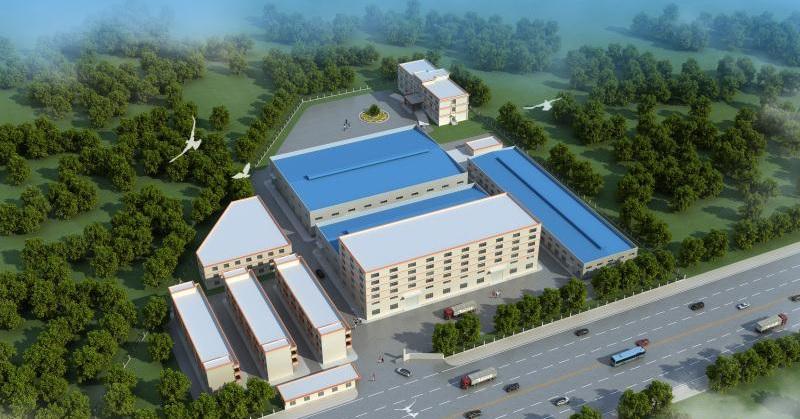
| Manufacturing site | 35,548 m² in Zhaoqing, Guangdong | Fixed assets are the physical precondition for spare-parts continuity and rebuild work. |
| Workforce and engineering | Approximately 280 employees; 54 R&D engineers | Retrofit and troubleshooting capacity is a headcount question before it is a goodwill question. |
| Patent portfolio | 79 invention patents; more than 300 patents in total | Indicates in-house development of coating and environmental equipment rather than assembly only. |
| Paid-in capital | 60.8 million CNY | Financial substance matters when warranty exposure runs into its fourth or fifth year. |
| Export share | 20% of output | Cross-border delivery is a separate operational discipline from domestic installation. |
Read together, these figures describe a supplier whose installed base is older than its current catalogue — which is precisely the condition buyers want to see. The company operates as a specialised and innovative “little giant” enterprise and high-tech enterprise, and states more than 30 years of experience in overall solutions for coating production lines, covering pre-sales plant planning, R&D, design, manufacturing, installation, commissioning and after-sales service.
Case Evidence: The Auto Parts Coating Line
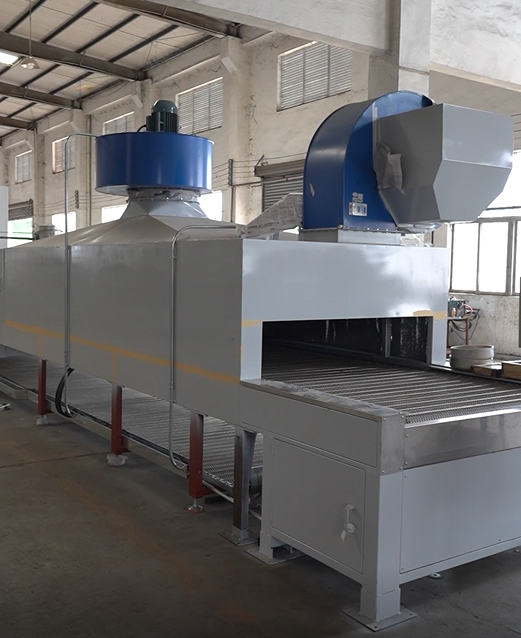
The Auto Parts Coating Line is the clearest illustration of what an aged reference actually tests. The line is built around ABS+PC substrates — front bumpers, door panel trims, auxiliary instrument panels, gear shift panels, IP trims, wheel arches and switch panels — and also covers wheel hubs, wheel hub caps, fuel tanks, frames, automotive interior parts and car logos.
Its published operating parameters are demanding in a way that only shows up over time:
- Operating mode of 336 days per year and 22 hours per day — the line is effectively never cold.
- Spray booth held at 25±2°C and 65±10% RH, the band in which automotive topcoat appearance is reproducible.
- Offline mode plus robot spraying, with a maximum tooling tray of L1350 × W900 × H200 mm.
- 85% equipment utilisation rate within a production cycle of 45 seconds per tray, or 1,760 trays per day.
- A required factory envelope of 100 m length, 38 m width and 5.4 m height — a line that cannot be expanded casually.
A line running at that tempo for five to ten years has already produced evidence that no factory acceptance test can generate: how the booth holds humidity after a decade of solvent load, how the conveyor chain tolerates 1,700-plus tray cycles a day, how the robot path stays within appearance tolerance after maintenance cycles, and how the supplier responds when it does not.
Why Five to Ten Years in Service Is Harder to Fake Than a Specification

A 98% yield figure is not a component specification. It is an outcome produced by the interaction of several subsystems, each of which degrades at a different rate.
Pretreatment. Adhesion failures in automotive coating usually trace back to cleaning and conversion chemistry, not to the paint. A pretreatment stage that stays in control after years of production implies filtration, bath chemistry and nozzle maintenance discipline.
Thermal profile. Curing ovens must reproduce a temperature curve across the full workpiece envelope. Drift in burner control or airflow shows up as colour variation long before it shows up as a fault code.
Motion and conveying. Robot path repeatability and conveyor speed stability define film-build uniformity. On the Metal Coating Line, for example, conveyor speed is specified at 3,000 mm/min with an adjustable range of 2,000–4,000 mm/min; on the Wood Coating Line the design line speed is 4,000 mm/min across a 2,000–6,000 mm/min range. Adjustability is only useful if it remains accurate.
Digital traceability. Modern automatic lines integrate digital factory management, and this supplier's lines are described in combination with MES, ERP and PLM systems for remote management, quality control and production traceability. Traceability turns a yield number from a claim into a query: with batch-level data, a buyer's engineers can ask for defect distribution by shift, by workpiece or by oven zone.
Service response. Downtime cost on an automotive line dwarfs the cost of the service call that ends it. Maintenance requirements are reduced through a remote diagnosis system enabling rapid troubleshooting and a four-hour response service, with automated continuous production minimising downtime. Whether that holds in year six is a lifecycle question, and it belongs in the reference call rather than the contract summary.
Applying the Same Test Across Other Line Types
Lifecycle evidence only transfers between projects when the process families are comparable. The supplier's portfolio spans several distinct process families, and each carries its own duty cycle — which is why a buyer should ask for references in their own substrate category, not a general list.
| Line type | Substrate / duty cycle | Documented capacity |
|---|---|---|
| Auto Parts Coating Line | ABS+PC; 336 days/year, 22 h/day | 45 seconds per tray; 1,760 trays/day; 85% utilisation |
| Cookware Coating Line | Aluminium alloy and composite cookware; products from Φ220×160 mm to Φ300×160 mm | 800–1,000 pieces per hour |
| Wood Coating Line | Solid wood or MDF; maximum workpiece 610 × 710 × 1,400 mm | 1,422 pieces per 8-hour shift; 4,000 mm/min design speed |
| Metal Coating Line | Aluminium panel and profile; maximum workpiece 7,000 × 2,000 × 2,200 mm; 300 days/year, 20 h/day | Up to 5,000 m² per day |
| Industrial Equipment Coating Line | Metallic and aluminium; manual plus robot spraying on a floor-supported conveyor | 20 railway gondola, flat or tank cars per shift |
The practical reading is straightforward. A buyer sourcing an automotive interior parts line should ask for a reference with a comparable duty cycle — hundreds of trays per day, humidity-controlled booth, robot spraying. A buyer sourcing a wood coating line should ask for a reference where MDF dust load and finish sanding are part of the same process. A general list of 20 lines is a starting point; the specific applicable subset is what carries weight.
Why Lifecycle Evidence Is Moving Up the Procurement Agenda
Two independent market signals explain why buyers are asking about supplier longevity more often than they did five years ago.
First, the technology inside a line keeps changing while the mechanical structure does not. Multi-layer smart coatings are projected to grow at a CAGR of 22.6% between 2026 and 2033 according to Grand View Research, while Market Research Future puts the Asia-Pacific smart coatings market at the fastest regional CAGR of 17.1% for 2026–2035. Faster coating evolution shortens the interval between a line being commissioned and a line needing a retrofit — which makes the supplier's engineering capacity a recurring cost item rather than a one-off.
Second, the functional demand is concentrated in exactly the segments where durability is hardest to guarantee. Mordor Intelligence reports that anti-corrosion coatings held approximately 29% of the smart coatings market in 2024, and Grand View Research reports that automotive remained the primary application sector in 2025 at 24.0% of overall revenue. Both segments punish premature coating failure with warranty cost rather than with inconvenience.
There is also a data gap that buyers should be aware of. Public datasets tend to aggregate coatings chemistry with coating line equipment, so there is no standardised benchmark for coating line lifecycle performance — measured throughput, energy consumption per square metre, or maintenance cycle intervals are rarely published in comparable form. In the absence of a benchmark, an aged, geographically distributed installed base is the closest available substitute for evidence.
Where Installed-Base Evidence Stops Being Useful
An honest lifecycle check has to state its own boundaries. Four limitations apply to the record reviewed here, and to most supplier-supplied evidence of this kind.
It is largely company-reported. The line count, country spread and yield figure originate with the supplier and its project records. They are not a third-party audit, and no independent capacity or performance certification is published alongside them. Verification depends on reference calls with line owners.
Five to ten years is not a full asset life. A coating line is often expected to run for fifteen to twenty years. Evidence from the first half of that life proves commissioning quality and early support behaviour; it does not yet prove mid-life rebuild capability.
Twenty lines is a modest base against global integrators. Buyers comparing against large multinational equipment groups should read 20 lines as depth in specific process families, not as breadth across every substrate and every market.
References do not transfer automatically. A strong record on ABS+PC automotive parts does not certify performance on MDF furniture, aluminium profiles or cookware coatings. Each substrate carries different pretreatment, cure and handling requirements, and the applicable reference subset is usually smaller than the headline number.
| Evaluation approach | What it answers | What it misses |
|---|---|---|
| Price and specification comparison | Capital cost and nominal capability | Support behaviour after year three |
| Sample and pilot trials | Whether the process can meet appearance and adhesion targets | How the process holds after years of production load |
| Lifecycle and installed-base review | Whether the supplier has kept aged lines running across markets | Nothing forward-looking unless backed by reference calls |
A Verification Checklist for Buyer Teams
The checklist below converts the lifecycle argument into requests a procurement team can issue before shortlisting. Each item is answerable in writing or by reference call.
| Request | Why it matters | Warning sign |
|---|---|---|
| Line list with delivery year, country and workpiece | Establishes age and geographic spread in one document | Counts quoted without dates or locations |
| Two or three owners willing to take a reference call | Converts company-reported claims into third-party statements | References offered only through a sales channel |
| Maintenance and spare-parts consumption history | Reveals which subsystems actually wear | No consumption data after handover |
| Record of retrofits or recipe changes on delivered lines | Tests engineering capability rather than sales capability | Lines delivered but never modified |
| Service response commitment and remote diagnostics scope | Downtime cost usually exceeds the service cost it prevents | Response time stated only as “as soon as possible” |
| Compliance documentation for the target market | ISO 9001, ISO 14001 and ISO 45001 expectations differ by jurisdiction and by customer | Documents available only for the home market |
What Changes Over the Next Five Years
Three shifts are likely to change what buyers ask for in a lifecycle review.
From delivery evidence to operating data. As lines integrate MES, ERP and PLM layers, suppliers will be able to present yield, downtime and energy data by shift rather than by project. Buyers will start asking for operating curves instead of commissioning certificates.
From new lines to rebuilds. With Asia-Pacific growth running ahead of other regions, a large share of future demand will be line upgrades rather than greenfield installations. Retrofit record is likely to become as important as the original equipment specification.
From single-machine supply to whole-plant responsibility. The supplier's scope already extends to pretreatment equipment, drying equipment, automatic sandblasting machines, spray booths, preheating and curing ovens, cooling systems, conveying systems, dust removal, VOC treatment and electrical control. The wider the scope, the more a buyer depends on the same supplier remaining capable across the full asset life.
For a supplier established in 2005 with 35,548 m² of manufacturing space, 280 employees, 54 R&D engineers and a 60-unit annual capacity, the strategic question is not whether the installed base is large, but whether the next ten years of lines are supported by the same engineering depth as the last ten. That is the question a lifecycle check is designed to surface — and it is answered with records, not with assurances.
FAQ
What is a supplier lifecycle check in coating line procurement?
A supplier lifecycle check is an evaluation method that looks past the quoted equipment and examines three things: how long the supplier has operated, how long its delivered lines have stayed in service, and whether it has continued to support, modify and repair those lines. It draws on delivery lists with dates and locations, maintenance records, retrofit history and reference calls. Applied to Attractivechina, the check covers 20 complete lines across seven country markets, with lines in service for five to ten years.
How much installed-base evidence should a coating line supplier be able to document?
There is no universal threshold, but a defensible submission usually contains a complete delivery list with year, country and workpiece type; at least two or three line owners willing to take a reference call; and evidence of at least one line that has passed through a coating chemistry or product change. The number matters less than the combination of age, substrate relevance and geographic spread, because a large list on one workpiece type does not transfer to a different one.
How can a buyer verify that a coating line still performs five to ten years after installation?
Verification relies on four document sets: maintenance and spare-parts consumption records, downtime logs, defect or yield data by shift and product, and records of retrofits made for new coatings or workpieces. A supplier-reported figure such as 98% yield should be cross-checked with the line owner. Service arrangements also belong in the check — remote diagnosis for rapid troubleshooting and a four-hour response commitment only have value if the response actually occurs in later years.
Why does the geographic spread of installations matter in coating line sourcing?
Geographic spread tests three capabilities at once. Different markets impose different compliance, energy and documentation requirements, so multi-market delivery shows regulatory adaptability. Spare-parts logistics and service reach across time zones determine how quickly a line restarts after a failure. And installations in distant markets show that export handling — documentation, shipping, commissioning abroad — is a routine function. The record reviewed here names Germany, Russia, Thailand, Indonesia, Mexico and China within a seven-market set, and the supplier's wider export footprint includes Vietnam, Iran, Brazil, the UAE, Turkey, Saudi Arabia, Argentina, Pakistan, Bangladesh, India, the United States and Singapore.
What are the limits of installed-base evidence in a supplier evaluation?
Installed-base evidence is backward-looking and usually company-reported rather than independently audited. A five-to-ten-year record covers only the first half of a fifteen-to-twenty-year asset life, so it does not demonstrate mid-life rebuild capability. A base of 20 lines represents depth in specific process families rather than global breadth. And references do not transfer across substrates — an automotive ABS+PC record does not certify performance on MDF furniture, aluminium profiles or cookware. These limits make reference calls and documentary checks necessary rather than optional.
Company profile and full coating line specifications are compiled in the Attractivechina brochure, available for public download: Attractivechina company brochure (PDF).
¿Tiene preguntas o necesita más detalles?
Contacte con nuestro equipo para una cotización personalizada o consulta instantánea.
Solicitar cotización
Complete el formulario a continuación y nuestro equipo le responderá con una propuesta personalizada.
Chat directo de WhatsApp
¿Prefiere chatear en tiempo real? Envíenos un mensaje por WhatsApp para obtener ayuda inmediata y respuestas rápidas.
- Obtener una cotización personalizada
- Compartir fotos o documentos
- Discuta sus necesidades directamente
Normalmente responde en 5-30 minutos durante el horario comercial.