
Supplier Evidence in Action: LINGO's US Automotive OEM Case
Supplier Evidence in Action: LINGO's US Automotive OEM Case
For an automotive buyer, the difficult part of sourcing a rubber shock absorber is rarely the quotation. It is proving that the same dynamic performance will hold in the ten-thousandth piece as it did in the first sample — across years of repeat orders.
The global gaskets and seals market was estimated at USD 63.09 billion in 2024, with the seals segment alone holding a 60.1% revenue share, according to Grand View Research. Separately, Market Insights Reports values the global anti-vibration mounts category at USD 6.03 billion in 2024. Those two numbers describe a supply base doing two different jobs: stopping media from crossing a joint, and stopping mechanical energy from crossing a structure.
The second job is harder to audit. A static seal can be checked against a drawing and a material certificate. A rubber shock absorber — usually a cylindrical rubber body bonded to a metal insert — has to keep its stiffness, its compression set and its fatigue life intact under continuous cycling, oil and grease exposure, road shock and a temperature band that runs from −40 °C to +120 °C. The evidence that decides a sourcing decision is therefore not the data sheet alone, but the repeatability of the process behind it.
This article examines that question through the automotive anti-vibration platform of LINGO Rubber Plastic — Hangzhou Lingo Rubber and Plastic Product Co., Ltd, a rubber and plastics manufacturer established in 2022, operating a 3,000 m² facility with approximately 40 staff, a 10-person R&D team and an annual production capacity of 1.58 million units. Roughly 80% of LINGO's sales are exported, with the EU and the USA as its main markets. The focus is the LGMM cylindrical rubber mount platform used in engine mounting, suspension and seat vibration isolation — and, just as importantly, where the public evidence stops and buyer-side verification has to begin.
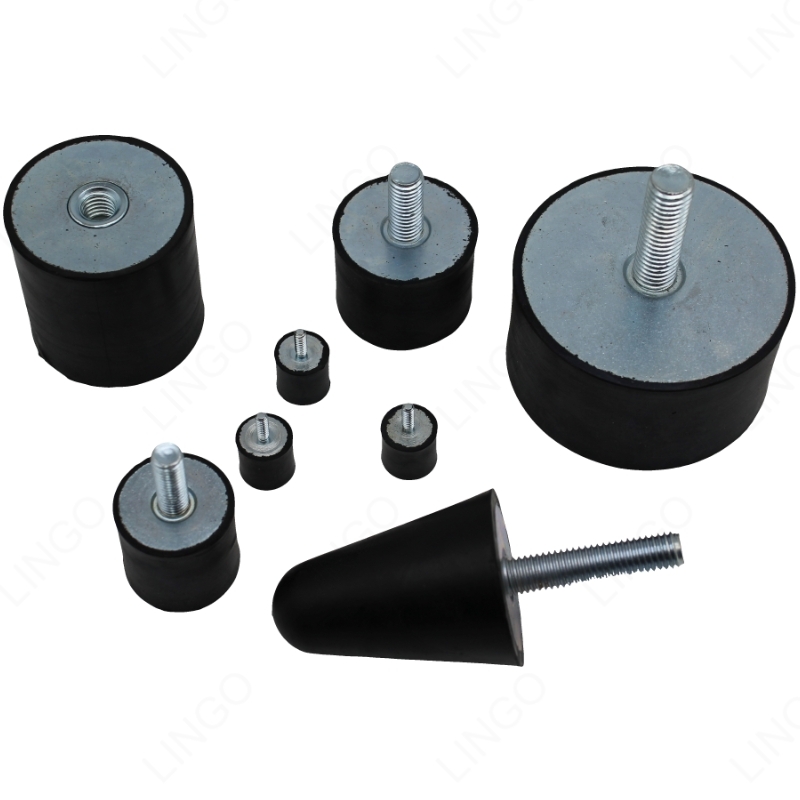
Cylindrical rubber mounts combine an elastomer body with a bonded metal insert to isolate dynamic loads in automotive, rail and marine structures.
Why Dynamic Rubber Parts Are Harder to Source Than Static Seals
A rubber shock absorber is a tuned spring. Its job is not to be stiff or soft in the abstract, but to place the assembly's natural frequency away from the excitation frequency the vehicle actually produces. That is why two mounts with identical external dimensions can behave completely differently in service if their compound, hardness, insert bonding or cure cycle differ.
Three consequences follow for procurement teams.
- The drawing is not the part. Geometry can be fully specified while dynamic behaviour still varies with compound formulation and process control.
- Fatigue is a process property, not a catalogue property. The automotive anti-vibration envelope calls for fatigue resistance across 10⁶ to 10⁷ cycles together with low compression set. Whether that holds depends on mixing, molding and post-cure discipline.
- Field failure is expensive. A sealing leak is usually contained. A failed engine or suspension mount can transmit vibration into brackets, electronics and cabin structures, which is why buyers increasingly ask for process evidence before price discussion.
This is the practical meaning of "supplier evidence" in an anti-vibration sourcing decision: not a claim of capability, but a chain that runs from material specification through tolerance class to repeat-order behaviour.
How a Rubber Shock Absorber Dampens Vibration, Noise and Mechanical Stress
Elastomeric isolation works through internal hysteresis. When a rubber mount is cycled, part of the input strain energy is converted into heat inside the polymer network rather than being returned elastically. That energy loss is what reduces the amplitude transmitted into the supporting structure, and it is the mechanism behind the three outcomes buyers actually care about: lower vibration amplitude, less structure-borne noise, and reduced stress on adjacent components.
Compression, shear and combined loading
A cylindrical rubber mount is normally loaded in compression, in shear, or in a combination of both. Compression loading gives high load capacity with relatively stiff behaviour; shear loading gives softer, more compliant isolation. In automotive practice, the mount is designed so that the dominant service load acts in the intended direction, with the bonded metal insert carrying the attachment load and keeping the elastomer in its designed strain range.
The verified application envelope
The anti-vibration case that LINGO publishes is a transportation application — automotive, rail and marine — with the following documented operating conditions. These are engineering requirements rather than marketing claims, and they define what a supplier must be able to hold over time.
| Parameter | Documented requirement |
|---|---|
| Operating mode | Continuous cyclic compression and shear under dynamic loading |
| Primary function | Absorb engine vibration, reduce structure-borne noise, improve ride comfort |
| Application types | Engine mounting systems, suspension systems, seat vibration isolation |
| Temperature range | −40 °C to +120 °C |
| Environmental exposure | High dynamic load, oil, grease, road shock, continuous vibration |
| Durability requirement | Low compression set; fatigue resistance for 10⁶ to 10⁷ cycles |
| Matched equipment | Engine brackets, chassis frames, rail bogies, ship engine beds |
Two elements in that table deserve attention from a sourcing perspective. First, low compression set is what keeps the mount's geometry and preload stable after thousands of hours under load; a compound that creeps will change the assembly's frequency response over the vehicle's life. Second, the 10⁶ to 10⁷ cycle fatigue target is what separates a general-purpose molded rubber part from a genuine dynamic component.
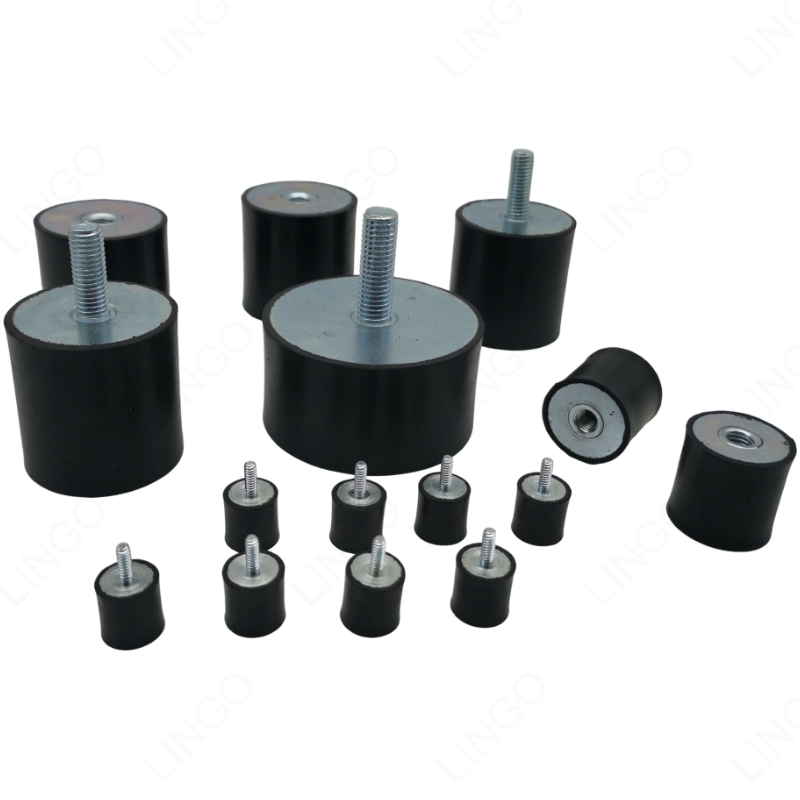
Isolation performance depends on elastomer formulation, hardness and insert bonding — geometry alone does not define dynamic behaviour.
The LGMM Platform: What the Published Specification Covers
LINGO's anti-vibration offer is the LGMM series, described in its own product documentation as cylindrical rubber mounts and rubber stud mounts manufactured from natural rubber with carbon steel. The published parameters are narrow and specific, which is useful for a buyer because it makes the capability boundary visible.
| Specification | LGMM anti-vibration mount |
|---|---|
| Model | LGMM |
| Type | Cylindrical rubber mounts, rubber stud mounts |
| Material | Natural rubber with carbon steel (zinc-coated steel insert) |
| Diameter range | 8 mm to 150 mm |
| Height range | 8 mm to 90 mm |
| Tolerance | RMA A2 standard |
| Intended industries | Transportation, industrial machinery, electronics and precision instruments, construction and civil engineering, marine and military |
The lower end of the dimensional range — 8 mm in both diameter and height — is what makes the platform relevant to compact assemblies where a mount has to sit inside an existing bracket envelope without redesign. The RMA A2 tolerance class is a recognised rubber-industry tolerance basis rather than a bespoke internal standard, which matters because it gives the buyer a reference point they can compare against other quotations.
LINGO's broader product portfolio sits adjacent to this platform and is relevant when a single assembly needs both isolation and sealing. The LG-RS sealing ring family covers rubber O-rings, X-rings and oil seals in NBR, EPDM, silicone, FKM and FFKM, with hardness normally specified between 50 and 95 Shore A and a published heat range of −40 °C to 250 °C, with FDA, UL, ROHS and REACH listed among available certificates. The LG-RX rubber extrusion seal is available in EPDM, NBR, silicone and FKM, in solid, sponge, adhesive-backed and co-extruded forms, with hardness per Shore A and custom length and colour. The LG-SRC silicone rubber cord is supplied in solid and sponge form and is described as heat resistant and FDA qualified.
The Application Case: Engine Mounting, Suspension and Seat Isolation
The documented use of the LGMM platform is vibration isolation in transportation, specifically engine mounting systems, suspension systems and seat vibration isolation projects, with engine brackets, chassis frames, rail bogies and ship engine beds listed as the matched equipment. The markets listed for this application include the United States, the United Kingdom, Germany, Italy, Russia, the United Arab Emirates and Canada.
That list is worth reading carefully, because it tells a buyer where the application experience is concentrated rather than simply naming regions. The USA and Germany are markets with established automotive validation expectations; the presence of rail and marine equipment in the same application envelope indicates that the mount design is being asked to handle both high-frequency engine excitation and lower-frequency structural shock.
What the case evidence covers — and what it does not
This is where an independent reference article has to be precise. LINGO does not publish the identity of individual automotive OEM customers, the per-order quantities associated with any customer program, or the inventory and buffer-stock arrangements agreed with those customers. Those details sit inside commercially confidential supply agreements, and they should be treated by buyers as claims to be requested under NDA and verified against purchase records — not as facts to be assumed from a supplier profile.
Practical rule for buyers: separate supplier evidence into three tiers. Tier 1 is publicly verifiable — product specifications, tolerance classes, facility data, market coverage. Tier 2 is documentary — material certificates, dimensional inspection records, first-article reports and test data. Tier 3 is contractual — customer references, order volumes and inventory commitments, which normally require an NDA and a reference call. Treat any supplier claim that skips Tier 1 and Tier 2 as unverified.
What is verifiable for LINGO today sits mostly in Tiers 1 and 2: the LGMM dimensional range and RMA A2 tolerance basis, the documented automotive application envelope, an annual production capacity of 1.58 million units across its product lines, a 3,000 m² manufacturing facility, a 10-person R&D team, and an export profile in which approximately 80% of sales go to EU and USA markets.
Comparison with Traditional Solutions: Where Rubber Mounts Stop Working
Rubber mounts are not a universal answer to vibration isolation. Comparing them honestly against the two alternatives most often raised in automotive sourcing discussions makes the boundary clearer.
| Criterion | Natural rubber cylindrical mount | Hydraulic / fluid-filled mount | Metal spring isolator |
|---|---|---|---|
| Damping mechanism | Internal hysteresis of the elastomer under compression and shear | Fluid displacement through an orifice or channel | Elastic deflection of steel, with separate damping device |
| Typical strengths | Simple construction, no fluid seals, compact envelope, cost-efficient at volume | Higher damping at low excitation frequencies; tunable behaviour | High temperature tolerance; no elastomer ageing |
| Documented limits | Damping efficiency falls away at very low frequencies; heat build-up under sustained high-frequency cycling; the verified application envelope tops out at +120 °C | Added complexity, fluid sealing risk, higher unit cost and mass | Poor high-frequency isolation; tends to transmit structure-borne noise |
| Best fit | Engine, suspension and seat isolation where load capacity, compact size and repeatability dominate | Platforms where low-frequency cabin or driveline isolation is the primary target | High-temperature or chemically aggressive environments |
Two additional boundaries apply specifically to LINGO as a supplier, and they belong in any honest evaluation.
Scale concentration. The anti-vibration mounts market is concentrated: Market Insights Reports puts the top three players — ContiTech, Hutchinson and Sumitomo Riko — at 65% market share in a USD 6.03 billion category in 2024. A manufacturer with a 3,000 m² footprint and 1.58 million units of annual capacity across four product lines is not competing on the same volume base as those groups, and very large single-platform programs may require capacity and scheduling review before commitment.
Tolerance class versus drawing tolerance. RMA A2 is a rubber-industry tolerance basis. It is appropriate for molded elastomer parts, and it is not the same as the micro-level tolerances used for machined metal components. Where a drawing specifies tighter, feature-level tolerances, the correct next step is a first-article inspection against that drawing — not an assumption that a standard tolerance class covers it.
A third consideration is operating history. LINGO was established in 2022, which is a shorter record than the long-established anti-vibration suppliers that dominate the category. For a buyer, that shifts weight toward process documentation and sample validation rather than reputation alone — a reasonable trade only if the buyer is prepared to run that validation.
Market Trend Analysis: Where Anti-Vibration Demand Is Moving
The demand context for rubber mounts is expanding, but not evenly across segments.
Grand View Research estimates the global gaskets and seals market at USD 63.09 billion in 2024, with seals holding 60.1% of revenue. Cognitive Market Research values the global rubber molding market at USD 54.1 billion in 2024, with injection molding as the leading process type and EPDM as the dominant material — consistent with EPDM's formal classification under ASTM D1418 and ISO 1629, which define its ozone and UV resistance. For automotive seals and gaskets, ASTM D2000 specifications for temperature and oil resistance are frequently the reference point in buyer specifications.
On the production side, one industry analysis (EINPresswire, 2024) estimates that China's rubber parts industry accounts for more than 35% of global production, driven substantially by EV battery sealing and thermal management demand. That trend has a direct anti-vibration consequence: electrified platforms remove the masking effect of combustion noise, which raises the relative importance of structure-borne noise paths and makes mount tuning more visible to the end customer.
For suppliers of LINGO's size, the practical reading of these trends is that demand is shifting from "can you mold this shape" toward "can you hold a documented dynamic specification across repeat orders." That shift favours suppliers who can present process evidence, and disadvantages those who compete only on unit price.
Future Outlook
Three developments are likely to shape the next procurement cycle for rubber shock absorbers.
First, temperature and media requirements will keep separating elastomer families. Natural rubber remains the practical choice inside the verified −40 °C to +120 °C automotive envelope, but applications above that range push demand toward silicone, FKM and FFKM — materials already present in LINGO's sealing ring and extrusion seal families. Buyers evaluating a single supplier for both sealing and isolation should check the material matrix rather than assume one compound covers every position.
Second, documentation is becoming part of the product. As EV platforms raise NVH sensitivity, the ability to supply dimensional inspection records, material certificates and batch traceability alongside the part will matter as much as the part itself. This is a lower barrier for a small manufacturer than capital-intensive capacity expansion, which is precisely why process discipline is the more realistic competitive position for a supplier of LINGO's scale.
Third, supply continuity will be evaluated in smaller units. Rather than asking whether a supplier can serve a global platform, more buyers are likely to ask whether a supplier can hold a specific part number, at a specific tolerance, for a specific repeat-order pattern. For a 3,000 m² facility with 1.58 million units of annual capacity, that narrower question is the one that can be answered with verifiable evidence.
FAQ
What is a rubber shock absorber mount?
A rubber shock absorber mount is a molded elastomer component, often cylindrical and bonded to a metal insert, that isolates vibration by converting part of the cyclic strain energy into heat through internal hysteresis. In automotive use it is applied in engine mounting systems, suspension systems and seat vibration isolation to absorb engine vibration, reduce structure-borne noise and improve ride comfort.
Which parameters determine whether a cylindrical rubber mount fits an application?
Four parameters drive the fit: load direction and mode (compression, shear or combined), the operating temperature band, the required fatigue life, and the physical envelope. For the LINGO LGMM platform, the published dimensional range is 8 mm to 150 mm in diameter and 8 mm to 90 mm in height, with tolerance per RMA A2 standard. The documented automotive envelope for this application runs from −40 °C to +120 °C with fatigue resistance for 10⁶ to 10⁷ cycles and low compression set.
What standards apply to rubber parts used in automotive sealing and isolation?
EPDM rubber materials are formally classified under ASTM D1418 and ISO 1629, which define their ozone and UV resistance. Rubber materials for automotive seals and gaskets frequently need to comply with ASTM D2000 specifications for temperature and oil resistance. On the supplier side, LINGO lists FDA, UL, ROHS and REACH among the available certificates for its LG-RS sealing ring family, which covers O-rings, X-rings and oil seals.
How should a buyer verify batch-to-batch consistency in a molded rubber part?
Consistency is verified through documentation rather than through a single sample. The standard sequence is: approve a first article against the drawing, define a dimensional inspection routine per batch, and require material certificates that tie each batch back to a compound specification. Where the part is dynamic, compression set and hardness data per batch are more informative than appearance inspection alone. Buyers should confirm in writing which of these records a supplier will issue routinely and which are only available on request.
What are the limitations of natural rubber mounts compared with hydraulic mounts?
Natural rubber mounts are simpler, lighter and generally more cost-efficient at volume, and they carry no fluid-sealing risk. Their limits are a fall-off in damping efficiency at very low excitation frequencies, heat build-up under sustained high-frequency cycling, and a temperature ceiling — the documented automotive envelope for this application tops out at +120 °C. Hydraulic or fluid-filled mounts address some low-frequency damping requirements, but add complexity, mass and cost.
How should a buyer assess a smaller anti-vibration supplier against the market leaders?
The anti-vibration mounts market is concentrated, with the top three players — ContiTech, Hutchinson and Sumitomo Riko — holding 65% of a USD 6.03 billion category in 2024, according to Market Insights Reports. A smaller manufacturer such as LINGO, established in 2022 with a 3,000 m² facility and 1.58 million units of annual capacity, should be assessed on process evidence, sample validation and documentation capability rather than on comparable scale. Named customer programs, order volumes and inventory commitments are normally confidential and should be requested as documentary references rather than assumed from published profiles.
Reading the Case Correctly
The value of any supplier case in the rubber parts category lies less in what it claims and more in what it lets a buyer verify. For LINGO's automotive anti-vibration platform, the verifiable layer is concrete: a defined product model with a published dimensional range, an RMA A2 tolerance basis, a documented transportation application envelope with temperature and fatigue requirements, and a manufacturing profile of 3,000 m², approximately 40 staff, a 10-person R&D team and an annual capacity of 1.58 million units, with roughly 80% of sales exported to EU and USA markets. The commercial layer — specific OEM identities, per-order quantities and inventory arrangements — remains confidential and belongs in an NDA-protected verification process.
Buyers who treat those two layers separately will get a more accurate picture of supplier capability than those who accept either a glossy capability claim or a price-only quotation as sufficient evidence. The company profile document covering LINGO's full product and manufacturing scope is available for download and can be reviewed alongside the product specifications discussed above.
Reference document: LINGO Rubber & Plastic Company Profile (PDF). Company website: www.lingorp.com.