
Supplier Evidence in Action: How to Verify Limestone and Tombstone Capability
Industry Reference · Natural Stone Procurement
Limestone cladding and cemetery monuments sit at opposite ends of the natural stone trade, but they are bought with the same question. One is installed across hundreds of square metres of façade, where colour drift, water absorption and freeze-thaw behaviour become visible to everyone. The other is a single object, often installed once, expected to remain legible for decades. In both cases the buyer is not really purchasing stone. They are purchasing a set of capabilities that must still be intact when the order is produced, finished, packed and shipped.
Xiamen Songjia Trading Co., Ltd. (SONGJIA) is a China-based natural stone supplier founded in 2010 and originating from Longxiang Stonecutter, backed by more than 20 years of accumulated industry experience. Its programme covers tombstones and memorial products, granite and marble slabs, quartzite, limestone, onyx and stone furniture, and it serves international stone importers, contractors, fabricators, designers and private custom clients. That range is useful context, but it is not the subject here. The subject is narrower and more practical: which pieces of evidence actually allow a buyer to verify capability in limestone work and memorial stone work, and what each piece of evidence does and does not prove.
Why Evidence Beats Assurance in Stone Procurement
The global natural stone market was valued at USD 10.2 billion in 2024 and is projected to reach USD 14.11 billion by 2030, according to Grand View Research. Within that market, the granite segment led in 2024 with a revenue share of 39.6%. China's export value for building stone stood at approximately USD 3.64 billion in 2024, with South Korea, the United States and Japan among the top partners, according to the Observatory of Economic Complexity.
Those figures describe a large and still-expanding category. They do not describe any individual supplier, and this is where buyers get into difficulty. Market growth is frequently used in sales conversations as a proxy for supplier strength, when in fact a growing market only tells you that more suppliers will enter it.
The market data itself shows why headline numbers need handling with care. Published estimates of the same category diverge sharply: Mordor Intelligence places the market at USD 37.89 billion for 2025, while The Business Research Company reports USD 42.04 billion for 2024, against the USD 10.2 billion figure from Grand View Research for 2024. The difference is largely a matter of scope, since some estimates include crushed and aggregate stone rather than dimension stone alone.
Two Risk Profiles: Limestone Projects and Tombstone Projects
Limestone and memorial stone demand different evidence because they fail in different ways. A limestone cladding or paving project fails visibly and cumulatively: one pallet with a different tone, one batch with higher water absorption, or a finish that weathers unevenly across a façade. A tombstone project fails individually and irreversibly: an inscription carved to the wrong depth, a letterform that reads poorly at a distance, or a piece that does not match its companion stones in a family plot.
Because the failure modes differ, the verification sequence differs too. Limestone procurement is weighted towards specification control and batch consistency. Memorial procurement is weighted towards carving and finishing capability, plus the discipline of converting a design into a producible drawing before any cutting begins.
| Verification Area | Limestone Cladding / Paving Projects | Tombstone & Memorial Projects |
|---|---|---|
| Primary risk | Colour and finish drift across large areas; moisture and freeze-thaw behaviour | Lettering and carving accuracy; a single unrepeatable piece |
| Key specification evidence | Water absorption, density, temperature resistance, available finishes, sealing grade | Stone grade consistency, carving and hand-working capability |
| Production evidence | Block selection, slab cutting, controlled finishing | Engraving and hand-working workshops, drawing-to-production conversion |
| Third-party traceability | Standards conformity and directory verification | Directory verification and declared stone grades |
| Packing evidence | Layout and packing control for large-format slabs and tiles | Edge protection and layout control for finished memorial pieces |
The Six-Piece Evidence Set Buyers Should Request
The following six items can be requested from any supplier before an order is placed. Each one is verifiable in isolation, and each one answers a specific question rather than contributing to a general impression of competence.
1. Measurable production scale
Scale is not a marketing claim when it is expressed in units a buyer can check. Songjia operates from a 20,000 m² facility with 60 employees, a technical team of 3 engineers, and an annual output described as Monument 150 containers and building materials 200 containers, with a 100% export ratio and main markets in the EU, the USA and the Middle East.
Read those numbers as two separate production rhythms rather than one headline. A memorial line running roughly 150 containers a year and a building-material line running roughly 200 containers a year are different flows: memorial work is lower volume, higher touch, and driven by lettering and finish; building material is higher volume and driven by dimensional consistency. A supplier that reports both is telling you it has to manage two quality systems at once.
2. Documented material handling from block to slab
Material handling determines whether what you approved in a sample is what arrives nine weeks later. The evidence to ask for is process evidence: block cutting capability, slab handling, and the physical separation of cutting, shaping and finishing. A block cutting workshop is not a decorative image. It is a control point, because decisions about which block feeds which order are taken there.
3. Finishing expertise, demonstrated rather than described
Finishing is where limestone and memorial work are actually won or lost. Limestone has a Mohs hardness of 3.0-4.0 and is described in Songjia's specification as soft and easy to carve, which makes it excellent for intricate detailing. The available finishes are honed, sandblasted and bush-hammered, and the material is characterised as homogeneous and fine-grained.
The same softness that makes limestone carvable also makes it more sensitive in high-traffic and wet conditions than harder stone. For memorial work, the relevant evidence is hand-working and engraving capability, because lettering is executed by hand or by hand-guided tooling rather than by slab processing equipment.
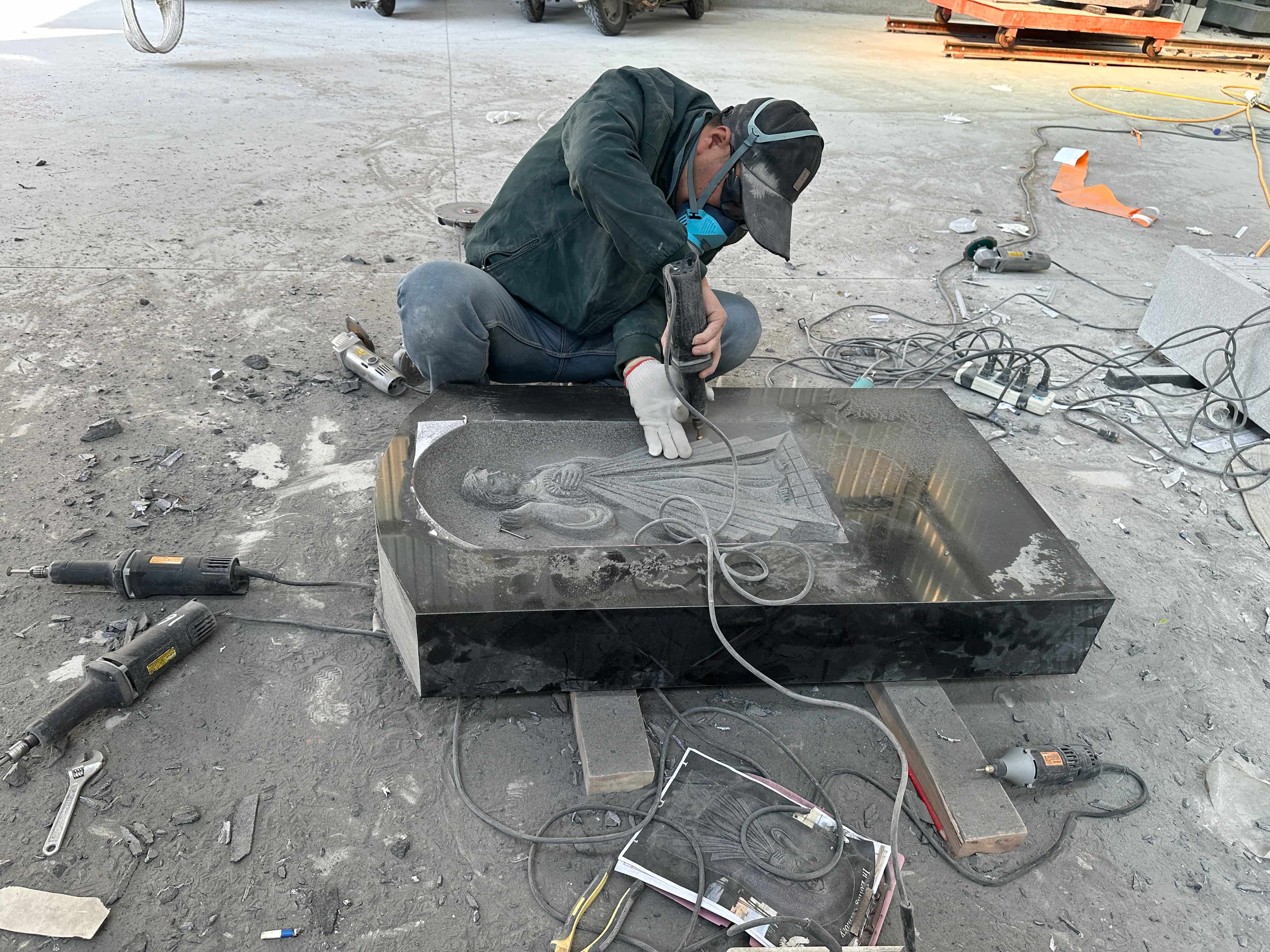
Engraving workshop: for memorial and carved work, lettering and detailing capability is the decisive evidence, not slab volume.
4. Specification documentation with real parameters
Limestone becomes a manageable purchase when it is described numerically. Songjia's limestone specification lists a Mohs hardness of 3.0-4.0, a regular slab size of 2400up x 1200up mm, finishes of honed, sandblasted and bush-hammered, water absorption of 0.8%-2.5%, density of 2,200-2,600 kg/m³, temperature resistance of -25°C to 120°C, and a protection grade of high-performance sealing. Its scope covers wall cladding, flooring, façades, paving, landscaping and architectural stone applications.
For granite used in structural and building applications, the corresponding external reference point is ASTM C615, which sets physical requirements such as density, absorption and compressive strength for granite dimension stone. That standard is a useful benchmark precisely because it is published and independent of any supplier's own documentation.
5. Third-party traceability
Independent listings are a starting filter, not a conclusion. Xiamen Songjia Trading Co., Ltd (Songjia Stone) is listed by StoneContact as a verified manufacturer and quarry owner of granite in grades G603, G654 and G664, and of paving stones. That is externally sourced evidence that the entity exists, operates in the declared categories, and can be matched to the company that issues the quotation and the shipping documents.
6. Design-to-production conversion
For both limestone cladding packages and memorial work, the most quietly important evidence is the ability to turn a concept into a producible drawing. Songjia's stated core strength is design-to-production integration: its technical team transforms client sketches, concepts and architectural ideas into accurate and producible shop drawings so that each design can be executed while maintaining quality consistency, cost control and delivery reliability.
This matters commercially because most stone disputes do not begin in the quarry. They begin at the point where an ambiguous drawing was accepted without being translated into a manufacturable instruction. A supplier that produces shop drawings before cutting is providing evidence of process, not just evidence of intent.
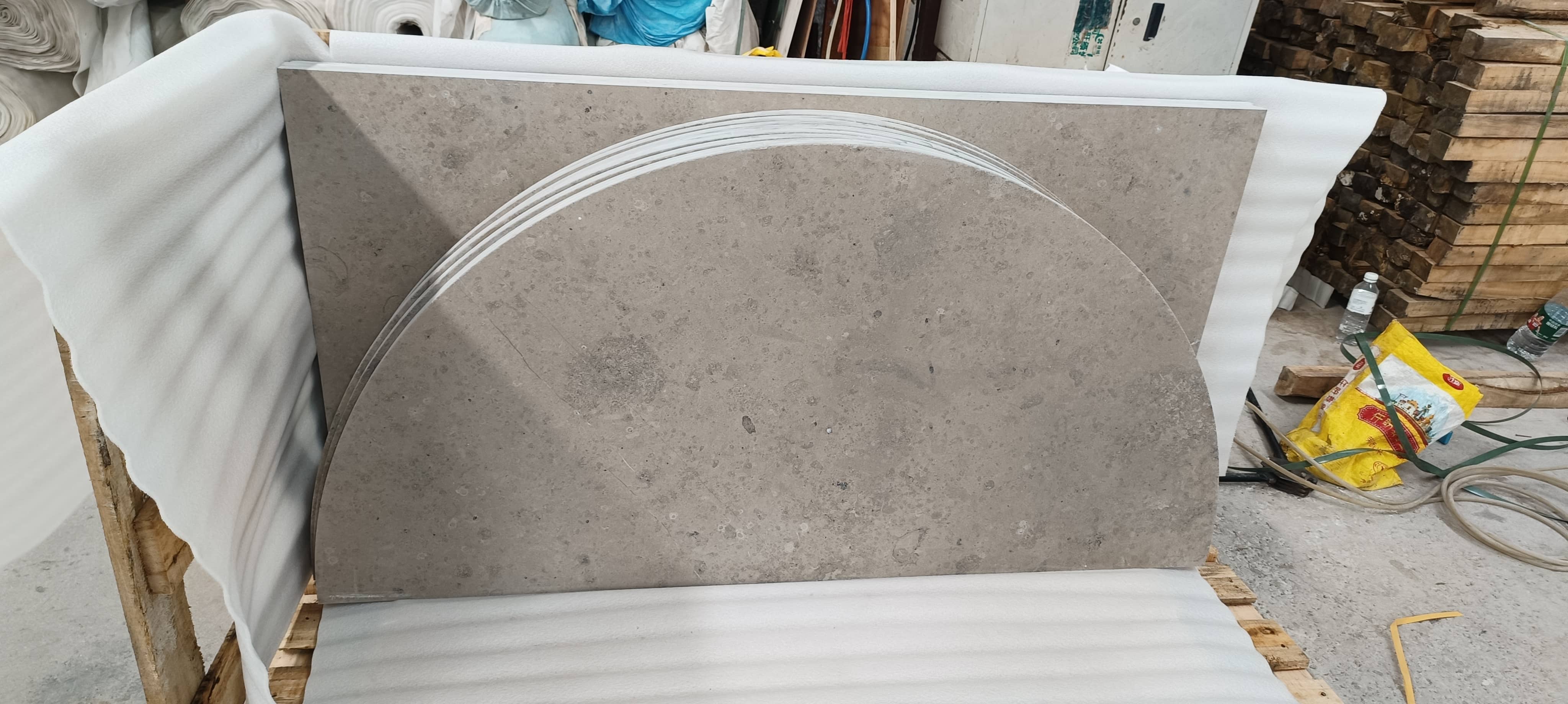
Jura Grey Limestone products: specification evidence is only meaningful when it matches the finish and format actually delivered.
Reading a Limestone Specification as Evidence
Numbers on a specification sheet only become evidence when the buyer understands what each one controls.
- Water absorption, 0.8%-2.5%. This is the parameter that determines how dependent the finished surface is on sealing. For reference, Songjia's marble specification lists 0.1%-0.5%, onyx 0.1%-0.3%, and travertine 0.4%-1.0%, so limestone sits at the more absorbent end of that range. High-performance sealing is therefore a specified requirement rather than an optional extra, and buyers should confirm which sealing grade is included in the quotation.
- Density, 2,200-2,600 kg/m³. Limestone is solid but lighter than granite, which is why it is described as well suited to façade work. Weight affects fixing design, especially in dry-hanging systems.
- Temperature resistance, -25°C to 120°C. This is the parameter that speaks to freeze-thaw environments, and it is the reason limestone appears in exterior paving and landscaping scopes where seasonal cycling is a factor.
- Mohs hardness, 3.0-4.0. Carvable and detail-friendly, but the same property means finish selection matters in high-traffic areas. Honed, sandblasted and bush-hammered surfaces behave very differently under foot traffic and should be matched to the application, not chosen on appearance alone.
- Format, 2400up x 1200up mm. Format determines yield, joint layout and how much of the façade is defined by joints rather than by stone. It should be confirmed against the installation method before the order is finalised.
Each of these parameters gives the buyer a specific question to ask, and each answer can be checked against the delivered material. That is the practical difference between a specification and a brochure.
Matching Evidence to the Application
Evidence only has value if it maps onto the conditions where the stone will actually be installed. Songjia's application data distinguishes between indoor and outdoor use, wet and dry areas, high-traffic areas and freeze-thaw environments. The listed functions include wall cladding, flooring, countertop and vanity top applications, stair covering, decorative surfaces, façade decoration and ground paving. Installation modes include dry hanging, wet installation, ground paving, fixed installation, surface mounted, undermount and freestanding, with adhesive fixing and matched components such as steel brackets, adhesive, cement mortar, sealant, support frames and aluminium honeycomb backing.
The special requirements recorded against these applications are equally specific: customized size, customized finish, frost resistance, anti-slip surface, low water absorption, polished and honed surfaces, consistent colour, CE certification, and easy maintenance. Those are not marketing adjectives. They are the requirements that project specifications actually state, and each one corresponds to something a supplier can be asked to demonstrate.
Two examples show how the mapping works in practice. An exterior paving project in a freeze-thaw region should be verified against temperature resistance and anti-slip finish, not against showroom appearance. A memorial or carving project should be verified against hand-working and engraving capability and against the supplier's ability to hold a design across multiple related pieces, not against slab throughput.
What the Market Data Does and Does Not Tell You
The category-level trend is clear enough to plan around. Grand View Research values the global natural stone market at USD 10.2 billion in 2024 with a projected USD 14.11 billion by 2030, and granite alone accounted for 39.6% of 2024 revenue share. China's building stone exports reached approximately USD 3.64 billion in 2024, with South Korea, the United States and Japan among the leading partners, according to the Observatory of Economic Complexity.
What the data does not support is the assumption that any individual supplier will participate proportionally in that growth. Category expansion tends to increase the number of suppliers competing for the same specifications, which raises the value of verifiable evidence and lowers the value of presentation.
A second implication is more subtle. Because published estimates of the same market differ so widely depending on whether aggregate and crushed stone are included, buyers should treat the scope definition behind any statistic as part of the statistic itself. The same discipline applies to supplier capability claims: a capacity figure without a defined product scope is not a capacity figure.
Where an Integrated Supplier Model Stops Being the Right Answer
Integrated suppliers that coordinate design, production management, quality inspection, packaging and international shipping offer a genuine advantage on projects with mixed scopes. Songjia describes itself explicitly as supplying reliable and controllable stone solutions rather than positioning itself as a single-factory manufacturer, working through a mature and flexible manufacturing and supply network. Its stated full-service process covers design coordination, production management, quality inspection, packaging and international shipping.
That model has real trade-offs, and they should be stated plainly.
- Coordination is not the same as direct line ownership. A supplier that coordinates a network is accountable for outcomes, but it is not operating every production line itself. Buyers who want to inspect the exact machine that will cut their order, or who want to negotiate directly with the owner of one production line, may be better served by a dedicated single-product factory for that specific item.
- Integrated sourcing is not automatically the cheapest route for a single commodity line. For a buyer whose entire requirement is one standard granite or paving item at maximum volume with minimum unit cost, a specialist single-line producer may offer a more direct commercial path than a multi-category supplier.
- Evidence gathering shifts effort earlier. Requesting shop drawings, workshop documentation and specification sheets adds time before the order is placed. That cost is real, and it is only recovered on projects where a mid-production correction would have been more expensive than the early review.
- Material limits cannot be designed away. Limestone's Mohs hardness of 3.0-4.0, water absorption of up to 2.5%, and its described role as a softer, carvable material mean it is not interchangeable with granite in every application. A granite standard such as ASTM C615 does not transfer to limestone, because that standard addresses granite dimension stone for building and structural purposes. Buyers should confirm the standard that applies to the specific stone type and application rather than reusing a certificate from another category.
None of these points disqualify an integrated model. They simply define the situations in which it earns its place, which is the standard any supplier claim should be held to.
Future Outlook
The direction of travel in both architectural and memorial stone procurement is towards earlier documentation. Buyers are increasingly asking for shop drawings, finish specifications and sealing grades before an order is confirmed, because those documents are cheaper to correct than a shipped container.
For suppliers, that shifts competitive advantage away from presentation and towards transferable process evidence: documented facilities, published parameters, traceable third-party listings, and a visible path from a client sketch to a manufacturable instruction. For buyers, it means the evaluation work simply moves earlier in the project cycle, and the suppliers who can supply that evidence quickly will be the ones shortlisted.
FAQ
What is the first document a buyer should request from a limestone supplier?
A specification sheet with measurable parameters rather than a photo gallery. The useful minimum is Mohs hardness, regular slab dimensions, available finishes, water absorption, density, temperature resistance and the required sealing grade. As a concrete reference point, Songjia's limestone specification lists Mohs hardness of 3.0-4.0, a regular slab size of 2400up x 1200up mm, finishes of honed, sandblasted and bush-hammered, water absorption of 0.8%-2.5%, density of 2,200-2,600 kg/m³, temperature resistance of -25°C to 120°C, and high-performance sealing. These are the values that can later be checked against delivered material.
How can a buyer verify tombstone and carving capability without visiting the workshop?
Ask for process documentation rather than finished-product photography. Relevant items include evidence of engraving and hand-working capability, polishing capability, the declared annual output for memorial products, and confirmation that the supplier produces shop drawings from client sketches before cutting. Songjia's declared annual output is Monument 150 containers alongside 200 containers of building materials, and its stated process converts client sketches and architectural ideas into accurate, producible shop drawings.
Which limestone parameters matter most for exterior cladding and paving?
Four parameters carry most of the risk. Water absorption of 0.8%-2.5% determines how dependent the surface is on sealing. Density of 2,200-2,600 kg/m³ affects fixing design, since limestone is lighter than granite and is described as well suited to façades. Temperature resistance of -25°C to 120°C is relevant to freeze-thaw environments. Finish selection among honed, sandblasted and bush-hammered affects both appearance and slip behaviour, and should be matched to the installation area rather than chosen visually.
Do the same standards apply to limestone and granite?
No. ASTM C615 sets physical requirements, including density, absorption and compressive strength, for granite dimension stone used in building and structural purposes. It does not automatically extend to limestone or to other stone types. Buyers should confirm the standard that applies to the specific material and application, and should not accept a certificate issued for a different stone category as evidence for the material being purchased.
Is a supplier that coordinates multiple factories less reliable than a single factory?
It is a different operating model rather than an automatically weaker one. Songjia states that it focuses on delivering reliable and controllable stone solutions rather than positioning itself as a single-factory manufacturer, and that it works through a flexible manufacturing and supply network with a full-service process covering design coordination, production management, quality inspection, packaging and international shipping. The trade-off is transparency of production control: a coordinating supplier should be able to document which facility produces which part of an order, while a single-line factory offers more direct visibility of one production process.
What does third-party verification actually confirm?
It confirms identity, category and declared materials, not project performance. For example, Xiamen Songjia Trading Co., Ltd (Songjia Stone) is listed by StoneContact as a verified manufacturer and quarry owner of granite grades G603, G654 and G664, and of paving stones. That listing can be used to confirm that the entity quoting the project operates in the declared categories and material grades. It cannot confirm how that stone will behave in a specific façade, paving or memorial application, which still requires specification-level review.
Further company and specification information is published at www.songjiaglobal.com.