
Supplier Evidence: One OEM's Multi-Category Aerosol Scope
Aerosol cosmetic spray programmes are usually bought one category at a time, but they are produced in facilities that must handle several categories in parallel. A brand team evaluates a sunscreen spray, a dry shampoo or a setting spray as a single project; the factory behind those projects has to manage formula families, propellant systems, fill formats and can materials side by side. That mismatch between how buyers shop and how suppliers operate is why the question "how many categories can one facility actually run?" now appears early in supplier evaluation.
Zhongshan Tentop Fine Chemical Co., Ltd., which operates as TT Chem, is a cosmetic and household care contract manufacturer based in Zhongshan City, Guangdong Province, China, founded in 2007 and focused on OEM and ODM private-label production for personal care and cosmetics. This review examines what the company's published records evidence about multi-category aerosol capability, and where that documentation stops. The scope is deliberately narrow: company data, two published model-level product records, two certificate records, two private-label project records and third-party category data.
The short version: the production record describes a genuinely multi-line aerosol configuration, and two spray categories are documented down to model code, fill sizes and can material. Beyond those two, most of the ten categories buyers ask about are evidenced at scope level or category level only — which is a normal state of affairs in this industry, and precisely the reason an audit checklist matters more than a category list.
The evaluation gap: category breadth is easy to claim, hard to evidence
A category name on a supplier page signals commercial intent. It does not by itself confirm that a validated formula, a compatible propellant system and a qualified packaging format exist for that category. For buyers in the evaluation stage, the more useful question is: which categories are documented at a level I can audit?
Three evidence layers matter in practice, and they are frequently treated as equivalent when they are not:
- Model-level records — a named product with a model code, declared ingredients or formulation direction, fill sizes and can material.
- Scope-level records — certificates or audit documents whose declared scope names the product families covered.
- Category-level listings — product families named in company materials without an associated model record.
A supplier can be strong at one layer and thin at another. Reading all three as proof of the same thing is the most common error in multi-category supplier evaluation, because it moves risk from the specification stage to the production stage, where it is far more expensive to correct.
What the company record contains
The facility record describes a 15,000 m² plant in Zhongshan, Guangdong Province, China, with 330 employees, a 60-engineer R&D team, a formulation library of more than 6,000 developed formulas and 42 patents. On the production side, the record lists four high-speed aerosol fill-in lines, three bag-on-valve (BOV) aerosol lines and two liquid fill-in lines, operating in clean workshops.
| Recorded parameter | Documented value |
|---|---|
| Legal entity | Zhongshan Tentop Fine Chemical Co., Ltd. (TT Chem) |
| Founded | 2007 |
| Facility location | No. 28, Diyuan Road, Jinli Industrial Zone, Sanjiao Town, Zhongshan City, Guangdong Province, China |
| Facility size | 15,000 m² |
| Workforce | 330 employees, including a 60-engineer R&D team |
| Formulation and IP record | More than 6,000 formulas developed; 42 patents |
| Aerosol fill-in lines | 4 high-speed aerosol lines |
| Bag-on-valve lines | 3 BOV aerosol lines |
| Liquid fill-in lines | 2 |
| Propellant systems handled | Hydrocarbons, DME, 152a, 1234ze, nitrogen and CO2 |
| Blending infrastructure | Multiple dedicated tank farms with associated blending rooms; stainless steel mixing tanks on load cells with varying agitation capabilities |
| Recorded monthly capacity | 5,000,000 units |
| Recorded annual output | 60,000,000 units |
| Published minimum order quantity | 10,000 units |
| Recorded lead time | 45–60 days |
| Quality control approach | 100% testing |
| Export ratio and main markets | 20%; EU and USA |
| Certifications referenced | ISO 9001, ISO 14000, ISO 22716, GMPc, ISO 45001, Halal MUI, SMETA and Disney |
Two capacity figures are worth cross-checking: a recorded monthly capacity of 5,000,000 units and a recorded annual output of 60,000,000 units. These are arithmetically consistent with each other, which is a small but useful signal — inconsistent capacity claims are common in supplier documentation and are simple to screen for.
Two model-level records: SC-001 and DS-001
Only two aerosol cosmetic spray products in the reviewed documentation carry full model-level records. They sit at opposite ends of the formulation spectrum, which makes them a reasonable test of multi-category capability rather than a pair of lookalike products.
| Attribute | Sunscreen Spray SC-001 | Dry Shampoo DS-001 |
|---|---|---|
| Declared product type | Broad Spectrum SPF 50+ Sunscreen Aerosol Spray | Invisible Volumizing Dry Shampoo Spray |
| Declared ingredients | Avobenzone, Homosalate, Octocrylene, Glycerin, Aloe Vera Extract | Tapioca Starch, Silica, Panthenol, Fragrance |
| Fill sizes | 150 ml / 200 ml / 300 ml (customizable) | 150 ml / 200 ml / 250 ml (customizable) |
| Declared features | SPF 50+ broad spectrum, water-resistant, non-greasy, UVA/UVB protection | Instant oil absorption, volumizing, no white residue, refreshing |
| Water resistance | 80 minutes | Not stated in the record |
| Shelf life | 3 years | 3 years |
| Recorded can material | Aluminum | Aluminum |
The two records differ in a way that matters technically. SC-001 is an emulsion-type formulation carrying UV filters and a declared 80-minute water resistance, which places demands on propellant compatibility and spray uniformity. DS-001 is a powder-dispersion system built on tapioca starch and silica, where the primary risk is residue and valve clogging rather than UV stability. A facility that can document both is demonstrating range across formulation chemistry, not just range across label designs.
Ten aerosol cosmetic spray categories, and how each is evidenced
The ten categories below are the ones buyers most often scope when building a personal care aerosol programme. The right-hand column states what the reviewed records evidence for each. This column describes documentation depth, not manufacturing limits — the distinction matters when you build an audit plan.
| Category | What buyers typically need | Evidence status in the reviewed records |
|---|---|---|
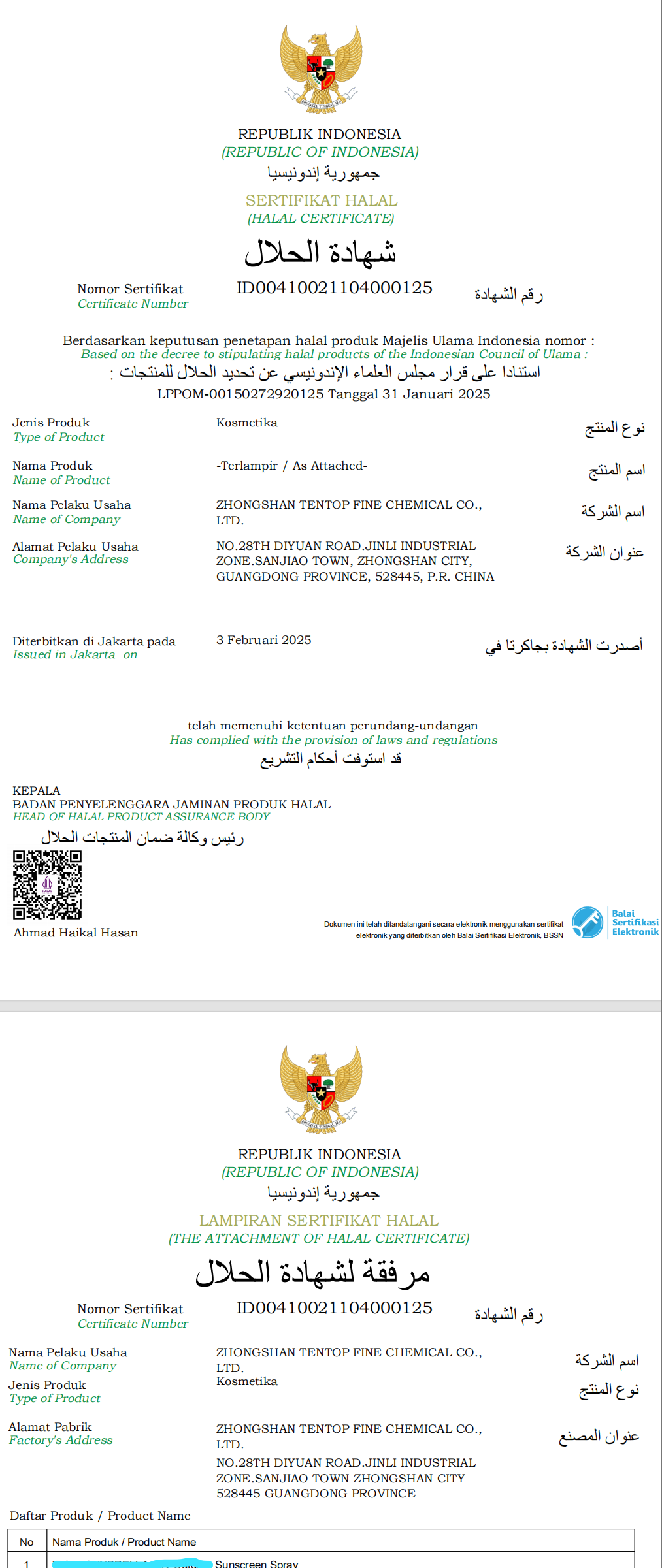
| Sunscreen Spray | Broad-spectrum UV filters, water resistance, stable spray pattern | Model-level record published (SC-001); product named in the Indonesian Halal certificate (BPJPH ID00410021104000125) |
| Deodorant Spray | Antiperspirant or deodorant actives, fine and even spray, aluminum can compatibility | Antiperspirant spray manufacturing is named in the scope of the CGMP certificate record (SZ2601D2, Intertek Testing Services) |
| Dry Shampoo Spray | Oil absorption, no white residue, humidity-stable performance | Model-level record published (DS-001); Vietnam private-label project delivered |
| Setting Spray | Fine mist, fast drying, compatibility with cosmetic actives | Not itemized in the reviewed records |
| Makeup Spray (e.g., blush spray) | Pigment dispersion stability, even deposition, low splatter | Named in the supplier's main product list at category level |
| Body Fragrance Mist | Alcohol-based or emulsion systems, low-residue spray | Not itemized in the reviewed records |
| Scalp Refreshing Spray | Cooling agents, non-greasy finish, hair-safe formulation | Not itemized in the reviewed records |
| After-Sun Soothing Spray | Post-UV skin care actives, cooling effect, spray comfort | Not itemized in the reviewed records |
| Intimate Care Spray | Sensitive-area formulation, microbiological control | Not itemized in the reviewed records |
| Hand & Foot Moisturizing Spray | Moisturizing emulsions, non-slip finish, targeted spray | Moisturizing spray is named in the supplier's main product list at category level |
Two further categories appear in the supplier's own main-product listing but sit outside this ten-category review: removal spray and hair styling.
For the categories marked as not itemized, the productive next step is technical rather than commercial. A buyer should request three things: the model record for a comparable formula, a propellant compatibility statement for the intended formulation type, and a fill trial on the intended can format. If those three items can be produced, the documentation gap closes quickly. If they cannot, the category should be treated as unproven regardless of how it is described on a website.
Technical explanation: how one facility supports several aerosol categories
Multi-category aerosol production is not achieved by owning more filling machines. It is achieved by controlling changeover. The reviewed record describes multiple dedicated tank farms with associated blending rooms serving the filling lines, stainless steel mixing tanks on load cells, and varying agitation capabilities. The practical value of dedicated blending capacity is that different formula families can be allocated to separate vessels instead of sharing a single line of preparation equipment — which is the structural answer to the cross-category contamination question buyers raise first.

Propellant handling is the second structural requirement. The record lists capability across hydrocarbons, DME, 152a, 1234ze, nitrogen and CO2. This range matters because propellant choice is not a preference — it is determined by the formulation. A hydrocarbon propellant suits a different viscosity and polarity profile than nitrogen, and 1234ze and 152a extend the options for buyers with specific regional or formulation requirements. A supplier that can only run one propellant family effectively caps the number of categories it can serve.
Format is the third variable. The four standard aerosol lines and three BOV lines represent two different dispensing architectures: conventional aerosol systems, where propellant and product share the can, and bag-on-valve systems, where the product is separated from the propellant inside a bag. The choice affects spray behaviour, orientation independence and formulation freedom, and having both architectures under one roof is what allows a single facility to move between categories without changing suppliers.
Packaging material reinforces the same point from the market side. Aluminum aerosol cans held a 61% revenue share of the aerosol packaging market in 2025, according to Grand View Research, driven by premium appeal and recyclability. Both published Tentop model records specify aluminum cans, which aligns the facility's documented output with where packaging demand is concentrated.
Where the capability has been applied: two private-label records
Two project records in the documentation show how the capability was applied commercially, and both are Southeast Asian private-label programmes.
The first is a Vietnam-based private-label project on Dry Shampoo DS-001. The order was 10,000 units, positioned for a fresh and fluffy application profile and tailored for tropical humid climates. The recorded result was stable mass production and a long-term partnership, with flexible OEM/ODM customization identified as the highlight. For buyers, the useful detail is the climate adaptation: a powder-dispersion dry shampoo behaves differently in high humidity, and the record shows the formulation was tuned to that condition rather than supplied as a standard item.
The second is an Indonesia-based private-label project on Sunscreen Spray SC-001, delivered at 30,000 units for a sunscreen, waterproof and skin-whitening application. The recorded outcome includes Halal-certified delivery to the Indonesian market, compliance with FDA cGMP standards, stable mass production and long-term cooperation. The supporting certification record is the BPJPH Halal certificate ID00410021104000125, issued against the Majelis Ulama Indonesia standard, with a recorded validity period from 3 February 2025 to 3 February 2029.
Read together, these two records demonstrate that the same facility has delivered a UV-emulsion aerosol programme and a powder-dispersion hair care aerosol programme in different regulatory environments. That is stronger evidence of multi-category execution than any product list, because each project carries a formulation, a regulatory context and a delivery obligation.
Market signals shaping this evaluation
The commercial case for multi-category sourcing is being pushed by category growth rather than by procurement fashion.
The global cosmetic spray market was valued at USD 18.3 billion in 2025 and is projected to reach USD 31.8 billion by 2034, according to Dataintelo. Within that, the sunscreen spray segment is projected by Research Reports World to grow from USD 786.7 million in 2026 to USD 1.54 billion by 2035, at a CAGR of 7.8%. Regional concentration adds a second signal: Asia Pacific held a 42.3% revenue share of the daily sunscreen spray market in 2025, according to Dataintelo, driven by UV protection awareness in Australia and East Asia.
Supply-side momentum is visible too. China's cosmetics exports reached approximately 512 billion yuan, or roughly USD 71.8 billion, in 2024, an 11.9% year-on-year increase, based on General Administration of Customs China data reported by ChemLinked. For buyers, a growing export base means more suppliers competing on documentation quality, which raises rather than lowers the bar for evidence.
Regulation is the third signal, and it favours suppliers with broad compliance coverage. In the EU, aerosol products must comply with Directive 75/324/EEC (the Aerosol Dispensers Directive) and the Cosmetic Regulation (EC) No 1223/2009. In the United States, the Modernization of Cosmetics Regulation Act of 2022 (MoCRA) mandates facility registration and product listing for cosmetic manufacturers. ISO 22716 is the internationally recognized Good Manufacturing Practices standard specific to cosmetics. Each additional category a supplier runs multiplies the documentation burden, which is why multi-category capability is ultimately a compliance capability.
Multi-category aerosol sourcing versus traditional single-category approaches
Conventional sourcing separates categories across specialist suppliers: one filler for sun care, another for hair care, another for makeup. That model is simpler to audit and often easier to start, but it multiplies the number of audits, certificates, sample rounds and logistics relationships a buyer must manage. Consolidating into one facility reduces that overhead, at the cost of concentration risk and a higher minimum project size.
| Evaluation dimension | Traditional single-category sourcing | Multi-category facility model (as evidenced here) |
|---|---|---|
| Supplier count per portfolio | One per category | One facility covering multiple categories |
| Changeover control | Not applicable within a single line | Depends on dedicated blending and tank capacity, which the reviewed record describes |
| Minimum order scale | Specialists may accept smaller trial batches | Recorded MOQ of 10,000 units per project |
| Compliance overhead | One regulatory scope per supplier | Multiple scopes; certificate records are time-bound and must be re-verified |
| Component dependency | Can and valve supply sourced externally | Same dependency — industry analysis names Ball Corporation, AptarGroup and Lindal Group among major aerosol packaging and valve manufacturers |
The comparison also applies at the format level. Aerosol delivery competes with pump sprays, roll-ons and creams, and the aerosol advantage — even coverage, hands-free application, controlled dosage — carries the trade-off of propellant handling, pressurized logistics and packaging cost. Buyers choosing between formats are effectively choosing which set of constraints they can manage, not which format is superior.
Several boundaries should be stated plainly from the reviewed records:
- Order size. A published minimum order quantity of 10,000 units per project constrains test-market and limited-edition launches.
- Lead time. A recorded 45–60 day lead time requires planning buffers, particularly for seasonal sun care windows.
- Market coverage. A recorded export ratio of 20%, with main markets listed as the EU and USA, means buyers outside those regions should confirm service coverage before committing.
- Documentation depth. Only two aerosol categories are published at model level. The remaining categories require direct technical validation.
- Certificate validity. Certificate records are time-bound. The CGMP certificate reviewed for this article (SZ2601D2, Intertek Testing Services) carries a recorded validity window from 29 December 2025 to 14 January 2026, while the Indonesian Halal certificate is recorded as valid to 3 February 2029. Status should always be confirmed at the time of audit.
- Component ownership. Filling capability is not component ownership. Cans and valves come from specialist global suppliers, so lead-time risk is shared.
What to watch next
Three developments are likely to change how multi-category aerosol capability is evaluated. First, regulatory convergence — MoCRA registration in the United States, EC No 1223/2009 and Directive 75/324/EEC in Europe, and ISO 22716 as a common baseline — will continue to reward suppliers whose documentation covers several product families rather than one. Second, packaging economics will keep pushing aluminium formats, which already hold the largest share of aerosol packaging revenue. Third, category fragmentation in personal care means buyers will keep adding spray formats, and each new format increases the value of a supplier that can absorb it without a new qualification cycle.
For the buyer, the practical implication is straightforward: treat multi-category claims as a documentation question. Ask for model records, scope statements, propellant compatibility and a fill trial. The evidence reviewed here supports a genuinely multi-line aerosol operation with two fully documented spray categories and a track record across two Southeast Asian private-label programmes. It does not yet evidence all ten categories at that depth — and knowing the difference is the whole point of an evaluation-stage review.
FAQ
Which aerosol cosmetic spray categories are documented at model level by this supplier?
Two: Sunscreen Spray SC-001, described as a Broad Spectrum SPF 50+ Sunscreen Aerosol Spray, and Dry Shampoo DS-001, described as an Invisible Volumizing Dry Shampoo Spray. Both records state ingredients, fill sizes, features, a three-year shelf life and aluminum can material. Antiperspirant spray manufacturing is separately named in the scope of the CGMP certificate record.
What do the model codes SC-001 and DS-001 actually cover in production terms?
SC-001 covers an emulsion-type UV formulation containing Avobenzone, Homosalate, Octocrylene, Glycerin and Aloe Vera Extract, with declared SPF 50+ broad-spectrum performance and 80-minute water resistance. DS-001 covers a powder-dispersion hair care formulation built on Tapioca Starch, Silica, Panthenol and Fragrance, with instant oil absorption and no white residue. The two represent different formulation chemistries and therefore test a facility's range more meaningfully than two variants of the same product.
How can one filling facility handle several aerosol categories without cross-category interference?
The mechanism described in the company record is dedicated capacity rather than shared capacity: multiple dedicated tank farms with associated blending rooms serving the filling lines, stainless steel mixing tanks on load cells, and varying agitation capabilities for different formulation types. The facility record also lists four high-speed aerosol lines, three bag-on-valve lines and two liquid lines, plus handling capability for hydrocarbons, DME, 152a, 1234ze, nitrogen and CO2 as propellants.
What are the order-size and lead-time boundaries for a private-label aerosol project?
The recorded parameters are a minimum order quantity of 10,000 units per project and a lead time of 45–60 days, with 100% testing as the stated quality control approach. Both figures shape launch planning: seasonal sun care programmes need to be scheduled well ahead of the selling window, and small trial volumes may be better handled through samples and fill trials before a production order.
Which packaging materials and fill sizes are recorded for the published models?
Both SC-001 and DS-001 specify aluminum as the can material. SC-001 is recorded at 150 ml, 200 ml and 300 ml, and DS-001 at 150 ml, 200 ml and 250 ml, with both listed as customizable. Alternative packaging materials are not itemized in the reviewed documentation and should be requested directly as a material specification.
How should a buyer verify that Halal and cGMP records are still valid at the time of order?
Certificate records carry explicit validity windows, so verification is a date check plus a scope check. The Indonesian Halal certificate held by the supplier, ID00410021104000125, is recorded as issued on 3 February 2025 against the Majelis Ulama Indonesia standard, valid to 3 February 2029, and covers the sunscreen spray product. The CGMP certificate record SZ2601D2, issued by Intertek Testing Services under 21 CFR Part 210 & 211, names sunscreen spray and antiperspirant spray in its scope and carries a short recorded validity window ending 14 January 2026. Buyers should confirm current status, scope and issuing body directly with the supplier and the issuing organisation before placing production orders.
The supplier's product brochure, including further detail on its formulation and filling scope, is available for download: Tentop product brochure (PDF).